Published 27 May 2026 in quant-ph | (2605.28289v1)
Abstract: Levitated mechanical systems are promising candidates for quantum gravimetry, as gravity couples directly to their center-of-mass motion, enabling the large mass of a mesoscopic particle to serve as a sensing resource. In this paper, we propose a mechanical squeezed-Fock qubit gravimeter using a Duffing oscillator that is driven by a detuned two-phonon pump. In the squeezed-Fock basis, the gravitational force couples to the anti-squeezed quadrature, which enhances the gravity-induced transition rate while preserving the direct mass scaling of the mechanical force coupling. We show that sensitivity improves with reduced effective qubit splitting that is controlled by the squeezing parameter and the Duffing nonlinearity. We further analyze mechanical damping and show that squeezing converts ordinary dissipation into anisotropic qubit noise, setting a practical trade-off between signal amplification and decoherence rate. These results identify the mechanical squeezed-Fock qubit as a new platform for quantum-enhanced gravimetry.
The paper demonstrates a quantum-enhanced gravimeter by encoding gravity signals in squeezed-Fock qubits, enabling exponential sensitivity improvements.
The methodology employs detuned two-phonon pumping on a Duffing oscillator to overcome weak anharmonicity and achieve robust qubit operation.
The results highlight practical trade-offs between squeezing-induced sensitivity gains and decoherence effects, guiding chip-scale gravimetry designs.
Mechanical Squeezed-Fock Gravimeter: Quantum-Enhanced Gravimetry via Squeezed Motional Qubits
Introduction and Context
The work titled "Mechanical Squeezed-Fock Gravimeter" (2605.28289) introduces a quantum gravimetry platform leveraging the center-of-mass (CM) motion of levitated mesoscopic particles, encoded in a squeezed-Fock qubit basis. The motivation stems from the limitations associated with cold-atom interferometers—namely, the scaling of sensitivity with arm length and their incompatibility with compact, robust, chip-scale architectures. Mechanical sensors using levitated massive particles intrinsically provide superior scaling with the mass, and the direct CM coupling to gravity enhances susceptibility to weak gravitational forces. However, encoding quantum information directly in the weakly anharmonic mechanical spectrum is challenging due to small intrinsic nonlinearities.
To circumvent this, the authors propose the use of squeezed-Fock states induced by a detuned two-phonon pump on a Duffing nonlinearity, thus exponentially enhancing the effective anharmonicity and enabling robust two-level (qubit) dynamics even when the base nonlinearity is weak. The resulting "mechanical squeezed-Fock qubit" (MSFQ) architecture achieves both mass amplification and quadrature-level squeezing enhancement of gravity coupling.
Theoretical Framework
Squeezed-Fock Qubit Encoding
The gravimeter operates with a Duffing oscillator, where a periodically modulated, off-resonant parametric (two-phonon) drive generates a squeezed-Fock basis. The effective mechanical Hamiltonian under Bogoliubov transformation and in the rotating frame is, under the RWA,
H^eff≃ℏωbb^†b^−ℏUbb^†2b^2
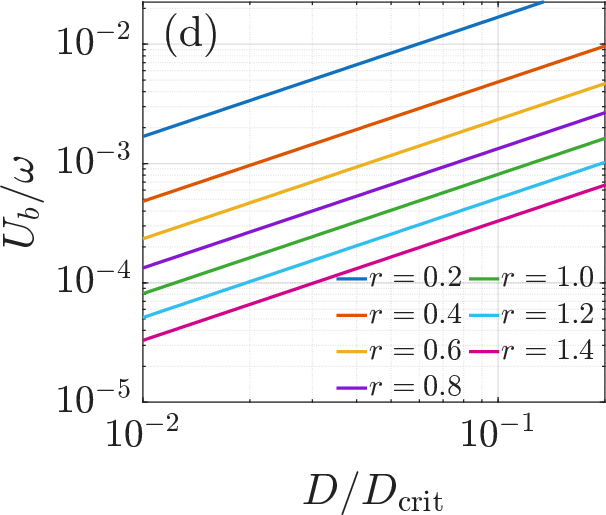
The squeezing parameter r is controlled via the pump/detuning, and its exponential enhancement, e4r, amplifies the effective anharmonicity such that qubit encoding is effective even at modest intrinsic D. Crucially, the gravitational signal, when projected onto the anti-squeezed quadrature, is amplified by er at the Hamiltonian level.
Quantum Fisher Information and Sensitivity
The optimal sensitivity is computed using quantum estimation theory, explicitly evaluating the quantum Fisher information (QFI) for g encoded into qubit dynamics. In the weak-force regime, the time-normalized sensitivity is:
Tδgopts≃e−r8mπℏωωb
This scaling marks an explicit exponential improvement in sensitivity with squeezing, in addition to the direct (preserved) mass scaling—both of which are not attainable in hybrid approaches.
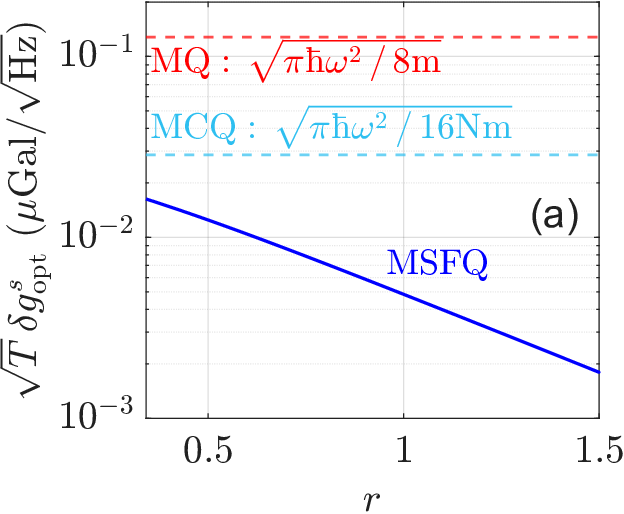
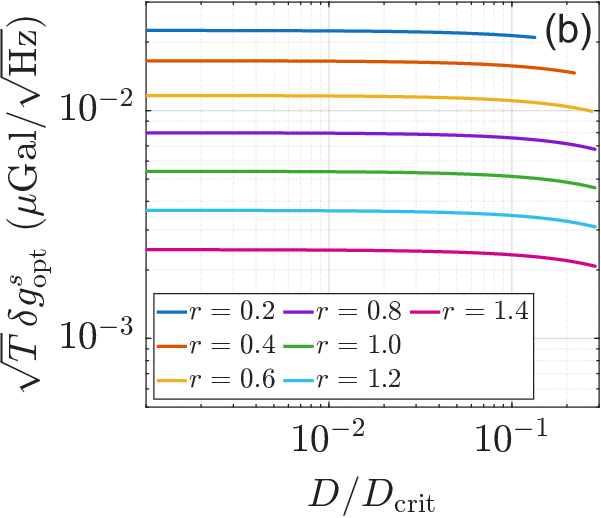
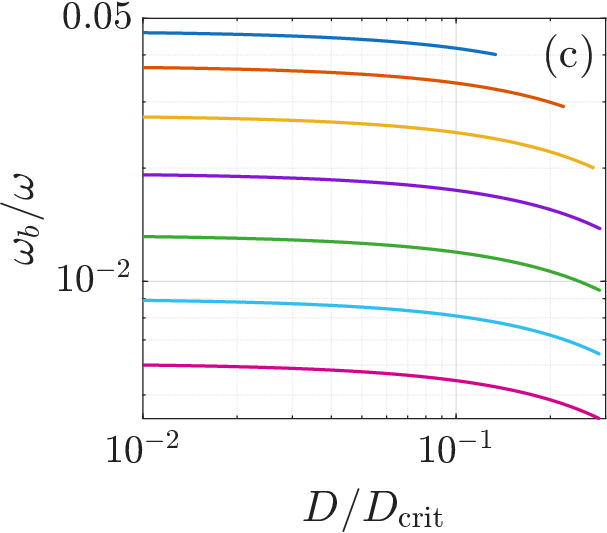
Figure 1: Coherent performance of the MSFQ gravimeter; sensitivity versus squeezing r and anharmonicity ratio D/Dcrit; effective qubit gap and anharmonicity scaling with control parameters.
Performance: Coherent and Decoherent Regimes
Ideal Coherent Operation
Under ideal conditions (neglecting dissipation), sensitivity improves monotonically with increased squeezing (r) and larger Duffing nonlinearity (r0), provided the RWA remains valid and the qubit gap does not collapse. The exponential resource advantage conferred by squeezing allows the MSFQ to outperform both the mechanical qubit (MQ) and mechanical cat-state qubit (MCQ) benchmarks at moderate r1.
Increasing r2 reduces the effective qubit splitting r3, extending the optimal interrogation time and tightening the sensitivity bound. However, excessive r4 or large r5 can render the RWA invalid; thus, practical operation must respect these theoretical boundaries.
Open System Analysis: Mechanical Damping
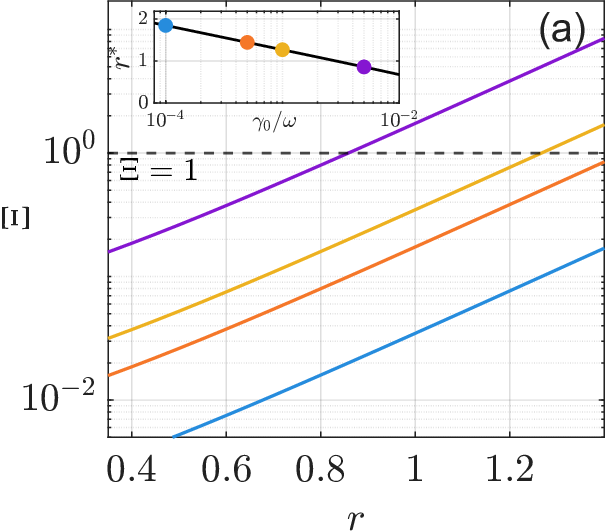
Introducing mechanical damping (modeled at zero temperature) projects the system dynamics into an anisotropic noise channel in the squeezed-Fock basis. The primary decoherence channel is exponentially amplified along the anti-squeezed quadrature. The competition between coherent Rabi precession and anisotropic (squeezing-enhanced) decay is characterized by the ratio r6, with r7.
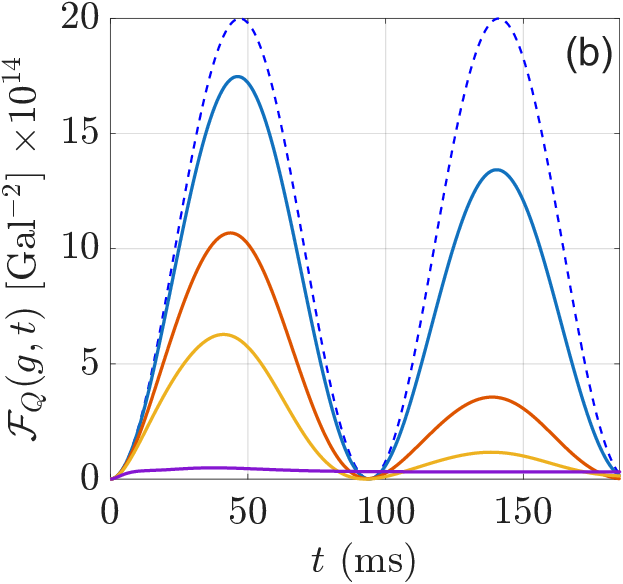
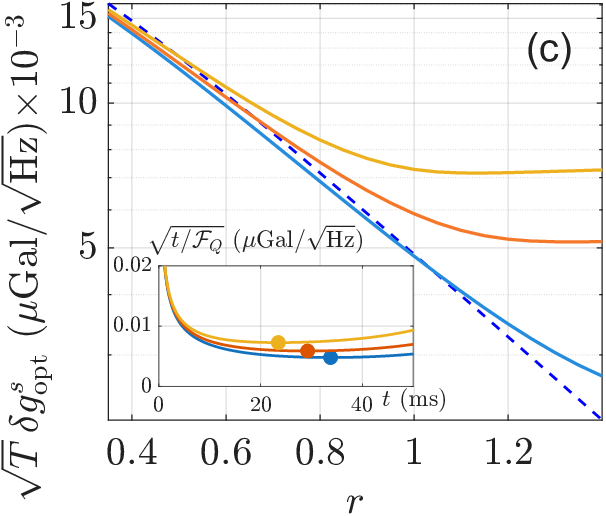
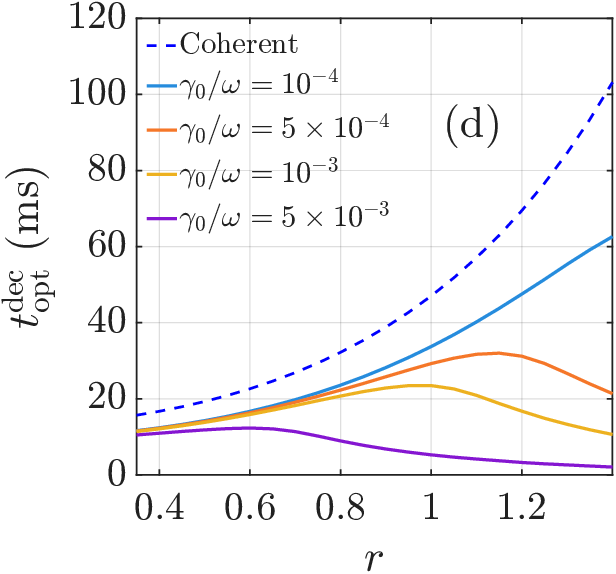
Figure 2: Decoherent performance of the MSFQ gravimeter; illustrates the competition ratio r8, QFI time dependence, sensitivity saturation, and optimal interrogation time under damping.
The key practical limitation is the crossover between the coherent (r9) and decoherent (e4r0) regimes. For any given mechanical dissipation, the maximum useful squeezing is bounded: increasing e4r1 beyond this point no longer improves sensitivity due to the exponential amplification of the dominant noise channel.
Measurement Optimization in the Open System
In the presence of decoherence, population measurement in the squeezed-Fock basis becomes sub-optimal, as information is redistributed across the Bloch vector. The optimal strategy involves projecting along the symmetric logarithmic derivative (SLD) direction, which, in general, requires an adaptive rotation before readout.
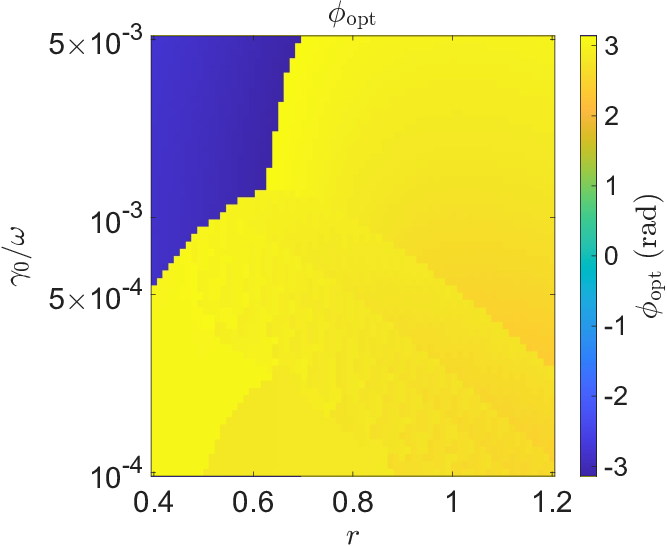
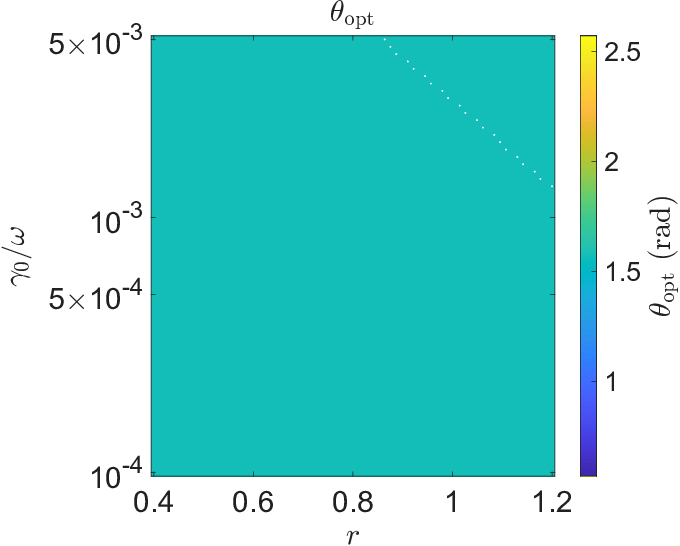
Figure 3: Optimal measurement angles e4r2 across different decoherence rates and squeezing values, indicating the locally optimal projective measurement basis.
Parameter Regimes and Practical Constraints
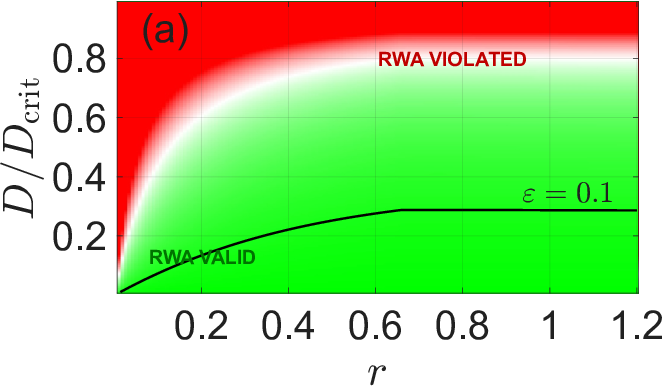
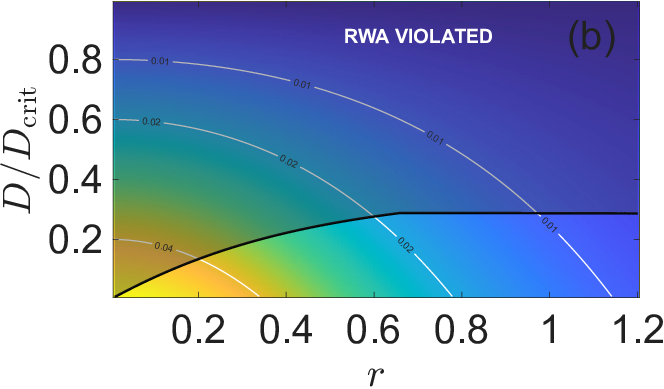
The exponential enhancement from squeezing must be balanced against increased decoherence, reduction of the qubit gap, and the RWA validity limits. The "safe operating window"—where substantial squeezing is utilized without decoherence dominating—depends sensitively on the mechanical quality factor and tunability of the Duffing nonlinearity. The authors provide quantitive RWA breakdown boundaries, highlighting the shrinking of the valid parameter space as e4r3 increases.
Figure 4: RWA validity map and accessible parameter space for e4r4, with contours indicating the breakdown boundary.
Implications and Future Directions
This study identifies the MSFQ architecture as a fundamentally distinct pathway for quantum-enhanced gravimetry, exploiting squeezed mechanical qubits that maximize both mass scaling and parametric signal amplification in a purely mechanical, single-mode system. The central claim—that squeezing enhances sensitivity exponentially, while mass scaling is fully preserved—contradicts the null mass scaling found in hybrid (spin-mechanical or optomechanical) devices.
Practically, this opens the prospect of scalable, miniaturized, highly sensitive gravimeters compatible with chip-scale integration, leveraging levitated optomechanical technology. The theoretical formalism also generalizes to quantum sensing of other weak static or quasistatic forces, and provides a testbed for non-Gaussian quantum control and open-system metrology.
Further advances will depend on improved mechanical quality factors, stronger tunable nonlinearities, and precise control over the squeezed-Fock state preparation and measurement—domains in which rapid experimental progress is ongoing.
Conclusion
The "Mechanical Squeezed-Fock Gravimeter" (2605.28289) proposes and analyzes an architecture wherein squeezed-Fock encoding in a mesoscopic mechanical oscillator delivers exponential quantum-enhanced gravimetric sensitivity while fully preserving direct e4r5-dependent coupling. The paper provides theoretical bounds for both coherent and open-system regimes, quantifies the trade-offs between squeezing and decoherence, and delineates the practical limits imposed by intrinsic system parameters and control. This work establishes the MSFQ as a promising and competitive candidate for next-generation quantum gravimetry and precision force sensing.
“Emergent Mind helps me see which AI papers have caught fire online.”
Philip
Creator, AI Explained on YouTube
Sign up for free to explore the frontiers of research
Discover trending papers, chat with arXiv, and track the latest research shaping the future of science and technology.Discover trending papers, chat with arXiv, and more.