- The paper establishes that CEPs induce singular anisotropic scaling in the covariance, leading to enhanced quantum spin squeezing.
- It employs a GKSL master equation and Lyapunov analysis to derive universal scaling laws that link fluctuation suppression with the order parameter.
- Numerical simulations reveal that finite-size effects and decoherence critically influence the metrological usefulness of the squeezed states.
Quantum Spin Squeezing at Critical Exceptional Points: Covariance-Geometry and Fluctuation Anisotropy
Introduction and Background
This work analyzes the emergence of enhanced quantum spin squeezing in open many-body spin systems near critical exceptional points (CEPs) in their nonequilibrium phase diagrams (2605.28126). Open quantum systems with dissipative dynamics fundamentally differ from equilibrium systems; they allow both unitary and non-unitary effects and support phase transitions not captured by equilibrium statistical mechanics. The breakdown of detailed balance in such systems permits non-Hermitian degeneracies—exceptional points (EPs)—at which multiple dynamical modes and their eigenvectors coalesce. When an EP coincides with a continuous phase transition, it becomes a "critical exceptional point," and fluctuation properties near the CEP are expected to exhibit singular behavior.
The unique aspect of this study is its direct analysis of the quantum fluctuations as encoded by the covariance structure, focusing on how the steady-state squeezing parameter and its anisotropy are controlled by the approach to the CEP. While classical fluctuation amplification at CEPs is established, this work clarifies the fate of inherently quantum fluctuations, revealing that CEPs induce a singular, highly anisotropic geometry in the quantum covariance matrix and thus in collective spin squeezing observables.
Theoretical Framework
The system of interest consists of N fully-connected spin-$1/2$ particles governed by a Gorini–Kossakowski–Sudarshan–Lindblad (GKSL) master equation. The Hamiltonian is quadratic in intensive collective spin operators, and all Lindblad operators responsible for dissipative channels are linear in the collective spin, allowing for a Gaussian fluctuation description at leading order in $1/N$.
The key quantum observable is the Kitagawa–Ueda squeezing parameter ξS2, which is defined via the minimum variance of spin components perpendicular to the mean spin:
ξS2=S2min(ΔS⊥)2,
with S=N/2. A state is squeezed when ξS2<1, corresponding to entangled, metrologically useful states.
To extract the covariance dynamics, the authors formulate a Lyapunov equation for the covariance matrix Σ, which, at steady state, reduces to a matrix equation:
JΣ+ΣJT+D=0,
where J is the Jacobian of linearized mean-field drift, and $1/2$0 is the diffusion matrix derived from the Lindblad terms.
The study focuses on models with Lindbladian PT symmetry, which ensures a specific structure in the fixed-point mean-field dynamics and the linearized stability matrix at the CEP. At the CEP ($1/2$1), the Jacobian matrix contains a nilpotent Jordan block, and the linearized dynamics becomes defective, leading to singular susceptibility along the coalescing direction.
Universal CEP-Induced Scaling of Fluctuations
The main analytical result is an explicit, universal scaling form for the principal variances of the covariance matrix near the CEP. On approach to the CEP, denoting by $1/2$2 the (small, PT-broken) order parameter of the symmetry-broken branch,
$1/2$3
Thus, the squeezed variance vanishes linearly with the order parameter, while the anti-squeezed variance diverges reciprocally. The physical interpretation is that, as the CEP is approached, quantum fluctuations become extremely anisotropic: the squeezed direction is suppressed, while the anti-squeezed direction is strongly enhanced and locks to the coalescing eigenvector of the stability matrix. These scalings persist unless the dissipative diffusion matrix contains a finite component along the coalescence direction, in which case the singular behavior is cut off before the CEP.
Numerical Demonstration and Effects of Decoherence
A prototypical model is considered: a collective spin with one-axis twisting and collective decay exhibiting an L-PT-symmetric CEP. Analytical predictions agree precisely with numerical solutions of the master equation for large $1/2$4. The calculated squeezing parameter $1/2$5 collapses towards the analytic prediction as $1/2$6 increases, with a clear singular suppression near the CEP.
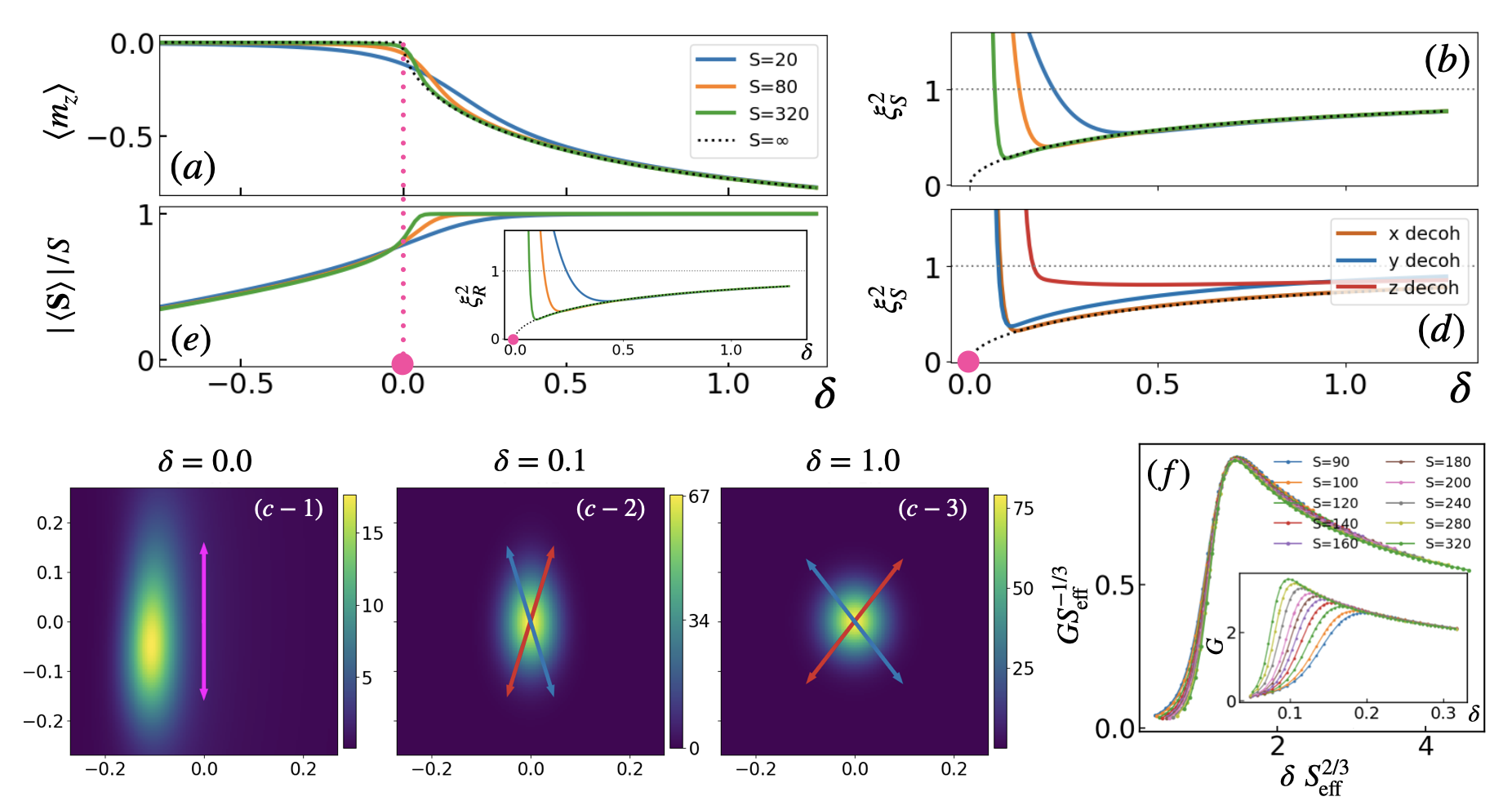
Figure 2: Numerical calculation of the dissipative collective spin model showing the sharp suppression of the squeezing parameter $1/2$7 as a function of the control parameter near the CEP; anisotropic phase-space distributions and robustness to $1/2$8, $1/2$9 dephasing are also shown.
The Husimi $1/N$0-function in the transverse plane confirms the anisotropic nature of the steady-state quantum fluctuations near the CEP, with the major axis aligned with the defective mode.
Inclusion of additional dephasing (either via $1/N$1, $1/N$2, or $1/N$3 channels) demonstrates the robustness of the CEP-induced enhancement of squeezing: dephasing along the coalescing direction ($1/N$4) destroys squeezing, while transverse dephasing channels do not affect the scaling at leading order.
Finite-Size Effects and Scaling Collapse
Finite-size corrections are captured by a Ginzburg-type criterion. The fluctuation-induced width in the anti-squeezed direction grows as $1/N$5; when this becomes comparable to the order parameter, the system crosses over from critical to noncritical scaling, yielding an algebraic cutoff for the squeezing enhancement:
$1/N$6
Logarithmic corrections further refine this scaling, and a data collapse is observed for the inverse squeezing scaled as $1/N$7,
$1/N$8
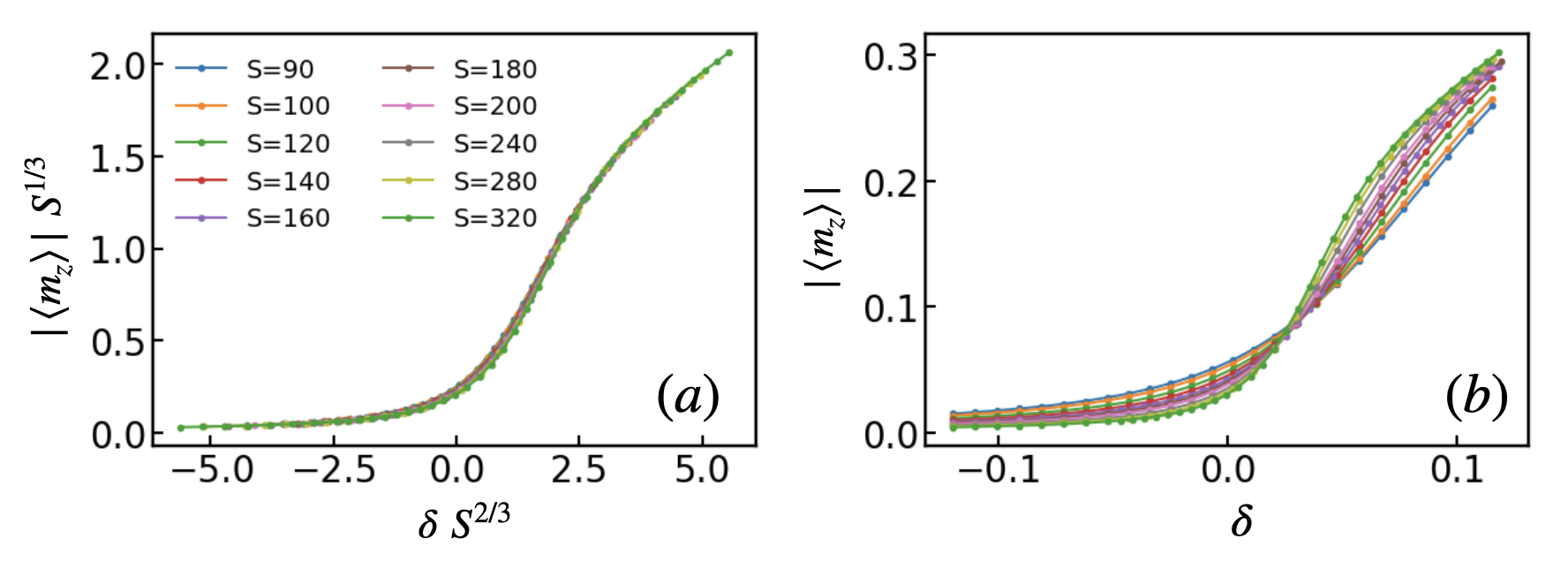
Figure 1: Finite-size scaling of the order parameter near the CEP, demonstrating scaling collapse in agreement with analytic predictions.
Generalizations and Experimental Considerations
The covariance-geometry mechanism for spin squeezing at CEPs is not restricted to idealized spin models but also appears in more realistic settings, such as cavity quantum electrodynamics with spin-boson coupling and bosonic loss. The structure and scaling of singular covariance near CEPs carry over to these models, supporting the claim that CEP-induced anisotropic quantum fluctuations are generic among driven-dissipative platforms with appropriate symmetry and dynamical structure. Experimentally, all ingredients required for CEP-induced steady-state squeezing are accessible with cold atoms in high-finesse cavities or Rydberg arrays.
Theoretical and Practical Implications
Key implications include:
- Covariance geometry as a diagnostic: The CEP provides a universal organizing principle for correlations and quantum fluctuations in open many-body dynamics, evidenced by the singular scaling of covariance anisotropy.
- Platform-independent scaling: Provided appropriate symmetry and damping structure, the singular covariance geometry and squeezing enhancement are not tied to a particular physical realization.
- Entanglement detection and metrology: The singular enhancement in squeezing near the CEP corresponds directly to metrologically useful entanglement certified via the Wineland parameter, potentially improving quantum sensors.
- Noise channel engineering: The sensitivity of the scaling to specific directions in diffusion channels offers guidelines for optimizing open-system squeezing generation via engineered dissipation.
These results suggest new regimes for generating entangled, squeezed steady states in synthetic quantum matter, with the critical exceptional point as a tunable parameter.
Conclusion
This study rigorously establishes that critical exceptional points in open, driven-dissipative spin systems yield robust, universal, and tunable enhancement of steady-state quantum spin squeezing, with fluctuation anisotropy controlled by the order parameter and singularly locked to the critical coalescing direction. The work identifies the Jordan-block structure at the CEP as the organizing principle for this quantum covariance geometry. These insights open up avenues both for experimental realization of entangled steady states near CEPs and for a deeper theoretical understanding of criticality and non-Hermitian degeneracy in open quantum systems.

