- The paper introduces a scalable optimal-control protocol using rotor–spin-wave theory to enhance spin squeezing in 2D dipolar XX models.
- It achieves squeezing surpassing the two-axis twisting benchmark by optimizing a single collective transverse field and confining dynamics to the maximal spin Dicke subspace.
- The method demonstrates robustness against dephasing noise and boundary effects, ensuring practical applicability to experimental quantum platforms.
Optimal Control of Spin Squeezing in 2D Finite-Range Interacting Systems
Introduction and Motivation
Spin squeezing is a fundamental signature of many-body quantum entanglement and has crucial importance for quantum-enhanced metrology. Conventional squeezing production protocols exploit all-to-all interactions, facilitating protocols such as One-Axis Twisting (OAT) and Two-Axis Twisting (TAT), which rely on global permutation symmetry. However, real-world quantum platforms—including Rydberg atom arrays and magnetic quantum gases—feature finite-range interactions with spatially decaying coupling Jij∼1/rijα, leading to the breakdown of global symmetry and the degradation of squeezing performance. Scalable squeezing in such finite-range systems is nontrivial, especially for two-dimensional (2D) lattice geometries with long-range dipolar interactions.
This paper addresses the generation of strong spin squeezing in 2D XX models with dipolar (α=3) interactions, proposing a scalable optimal-control protocol that leverages rotor–spin-wave (RSW) theory. The approach enables efficient optimization by confining system evolution to the maximal-spin Dicke subspace, dynamically suppressing the detrimental inter-subspace mixing induced by finite-range couplings. The protocol is further generalized to open boundary conditions (OBC) and is shown to exhibit robustness against dephasing noise, maintaining substantial squeezing enhancement at large scales.
Model and Theoretical Framework
The Hamiltonian considered is a 2D XX model with power-law interactions and a time-dependent uniform transverse field,
H=−i<j∑Jij(SixSjx+SiySjy)−h(t)i∑Six,
where Jij=4J∣ri−rj∣−α, Siμ are spin-$1/2$ operators, and h(t) is the control field. The system is initialized in a coherent spin state pointing along the x axis. Squeezing is quantified via the Wineland parameter,
ξ2=∣⟨S⟩∣2N(ΔS⊥,min)2,
with ξ2<1 indicating entanglement and metrological advantage.
To circumvent the exponential scaling in Hilbert space, the RSW theory is employed. It splits the spin dynamics into a collective zero-momentum sector (described by an effective OAT Hamiltonian) and linear spin-wave excitations for nonzero momenta. This enables tractable optimization of the control field for large system sizes under periodic boundary conditions (PBC); a canonical generalization allows similar treatment for OBC.
Optimal Control Results under Periodic Boundary Conditions
The central result is the substantial enhancement of spin squeezing achievable using a single collective transverse field, exceeding the TAT benchmark even in dipolar XX models with finite interaction range. The optimization protocol utilizes gradient-based minimization of α=30, parameterized as piecewise constant α=31. The optimized field actively suppresses mixing out of the maximal spin sector, evidenced by the dynamics of α=32 and the robust growth of squeezing.
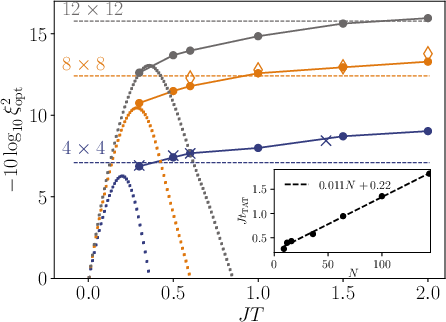
Figure 1: The optimal squeezing parameter as a function of total evolution time α=33 for various system sizes under PBC, showing results from RSW, ED, and t-VMC; TAT and uncontrolled cases plotted for comparison; inset displays crossover time α=34 vs. system size.
Notably, as shown in Figure 1, controlled dynamics consistently surpass the TAT limit for sufficiently large α=35. The crossover time α=36 scales linearly with system size, α=37. The optimized protocol maintains evolution within the maximal spin Dicke subspace, as indicated by suppressed decay of α=38, resulting in enhanced squeezing over the uncontrolled case.
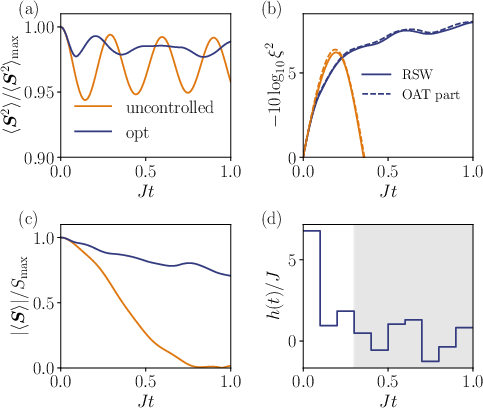
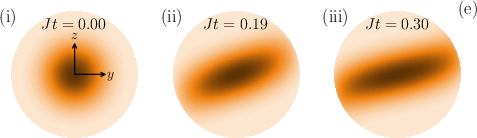
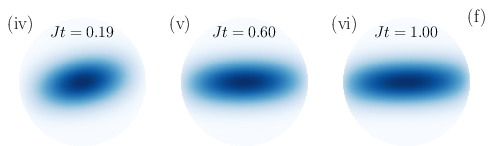
Figure 2: Time evolution of α=39, squeezing parameter, mean spin, and control field; Bloch sphere visualizations depict squeezing trajectories under uncontrolled and optimized conditions.
The Husimi Q-function dynamics (Figure 2e/f) further confirm controlled synchronization of squeezing and spin rotation, preventing over-twisting and enabling sustained squeezing along the optimal axis.
Robustness Against Dephasing Noise
Experimental implementations are subject to decoherence, especially collective and individual dephasing (e.g., from laser phase fluctuations in Rydberg platforms). The protocol's robustness is explored via Lindblad dynamics with dephasing rate H=−i<j∑Jij(SixSjx+SiySjy)−h(t)i∑Six,0, using generalized RSW for open quantum systems.
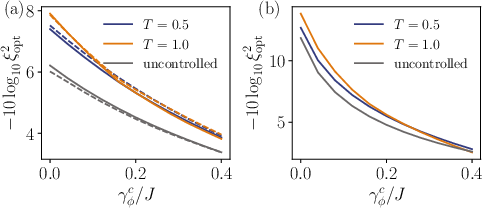
Figure 3: The optimal squeezing parameter as a function of collective dephasing rate for H=−i<j∑Jij(SixSjx+SiySjy)−h(t)i∑Six,1 and H=−i<j∑Jij(SixSjx+SiySjy)−h(t)i∑Six,2 lattices, contrasting uncontrolled and optimized protocols, and validating RSW accuracy against ED.
The optimized control field yields stronger squeezing than the uncontrolled evolution throughout the explored noise regime (H=−i<j∑Jij(SixSjx+SiySjy)−h(t)i∑Six,3) and retains advantage at intermediate evolution times, where decoherence effects become significant. Longer H=−i<j∑Jij(SixSjx+SiySjy)−h(t)i∑Six,4 enhances ideal squeezing but increases exposure to noise, dictating optimal trade-offs under experimental constraints.
Extension to Open Boundary Conditions and Applicability to Larger Systems
The RSW framework is extended to OBC, relevant for real quantum hardware. The protocol remains effective, with the optimized field suppressing spin-wave excitations and maintaining applicability for large open systems.
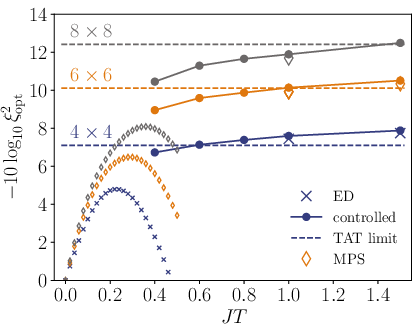
Figure 4: Optimal squeezing parameter for OBC systems as a function of total evolution time, with RSW, ED, and TDVP/MPS results compared; controlled protocol achieves significant squeezing enhancement.
Numerical validation against t-VMC (periodic) and MPS-TDVP (open) confirms the scalability and reliability of the theoretical predictions.
Noise Robustness for Individual Site Dephasing
Further simulations demonstrate that the protocol withstands individual dephasing, maintaining superior squeezing performance even as the site-dephasing rate increases.
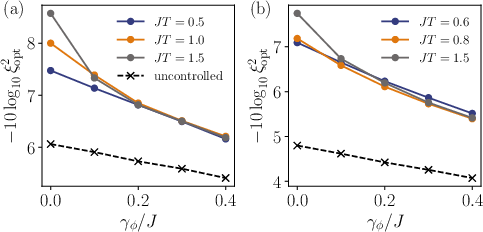
Figure 5: Optimal squeezing parameter versus site-dephasing noise rate for both PBC and OBC with H=−i<j∑Jij(SixSjx+SiySjy)−h(t)i∑Six,5, highlighting protocol resilience under varied decoherence strengths.
The advantage of longer evolution is reduced in the presence of strong noise, but the protocol's metrological usefulness persists across parameter regimes.
Conclusion
This work introduces a scalable optimal-control strategy for generating enhanced spin squeezing in 2D finite-range interacting XX models, specifically with dipolar interactions. Optimization of a single collective transverse field yields squeezing surpassing the TAT benchmark, a bold claim validated by numerical results at large system sizes. The rotor–spin-wave theory enables efficient simulation and physical interpretation, with the optimal protocol confining evolution predominantly to the maximal spin subspace, suppressing detrimental mixing and spin-wave excitations.
Robustness to experimental noise and boundary effects is demonstrated, rendering the protocol relevant for practical quantum sensing applications. The theoretical framework offers a foundation for optimal control in other geometries and higher-dimensional platforms, suggesting future developments in engineered entangled state preparation for metrology. Integrating optimal control with scalable many-body theories is positioned as a powerful approach for advancing programmable quantum technologies.

