- The paper demonstrates that finite-frequency scalar absorption uniquely reveals the A5 metric sector, which remains invisible in geometric-optics limits.
- It employs partial-wave techniques to analyze scattering across low- and high-frequency regimes, exposing sector-dependent deviations in black hole observables.
- The study underlines the necessity of full-wave diagnostics to complement shadow and photon-sphere tests in strong-field assessments of the no-hair theorem.
Scalar Absorption Beyond Geometric Optics in Klein–Gordon-Separable Johannsen Black Hole Spacetimes
Introduction and Motivation
This paper investigates scalar absorption in a variant of Johannsen black hole metrics, specifically focusing on metrics that allow separation of the massless Klein–Gordon equation. The Johannsen metric is a generic, stationary, axisymmetric deformation of Kerr spacetime, suitable for strong-field tests of the no-hair theorem and for parametrized phenomenological studies of black hole geometries. Unlike conventional geometric-optics approaches constrained by null geodesic observables, this work analyzes finite-frequency wave absorption, which probes sectors of the metric invisible to geometric optics.
A key motivation arises from the observation that several deformation sectors of rotating metrics—most notably those entered through the radial kinetic term—do not affect null-capture boundaries or the horizon area, and thus evade standard shadow and photon-sphere-based tests. The authors aim to clarify which deviations are detectable only through full-wave absorption diagnostics and precisely how the partial-wave formalism exposes this structure.
Metric Construction and Separability Structure
The chosen metric subclass adheres to: stationarity, axisymmetry, asymptotic flatness, Carter-type integrability, and separability of both the Hamilton–Jacobi and Klein–Gordon equations. The Johannsen metric is written as a deformation of Kerr, with several independent radial and angular functions (A1, A2, A5, f). Klein–Gordon separability enforces constraints among them, leaving a privileged set of deformation sectors: A1(r) and A2(r) (modifying the radial size function X(r)), and A5(r) (entering only the radial kinetic term).
The weak-field parametrized post-Newtonian (PPN) compatibility further restricts the coefficient choices. The authors explicitly distinguish their Klein–Gordon-separable subclass from other parametrized metrics, stressing that metric functions relevant for wave propagation may be invisible to weak-field or geometric-optics probes.
Scalar absorption is calculated using partial-wave techniques, with the radial equation cast in a Schrödinger-like form. The structure is such that A1 and A2 appear in the algebraic wave factor and alter the horizon area and null-capture conditions, while A20 modifies only the radial kinetic term and the tortoise coordinate.
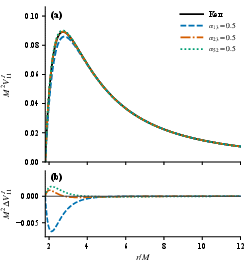
Figure 1: Dimensionless scalar wave effective potential A21 for representative leading Johannsen deformations, illustrating sector-dependent changes in the scattering barrier.
This structural separation is captured visually in the effective potential profiles, demonstrating that A22 induces radial changes invisible to geometric optics but visible to finite-frequency wave propagation.
Limiting Regimes: Area Law and Null Capture
The low-frequency limit yields an absorption cross section equal to the horizon area, sensitive only to A23 and A24; A25 is absent as it does not impact the induced metric on the horizon. Conversely, the high-frequency regime approaches the geometric cross section determined by the critical null-capture boundary—again insensitive to A26 by construction. This means that geometric probes (e.g., shadow imaging and photon-sphere properties) are intrinsically blind to A27 deformations.
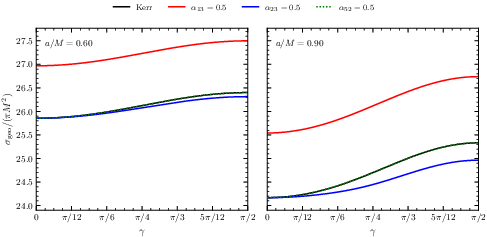
Figure 2: High-frequency geometric capture cross section as a function of incidence angle for A28 and A29, showing that only A50 and A51 significantly modify the null-capture boundary.
Finite-Frequency Absorption: Wave-Optics Diagnostics
The central numerical results reveal that finite-frequency absorption cross sections are sensitive to all three sectors, including A52. Oscillatory deviations are found in the finite-frequency regime, which are sector-dependent and carry distinctive signatures outside both limiting cases.
A hierarchy analysis demonstrates that the response to deformation coefficients with larger radial falloff is suppressed, supporting the focus on leading-order coefficients (A53, A54, A55).
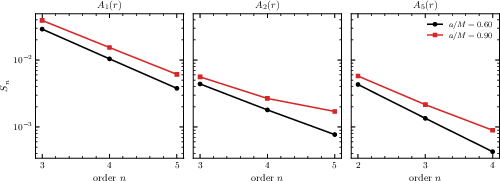
Figure 3: Hierarchy of Johannsen coefficients with increasing radial falloff, showing diminishing RMS sensitivity A56 with higher-order terms.
Relative deviations from Kerr are computed, and the sector-dependent oscillatory structure is evident, notably in the A57 case which has zero deviation in the null-capture limit but nonzero spectral signature in absorption.
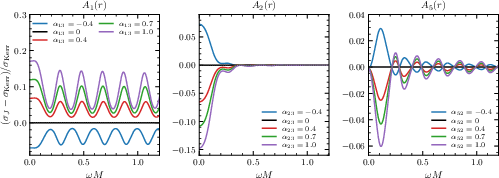
Figure 4: Relative deviations from Kerr by deformation sector for on-axis incidence at fixed spin A58 and A59, illustrating sector- and frequency-dependent departures.
Azimuthal asymmetry and off-axis incidence are considered, showing sector-sensitive corrections in co-/counter-rotating mode contributions. f0 drives finite-frequency corrections beyond Kerr, despite remaining degenerate in geometric optics.
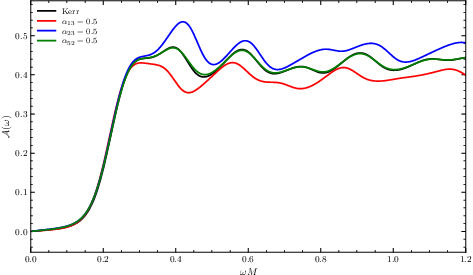
Figure 5: Azimuthal asymmetry for off-axis incidence at f1 and f2, measuring the frequency-dependent imbalance in co-/counter-rotating sectors.
Superradiant Modes and Horizon Angular Velocity
Superradiant amplification is analyzed via the f3 partial absorption cross section at high spin. Here, f4 and f5 shift the horizon angular velocity f6 and thus the superradiant threshold, while f7 leaves the threshold unchanged but modifies the amplification profile.
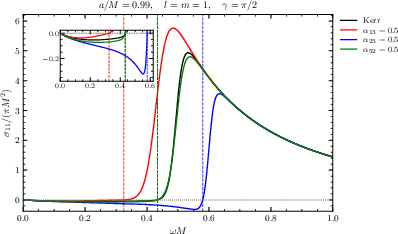
Figure 6: Partial absorption cross section f8 for the f9 scalar mode at A1(r)0, showing mode-level superradiant effects and sector-specific threshold shifts.
Implications and Perspectives
The primary claim of the paper is that finite-frequency scalar absorption breaks a degeneracy present in geometric-optics probes: the A1(r)1 sector, invisible to both the area law and the null-capture boundary (and hence untestable via shadows, photon-spheres, or geometric gravitational wave signals), is distinctly resolved with scalar wave absorption. Consequently, tests relying solely on geometric observables cannot fully constrain the Kerr deviation space.
This finding is a substantive addition to strong-field phenomenology: wave-optics observables are necessary for a comprehensive test of black hole uniqueness, complementing shadow and photon-ring measurements. The work advocates for systematic inclusion of finite-frequency absorption, scattering spectra, and quasinormal mode analyses as diagnostics in the broader program of no-hair theorem tests.
Future directions suggested include parameter surveys over broader spin domains, inclusion of massive scalar fields, electromagnetic and gravitational perturbations, and comparisons with exact solutions (Kerr–Newman/Sen). The framework can be generalised to other rotating metrics with different separability properties, and to cases with backreaction and more complicated matter content.
Conclusion
The paper establishes that finite-frequency scalar plane-wave absorption in Klein–Gordon-separable Johannsen spacetimes uncovers metric sectors invisible to geometric-optics diagnostics. The radial kinetic term, encapsulated via the A1(r)2 function, yields detectable spectral imprints absent from both low-frequency area law and high-frequency null-capture observables. This sectoral discrimination underlines the necessity of full-wave absorption and scattering measurements for strong-field tests of black hole geometry beyond Kerr.
By providing a systematic partial-wave absorption analysis and sector separation—supported by numerical precision and strong spectral evidence—the work illustrates the importance of wave-mechanics-based approaches complementing geometric probes. Its implications span phenomenological modeling, astrophysical inference, and the theoretical understanding of metric degeneracies relevant to the no-hair conjecture and general relativity’s uniqueness theorems.