- The paper shows that higher-curvature corrections (parameter α) yield regular black holes with enhanced photon sphere and increased absorption cross section versus singular Tangherlini solutions.
- It employs a WKB-based approach to compute greybody factors, revealing low-frequency suppression and multipole shifts as functions of spacetime dimensionality (D) and the curvature parameter.
- The study demonstrates that as D increases, regular black holes tend toward classical singular behavior, underlining the potential of EM observations in testing modified gravity theories.
Scattering of Electromagnetic Fields in Quasi-Topological Gravity
Introduction
This paper addresses the propagation and scattering of brane-localized electromagnetic perturbations in the background of higher-dimensional, regular black holes arising from quasi-topological gravity. The analysis focuses on quantifying the deviations in absorption and scattering properties as compared to the singular Tangherlini solution, employing WKB-based calculations of greybody factors, and elucidates the respective roles of higher-curvature corrections (parametrized by α) and spacetime dimensionality D.
Regular Black Holes in Quasi-Topological Gravity
The quasi-topological gravity framework considered introduces higher-order curvature invariants while preserving second-order equations for spherically symmetric configurations. This class of theories admits regular solutions—namely, black holes devoid of central curvature singularities—whose behavior at small radii is controlled by the coupling parameter α.
The study systematically contrasts the canonical singular Tangherlini black hole metric with several regular solutions. Notably, regularity leads to the emergence of a smooth central core and, in some configurations, an additional inner horizon ri besides the event horizon r0. The metric profiles reveal that regularization introduces significant deviations from the singular case primarily in the near-horizon and core regions, with these effects attenuated as D increases.
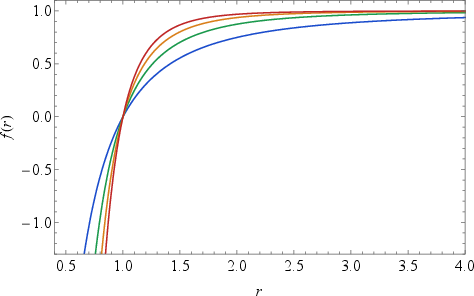
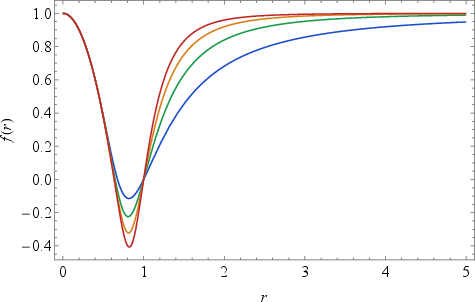
Figure 1: Metric functions for the singular Tangherlini (left) and regular (right) black holes, illustrating dimensional and regularity dependencies.
Electromagnetic perturbations are treated as effective massless spin-1 fields propagating on a four-dimensional induced brane geometry, despite the bulk black hole being higher-dimensional. Linearization of the Maxwell equations reduces the problem to solving a wave equation with an effective potential shaped by the underlying higher-curvature geometry:
dr∗2d2Ψ(r∗)+[Ω2−V(r)]Ψ(r∗)=0,V(r)=f(r)r2ℓ(ℓ+1).
Regular black holes alter f(r) relative to the Tangherlini metric, leading to a modified effective potential, especially near the horizon and at smaller radii.
WKB Greybody Factors Computation
The absorption, or greybody, factors Γℓ(Ω) quantify the transmission probability for each partial wave through the effective potential barrier—a central object linking spacetime geometry to observable absorption rates. The WKB approximation, including a recently proposed analytic version utilizing the first two dominant QNM frequencies (ω0,ω1), facilitates efficient and accurate computation of D0 even for moderate D1. The high-D2 (eikonal) limit gives further simplification and physical intuition.
Key trends observed:
- Suppression at low frequencies: Transmission probabilities D3 for all D4 as D5.
- Multipole dependence: Higher D6 shifts the dominance toward lower D7 and improves convergence to geometric-optics.
- Enhanced deviations for increasing D8: Regularity raises the potential barrier, shifting greybody spectra and systematically suppressing low-frequency transmission compared to the singular limit.
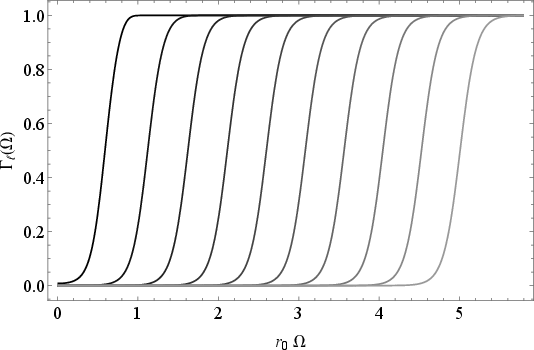
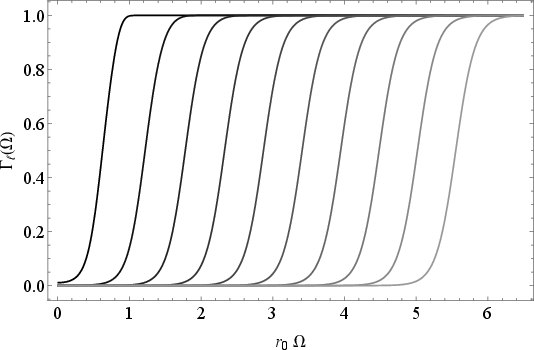
Figure 2: Greybody factors for various multipole numbers for the regular black hole, showing suppression at low D9 and α0 dependence as α1 or α2 is varied.
Absorption Cross Section and Geometric Optics Limit
The absorption cross section α3 is constructed via partial wave summation of greybody factors, with sharp contrast in behavior between low- and high-frequency regimes. At low α4, the cross section drops rapidly, while at high frequencies, classical capture by the photon sphere dominates.
Regular black holes modify the impact parameter α5 and thus the geometric-optics cross section:
α6
with the photon sphere radius α7 found by extremizing the effective potential. The analysis demonstrates:
- Regularization effect: For fixed α8, increasing α9 systematically enlarges ri0, thus increasing the classical absorption area and the associated black hole shadow radius.
- Dimensional suppression: As ri1 increases, the deviations between regular and singular solutions diminish. The photon sphere and ri2 converge toward the Tangherlini values due to the rapid radial decay of the higher-dimensional gravitational field.
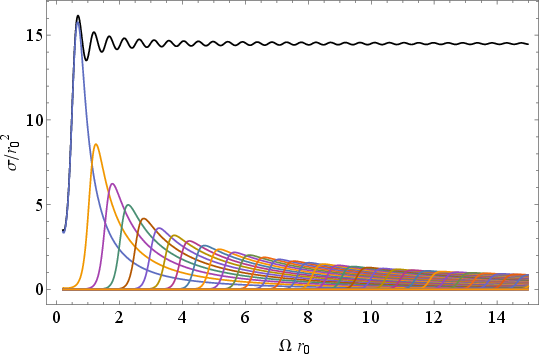
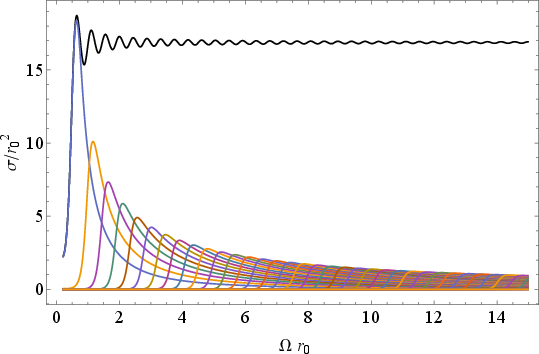
Figure 3: Cumulative contributions of the first 50 multipoles to the cross section, displaying the effect of ri3 on convergence to the geometric limit for ri4.
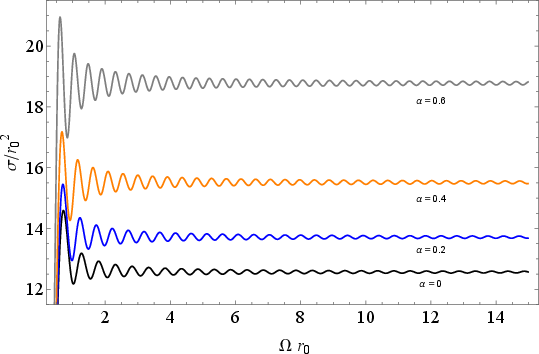
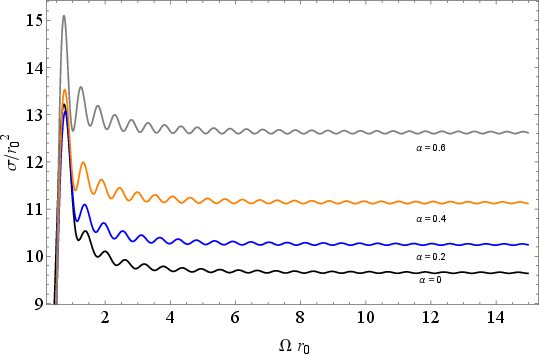
Figure 4: Multipole contributions to the total cross section, for ri5 and ri6, as a function of ri7 for the regular configuration.
A detailed scan of configurations and parameters reveals a monotonic increase in absorption cross section with ri8, and monotonic suppression of differences with the singular limit as ri9 is raised.
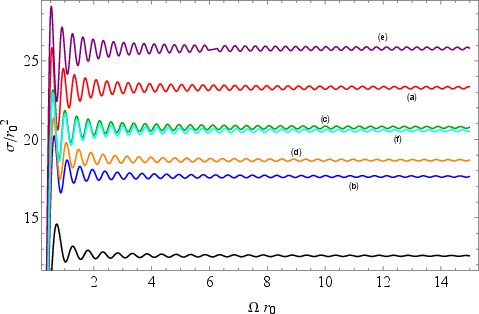
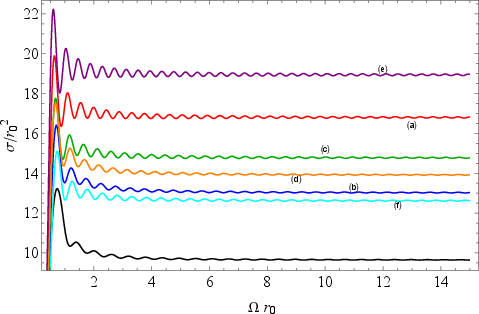
Figure 5: Comparison of the first 40 multipolar contributions to the total cross section across all regular and singular configurations in the extremal regime for r00.
Physical and Theoretical Implications
This study solidifies several robust, testable claims:
- The shadow radius and geometric-optics cross section are always increased in regular black holes relative to singular Tangherlini ones for any fixed r01 and allowable r02.
- Deviation from the singular case is maximized at low r03 and high r04; increasing r05 drives the system toward classical, singular-like behavior.
These findings have direct implications for probing generic modifications of GR via electromagnetic (and potentially gravitational) wave observations. The systematic impact on greybody factors, absorption spectra, and shadow radius offers a unified diagnostic for the underlying geometry. In higher-dimensional or string-motivated gravity models with regularization mechanisms, distinguishing empirical signatures becomes feasible through such phenomena.
Future developments could focus on more general brane scenarios, rotating or charged regular black holes, and the extension to other field spins. Furthermore, the WKB framework used here is readily generalizable to other compact object backgrounds, including horizonless exotic mimickers, offering a pathway to systematic observational constraints on regularity and higher-dimensional gravitational effects.
Conclusion
The analysis rigorously demonstrates that higher-curvature regularization in quasi-topological gravity produces clear, quantifiable modifications to the scattering and absorption properties of higher-dimensional black holes, as projected onto a 4D brane. Regular black holes exhibit an enhanced photon sphere and absorption cross section—effects that are gradually washed out as r06 increases. Both practical (absorption rates, shadow sizes) and theoretical (limiting behaviors, convergence to GR predictions) aspects are characterized precisely.
The results consolidate the use of scattering observables as sensitive, complementary probes of higher-curvature gravity and brane-world phenomenology, where the interplay between r07 and r08 encapsulates the nature and magnitude of deviations from standard General Relativity.

