- The paper introduces a Bayesian statistical framework that uses Beta posterior inference to compute approval probabilities for landing controllers under finite rollout conditions.
- The paper presents a sequential decision protocol that distinguishes between empirical reward optimization and calibrated deployment readiness, ensuring conservative validation even with high empirical success rates.
- The empirical results reveal that high success rates may not translate to deployment approval due to finite-sample uncertainty, underscoring the need for rigorous statistical validation in safety-critical systems.
Bayesian Deployment Approval for Learned Landing Controllers under Finite Rollout Validation
Introduction and Motivation
The deployment of learned control policies for safety-critical tasks such as autonomous landing requires more rigorous statistical validation than traditional reinforcement learning (RL) metrics provide. While cumulative reward and empirical success frequency on simulation rollouts are standard for RL evaluation, these empirical measures under finite sample regimes do not translate directly into calibrated evidence of deployment readiness under uncertainty. This gap is addressed by introducing a Bayesian statistical framework for deployment approval that quantifies uncertainty and supports principled decision-making based on limited validation data.
Framework: Probabilistic Landing Capability and Bayesian Approval
The paper formulates landing capability as the probability that a policy produces a trajectory satisfying all requisite touchdown safety constraints (position, velocity, pitch, contact) under random operating conditions. Rollout validation is treated as a sequence of conditionally independent Bernoulli trials, each indicating binary satisfaction of multi-criteria safety events. Instead of simply thresholding empirical success rates, the framework models the capability parameter pπ with a Beta prior, yielding a posterior after observing n validation outcomes.
Bayesian posterior inference is used to directly compute:
- The posterior probability qn=P(pπ≥p0∣Dn) that the controller meets the required reliability threshold p0 (e.g., p0=0.95).
- The complementary posterior false-approval risk 1−qn.
- The sequential evolution of these probabilities as rollout validation continues.
This probabilistic approach enables explicit uncertainty calibration: even perfect observed success in small samples can correspond to low confidence in true deployment safety due to substantial posterior dispersion.
Sequential Validation and Decision Protocol
The framework introduces a sequential approve/reject/continue decision rule. At each step, the posterior approval probability is compared to predefined thresholds: approve if qn≥τA, reject if qn≤τR, and otherwise continue collecting further validation data, up to some maximum horizon. A minimum-evidence safeguard is imposed to prevent premature decisions based on very limited data.
This design ensures:
- Early stopping for controllers with clearly strong or weak evidence.
- Adaptive allocation of simulation effort, concentrating validation where the uncertainty about pπ is highest.
- Statistical decision-theoretic alignment: deployment is interpreted as a hypothesis-testing or Bayesian decision problem, not as a mere empirical result.
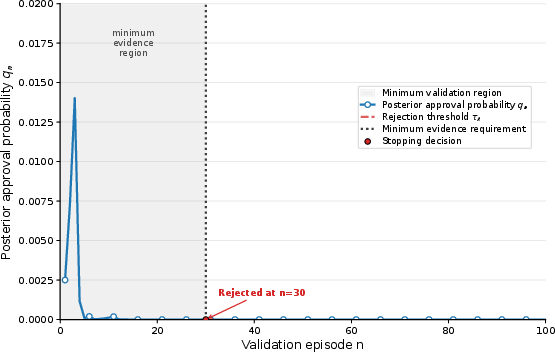
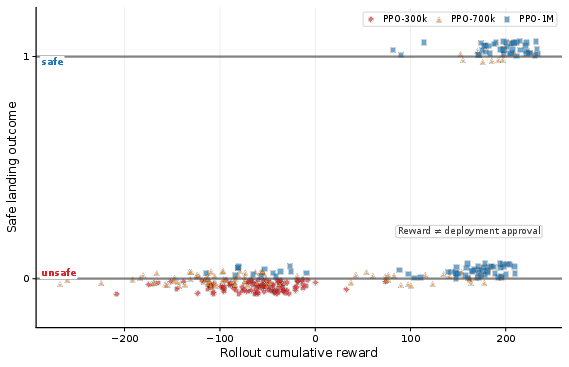
Figure 2: Sequential Bayesian approval probability and reward trajectories during rollout validation, illustrating the rapid decay of posterior approval under negative evidence and the mismatch between reward optimization and deployment readiness.
Empirical Results: Reward-Approval Gap and Finite-Sample Conservatism
Simulation experiments with PPO and SAC landing controllers emphasize the mismatch between empirical reward optimization and calibrated deployment approval. Even as RL training progresses and both reward and empirical safe landing rates improve, the Bayesian approval probability evolves much more conservatively, often staying well below approval thresholds near decision boundaries. This is attributable to the sharpening of posterior uncertainty only with substantial validation evidence, especially under stringent reliability requirements.
The results reveal:
- Early rejections for poor controllers with failed rollouts.
- Controllers with high empirical success rates (e.g., >95%) remaining unapproved due to the width of the posterior under finite sample sizes.
- Non-monotonic and sensitive approval probability fluctuations near the n0 threshold.
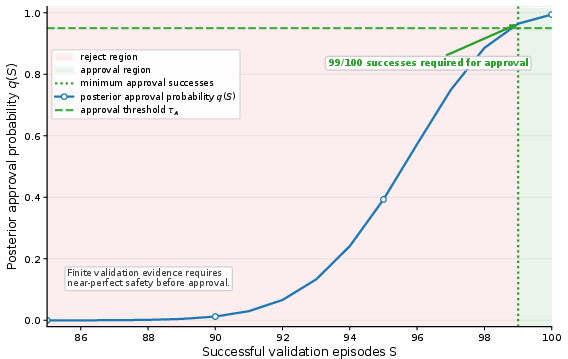
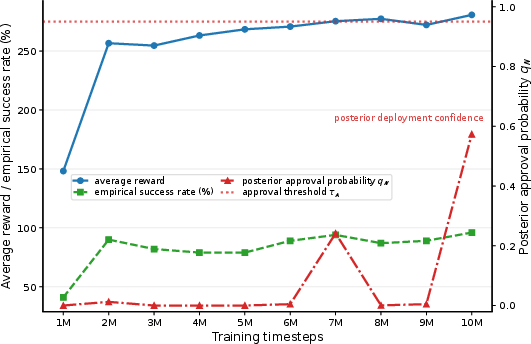
Figure 4: The boundary of Bayesian approval under finite validation evidence, showing that even high empirical success is insufficient for approval due to finite-sample uncertainty, and the conservative evolution of posterior confidence across training checkpoints.
Implications and Theoretical Insights
Formally distinguishing reward optimization from reliability capability is fundamental for the safe deployment of learned controllers in uncertain environments. The Bayesian framework provides:
- A statistically justified connection between RL evaluation and safety-critical deployment needs.
- Explicit recognition of the high bar imposed by rare-event safety requirements—empirical performance alone can be grossly misleading under limited validation data.
- Sequential validation protocols that improve efficiency and risk calibration, yielding practical advantages for safety certification processes in autonomous systems.
Of note, the approach is agnostic to the underlying controller—applicable to RL policies, heuristic, and classical controllers.
Limitations and Future Prospects
The current instantiation applies to a simplified 2D landing domain and presumes independence of rollout conditions. Generalization to high-fidelity simulators, more complex operating distributions (including distributional shift or nonstationarity), and rare-event estimation constitute practical and theoretical frontiers. Extension to broader classes of autonomous systems (robotics, driving), integration with runtime monitoring, and adaptive budget allocation for validation are natural future directions.
On the theoretical side, further work could address:
- Hierarchical Bayesian approval formulations for multi-system deployments.
- Calibration of Bayesian approval probabilities over repeated deployments and external validity in real-world simulators.
- Explicit modeling of distribution shifts to bridge simulation-to-reality (sim-to-real) gaps.
Conclusion
This work establishes that uncertainty-calibrated statistical inference is essential for making deployment decisions regarding learned control systems under finite validation evidence. By dissociating controller learning from deployment approval and adopting a sequential Bayesian framework, the paper illuminates the conservative, data-dependent, and theoretically principled nature of real-world deployment readiness. The implication is clear: future AI deployment, especially for safety- and mission-critical domains, must move beyond empirical performance to formally account for statistical uncertainty through such probabilistic validation frameworks.

