- The paper introduces a Bayesian inferential approach employing temporal evidence accumulation to filter sensor noise and enhance landing site reliability.
- The paper integrates a hard geometric feasibility constraint to ensure that landing sites are physically compatible with the UAV's landing footprint.
- The paper decouples high-level probabilistic decision-making from low-level ORB-based visual servo control to achieve stable and precise UAV landings.
Evidence-Based Probabilistic Landing Site Selection for UAVs
Introduction
The paper "Evidence-Based Landing Site Selection and Vision-Based Landing for UAVs in Unstructured Environments" (2605.01432) addresses the persistent challenge of safe and robust autonomous UAV landing in environments characterized by clutter, unknown layouts, and significant sensor noise. The research presents a probabilistic, evidence-accumulating framework that decouples high-level decision-making under uncertainty from low-level visual servo execution, integrating hard geometric feasibility constraints to ensure collision-free and physically admissible landings.
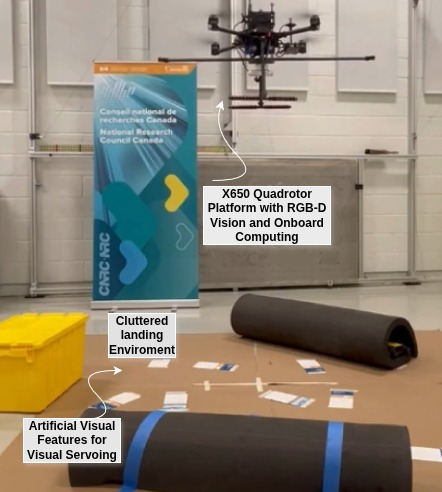
Figure 1: Experimental UAV platform with onboard depth camera and compute for real-time geometric likelihood estimation, temporal belief mapping, and execution using ORB-based visual servoing.
Probabilistic Framework and Temporal Evidence Accumulation
The core innovation is a Bayesian inferential approach to landing site selection. At each timestep, the UAV's depth sensor produces candidate landing regions, each scored via a feature vector comprising surface flatness, slope, and obstacle proximity cues. These cues are individually mapped to likelihoods under both "safe" and "unsafe" latent region hypotheses, and an overall likelihood is constructed as a product of weighted, conditionally independent terms.
Temporal consistency is enforced by recursively updating the posterior belief for each candidate region using a Markov process with persistence parameter α. This approach explicitly distinguishes between static, physically safe sites and transient perception artifacts, suppressing spurious false positives induced by depth sensor noise or egomotion disturbances. The resulting belief map is temporally smoothed compared to instantaneous likelihoods.
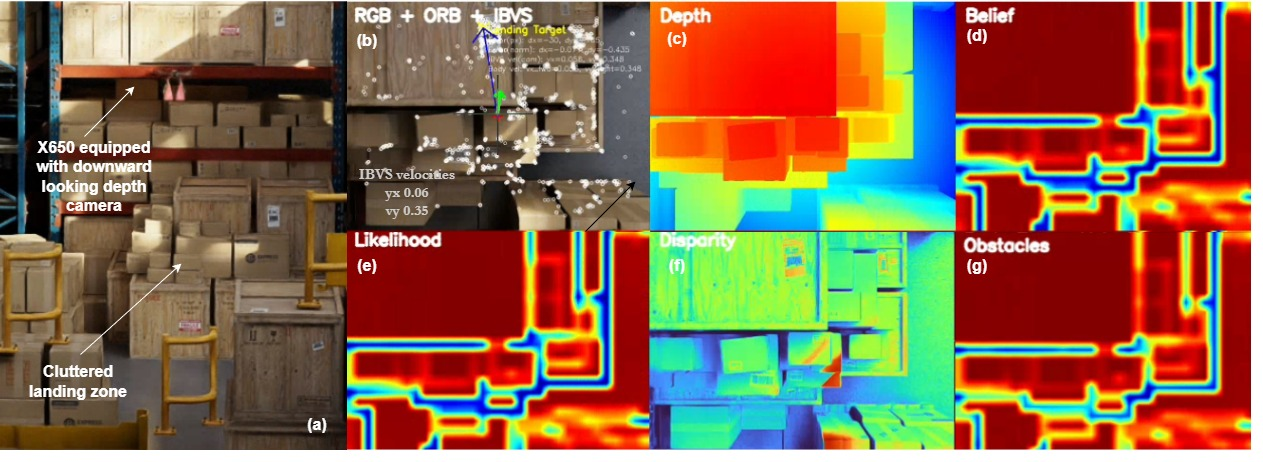
Figure 2: Simulated landing pipeline; cue extraction, belief map formation, and posterior integration in a cluttered warehouse environment, as visualized in Isaac Sim.
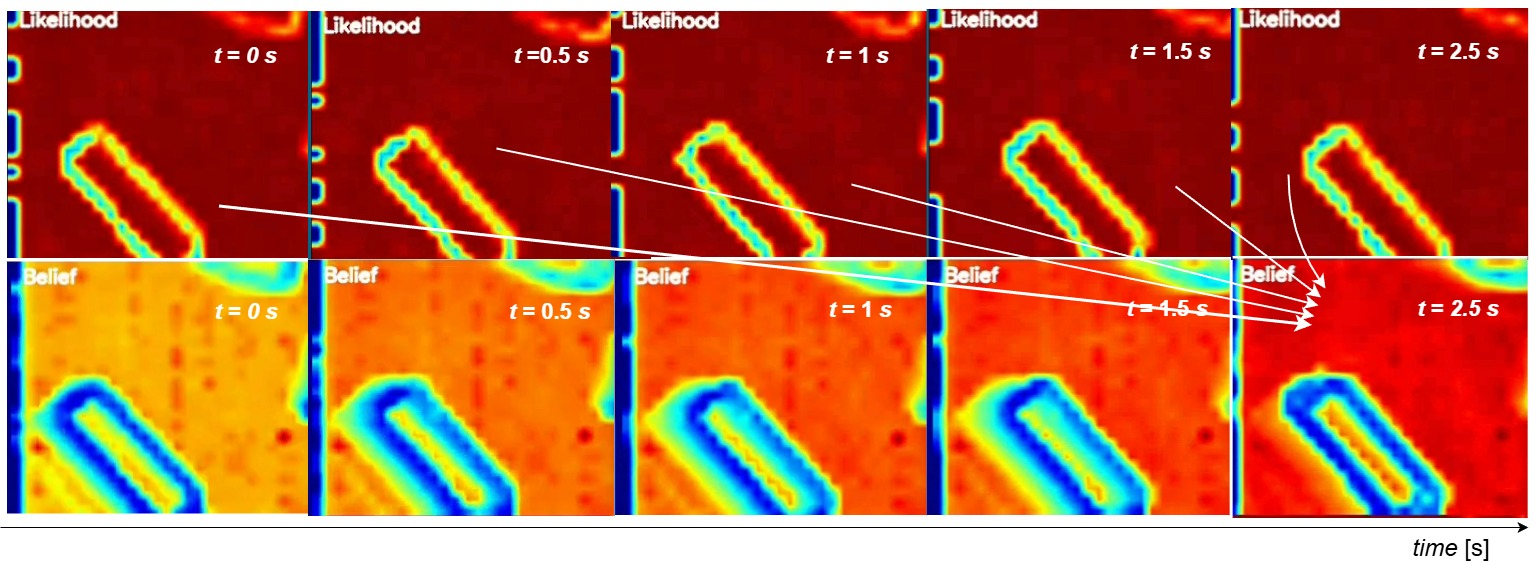
Figure 3: Temporal evolution comparing instantaneous likelihoods (top) and accumulated beliefs (bottom); the latter are less sensitive to sensor noise and offer enhanced stability for site selection.
Geometric Feasibility Constraint
A key flaw in many prior approaches is selection of regions that are visually favorable but physically undersized. This paper introduces a hard constraint based on the maximum inscribed disk radius within candidate regions, computed via Euclidean distance transforms of region masks. The selected site must satisfy a minimum radius threshold, ensuring compatibility with the UAV's landing footprint and safety buffer requirements. Only geometrically admissible regions are considered as MAP candidates in the final site selection.
Decoupled Visual Servo Execution
Once a landing site is probabilistically chosen, the framework transitions to execution by initializing ORB feature tracking and employing image-based visual servoing (IBVS). A centroid of tracked features within the region anchors the control reference, with the UAV's translational velocity controlled via a pseudoinverse-based IBVS law, using local depth estimates. Robustness emerges from decoupling high-level probabilistic reasoning from low-level feedback control, leveraging mature IBVS techniques for stable terminal alignment and smooth descent.
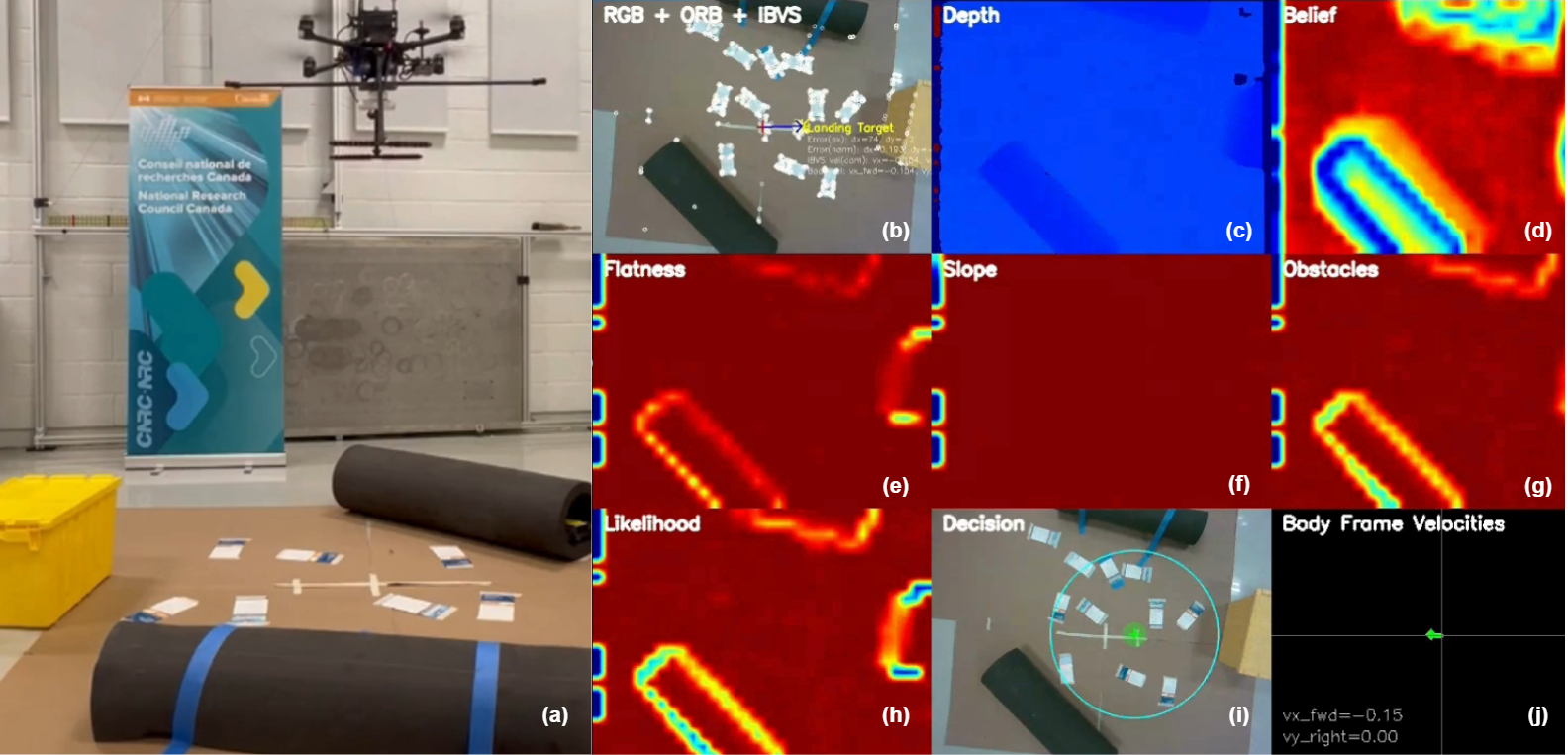
Figure 4: Lab-based trial: RGB scene, cue responses, belief maps, and IBVS velocity commands during descent. Feature centroid and tracking overlays shown.
Experimental Validation
Validation comprises both high-fidelity simulation in NVIDIA Isaac Sim and full-scale hardware tests on a quadrotor platform with onboard Jetson computation. Simulation with randomized clutter demonstrates that instantaneous geometric cues fluctuate rapidly due to sensor artifacts and dynamic changes, yet the temporal belief accumulator yields stable, conservative posterior maps that reliably segment persisting, safe regions from noise.
Figure 4: Laboratory experiment visualizes the end-to-end pipeline from scene perception to cue integration, belief map formation, and execution velocity commands during real-world descent.
Quantitative and qualitative results from laboratory tests corroborate the simulation findings:
- Transient geometric artifacts from sensor noise and motion are robustly filtered out by Bayesian evidence accumulation, providing consistent landing site inference.
- The hard geometric feasibility constraint systematically rejects regions smaller than the UAV's landing gear footprint, directly preventing physically infeasible descent maneuvers.
- IBVS-based execution delivers smooth, bounded lateral/vertical velocity profiles, with successful and precise landings confirmed across diverse experimental scenarios.
Parameter settings (belief thresholds, cue weights, IBVS gain, minimum radius) are empirically validated and remain robust to scene variation; obstacle proximity weighting is critical in avoiding landings adjacent to clutter.
Discussion and Implications
This work establishes a methodologically rigorous, probabilistically principled approach to landing site selection in the presence of noisy, unreliable perception. Notably, it challenges the sufficiency of frame-wise or cost-map approaches, underscoring the necessity of temporal reasoning and explicit geometric validation. The paper's numerical evidence demonstrates improved stability and safety, a crucial result for deployment in safety-critical or unknown indoor and urban settings.
The practical implications are significant for autonomous landing in inspection, logistics, and search-and-rescue domains. Theoretically, the framework can be generalized to other decision-making tasks under spatial uncertainty with physical constraints.
Future Directions
Several avenues are highlighted for advancement:
- Integration of learned or self-adaptive visual cues in place of hand-crafted geometric features, to further increase robustness to domain shifts.
- Context-aware adaptation of belief update parameters using meta- or reinforcement learning, allowing dynamic tuning in response to environmental non-stationarity.
- Closed-loop robustness to wind disturbances and dynamic objects, potentially by embedding adversarial or robust control modules.
- Real-world outdoor and highly dynamic validation to extend reliability claims beyond laboratory and simulation.
Conclusion
The evidence-based probabilistic framework presented provides a robust solution for UAV autonomous landing in unstructured, cluttered environments. The explicit modeling of perceptual uncertainty, enforcement of hard physical constraints, and decoupled visual servo execution yield conservative, reliable site selection and stable descent. The approach is validated through rigorous simulation and experimental data, sets a methodological precedent for probabilistic robotics under environmental uncertainty, and highlights promising directions for integrating learning-driven perception with model-based inference for future autonomous aerial systems.

