- The paper presents a novel framework using RCWA and a generalized Hopfield model to transition from multimode strong coupling to the superstrong coupling regime with exciton-tunable phase control.
- The paper shows that confining the active material to a fractional waveguide region breaks modal orthogonality, enabling nontrivial overlaps and precise control of polariton dispersion.
- The paper validates its theoretical predictions with simulations that reveal compact phase modulation and modal switching devices for integrated, room-temperature optical architectures.
Exciton-Tunable Phase Control and Superstrong Coupling in Planar Waveguide Multimode Polaritonics
Overview and Motivation
The manuscript "Exciton-Tunable Phase Control and Superstrong Coupling Through Multimode Polariton Engineering in Planar Waveguides" (2605.27714) systematically analyzes multimode exciton–photon coupling in planar visible-range semiconductor waveguides. Leveraging rigorous coupled-wave analysis (RCWA) and a generalized Hopfield model, the work elucidates the transition from conventional multimode strong coupling to the superstrong coupling (SSC) regime, where Rabi splittings approach intermodal spacings and individual polariton branches hybridize multiple photonic modes. By confining the active material to a subregion of the waveguide, the authors break modal orthogonality, enabling non-trivial overlaps and tunable multimode polariton dispersions.
The practical implications are substantial: small exciton resonance shifts induce strong propagation constant modulations in polaritonic branches, facilitating compact phase and intensity control elements for integrated optical architectures. This is further explored through two device schemes—interferometric phase modulation in the strong coupling regime and exciton-tunable modal switching in the SSC regime.
The study contrasts polariton platforms—microcavities, metasurfaces, and planar waveguides—highlighting their respective suitability for SSC based on mode overlap and tunable mode spacing. Waveguides are positioned as optimal due to facile engineering of high overlap and low energy separation among low-order modes without prohibitive fabrication constraints.
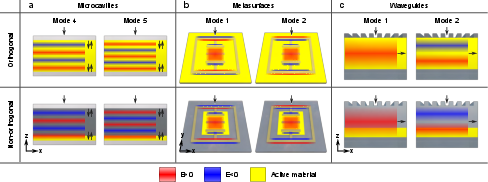
Figure 1: Modal overlap and energy spacing characteristics in microcavities, metasurfaces, and waveguides, with partial filling enabling multimodal contributions in polariton modes.
Theoretical Framework and Modal Overlap Engineering
SSC demands hybridization beyond the "2N" model, requiring nonzero overlap ηjk between electric field profiles within the active region. When the active material fills only a fraction of the waveguide, polarization distributions become non-orthogonal, enabling coherent coupling via degenerate excitonic states. The generalized Hopfield Hamiltonian captures this overlapping multimode coupling regime, quantifying the physical exciton composition in each polariton branch.
Optimization of overlap and coupling strength reveals a critical trade-off: maximal overlap is achievable with thin active layers near the waveguide boundary, but coupling strength diminishes in this configuration. Therefore, a fractional filling strategy (e.g., Δz/D=0.3) is adopted to balance these metrics for device applications.
Waveguide Design and SSC Transition
Prototypical structures are engineered with varying thickness (200 nm, 400 nm, 600 nm cores), systematically tuning mode spacing from multimode strong coupling to SSC. The mode energy separation ΔEPh,jk is shown to be weakly dependent on mode order—distinct from cavity architectures—enabling SSC with low-order modes.
Simulations with RCWA confirm the analytic predictions, with fitted Hopfield coefficients demonstrating negligible S-shaped energy gaps (as low as 3 meV) relative to exciton linewidth, a hallmark of the SSC regime.
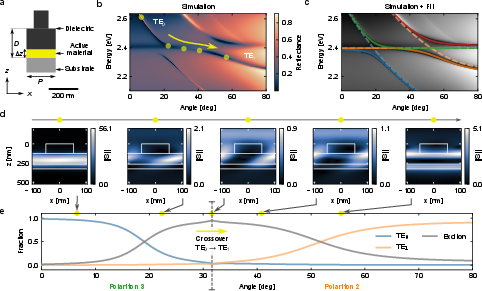
Figure 2: High modal overlap and multimode strong coupling dispersion in a thin (200 nm) waveguide, showing continuous crossover in dominant photonic mode.
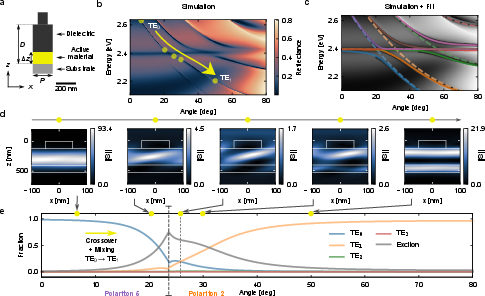
Figure 3: SSC regime in a mid-thickness (400 nm) waveguide with hybridization of TE0 and TE1 modes and pronounced S-shaped branch dispersion.
Comprehensive parametric sweeps further validate the model, revealing that for a given desired overlap (ηjk), coupling strengths are maximized for lowest-order mode pairs due to reduced cancellation in their spatial overlap integrals.
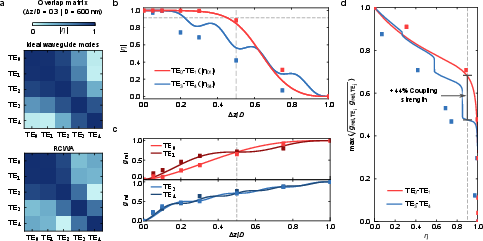
Figure 4: Relationship between active layer fraction, modal overlap, and achievable coupling strength for low vs. high-order modes.
Device Applications
Phase Modulation via Multimode Interference
In the multimode strong coupling regime, two polariton branches can be co-excited at a fixed energy, accumulating a tunable phase difference ΔΦex as the exciton energy shifts. The mechanism exploits distinct sensitivities of wavevector (β) to Eex stemming from differing Hopfield exciton fractions and group velocities. This allows compact ($14$–Δz/D=0.30m) Δz/D=0.31 phase shift interferometers for sub-10 meV exciton shifts, outperforming conventional electro-optic and thermo-optic modulators in speed and alignment constraints.
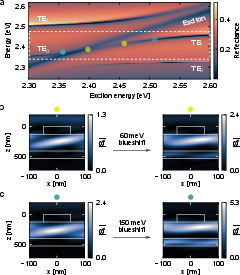
Figure 5: Exciton-controlled wavevector tuning and phase modulation in a low-thickness waveguide.
Modal Switching and Real-Space Field Shaping
The SSC regime enables a continuous transition between hybrid modal states, with the electromagnetic mode profile tunable by the exciton energy. The device functions as a beamsplitter in modal space, capable of arbitrary qubit encoding in single-photon applications, and facilitates real-space field reshaping for nonlinear optics or on-chip quantum state preparation. Modal switching requires larger exciton shifts (60–150 meV), but further geometrical optimization can reduce this requirement.
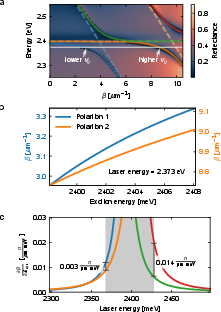
Figure 6: Exciton-tunable crossover from Δz/D=0.32-like to Δz/D=0.33-like polariton modes in a mid-thickness waveguide.
Implications and Prospects
The demonstrated multimodal engineering in planar waveguides sets a new standard for SSC at visible wavelengths and room temperature, with clear superiority over microcavity and metasurface configurations in both mode selectivity and device fabrication. Theoretical analysis is corroborated by quantitative RCWA simulations with realistic perovskite parameters, confirming high overlap and robust polariton dispersion control.
The practical impact extends to ultrafast, all-optical modulators, mode switches, and quantum photonic elements tightly integrated with existing on-chip architectures. The flexibility in modal engineering suggests broad applicability to other excitonic materials (TMDs, organic dyes), polarization diversity, and hybrid photonic-plasmonic systems.
Conclusion
This study provides a rigorous multimodal polariton engineering framework for planar waveguides, establishing both the theoretical foundation and numerical validation for SSC between low-order modes. By manipulating the spatial overlap of active materials and leveraging waveguide thickness as a tuning parameter, the authors demonstrate compact phase modulation and mode switching devices driven by modest exciton shifts. The work advances integrated polaritonics, presenting a scalable route for translating SSC physics into high-performance, room-temperature photonic systems.