- The paper presents a novel design in perovskite waveguides that forms nearly flat defect bands to support slow-light polaritonic modes.
- It leverages exciton-polariton strong coupling and structural dispersion engineering to achieve a more than 20× enhancement in the nonlinear optical phase shift.
- The results offer a scalable platform for integrated nonlinear photonics, with promising applications in quantum photonic circuits and all-optical logic.
Strongly Nonlinear Slow Light Polaritons in Subwavelength Modulated Waveguides
Introduction
This work presents a theoretical and computational study of nonlinear polaritonic slow-light in subwavelength-modulated dielectric waveguides based on perovskite materials (2603.29776). The central objective is to leverage structural dispersion engineering to achieve strong light-matter interaction in a scalable integrated photonic platform, especially enhancing the nonlinear optical phase shift at few-photon levels. The approach combines exciton-polariton physics with tailored photonic band structure, demonstrating that the synergy of slow-light modes and strong coupling yields a significant enhancement of nonlinear effects compared to conventional waveguides.
Structural Engineering for Slow-Light Regime
The device under consideration is a perovskite-based waveguide in which the guiding layer is subject to a corrugated modulation, periodically repeated to form a superlattice containing engineered defects. Each defect per supercell induces localized photonic modes within the bandgap, enabling a highly controllable flat-band regime with reduced group velocity and group velocity dispersion. The structure's design and effective refractive index engineering are performed using the effective index method and admittance plane wave techniques, facilitating tractable numerical solutions of the otherwise intractable three-dimensional Maxwell eigenproblem.
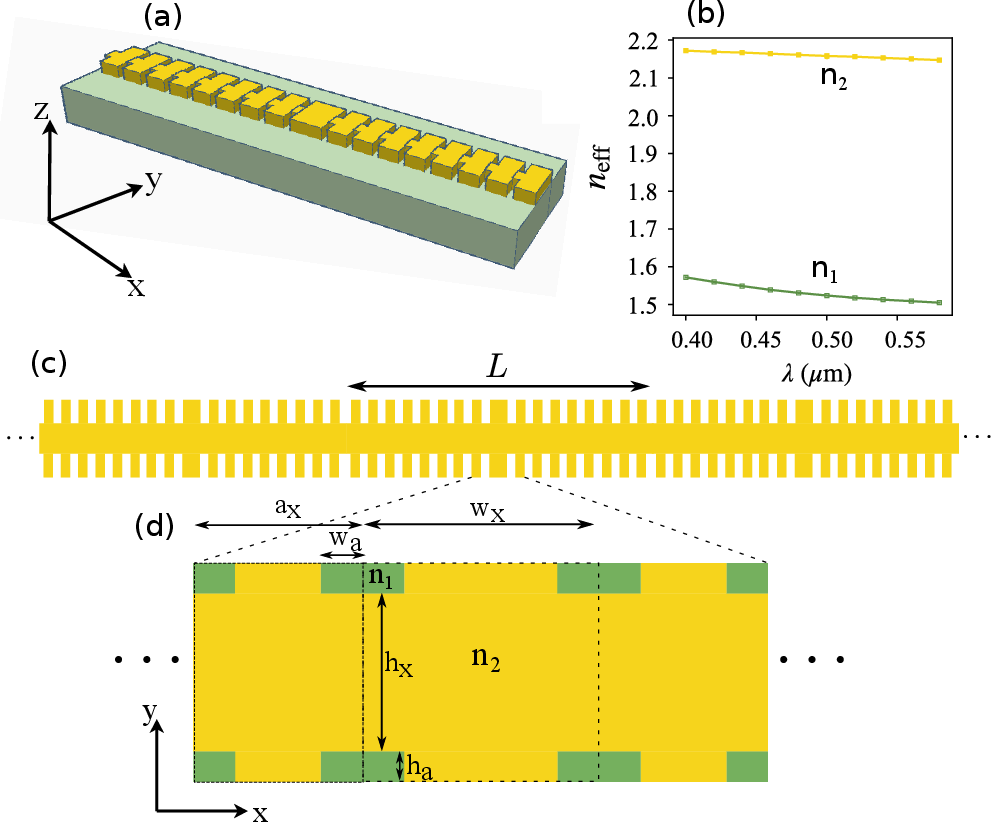
Figure 1: Corrugated perovskite waveguide design showing the formation of a defect-containing superlattice enabling slow-light polaritonic modes.
When the geometry is simulated, the periodic corrugation produces a well-defined photonic bandgap, as shown by the frequency-wavevector dispersion. Introduction of a defect breaks the perfect periodicity, resulting in a defect band with nearly zero group velocity and low group velocity dispersion over a substantial bandwidth.
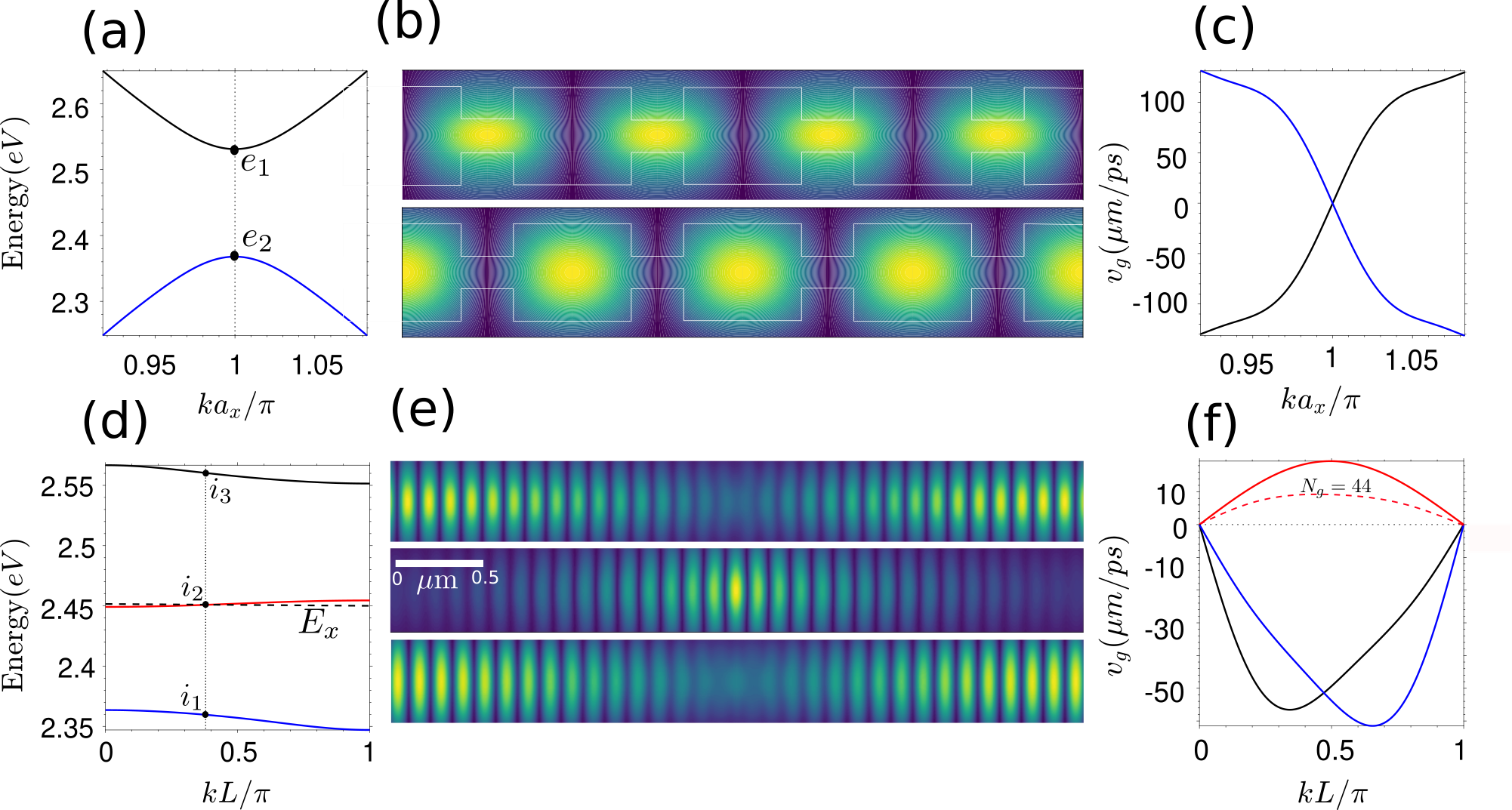
Figure 2: Photonic dispersion and electric field profiles in periodic and defect-engineered superlattice geometries; the nearly flat gap band characterizes the slow-light regime.
The crucial result is the formation of a nearly-flat photonic defect band that is spatially localized near the designed defects. This band can be tuned to spatially and spectrally overlap with the Wannier exciton resonance of the perovskite material, optimizing the conditions for strong light-matter coupling to form slow-light exciton-polaritons.
Nonlinear Enhancement via Exciton-Polariton Strong Coupling
The slow-light defect band serves as the photonic component for hybridization with semiconductor excitons, forming exciton-polaritons in the strong coupling regime. The coupled system is modeled with a Heisenberg-Langevin formalism for coupled photon and exciton fields, explicitly including Kerr and phase-space filling nonlinearities, and realistic loss channels. The key control parameter is the ratio of the group velocity to the phase velocity, which determines the local compression of the pulse and thus the enhancement of the local field intensity and the effective interaction time.
The main figure of merit is the nonlinear phase shift accumulated by a polariton pulse propagating in this regime. Direct simulations show that a Gaussian wavepacket injected into the flat defect band experiences both spatial compression and substantial enhancement of the nonlinear phase shift compared to fast-light propagation in the fundamental mode.
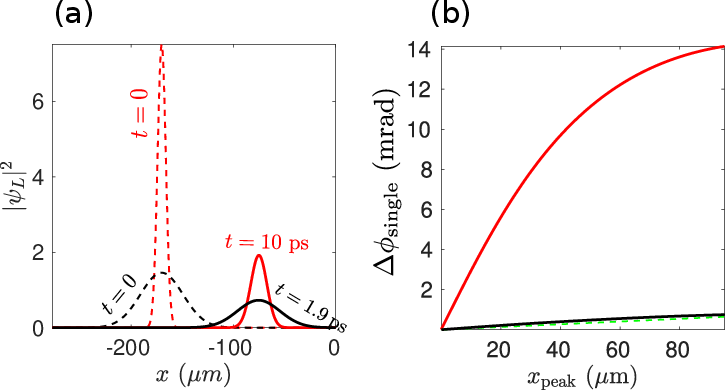
Figure 3: (a) Temporal evolution of slow-light and fast-light polariton wavepackets showing spatial compression and delay; (b) corresponding nonlinear phase shifts, emphasizing the more than 20× enhancement for the slow-light gap band.
Quantitative analysis demonstrates that the slow-light polariton regime yields a nonlinear phase shift enhancement exceeding 20× with respect to the standard waveguide. This is achieved despite the relatively moderate third-order nonlinearity of perovskites, as the enhancement is primarily structural in origin rather than intrinsic to the material's χ(3).
Implications and Future Directions
Practically, the findings show that current perovskite platforms—which are compatible with room temperature operation and existing nanofabrication technologies—can be harnessed for scalable, integrated nonlinear photonics in the few-photon regime. The device concept circumvents two major limitations of existing nonlinear photonic systems: the small intrinsic nonlinearity of integrated materials, and the short photon-matter interaction time due to high group velocity. Furthermore, the slow-light defect band is less susceptible to disorder-induced localization compared to bound states in the continuum, offering enhanced robustness.
Theoretically, the approach can be generalized to other hybrid photonic systems and is compatible with additional enhancements via further dimensional or material confinement, as well as integration with quantum emitter arrays. While perovskites are highlighted for their ease of integration and excitonic properties, the method is not restricted to a particular material system and can potentially be leveraged in III-V or II-VI semiconductor platforms with higher nonlinear coefficients. GaAs-based materials may enable even larger nonlinear phase shifts if large superlattice periods are employed, as discussed in the supplementary materials.
Potential applications include deterministic photon-photon gates, scalable all-optical logic, quantum information processing, and quantum machine learning hardware. The moderate nonlinear phase shifts demonstrated (on the order of tens of milliradians per photon) are already suitable for functional quantum photonic architectures, including photonic quantum computing based on moderate nonlinearity [PhysRevApplied.15.054054].
Conclusion
This study provides a rigorous blueprint for engineering giant nonlinear optical phase shifts in integrated photonic platforms, capitalizing on the interplay of strong light-matter coupling and slow-light photonic modes. Structural dispersion engineering in perovskite superlattice waveguides enables dramatic enhancement of polaritonic nonlinearities in scalable, room-temperature-compatible devices. These results have immediate relevance for the advancement of photonic quantum technologies and nonlinear optical information processing, and suggest broad avenues for future material, structural, and functional optimization.