- The paper demonstrates that QSCI accurately reproduces active-space binding energies on quantum hardware, matching classical CASCI results within tight numerical precision.
- It integrates machine-learning potentials and counterpoise-corrected coupled-cluster methods to optimize molecular geometries and benchmark hydrogen-bond interactions in a pyridine-phenol complex.
- The study reveals that noise-induced broadening enhances active-space sampling, paving the way for scalable quantum molecular modeling in asphalt binder chemistry.
Quantum-Centric Calculation of Additive Binding Energies in Asphalt: Deployment of QSCI on Quantum Hardware
Introduction
This work introduces QuantumPave, a fully quantum-centric workflow for computing additive binding energies in asphalt binder, leveraging quantum-selected configuration interaction (QSCI) on superconducting quantum hardware. The methodology addresses oxidative ageing of road infrastructure, employing a pyridine-phenol hydrogen-bonded complex as a proxy for critical interactions within asphalt matrices. The workflow integrates machine-learning interatomic potentials, classical correlated references, and quantum algorithms, and demonstrates precise reproduction of active-space electronic energies on the IQM Emerald quantum processor. This essay details the technical innovations, numerical results, and implications for scalable quantum molecular modeling.
System Selection and Molecular Modeling
The pyridine-phenol complex (C11H11NO, 24 atoms) is selected for its experimental relevance, robust hydrogen-bonding motif, and computational feasibility. Its molecular topology mirrors dominant oxygen- and nitrogen-bearing functionalities found in asphalt binder, and its non-covalent binding character provides a stringent test for correlated electronic structure methods.
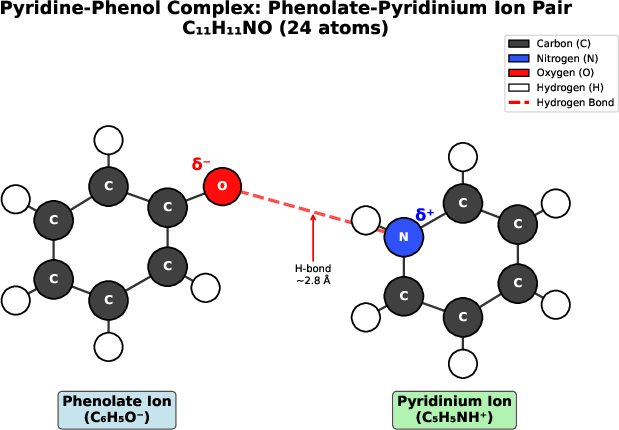
Figure 1: Molecular structure of the pyridine-phenol complex, highlighting the central O-H⋯N hydrogen bond responsible for additive binding.
Comprehensive geometry optimization is performed using ORB v3, a conservative, dispersion-corrected machine-learning potential trained on extensive ab initio datasets. The ORB v3 calculations accelerate structural relaxation and emulation of energies, supporting downstream quantum protocol preparation.
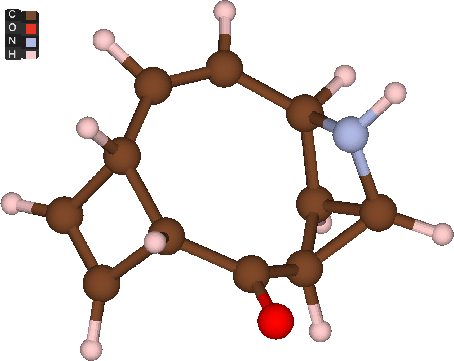
Figure 2: Three-dimensional visualization of the optimised pyridine-phenol complex, with explicit rendering of the hydrogen bonding and relevant spatial dimensions.
Computational Methodologies
Classical Reference Methods
The electronic interaction benchmark is established using counterpoise-corrected coupled-cluster theory, CCSD(T), within the def2-SVP and def2-TZVP basis sets on the LUMI HPC platform. Density functional theory (B3LYP/6-31+G(d)) and dispersion corrections (D3, D4) provide complementary reference values. These classical approaches capture dynamic correlation and dispersion essential for accurate binding energies.
Machine-Learning Potentials
ORB v3 is assessed for rapid binding energy estimation, suitable for high-throughput molecular screening. Recent benchmarks substantiate its near-ab initio accuracy when fine-tuned for relevant chemical architectures.
Quantum-Selected Configuration Interaction (QSCI)
The central technique, QSCI, operates by sampling dominant configuration bitstrings from a quantum processor in a (10e, 10o) active space, followed by classical diagonalisation. The configuration sampling employs self-consistent recovery to maintain particle-number symmetry, and includes noise broadening inherent to hardware runs. The active space is constructed via automated frozen core analysis, isolating valence orbitals associated with the binding interactions.
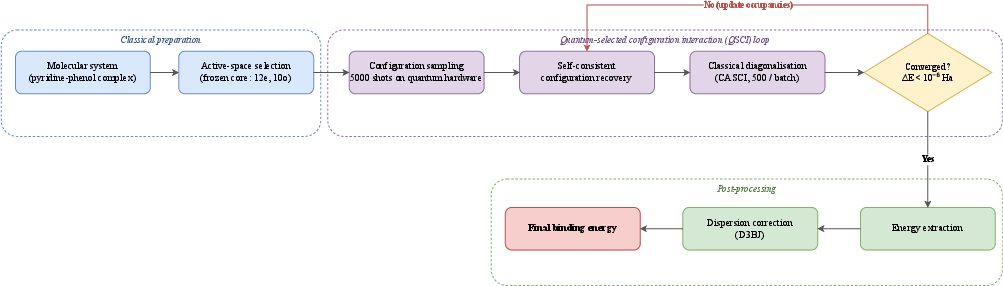
Figure 3: QSCI workflow detailing active space construction, quantum sampling, configuration recovery, and final energy convergence.
Numerical Results and Technical Achievements
The QSCI approach—implemented on the 54-qubit IQM Emerald processor—yields an active-space binding energy of -3.52 kcal/mol (−0.153 eV), reproducing the classical CASCI reference to numerical precision (agreement within 6×10⁻⁸ Ha). Device noise serves as a constructive broadening mechanism; the quantum processor's sampling fully spans the active space, eliminating the need for zero-noise extrapolation and ensuring robust convergence.
Classical gold-standard calculations report strongly binding energies: CCSD(T)/def2-SVP yields -8.53 kcal/mol; focal-point def2-TZVP calculations reach -9.51 kcal/mol. B3LYP/6-31+G(d) values are consistent at -9.08 kcal/mol. Experimental calorimetry for the hydrogen-bonded complex in CCl4 gives −6.2 to −6.3 kcal/mol, with zero-point and solvent corrections accounting for the remaining discrepancy.
Key outcomes:
- QSCI-SQD on hardware yields identical energy to classical CASCI reference, confirming the methodology's numerical accuracy in active space.
- Active-space limitation causes underbinding relative to CCSD(T) and experiment, not device or sampling error.
- No empirical dispersion correction is added to the QSCI result; dynamic correlation and dispersion are instead isolated in the classical reference.
Methodological Implications and Advances
QSCI shows distinct advantages for quantum chemistry:
- Systematic improvability: Expanding the correlated active space via qubit-efficient formulations (e.g., half-qubit QSCI (McFarthing et al., 1 Feb 2026), Hamiltonian simulation-based QSCI [D5CP02202A]) and embedding protocols (density matrix embedding (Patra et al., 27 Nov 2025)) allow scalable treatment of condensed-phase environments and larger molecular matrices.
- Hardware-robustness: Sampling noise enhances active-space coverage rather than degrading accuracy, marking QSCI's suitability for NISQ platforms and anticipated megaquop era devices.
The workflow's open-source implementation and explicit calibration of circuit layouts (20 qubits per molecule) facilitate future benchmarking and rapid methodological extension.
Technical Challenges and Optimization
Automated active space selection and frozen core identification require precise orbital analysis to target binding-relevant electrons, impacting both accuracy and resource allocation. Sampling convergence necessitates refined shot/batch optimization (5000 shots per molecule), maintaining energy tolerance at 10−6 Ha. Dispersion is treated exclusively in the classical gold-standard tier to avoid empirical correction bias. Charge-dependent D4 corrections improve DFT cross-checks for non-covalent assemblies.
Implications for Asphalt Binder Chemistry and Materials Science
The successful deployment of QSCI for additive binding energies in asphalt demonstrates real-world feasibility for quantum-centric supercomputing in industrial molecular modeling. Quantitative predictions of interaction energies underpin modelling of oxidative ageing mechanisms and enable rational additive selection. Systematic expansion of active spaces and embedding into realistic asphalt matrices are direct future directions, with quantum-classical hybrid architectures poised to address larger, more complex systems.
Conclusion
QuantumPave represents a significant technical advancement for quantum chemistry in materials informatics, achieving noise-robust, numerically exact binding energies in the active space on real quantum hardware. The implication is that quantum-centric workflows, leveraging QSCI and systematic active space expansions, are immediately applicable to molecular recognition problems central to materials science, catalysis, and beyond. Future efforts to expand active space coverage and embed molecular complexes in realistic condensed-phase environments will directly impact the precision and universality of quantum molecular modeling.
Code Availability
The complete QSCI/SQD workflow for binding energies on IQM Emerald is open source and accessible at https://github.com/MarcMaussner/2026_iqm_handsOn/tree/main.