- The paper constructs stationary generalizations of vacuum ring wormholes that exhibit dual slow- and fast-rotation branches and mimic extremal Kerr solutions.
- Numerical and analytic solutions of the Ernst equations reveal critical thresholds and bifurcations in mass and angular momentum.
- Introducing a phantom scalar field removes singularities, yielding globally regular, traversable geometries that challenge traditional energy conditions.
Stationary Generalizations for the Vacuum Ring Wormhole: Structure, Properties, and Kerr Mimicry
Background and Motivation
Vacuum ring wormholes represent the zero-mass limit of the Kerr metric, yielding locally flat spacetimes with nontrivial topology: two Minkowski regions connected via a throat encircled by a singularity (a conical defect with negative tension). Unlike conventional traversable wormholes, which require exotic matter and violate the Null Energy Condition (NEC), these solutions manifest solely from geometric/topological effects and distributional curvature sources. The paper systematically constructs stationary generalizations—rotating solutions different from the standard Kerr metric, but invariant under reflection across the wormhole throat.
This approach leverages the symmetry of the throat, departing from the Kerr metric’s asymmetry (M→−M swaps exterior regions but reverses mass sign), aiming for solutions with identical ADM mass and opposite angular momentum viewed from either side. The construction is ultimately reduced to solving the vacuum Ernst equations with these symmetry and asymptotic flatness conditions.
Construction of Stationary Ring Wormhole Solutions
Stationary generalizations are developed both numerically and via symmetry-adapted coordinate systems (spheroidal coordinates x,y), representing the ring radius and throat geometry adequately. The vacuum Einstein equations admit reduction to two coupled PDEs in V (gravitational potential) and W (rotation field), supplemented by boundary conditions encoding reflection (x→−x) and asymptotic flatness. The axial symmetry and smoothness at the throat enforce V symmetric, W antisymmetric; discontinuities at the throat are patched via rotating frames, ensuring physically consistent angular momentum signs.
Slow rotation yields a relation M∼J2—mirroring Newtonian rigid body rotation—while fast rotation transitions into the Regge relation J=M2, characteristic of highly spinning relativistic objects.
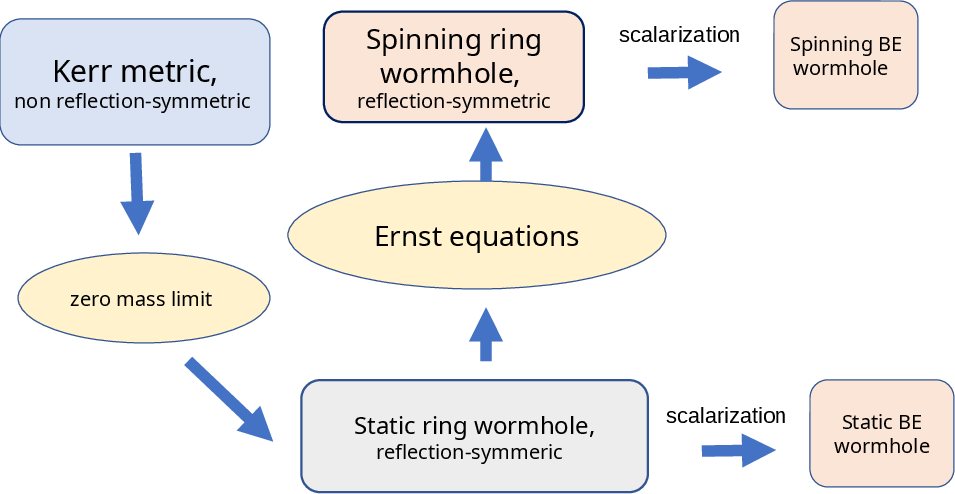
Figure 1: Schematic relationships among Kerr, static ring wormhole, their stationary generalizations, and scalarized solutions.
Numerical Results and Branch Structure
Numerical resolution of the Ernst equations elucidates the bifurcation into slow-rotation and fast-rotation branches for given throat angular velocity W0. The mass and angular momentum diverge in the fast-rotation limit if the static ring radius is held fixed; however, a simultaneous scaling of the ring size parameter x,y0 as x,y1 preserves finiteness, yielding a wormhole geometry with properties closely mimicking the extremal Kerr black hole.
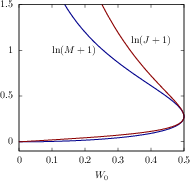
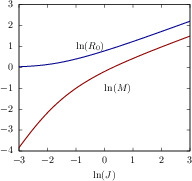
Figure 2: Mass and angular momentum as functions of throat angular velocity, and throat radius/mass versus angular momentum, illustrating dual branches.
Key numerical findings:
- Two solution branches for each x,y2: rapidly and slowly rotating.
- Critical values x,y3 at branch merger.
- For fixed x,y4, x,y5 and x,y6 diverge as x,y7; for x,y8, they remain finite.
- The wormhole approaches the extremal Kerr solution in the x,y9 limit, confirmed by matching metric profiles.
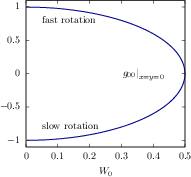
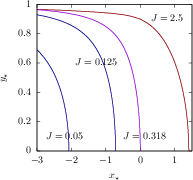
Figure 3: Comparison of V0 and V1 for spinning wormhole and extremal Kerr; near-identical profiles for V2.
Regularization via Scalarization
Vacuum ring wormholes carry a curvature singularity at the ring, manifesting as a negative tension cosmic string. A simple scalarization, introducing a phantom scalar field, removes this singularity. The scalar field modifies the V3-amplitude (conformal factor) such that the singularity vanishes when the integration constant matches the tension parameter. The resulting scalar-dressed solution (Bronnikov-Ellis type) is globally regular, maintains the same ADM mass and angular momentum, but is sourced by a phantom field rather than a curvature defect.
Geometrical and Embedding Properties
Throat geometry metrics enable the determination of equatorial radius (V4), polar radius (V5), and average radius (V6), both for vacuum and scalarized cases. Rotating wormholes become increasingly oblate, with V7 and V8 decreasing as V9 increases, approaching values akin to the extremal Kerr horizon.
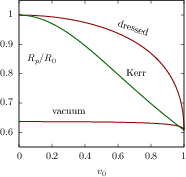
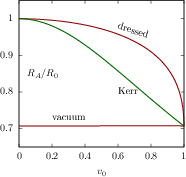
Figure 4: Isometric embeddings of wormhole throats for vacuum and scalar-dressed solutions; solid curves denote Euclidean embedding, dashed curves denote embedding in pseudo-Euclidean space.
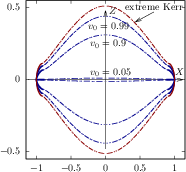
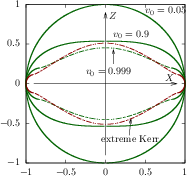
Figure 5: Isometric embeddings of equatorial sections, tracking deformation from disk or catenoid toward cylinder in extremal limit.
For fast rotation, the wormhole throat embedding exhibits mixed hyperbolic/spherical regions, matching the embedding of extremal Kerr horizons (see Smarr analysis).
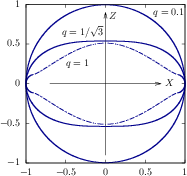
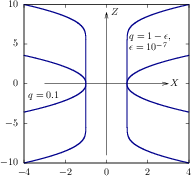
Figure 6: Embeddings of Kerr event horizon and equatorial section for varying angular momentum; extremal limit approaches cylinder geometry.
Theoretical and Practical Implications
The existence of traversable vacuum wormholes with rotating generalizations, constructed without exotic matter but supported by curvature defects, expands the landscape of allowable configurations in General Relativity. The transition to extremal Kerr mimicry introduces the possibility of wormholes as analogs of black hole exteriors, indistinguishable from Kerr to distant observers. However, the presence of singularities in the vacuum case—distributional or volumetric—is a core theoretical constraint, motivating scalarization for global regularity.
These results have implications for:
- Distinguishing wormholes and black holes observationally (especially in extremal regimes).
- The stability and geometric completeness of such solutions (black hole interiors are not accessible via symmetric reflection; wormholes are).
- Multipole structure and measurements (mass, angular momentum, quadrupole moment).
- Numerical and analytic solution generation strategies for axially symmetric spacetimes.
The work also suggests future directions for analytic solution generation (inverse scattering, soliton methods), stability analysis, and possible quantum implications for rapidly rotating, Planck-scale rings.
Conclusion
Stationary vacuum ring wormholes constitute a distinct, physically reasonable family of spacetimes, connecting two Minkowski regions via a rotating throat encircled by a negative tension ring. The stationary generalizations—symmetric under reflection and constructed by solving the vacuum Ernst equations—exhibit both slow-rotation and fast-rotation branches, with scaling limits in which wormhole geometry approaches the extremal Kerr solution. Scalarization removes singularities, yielding globally regular traversable wormholes. Such configurations, backed by rigorous numerical and geometric analysis, provide insight into the interplay between topology, symmetry, and rotation in General Relativity, challenging the necessity of exotic matter for traversability and uncovering new dualities with black hole physics.