- The paper shows that leveraging data from 66 diseases improves infectious disease forecasting, reducing MAE in most cases.
- The study compares GBM, LSTM, and MOA models across diverse data regimes, highlighting both benefits and limitations.
- The paper underlines the importance of careful auxiliary data selection to avoid negative transfer, especially in high-entropy scenarios.
Transfer Learning Across 66 Diseases for Robust Infectious Disease Forecasting
Background and Motivation
Traditional infectious disease forecasting systems are frequently circumscribed by reliance on single data streams, resulting in heightened brittleness when faced with short, noisy, or otherwise limited temporal histories. Recent advances, typified by models such as Flusion, have substantiated the benefit of synthesizing multiple reporting systems for influenza forecasting. However, the extension to cross-pathogen transfer learning, where a forecasting model leverages data from one disease to predict another, remains underexplored at scale. The paper "Transfer Learning using 66 Diseases for Disease Forecasting Applications" (2605.27269) constructs an extensive corpus comprising 66 diseases (76 counting subtypes) harvested from 13 distinct data sources. By systematically evaluating forecasting models on 20 highly diverse disease time series streams, the authors illuminate both the prospects and pitfalls of generalized transfer learning within infectious disease forecasting.
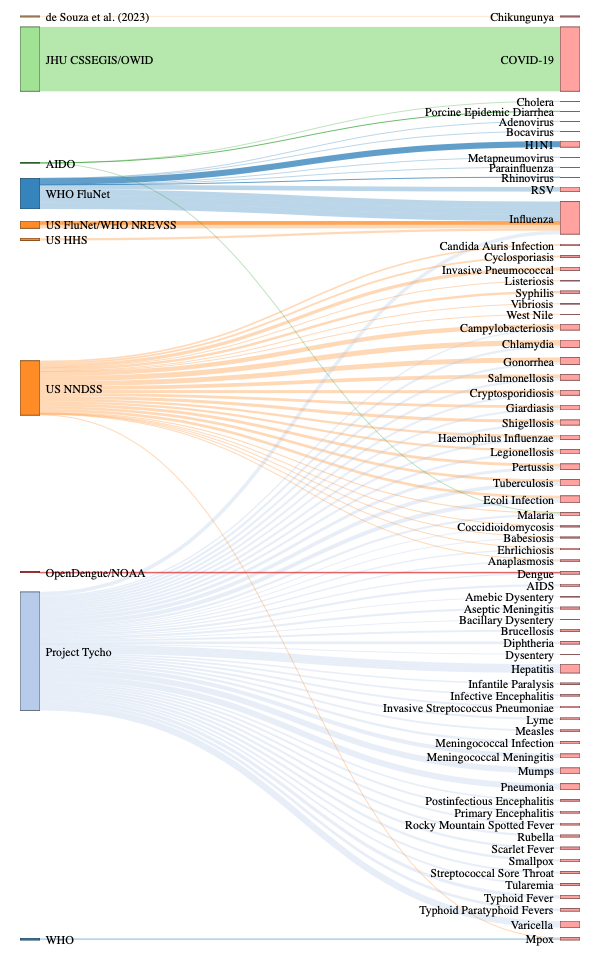
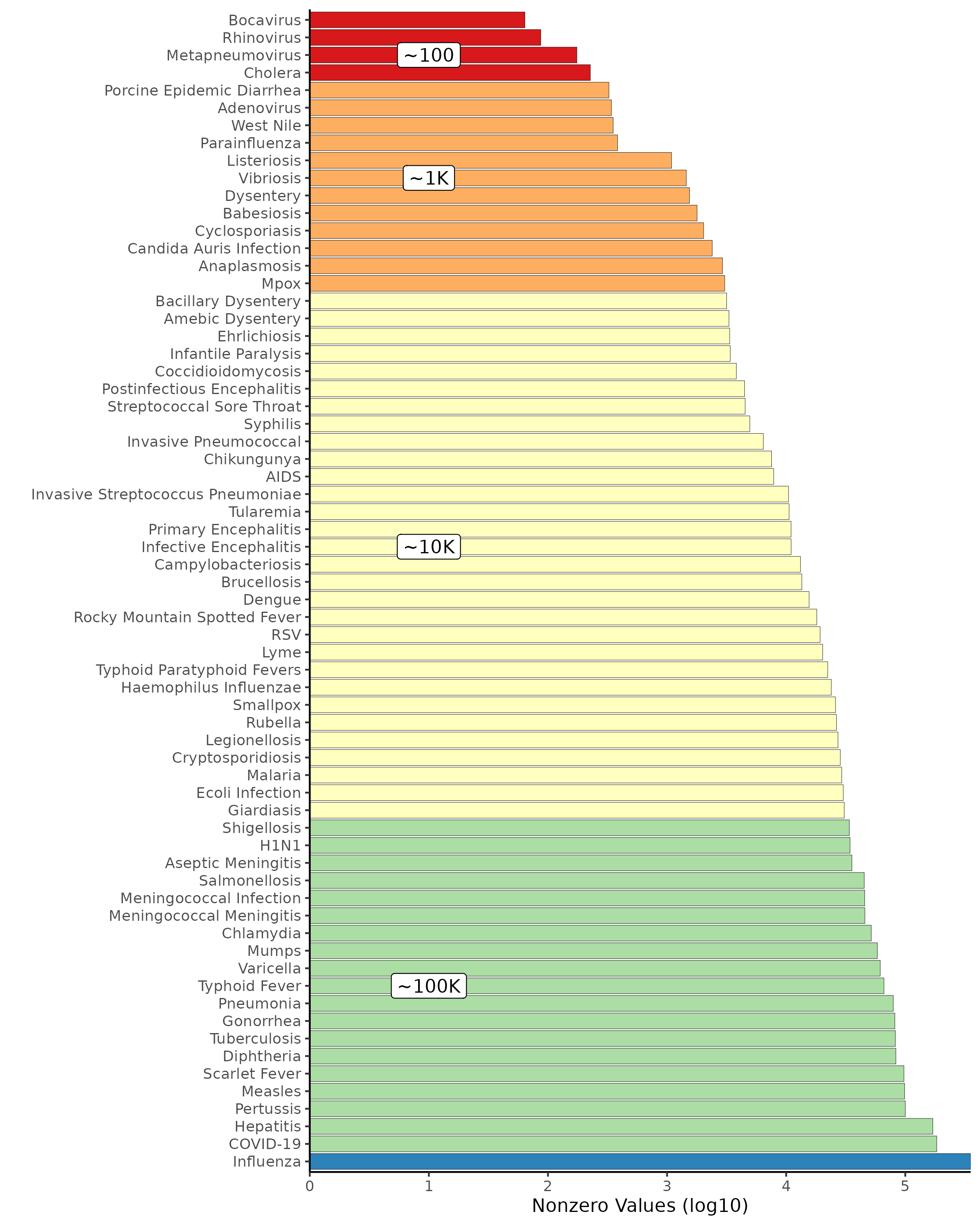
Figure 1: Sankey diagram of the breadth of pathogens and data streams compiled, and histogram quantifying weekly non-zero observations across the 66 diseases.
Methodological Framework
The authors investigate three primary forecasting paradigms: Gradient Boosted Models (GBM) using LightGBM, Long Short-Term Memory models (LSTM) via Keras, and an adapted Method of Analogues (MOA) as described in Murph et al. (2025). Each model is trained under four distinct data regimes:
- Single Data Stream: Forecasting exclusively from one disease and one reporting system.
- Single Disease Across Streams: Forecasting a disease using multiple reporting systems.
- Single Mode of Transmission Across Diseases: Pooling all diseases that share a transmission mode (e.g., respiratory, vector-borne).
- All Available Data: Pooling all diseases, modes, and streams.
Time series were rescaled by their last observed value to mitigate magnitude variability, and probabilistic forecasts (50%, 80%, 95% intervals) were extracted using quantile-specific models (pinball loss for GBM/LSTM; negative binomial uncertainty models for MOA).
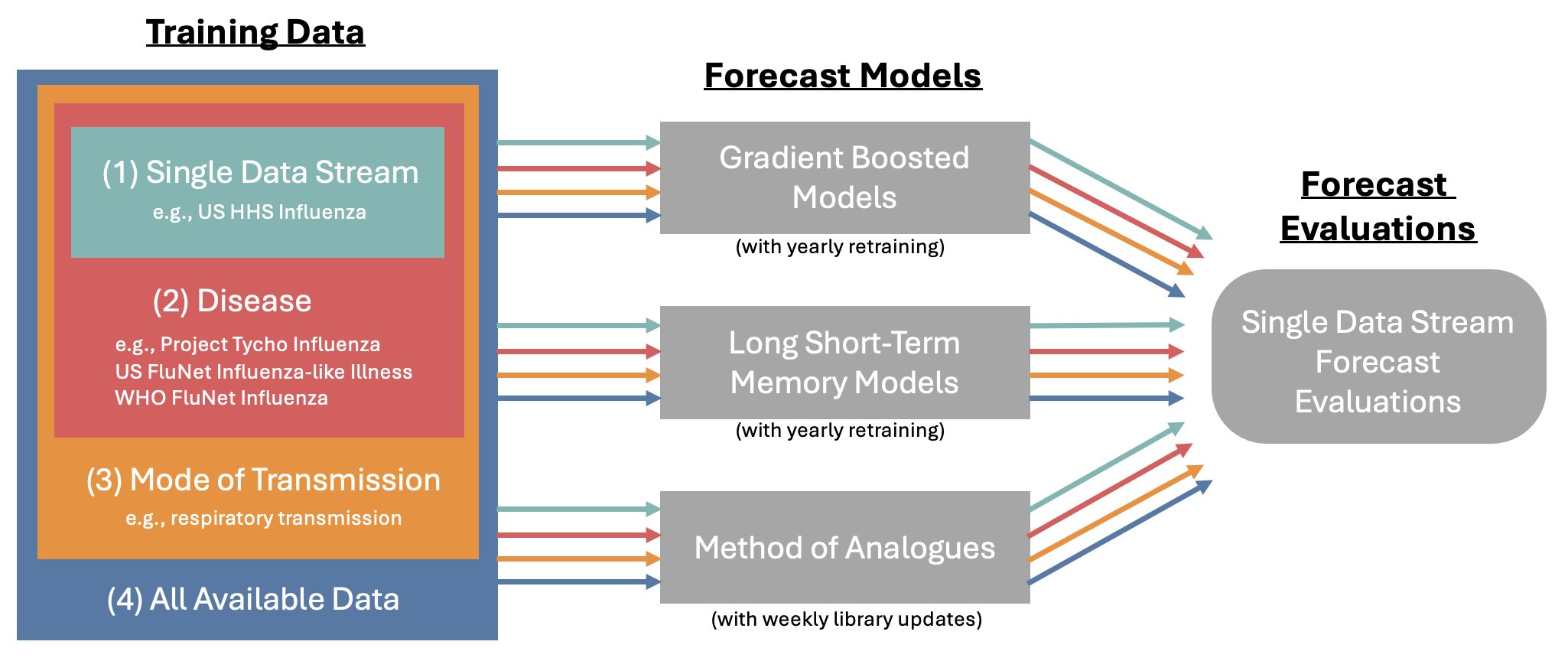
Figure 2: Methodological schematic depicting the multi-model, multi-data regime comparative forecasting pipeline.
Results: Positive and Negative Transfer Effects
Across >21 million individual forecasts, incorporation of auxiliary data streams substantially improved forecasting accuracy (measured by Mean Absolute Error, MAE) for the majority (84.9%) of evaluated time series and model structures. Notably, models trained only on the single stream yielded best MAE in just 15.1% of cases. The most pronounced gains were observed for COVID-19 and US HHS influenza forecasts; inclusion of other respiratory diseases led to strong reductions in MAE and improved probabilistic calibration.
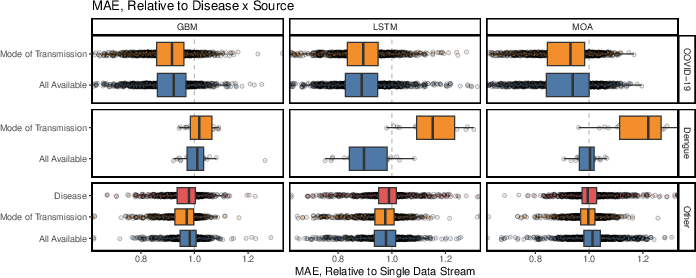
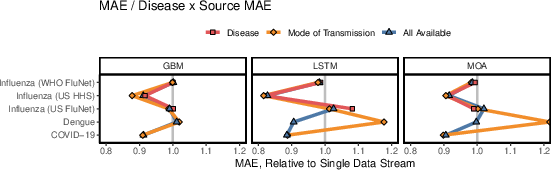
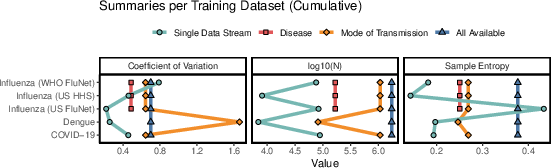
Figure 3: Relative MAE comparisons across data regimes, showing substantial gains from multi-stream and cross-mode learning for most diseases.
However, negative transfer manifested in certain contexts. For dengue fever, integrating vector-borne data from disparate sources engendered a marked degradation in forecast performance, especially in LSTM and MOA. Examination of signal-to-noise ratios and sample entropy suggested that mismatched data characteristics between the core dengue stream and other vector-borne diseases led to model confusion and diminished accuracy. This strongly supports the necessity for careful screening of candidate auxiliary datasets to avoid negative transfer.
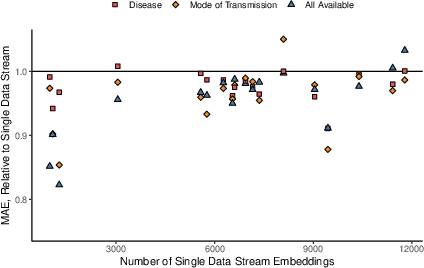
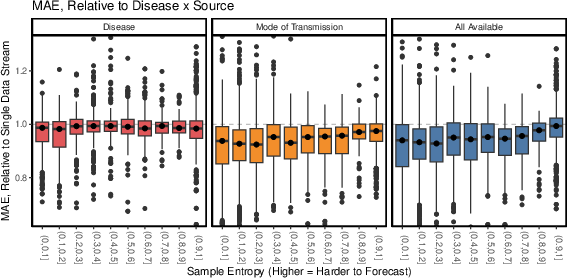
Figure 4: Relationship between training data regime MAE ratio and (a) sample size and (b) sample entropy, highlighting the greatest improvements in data-sparse and low-entropy settings.
Disease Composition and Model Interpretability
Analysis of MOA snippet neighborhoods for COVID-19 forecasts revealed that, beyond relying on abundant influenza data, scarlet fever and other respiratory diseases were disproportionately included relative to their prevalence in the snippet library. As more COVID-19 data became available, the model dynamically increased its reliance on COVID-19 historical snippets, indicating adaptivity in the transfer process.
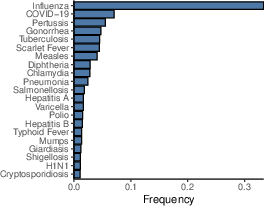
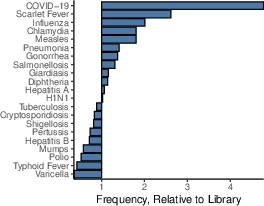
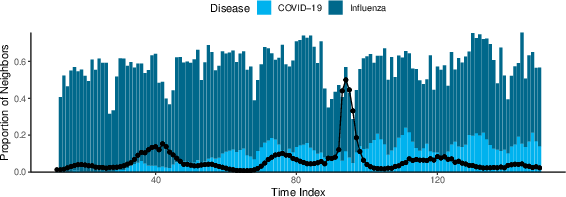
Figure 5: Disease composition analysis of MOA snippet neighborhoods in COVID-19 forecasting, illustrating disproportionate inclusion of relevant auxiliary diseases and evolving reliance on COVID-19 as the pandemic progressed.
Practical and Theoretical Implications
The demonstrated efficacy of transfer learning across modes, sources, and diseases substantiates its value for operational epidemic forecasting. Models leveraging wide-ranging data pools are less brittle, particularly for emerging pathogens or scenarios with limited surveillance history. However, empirical evidence of negative transfer underscores the importance of principled auxiliary data selection; models must either have embedded mechanisms to downweight dissimilar series or practitioners must perform rigorous data vetting for domain and distributional relevance.
The findings suggest that increasing data diversity is generally beneficial in low-entropy (predictable) and data-sparse settings, while the marginal utility diminishes for complex, high-entropy time series. Among model classes, LSTM gained most from cross-disease transfer, owing to its capacity for learning temporal abstractions unconstrained by handcrafted features. GBM also improved with auxiliary data, while MOA, despite lesser gains, provided interpretability indispensable for diagnostic analysis.
The assembled repository at the provided URL offers a substantial resource for the community, democratizing access to harmonized infectious disease temporal data and facilitating reproducible transfer learning benchmarks and future research.
Conclusion
This paper rigorously demonstrates that transfer learning utilizing 66 diseases and multiple data streams enhances infectious disease forecasting across most settings, with improvement contingent on both data stream compatibility and model architecture. The results encourage practitioners to adopt cross-disease and cross-stream transfer learning when building forecasting systems, but caution against indiscriminate pooling of highly dissimilar data. Future directions involve automated assessment of auxiliary data quality, dynamic weighting mechanisms, and application to real-time outbreak prediction for novel pathogens. The publicly available dataset offers a foundation for continued methodological advances in epidemic forecasting.