- The paper demonstrates that embedding a black hole in a Dehnen-type dark matter halo with quintessence enlarges the event horizon and shifts the photon sphere.
- The authors compute photon effective potentials and null geodesics to show how DM and DE parameters uniquely alter the shadow radius and observed intensity.
- Numerical ray-tracing and thin-disk accretion models reveal that geometric shadow features are robust probes for distinguishing dark matter from dark energy effects.
Shadows and Photon Spheres of Static Black Holes in Dehnen-Type Dark Matter Halo with Quintessence: Optical Signatures and Observational Discriminants
Introduction
The paper "Shadows and photon spheres of static black holes embedded in a Dehnen-(1,4,5/2)-type dark matter halo with a quintessential field" (2605.19567) presents a systematic analysis of black hole (BH) imaging within realistic cosmological environments, where both dark matter (DM) and dark energy (DE) jointly determine the structure of spacetime near the BH. The authors construct a background spacetime featuring a Schwarzschild BH surrounded by a Dehnen-type DM halo and a quintessential scalar field characterizing DE. By investigating null geodesics, effective potentials, and the resulting BH shadow and photon ring morphologies under physically motivated accretion models, the work delivers a technical account of DM-DE effects on horizon-scale features observable in present and future very-long-baseline interferometry experiments.
Composite DM-DE Metric and Horizon Structure
The metric function f(r) constructed incorporates: (1) the BH mass M, (2) the DM central density ρs and scale radius rs (Dehnen profile), and (3) the quintessential field normalization c and equation of state parameter wq, where wq<−1/3 is required for the DE sector to drive cosmic acceleration. This framework is appropriate for non-asymptotically-flat spacetimes that accommodate both an event horizon and, when wq→−1, a cosmological horizon.
Numerical analysis reveals that increasing any of the DM or DE parameters monotonically enlarges the event horizon radius, a conclusion that generalizes isolated results from the pure DM or Kiselev (quintessence-only) cases.
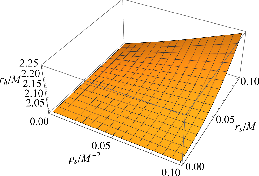
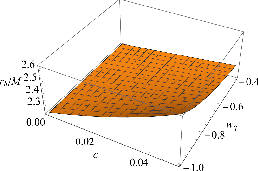
Figure 1: The event horizon radius rh/M increases as a function of DM parameters (ρs, M0, left) and as a function of DE parameters (M1, M2, right), holding the other sector fixed.
Photon Effective Potential and Null Geodesics
The authors compute the photon effective potential M3 and demonstrate that both DM and DE terms suppress M4, shift its maximum (the photon sphere) to larger radius, and lower the peak. However, the quantitative effect is larger for the DM parameters than for the quintessential field.
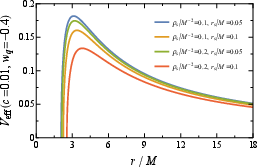
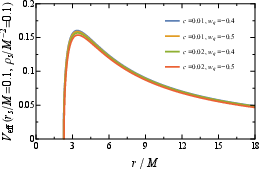
Figure 2: Effective potential M5 for photons as a function of M6 for varying DM (left) and DE (right) parameters, governing the location of the photon sphere and the critical impact parameter.
The influence on null geodesics is illustrated via ray-tracing for varying parameter sets, showing that the locations of the event horizon, photon sphere, and critical impact parameter all increase with M7, M8, M9, and ρs0.
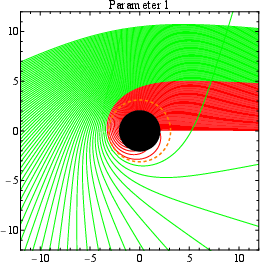
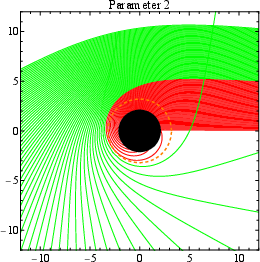
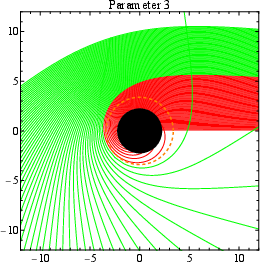
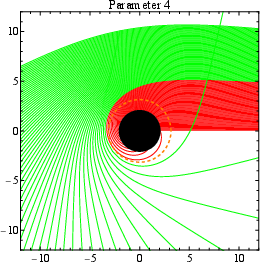
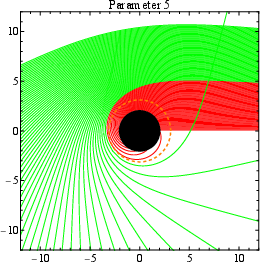
Figure 3: Sample light trajectories in the equatorial plane with colored curves distinguishing sub-critical, super-critical, and photon sphere orbits for five representative parameter sets.
Black Hole Shadow and Photon Ring in Spherical Accretion
Integrated Intensity and Observational Diagnostics
In both radially infalling and static spherical accretion flows, the specific form of the observed intensity ρs1 is derived, including all redshift factors relevant to a static or moving emitter. The shadow radius, defined by the angular position with vanishing intensity, is strictly determined by the critical impact parameter and is independent of the accretion model—demonstrating a key result: shadow size is a geometric probe of the background spacetime and not of the detailed accretion physics.
A principal observational signature is found:
- Increasing DM parameters (ρs2, ρs3): increases shadow radius but decreases the observed intensity (shadow is dimmer); effect is independent of the observer’s location.
- Increasing DE parameters (ρs4, ρs5): intensity increases while the shadow radius is largely unaffected; the effect depends strongly on the observer's radial position, with distant observers measuring higher intensity.
This non-degenerate response provides an avenue for differentiating DM- versus DE-dominated environments using horizon-scale imaging.
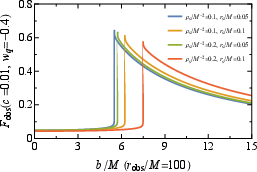
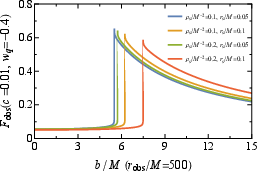
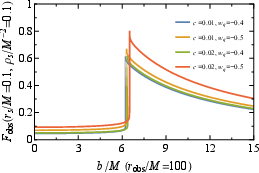
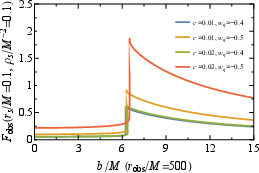
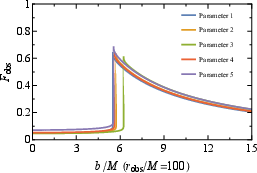
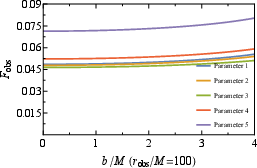
Figure 4: Dependence of observed integrated intensity ρs6 on impact parameter ρs7 for various spacetime and observer parameters, under infalling spherical accretion.
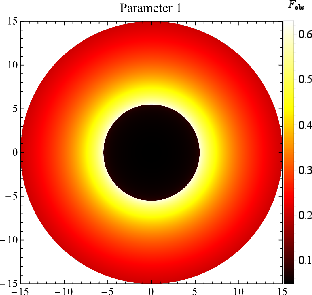
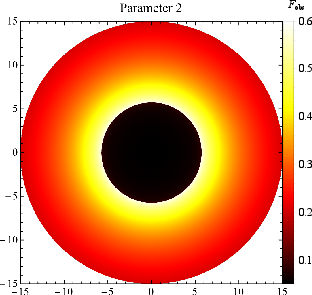
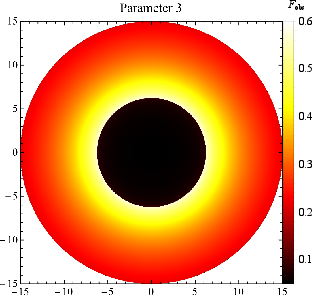
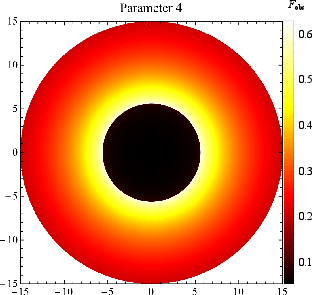
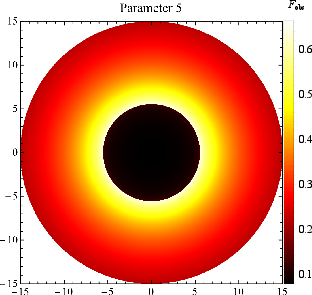
Figure 5: Black hole shadow images for infalling accretion, highlighting the dependence of ring width and brightness on DM and DE parameter choices.
In the static accretion scenario, the shadow is consistently brighter due to the absence of Doppler redshifting, as visible in the corresponding images.
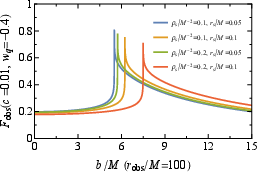
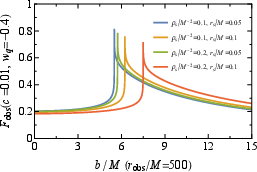
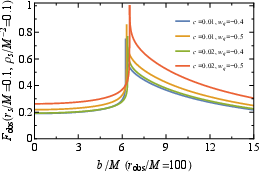
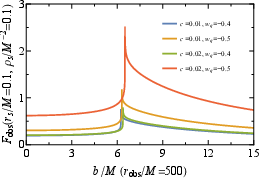
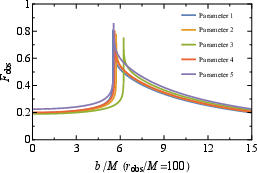
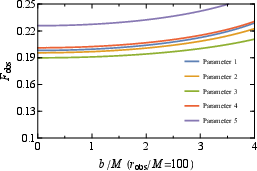
Figure 6: Dependence of ρs8 on ρs9 for static spherical accretion; geometric and parametric effects are analogous to the infalling case, but with systematically higher intensity.
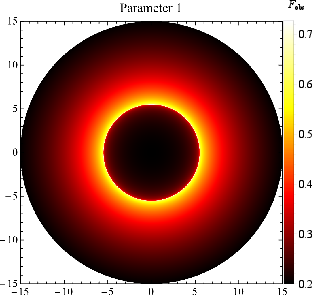
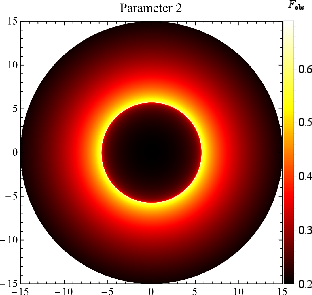
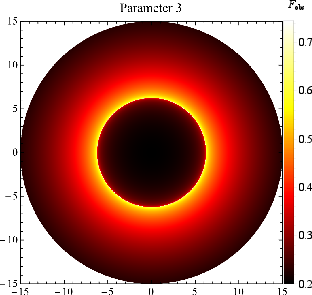
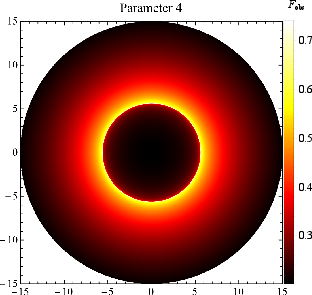
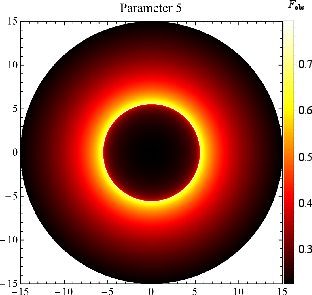
Figure 7: Shadow images for static accretion, mirroring Figure 5 but with order-of-magnitude higher central brightness.
Thin-Disk Accretion: Multiplicity of Ring Features
Light Ray Classification and Transfer Functions
Leveraging the analytic framework for ring decomposition (direct, lensed, photon rings) as in Gralla et al., the impact parameter ranges corresponding to different classes of light trajectories/multiple crossings are calculated for each parameter set.
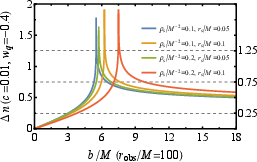
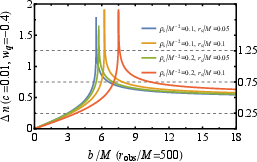
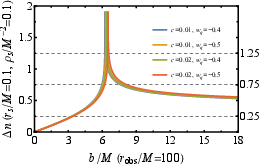
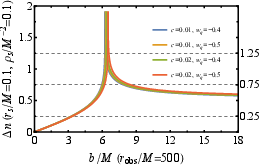
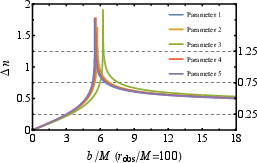
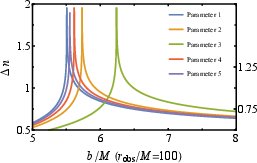
Figure 8: Total photon orbit number rs0 versus impact parameter rs1 across the parameter space, establishing ring region widths and their sensitivity to spacetime structure.
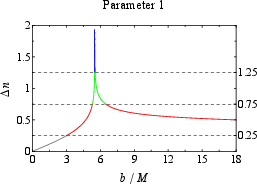
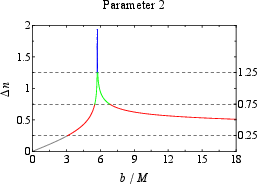
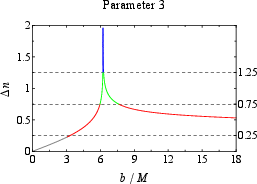
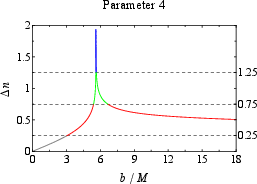
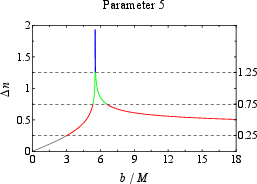
Figure 9: The mapping rs2 for all parameter sets, directly quantifying the geometric broadening of photon/lensed rings due to DM & DE.
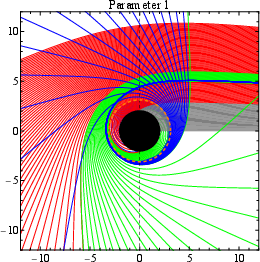
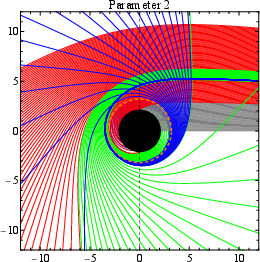
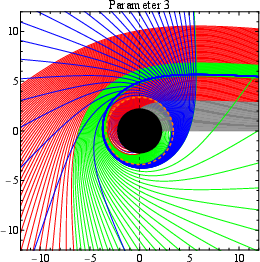
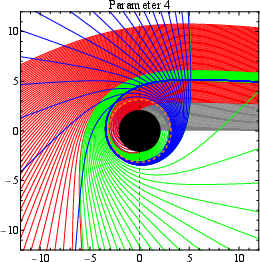
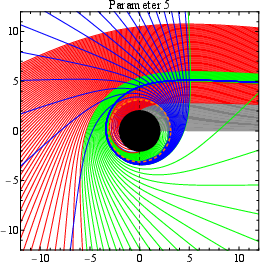
Figure 10: Detailed ray trajectories labeled for direct, lensed, and photon-ring emission morphologies, illustrating ring formation and expansion.
The radial locations of the lensed and photon rings are robust to observer inclination, while the ring widths are strongly dependent on rs3, rs4, rs5, and rs6.
Disk Model Dependence: ISCO, Photon Sphere, Event Horizon
Three disk models with inner boundaries at the ISCO, photon sphere, or horizon are compared.
- Inner edge at ISCO: largest shadow; three spatially separated emission peaks in intensity profile (well-isolated direct, lensed, photon rings).
- Inner edge at photon sphere: lensed and photon rings merged with direct emission; two dominant peaks.
- Inner edge at the event horizon: smallest shadow; emission peaks merged similarly.
The location of the inner disk boundary thus critically controls interpretability of shadow substructure.
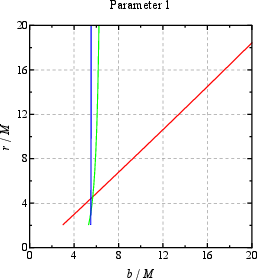
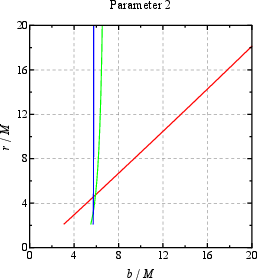
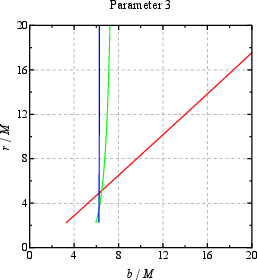
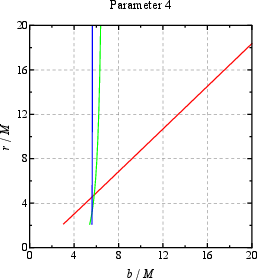
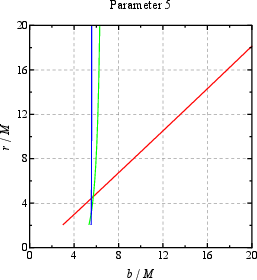
Figure 11: The first three transfer functions (rs7) for the direct, lensed, and photon rings; direct emission dominates the observable flux.
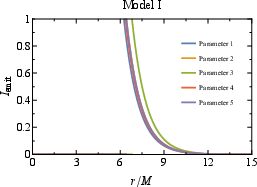
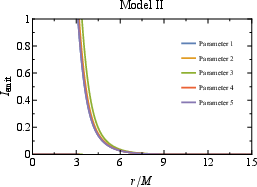
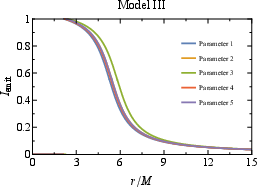
Figure 12: Disk emission profiles rs8 for all disk models and parameter sets; larger DM/DE parameters shift ISCO and broaden emission regions.
Integrated Intensity and Imaging Morphologies
Across disk models, direct emission dominates the observed intensity. The lensed and photon rings, though spatially broadened by DM/DE effects, remain sub-dominant even as their width increases with parameter magnitude.
Observer dependence is again detected: the effect of rs9 on c0 is strongly location-dependent, while the impact of c1, c2, c3 is nearly position-invariant. The decoupling of intensity and morphology provides a practical probe for DE equation-of-state parameters.
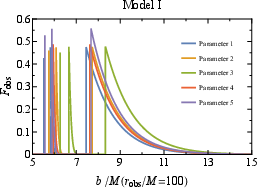
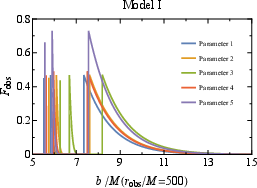
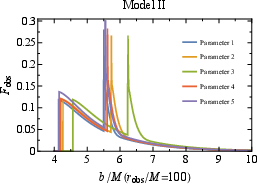
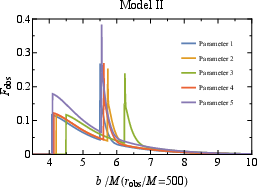
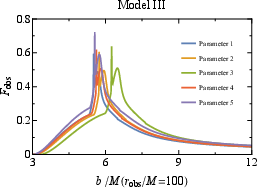
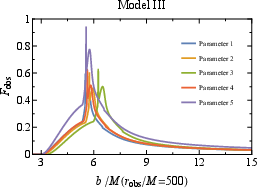
Figure 13: c4 for observers at different locations; panel structure demonstrates the parametric and geometric dependence across the disk model landscape.
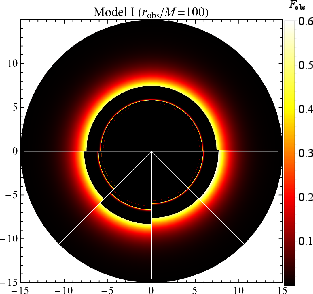
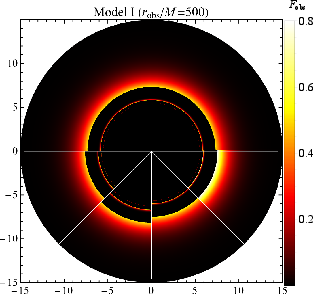
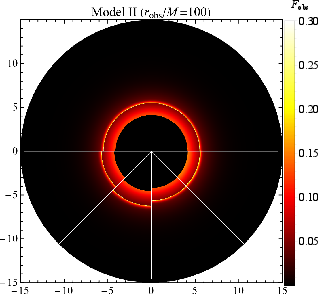
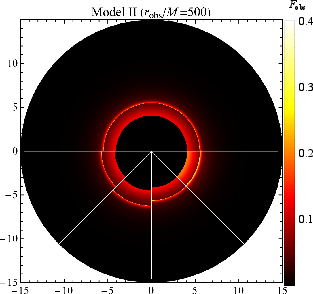
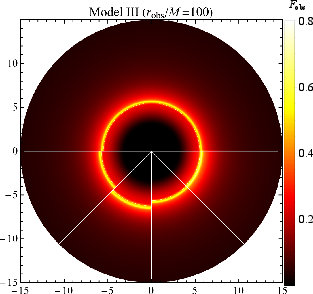
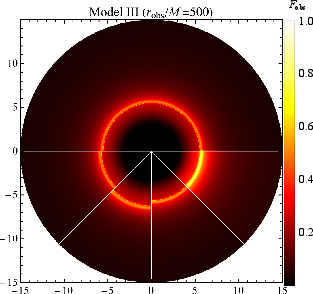
Figure 14: BH images for all disk models and parameter sets; arrangement encodes disk boundary location and spacetime parameter variations.
Implications and Theoretical Consequences
The mutual sensitivity amplification found between DM and DE parameters (e.g., increases in c5 render c6 more sensitive to c7, and vice versa for c8 and c9) is essential for precision constraints from future imaging. These results generalize and unify the treatment of BH shadow imaging in realistic cosmological contexts, offering a roadmap for using upcoming high-resolution VLBI observations to distinguish between DM- and DE-dominated regimes and for independent constraints on DE microphysics. The robust observer-independence of geometric ring locations sets a baseline for utilizing photon ring imaging as a probe of underlying spacetime structure, notably in the strong-field regime inaccessible to standard cosmological tests.
Astrophysically, the findings emphasize the need to model real accretion flow orientations, rotating (rather than static) disks, and more complex dark sector structures (e.g., interacting or isothermal DM halos, phantom DE, or modified gravity scenarios). This work also motivates exploration in the context of extended gravity theories, where non-trivial modifications to null geodesic structure or horizon morphology may further break degeneracies unresolvable by standard shadow size analysis alone.
Conclusion
Through rigorous analytic and numerical analysis, the authors provide decisive characterizations of how Dehnen-type DM halos and quintessential DE modify photon ring, shadow, and image intensities of static BHs for both spherical and disk accretion models. The differing dependence of shadow size and intensity on DM versus DE parameters, and the observer’s position, yield observational signatures with clear inference potential for upcoming horizon-scale BH imaging surveys (2605.19567). This comprehensive framework establishes a quantitative foundation for the astrophysical use of BH shadow imaging as a probe of the cosmic dark sector and offers a template for necessary future generalizations, including rotating and inclined systems, more realistic DM/DE models, and tests in the context of alternative gravity.