- The paper establishes a formal equivalence between semidefinite programming and bosonic thermal models by mapping eigenvalues to bosonic occupation numbers.
- It introduces an entropy-regularized framework that recovers the original SDP as temperature approaches zero while providing explicit, dimension-independent error bounds.
- The work develops hybrid quantum–classical algorithms using Hamiltonian simulation and Cauchy sampling to efficiently compute gradients and Hessians under favorable spectral conditions.
Bose–Einstein Thermal Operators for Semidefinite Optimization: A Technical Synthesis
Overview and Mathematical Foundations
This work establishes a formal equivalence between semidefinite programs (SDPs) over the unbounded positive semidefinite cone and the statistical mechanics of independent bosonic modes. In this correspondence, the eigenvalues of the optimization variable X represent bosonic occupation numbers, the linear objective Tr[HX] corresponds to the expected system energy, and linear constraints Tr[QiX]=qi are mapped to the conservation of potentially non-commuting “charges.” This perspective enables the reformulation of generic SDPs as entropy-regularized bosonic free energy minimization problems at strictly positive temperature, with a rigorous limiting procedure that recovers the original SDP as temperature approaches zero.
The free energy of the system is defined as
F[X]=Tr[HX]−TSBE(X),
where
SBE(X)=Tr[(X+I)ln(X+I)−XlnX]
serves as the Bose–Einstein entropy, characterizing occupation statistics of bosonic modes without exclusion principles or normalization requirements. The primal optimum in this regularized framework takes a closed form:
XT(μ)=(e(H−μ⋅Q)/T−I)−1,
with dual variables μ functioning analogously to chemical potentials in a grand canonical ensemble. The dual objective
fT(μ)=μ⋅q+TTrln(I−e−T1(H−μ⋅Q))
is strictly concave and amenable to first- and second-order optimization.
Entropic Regularization, Complementary Slackness, and Sharpness
A central aspect is the replacement of the unregularized SDP’s complementarity condition Kμ⋆X⋆=0—which enforces occupation strictly in the kernel of the dual slack operator—with a soft, temperature-parametrized generalization:
KμT⋆XT(μT⋆)=TXT(μT⋆)ln[I+XT(μT⋆)−1].
This smooths out the sharp occupation delineation, in analogy with thermal broadening in bosonic systems. As Tr[HX]0, the regularized solution approaches that of the unregularized SDP, with nonzero occupation confined to the ground space of Tr[HX]1.
Approximation Error Analysis
Critically, the authors derive explicit and dimension-independent bounds on the approximation error between the original and regularized problem:
- Entropy-based bounds apply when the feasible region is compact, scaling with the maximal Bose–Einstein entropy Tr[HX]2. This recovers classical worst-case Tr[HX]3 duality gap scaling.
- Spectral-gap-based bounds exhibit a notable improvement: if the slack operator Tr[HX]4 has degeneracy Tr[HX]5 and gap Tr[HX]6, the error scales as Tr[HX]7, thus, logarithmic in global dimension for fixed Tr[HX]8, Tr[HX]9.
Bose–Einstein Quantum Relative Entropy and Geometry
The work introduces the Bose–Einstein quantum relative entropy Tr[QiX]=qi0, a Bregman divergence generated by Tr[QiX]=qi1, suitable for the non-normalized, unbounded positive semidefinite cone where the Umegaki relative entropy can become negative. Tr[QiX]=qi2 is shown to be faithful, unitarily invariant, and additive under direct sums. Although it generally does not satisfy data-processing inequalities (DPI)—a direct consequence of its lack of joint convexity—it does obey monotonicity under physically relevant affine maps corresponding to bosonic Gaussian channels, specifically those with Tr[QiX]=qi3 for maps Tr[QiX]=qi4.
Quantum–Classical Algorithmics
The authors propose hybrid quantum–classical algorithms for evaluating gradients and Hessians of the dual problem necessary for optimization. These algorithms utilize Hamiltonian simulation, Hadamard tests, and classical Cauchy sampling, bypassing the need for quantum Gibbs sampling or block encoding. Notably, runtime bounds depend polynomially on Tr[QiX]=qi5, where Tr[QiX]=qi6 is the minimum eigenvalue of the dual slack operator, and only logarithmically on the Hilbert space dimension in the presence of a spectral gap. In contrast to prior quantum SDP solvers (e.g., those based on quantum multiplicative weights or quantum interior-point methods), no a priori upper bound on the primal trace is required.
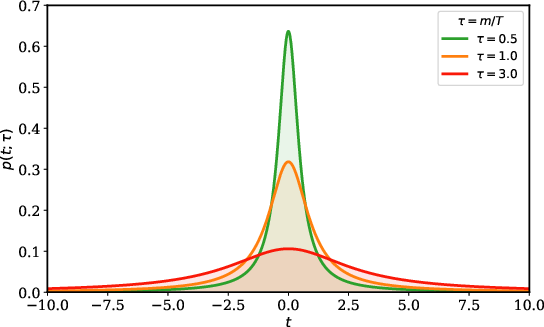
Figure 2: The probability density function of the Cauchy distribution Tr[QiX]=qi7 for varying Tr[QiX]=qi8, illustrating the heavy-tailed sampling needed for stochastic Hamiltonian simulation in the bosonic free energy optimization framework.
Implications, Comparisons, and Open Problems
From a theoretical perspective, this work completes the “thermodynamic trilogy” of entropy-regularized SDPs (with Boltzmann, Fermi–Dirac, and now Bose–Einstein statistics, each matching a specific spectral constraint class). The Bose–Einstein regularization enables direct treatment of optimization over the full positive semidefinite cone without trace or spectral upper bounds, which is structurally aligned with quantum information tasks involving bosonic systems, continuous-variable quantum optics, and problems with unbounded resources.
Practically, these algorithms offer a route to SDP solvers respecting physically relevant geometric and information-theoretic structures and potentially exponential runtime improvement over classical IPMs in gapped regimes with low ground-space degeneracy, provided the spectral properties of the dual slack operator are favorable.
The introduction of the Bose–Einstein relative entropy as a Bregman divergence on the unbounded cone has further implications for information geometry, resource theories involving unnormalized operators, and entropy-regularized mirror descent across quantum optimization landscapes.
Open problems include:
- Characterizing the tight asymptotic relationship between the regularization temperature Tr[QiX]=qi9 and the minimum eigenvalue F[X]=Tr[HX]−TSBE(X),0 along the optimization path to the zero-temperature limit.
- Extending efficient variance reduction techniques and mirror-descent algorithms tailored to the Bose–Einstein metric to enhance practical runtime.
- Empirical and application-driven exploration in quantum algorithms for continuous-variable systems, bosonic moment problems, and optical quantum information.
Conclusion
This paper provides a mathematically rigorous, physically grounded, and operationally significant generalization of entropy-regularized convex optimization to the unbounded semidefinite domain, via a mapping to bosonic thermodynamics. It demonstrates both structural and algorithmic advances—most strongly for cases with favorable spectral gap properties—positioning the Bose–Einstein thermal operator paradigm as a key tool for both classical and quantum algorithms addressing large-scale SDPs in quantum information, statistical physics, and convex optimization theory.

