- The paper identifies a 20% enhancement in SOT efficiency by integrating orbital Hall effect with spin Hall effect in Ta/W MTJs.
- The methodology used harmonic Hall voltage measurements and drift-diffusion modeling to quantify spin diffusion lengths and orbital-to-spin conversion.
- The study showcases vertical non-local switching with a simplified bottom-pinned device architecture that improves PMA and thermal robustness.
Orbital and Spin-Orbit Torque Interplay in Ta/W-based MTJs: Mechanisms and Device Implications
Introduction
The paper "Orbital and Spin-Orbit Torque Interplay in Ta/W-based Magnetic Tunnel Junctions with Vertical Non-local Switching" (2605.27215) investigates the enhancement of spin-orbit torque (SOT) efficiency in magnetic tunnel junctions (MTJs) via orbital physics, focusing on Ta/W-based heterostructures. This work identifies and quantifies the interplay between orbital Hall effect (OHE) and spin Hall effect (SHE), demonstrating improved SOT efficiency, robust perpendicular magnetic anisotropy (PMA), and compatibility with industrial thermal budgets. The paper also conceptualizes and confirms vertical non-local switching through orbital torques, proposing simplified bottom-pinned SOT-MTJ fabrication pathways.
Physical Mechanisms: Orbital and Spin Contributions
Ta/W bilayers are used to examine the combined contributions to SOT from both orbital and spin Hall currents. The orbital Hall effect arises in materials with a significant orbital angular momentum current, which is converted into spin current via an orbital-to-spin (OtS) conversion layer possessing strong spin-orbit coupling. The authors systematically probe this mechanism using harmonic Hall voltage measurements across various stack configurations and thicknesses.
Bulk-origin SOT is evidenced by ξDL increasing proportionally with SOT layer thickness in all stacks, consistent with SHE/OHE dominance. SOT efficiency saturation values and spin diffusion lengths are extracted via drift-diffusion modeling. Notably, Ta/W(1.5) achieves comparable ξDL to W-based references despite the conversion layer being just 1.5 nm thick, demonstrating a threefold enhancement over W(1.5) and fourfold over Ta(20) alone.
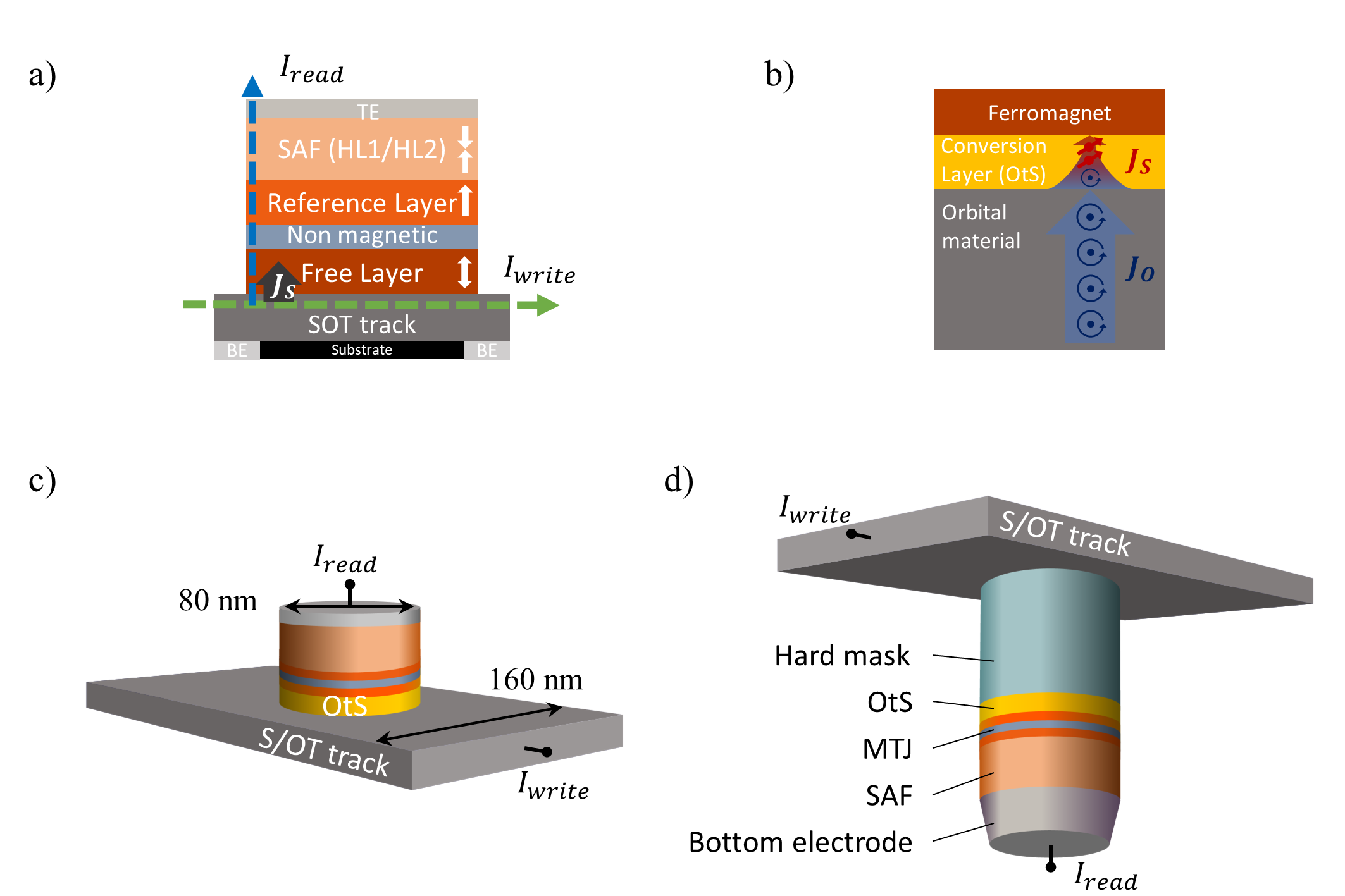
Figure 1: Device architectures capturing SOT-MTJ structure, orbital-to-spin conversion scheme, and fabrication simplifications for bottom-pinned MTJ.
The sign of SOT efficiency is dictated by the conversion layer's SOC, confirming conversion of orbital currents with SOC sign, verified in comparisons substituting W by Pt. The Ta/Ni system further supports dominant orbital contributions, as positive ξDL appears when Ni's positive SOC converts orbital current from Ta.
To decouple SHE and OHE contributions, a parallel resistor model estimates the additional OtS-generated SOT fields, showing the OtS component comprises up to 50% of the total SOT measured in Ta(20)/W(1.5). Despite interface effects not considered in the model, systematic enhancement across different material combinations points to a robust orbital-to-spin conversion mechanism.
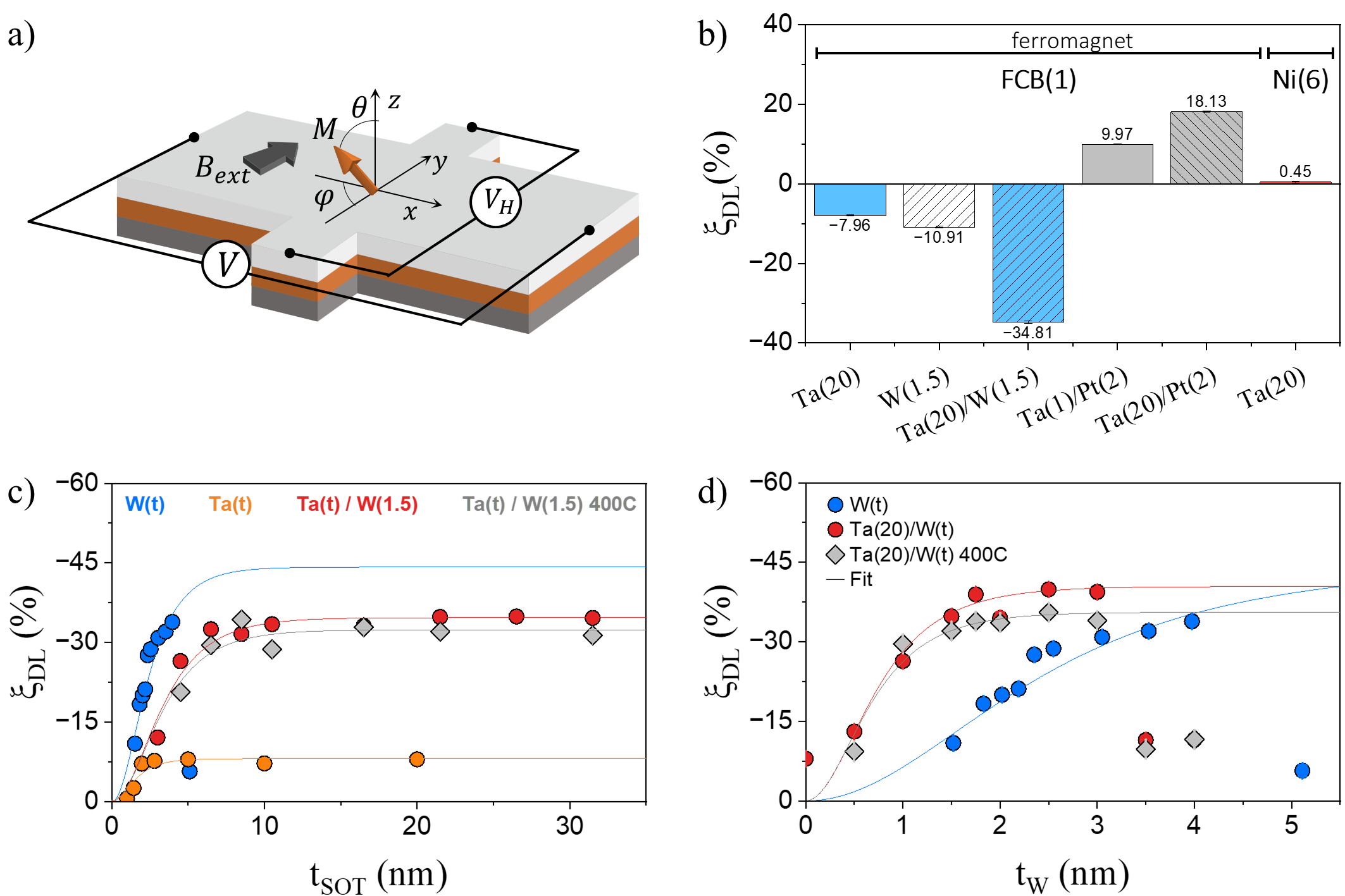
Figure 2: Harmonic Hall voltage measurement geometry and quantified SOT efficiency trends as a function of layer composition and thickness.
3-terminal SOT-MTJ devices integrating Ta/W stacks are fabricated and benchmarked against standard W-based MTJs. OtS devices exhibit substantially higher coercivity and anisotropy, directly affecting switching characteristics. Pulsed switching experiments reveal both stacks switch with SOT symmetry, with critical switching currents extracted and normalized to account for anisotropy and SOT track thickness.
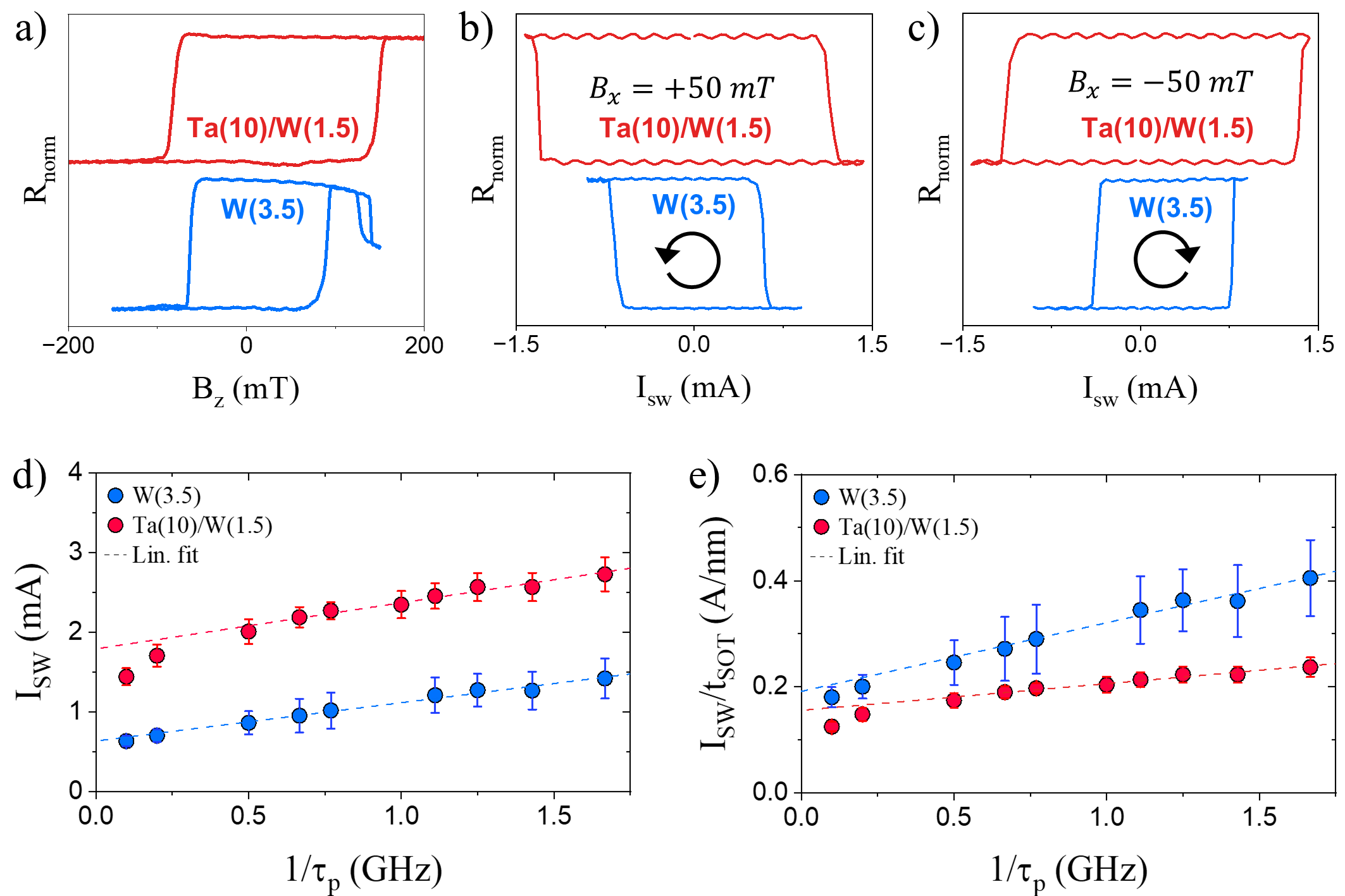
Figure 3: R-H loop, SOT switching traces, switching current versus pulse length, and normalization showing Ta/W matches W-based switching efficiency after accounting for stack and magnetic parameters.
After normalization by SOT track thickness and coercivity, Ta/W devices demonstrate lower or equivalent switching current densities compared to W, indicating superior conversion efficiency in practical device contexts. Enhanced PMA and annealing robustness provide further benefits for scalable integration.
Vertical Non-local Switching: Integration Paradigm
Building on orbital transport effects, the paper introduces vertical non-local switching in SOT-MTJ devices. By etching the pillar to leave a thick Ta spacer between SOT track and free layer, vertical spin/orbital current injection switches the MTJ despite a sizeable spacer. This concept enables a bottom-pinned integration scheme commonly used in STT-MRAM, improving MTJ properties without complex fabrication steps.
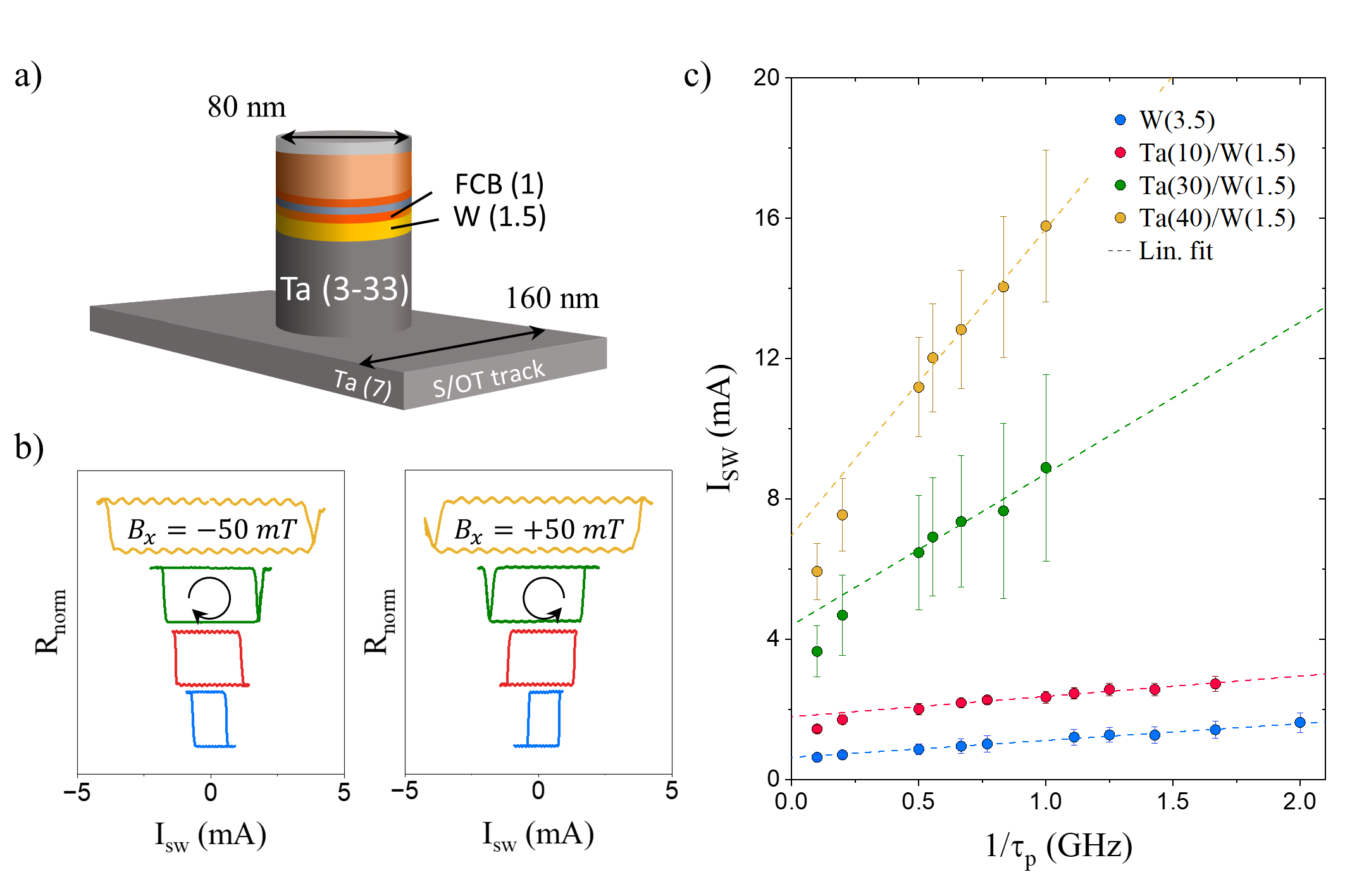
Figure 4: Device scheme and switching traces for varying Ta spacer thickness, demonstrating SOT switching symmetry across configurations and revealing dependence on current pathways.
Experimental measurements up to 40 nm Ta spacers confirm SOT-induced switching. COMSOL simulations and exponential modeling reveal that shunting effects dominate critical current increases, but discrepancies with simulation length-scale point toward an additional long-range bulk contribution likely tied to OHE. Normalized current fractions further corroborate a nonlocal switching component beyond classical shunting, with current density reductions in effective switching volumes as Ta thickness increases.
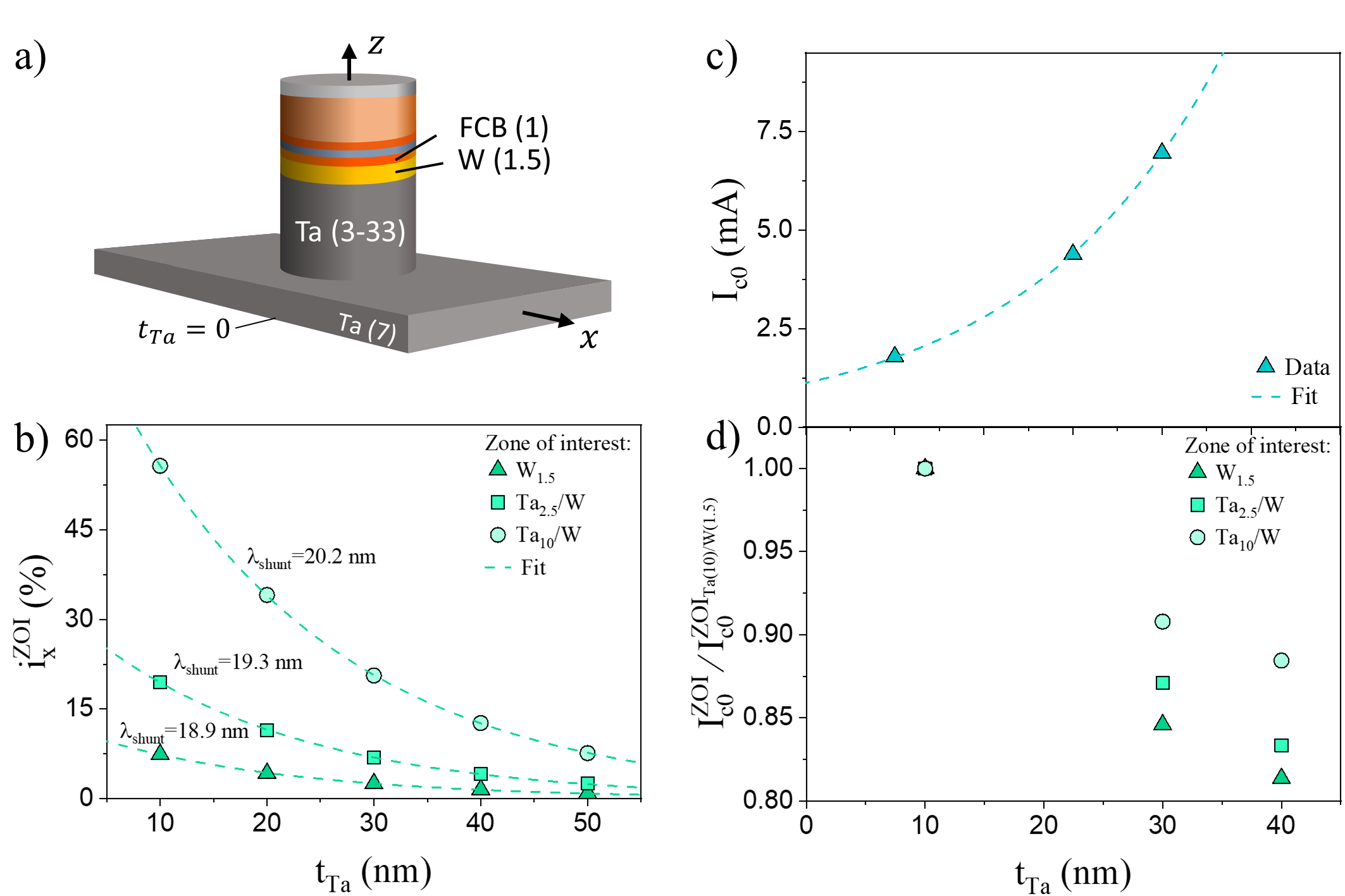
Figure 5: Simulated versus measured current distribution and critical switching current dependence on Ta spacer thickness, highlighting characteristic shunting length-scale and orbital current contributions.
Practical and Theoretical Implications
The results constitute authoritative evidence for the integration of orbital physics into SOT-MTJ devices, outperforming standard spin Hall systems in industrial contexts. The critical numerical result—a 20% SOT efficiency enhancement in Ta/W over W references, and up to 50% orbital-converted SOT field—implies a practical pathway toward meeting MRAM write current requirements. Annealing robustness and PMA support scalability and reliability, directly aligning with BEOL and cache integration demands.
The demonstration of vertical non-local switching via orbital torques simplifies bottom-pinned MTJ fabrication and introduces new device architectures exploiting long-range orbital transport. A key open question remains the extension of orbital diffusion length in device materials; current limitations motivate future exploration of materials with longer orbital diffusion and finer engineering of interface transparency.
Conclusion
This paper establishes Ta/W-based SOT-MTJ systems as promising candidates for next-generation MRAM, leveraging orbital Hall contributions to significantly enhance SOT efficiency and device performance. The vertical non-local switching paradigm extends design flexibility and integration potential, while robust PMA and annealing compatibility strengthen industrial applicability. Future research will likely focus on materials discovery for longer-range orbital transport, improved interface engineering, and optimization strategies for practical SOT-MRAM deployment.