Hybrid Expansion Cosmology in f(T) Gravity: Late-Time Evolution and Observational Bounds
Published 26 May 2026 in gr-qc and astro-ph.CO | (2605.27196v1)
Abstract: This study investigates the cosmological dynamics of an accelerating universe within the framework of teleparallel gravity using an exponential f(T) functional form. To obtain exact cosmological solutions, a hybrid scale factor is employed to model the smooth transition from an early decelerated phase to the present accelerated expansion of the Universe. The physical consistency of the model is analyzed through classical energy conditions and cosmographic parameters. By constraining the model parameters using 31 Hubble data points, we find that the resulting matter-energy density and pressure evolution remain consistent with the observed cosmic acceleration. Diagnostic analysis confirms that the model remains within the quintessence regime and asymptotically approaches the ΛCDM scenario.
The paper introduces a torsion-based f(T) gravity model that employs an exponential Lagrangian deviation to achieve late-time cosmic acceleration.
It uses a hybrid scale factor combined with H(z) measurements to constrain key parameters and demonstrate consistency with observational data.
Statefinder and Om(z) diagnostics reveal that the model asymptotically converges toward ΛCDM behavior while naturally avoiding an explicit dark energy component.
Hybrid Expansion Cosmology in f(T) Gravity: Late-Time Evolution and Observational Bounds
Overview of f(T) Gravity Framework
The examined study develops a cosmological model based on teleparallel gravity, employing an f(T) functional form where torsion, rather than curvature, governs gravitational dynamics. The selected functional, f(T)=αT0[1−e−bT/T0], encapsulates an exponential deviation from the standard teleparallel Lagrangian, offering mathematical tractability via second-order field equations. Tetrads serve as dynamical variables, providing torsion as the geometric structure and enabling modifications to the Einstein-Hilbert action. The model is constructed within a spatially flat FLRW metric, targeting late-time cosmic acceleration without explicit dark energy, and explores the implications of the chosen f(T) structure on energy density, pressure, and associated cosmographic parameters.
Hybrid Scale Factor and Dynamical Evolution
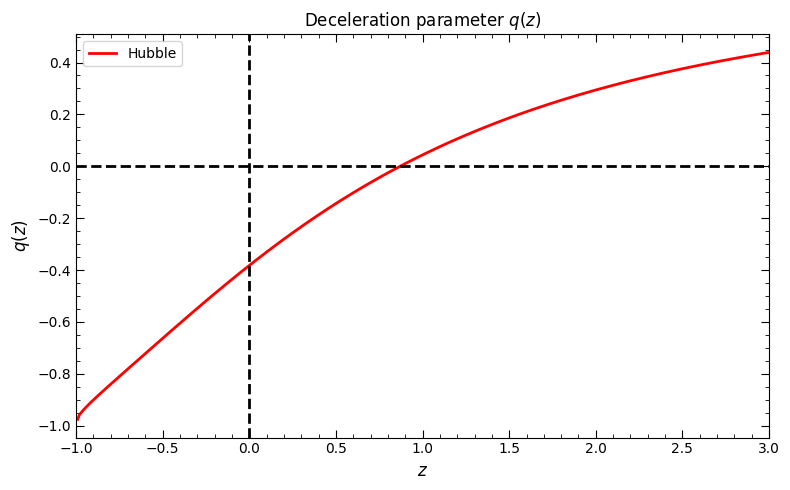
The hybrid scale factor, a(t)=eλttβ, combines power-law expansion at early times and an exponential late-time acceleration. The model’s parametric Hubble function H(z), normalized to H0, captures the transition from deceleration to acceleration and is constrained by observational Hubble parameter data. The deceleration parameter q(z) is derived and exhibits behavior consistent with observational requirements, showing a transition from positive values (deceleration) to negative values (acceleration) as redshift decreases.
Figure 1: Deceleration parameter in redshift. The curves are based on the constraints from H(z).
Observational Constraints and Statistical Consistency
The cosmological parameters f(T)0 and f(T)1 are constrained using 31 f(T)2 measurements via the DA method, employing f(T)3 minimization and MCMC sampling. The model’s best-fit values, f(T)4 and f(T)5, ensure normalization at f(T)6. Comparison with f(T)7CDM using the Akaike Information Criterion (AIC) demonstrates statistical indistinguishability (f(T)8AIC f(T)9 0.26) and competitive f(T)0 performance. These results confirm that the proposed f(T)1 framework robustly reproduces the expansion history without requiring a cosmological constant.
Cosmographic Diagnostics and Phase Space Analysis
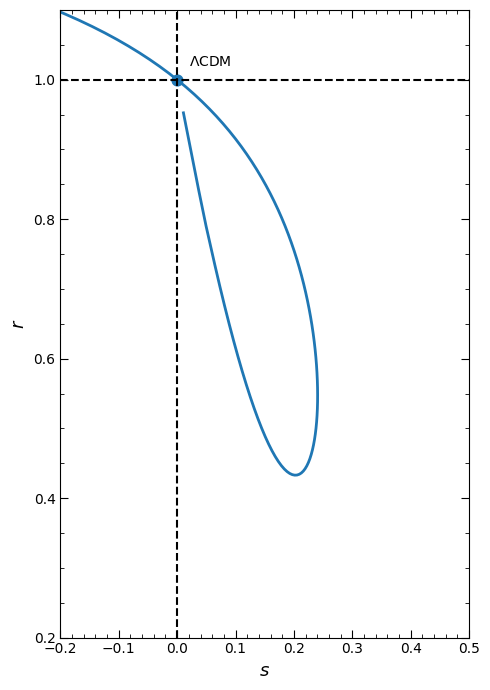
The statefinder parameters f(T)2, constructed from higher-order derivatives of the scale factor, allow discrimination between different expansion regimes. The trajectory begins in a quintessence-like phase (f(T)3, f(T)4), gradually approaching f(T)5, the f(T)6CDM fixed point, indicating asymptotic convergence to standard cosmology.
Figure 2: Evolutionary behavior of statefinder parameter, evaluated for constrained parameter values derived from the f(T)7 Hubble dataset.
Energy Density, Pressure, and Equation of State Evolution
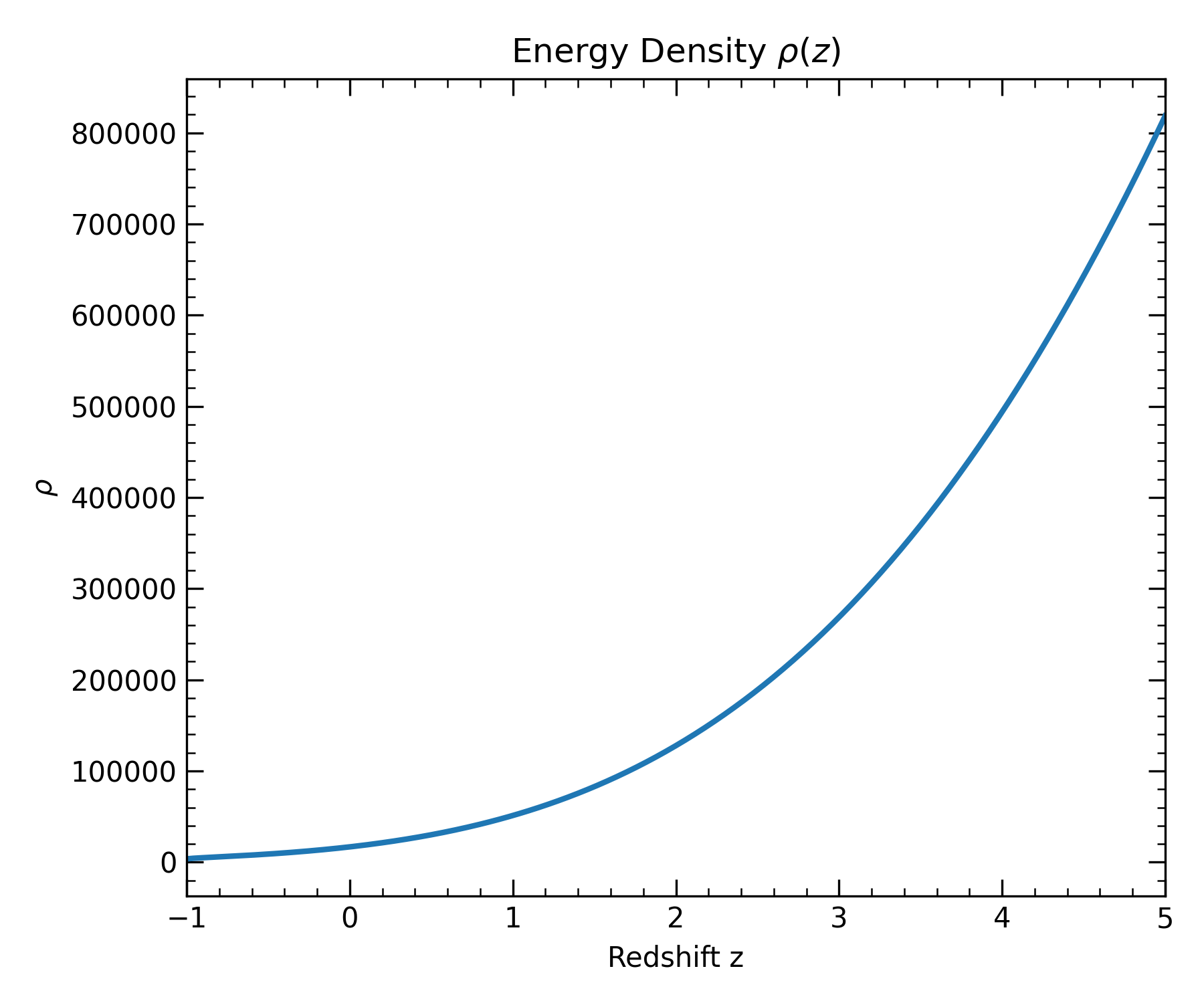
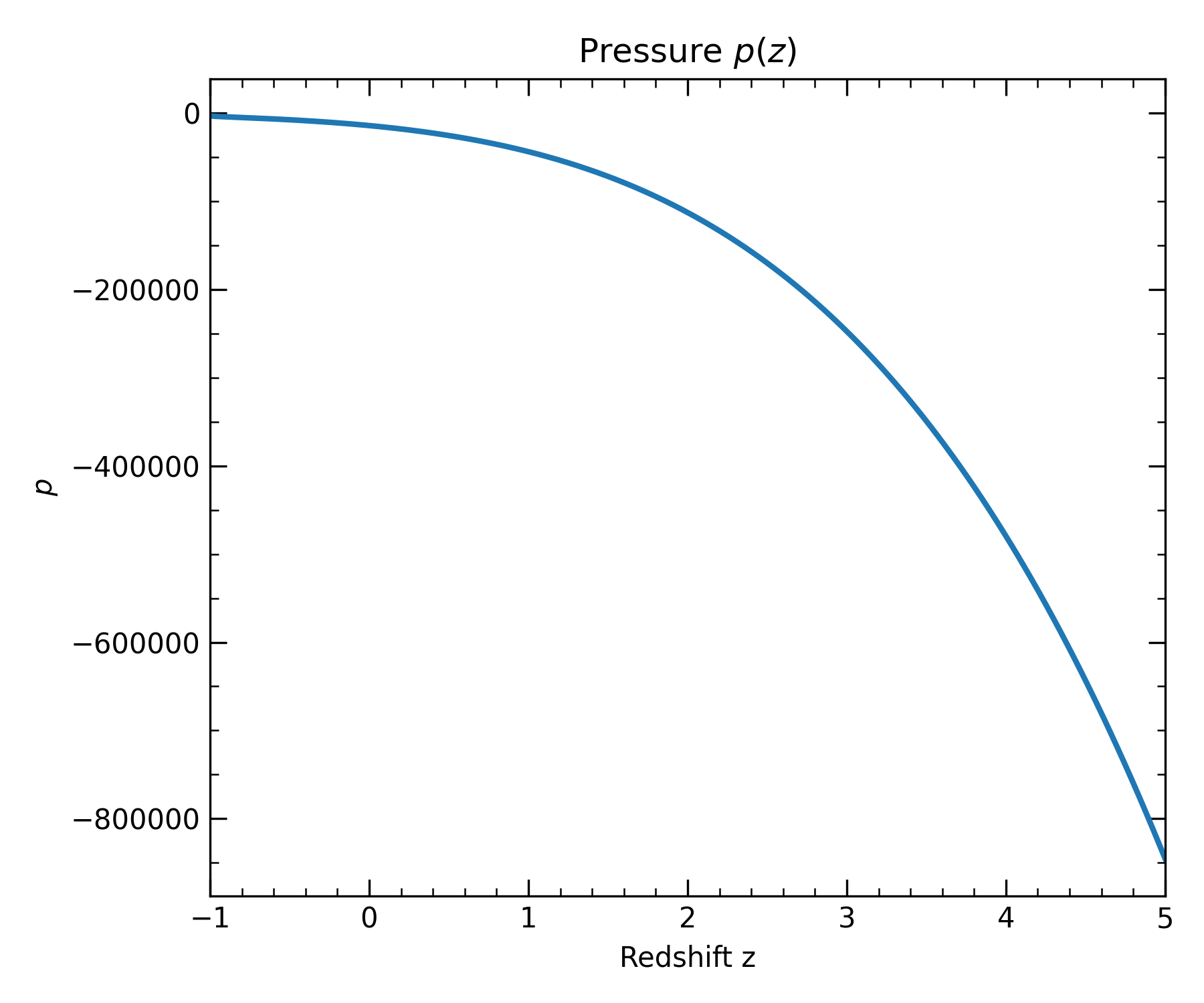
The physical consistency of the model is analyzed through the evolution of energy density, pressure, and the equation of state parameter. Energy density f(T)8 increases with redshift, consistent with matter-dominated early epochs, and decreases at late times. The pressure remains negative and diminishes in magnitude, sustaining continued acceleration.
Figure 3: Evolution of the energy density f(T)9 with redshift f(T)=αT0[1−e−bT/T0]0 for constrained parameter values obtained from the f(T)=αT0[1−e−bT/T0]1 Hubble dataset.
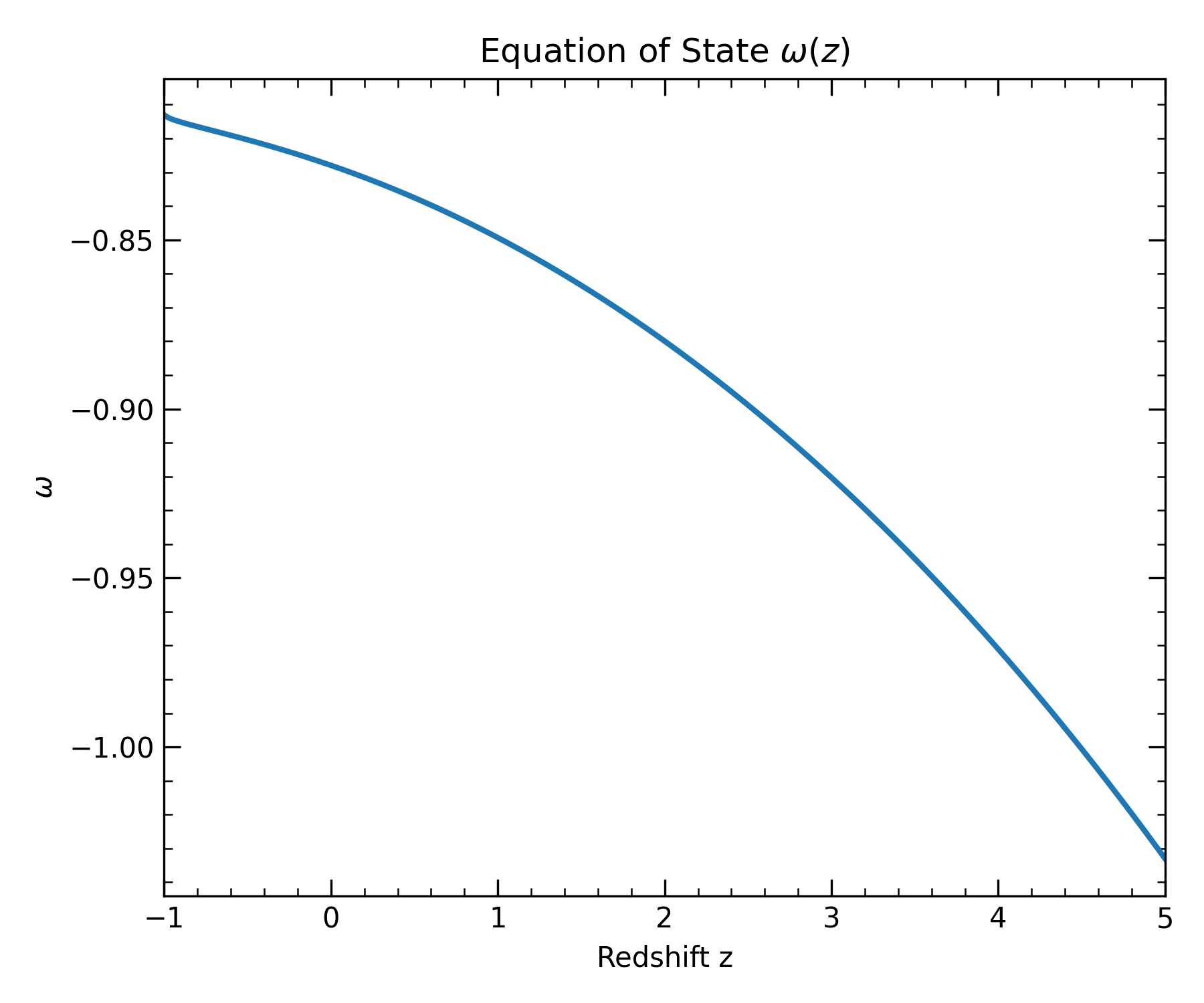
Figure 4: Evolution of the equation of state parameter f(T)=αT0[1−e−bT/T0]2 with redshift f(T)=αT0[1−e−bT/T0]3 for constrained parameter values obtained from the f(T)=αT0[1−e−bT/T0]4 Hubble dataset.
The EoS parameter f(T)=αT0[1−e−bT/T0]5 remains in the range f(T)=αT0[1−e−bT/T0]6, characteristic of quintessence, without converging to f(T)=αT0[1−e−bT/T0]7. The present-day value f(T)=αT0[1−e−bT/T0]8 falls within the observational bounds for an accelerating universe, supporting the model’s non-f(T)=αT0[1−e−bT/T0]9CDM acceleration.
Om(z) Diagnostic and Model Deviation from f(T)0CDM
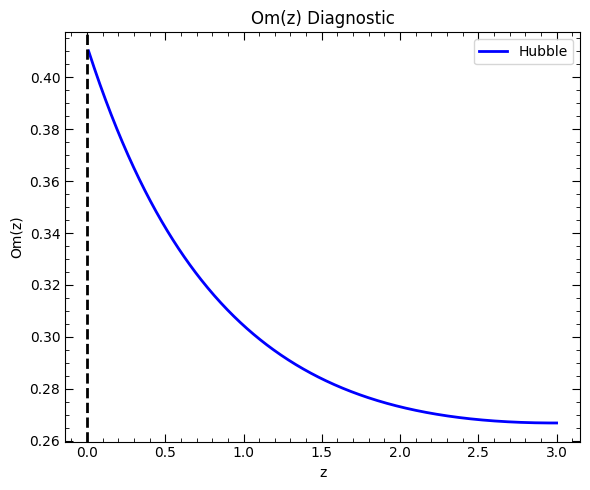
The Omf(T)1 diagnostic, calculated directly from the Hubble parameter, shows a non-flat, negatively sloped evolution, signifying deviation from constant-f(T)2CDM expansion and confirming persistent dynamical evolution unique to the f(T)3 framework.
Figure 5: Evolution of the Om(z) diagnostic with redshift f(T)4 for parameter values constrained by the f(T)5 Hubble dataset.
Energy Conditions and Consistency
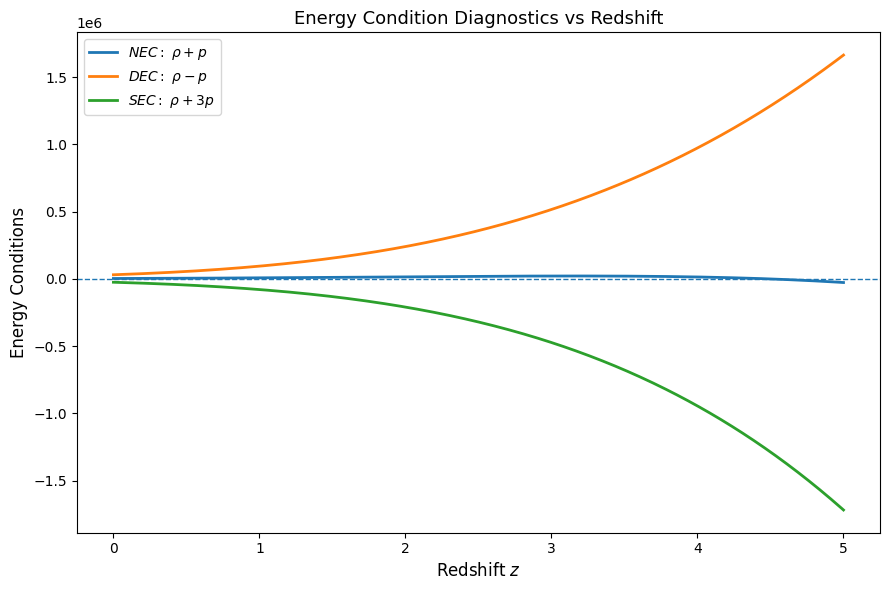
Verification of the classical energy conditions (NEC, WEC, DEC, SEC) reveals regimes of satisfaction and violation across redshifts, aligning with accelerated expansion and providing checks against unphysical behavior. The model ensures positivity of the matter-energy density and dominant negative pressure, as required for cosmological viability.
Figure 6: Redshift evolution of the energy conditions evaluated using parameter values constrained by the f(T)6 dataset.
Implications and Future Directions
The investigation confirms that torsion-based f(T)7 gravity models, when parametrized with a hybrid scale factor and exponential f(T)8, can reproduce late-time acceleration without explicit dark energy. The model’s consistency with observational expansion rates, cosmographic diagnostics, and energy conditions substantiates its theoretical viability. Practical implications include the potential to resolve the fine-tuning and coincidence problems associated with the cosmological constant. Theoretically, these models open avenues for further exploration of gravitational sector modifications as sources of cosmic acceleration, with direct consequences for dark energy phenomenology and model selection.
Anticipated future research may focus on tighter constraints with next-generation cosmological datasets, the inclusion of additional diagnostics (e.g., growth of structure, lensing), or extensions to spatially curved geometries. The f(T)9 framework’s mathematical simplicity relative to a(t)=eλttβ0 gravity suggests continued utility in cosmological modeling and numerical simulations for precision cosmology.
Conclusion
The study establishes an a(t)=eλttβ1 teleparallel gravity model based on a hybrid scale factor and exponential functional form, demonstrating observational consistency with a(t)=eλttβ2 datasets and robust reproduction of cosmic acceleration. Theoretical and empirical examination shows the model’s close correspondence to quintessence-like expansion, with asymptotic approach to a(t)=eλttβ3CDM. The results underscore the efficacy of torsion-based gravity modifications as alternatives to the cosmological constant, supporting their further investigation within the context of late-time cosmological evolution.
“Emergent Mind helps me see which AI papers have caught fire online.”
Philip
Creator, AI Explained on YouTube
Sign up for free to explore the frontiers of research
Discover trending papers, chat with arXiv, and track the latest research shaping the future of science and technology.Discover trending papers, chat with arXiv, and more.