- The paper presents an f(T) gravity model extending TEGR with non-linear torsion terms to reproduce cosmic acceleration.
- It employs phase-space dynamical analysis and MCMC observational fitting to tightly constrain model parameters like m and n.
- The study demonstrates smooth cosmic transitions through radiation, matter, and de Sitter epochs, aligning well with ΛCDM predictions.
Cosmological Parameters in f(T) Gravity: Theoretical and Observational Insights
Introduction and Theoretical Framework
The study systematically investigates a well-motivated class of f(T) gravity models, extending the teleparallel equivalent of General Relativity (TEGR) via the torsion scalar T. The functional form f(T)=αT−βu−n+γum (with u=−T/6) encompasses the effects of non-linear torsion contributions, allowing a flexible description of gravitational phenomena. The model is structured to address both theoretical and observational constraints, with α,β,γ,n,m parameterizing deviations from TEGR and introducing new dynamical features relevant for cosmic acceleration.
The framework takes vierbein fields as primary dynamical variables, constructing modified Friedmann equations within a flat FLRW background. The resultant field equations naturally yield effective dark energy (DE) density and pressure terms, with the equation-of-state (EoS) parameter for DE acquiring non-trivial redshift evolution. As is standard in f(T) cosmology, the violation of local Lorentz invariance is present but does not affect the field equations' general structure in the background cosmology considered.
Dynamical Systems and Phase Space Analysis
The model is recast into an autonomous dynamical system using dimensionless variables (x,y,r), encoding the effective densities corresponding to the β, γ extensions and the radiation sector, respectively. Critical points of the system, corresponding to radiation, matter, and dark energy dominated phases, are analytically determined, and their stability is interrogated via the eigenvalues of the Jacobian matrix.
The analysis identifies three fundamental critical points:
- f(T)0: A de Sitter attractor with f(T)1, corresponding to a late-time dark energy-dominated Universe; the stability analysis reveals two negative eigenvalues and one zero eigenvalue, confirming a stable, non-isolated attractor.
- f(T)2: Radiation-dominated (f(T)3), generically unstable or a saddle depending on the f(T)4 parameter regime.
- f(T)5: Matter-dominated (f(T)6), typically a saddle except for a subset of parameter choices.
These results establish that the f(T)7 model robustly accommodates the entire sequence of cosmic evolution—radiation, matter, and accelerated expansion—as fixed points with the appropriate (in)stability properties, provided the model parameters satisfy f(T)8, f(T)9 for dynamical viability.
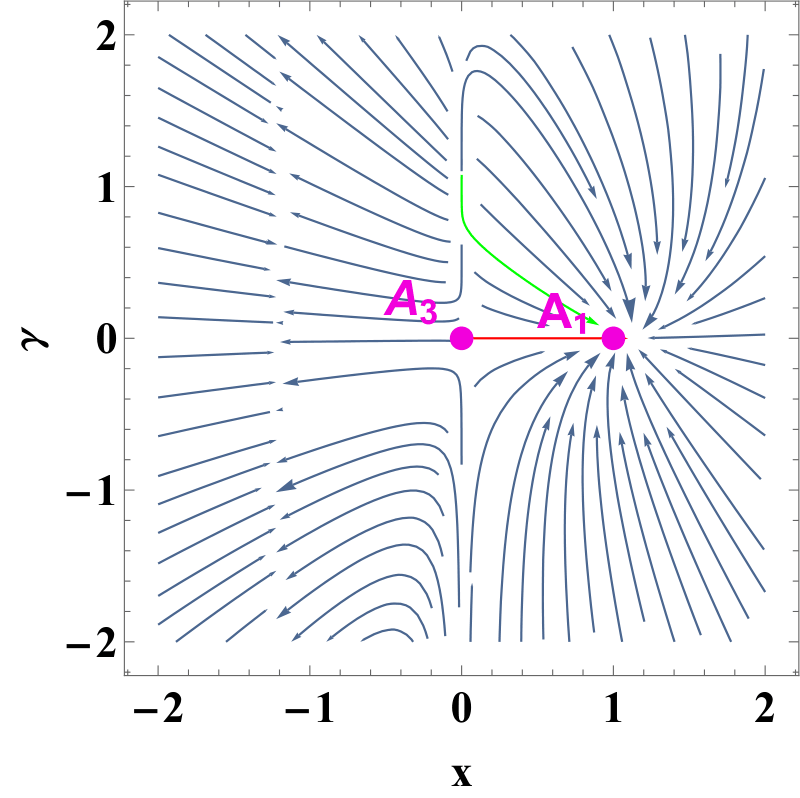
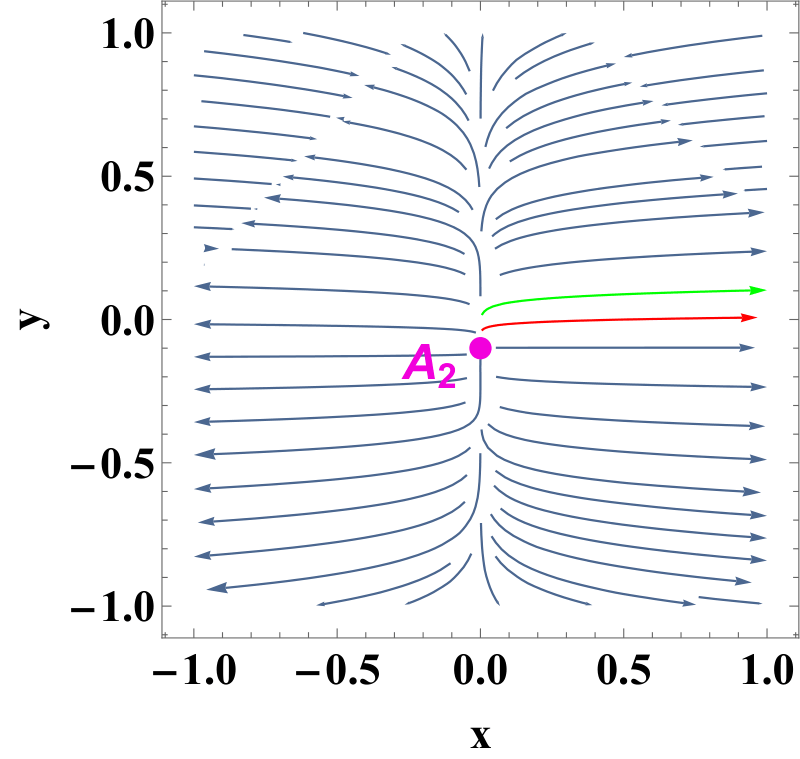
Figure 1: Phase space diagram of the autonomous system, illustrating the location and stability properties of the critical points T0 (de Sitter), T1 (radiation), and T2 (matter).
The redshift-dependent evolution of T3, T4, density parameters, and the deceleration parameter further corroborates this structure. Notably, T5 crosses the phantom divide (T6 at T7), matching recent CMB and supernova data.
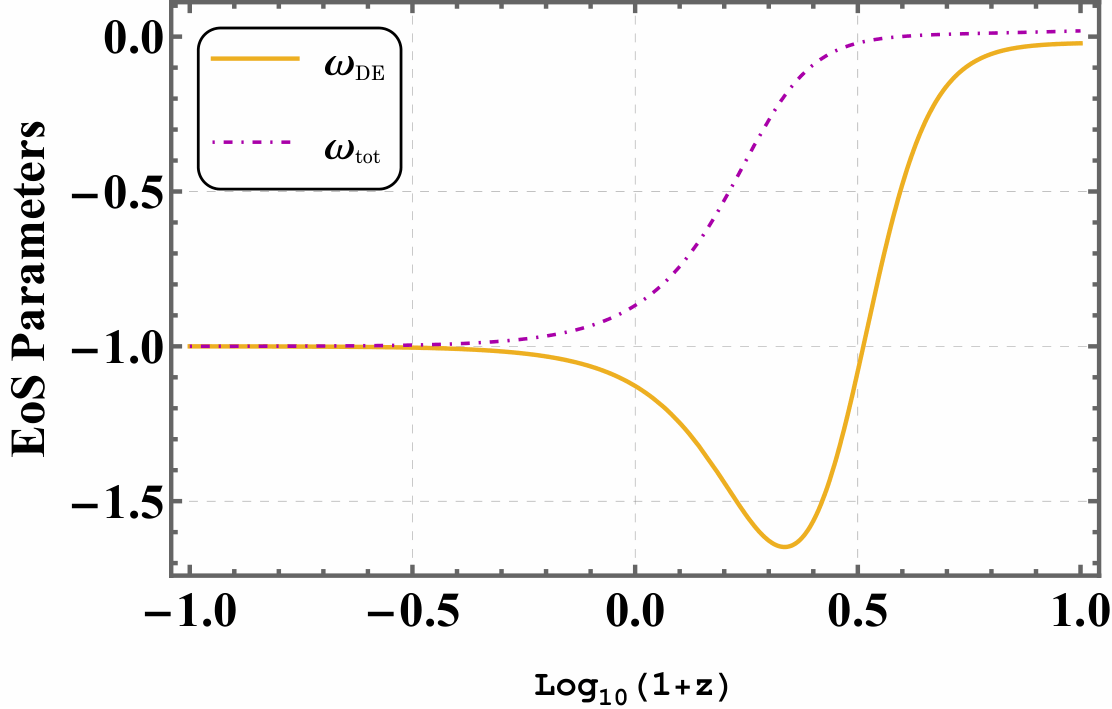
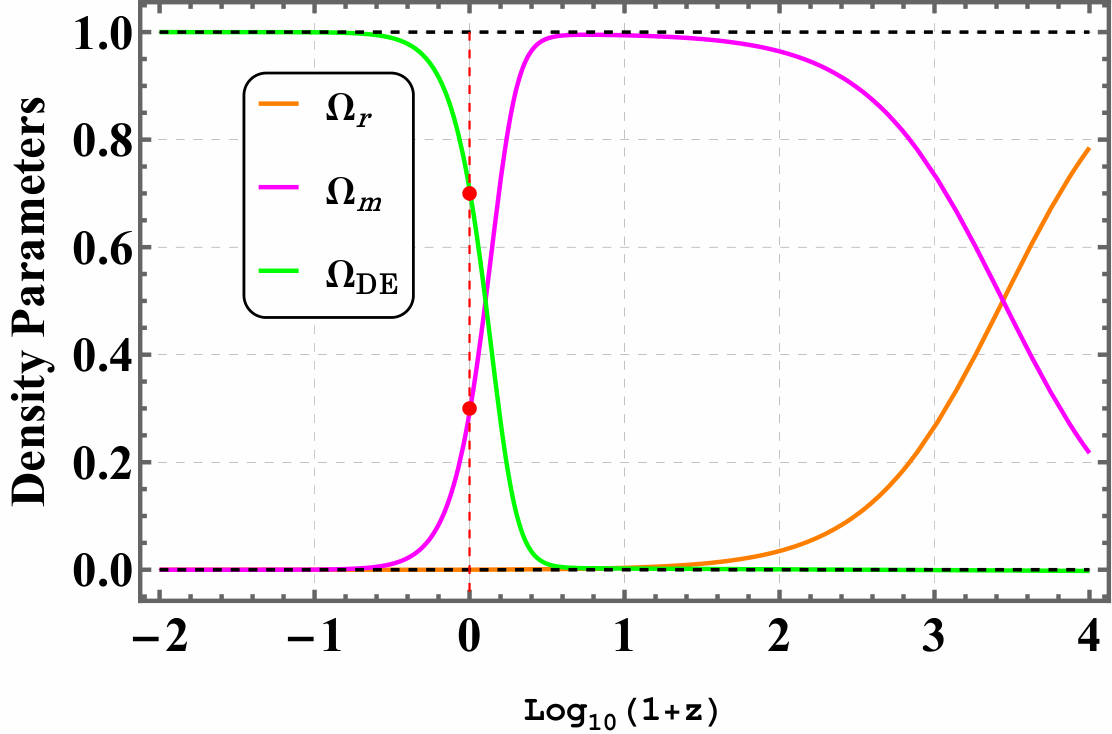
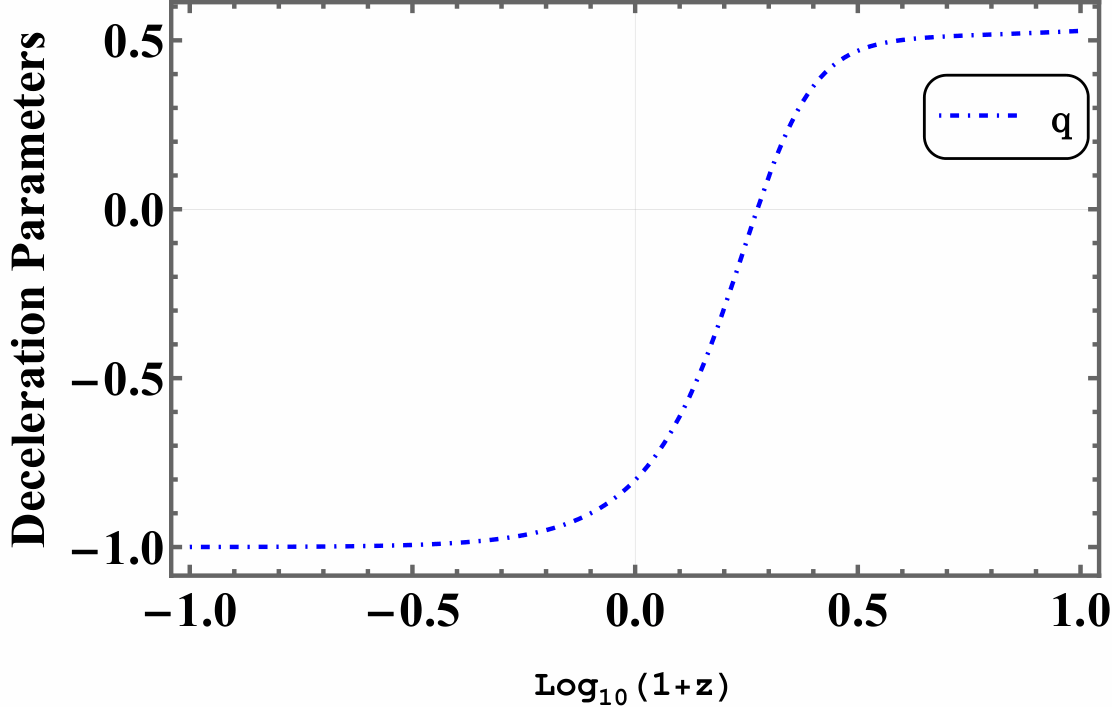
Figure 2: Evolution of EoS parameters, density components, and the deceleration parameter as functions of redshift, demonstrating transitions through radiation, matter, and dark energy dominated eras and consistent with T8CDM at late times.
Observational Constraints and MCMC Data Analysis
To anchor the model in observational reality, the analysis employs Markov Chain Monte Carlo (MCMC) methods on multiple cosmological datasets: T9 expansion rate measurements, the Pantheon+SH0ES Type Ia supernovae sample, and DESI DR2 BAO data. The parameter space f(T)=αT−βu−n+γum0 is simultaneously fit to the combined likelihood, with dimensional priors fixed by theoretical considerations.
Contour plots from these analyses reveal tight constraints, particularly from the combined dataset, with the best-fit values:
- f(T)=αT−βu−n+γum1,
- f(T)=αT−βu−n+γum2,
- f(T)=αT−βu−n+γum3,
- f(T)=αT−βu−n+γum4,
where the f(T)=αT−βu−n+γum5 values are consistent with the theoretically required stability regime.
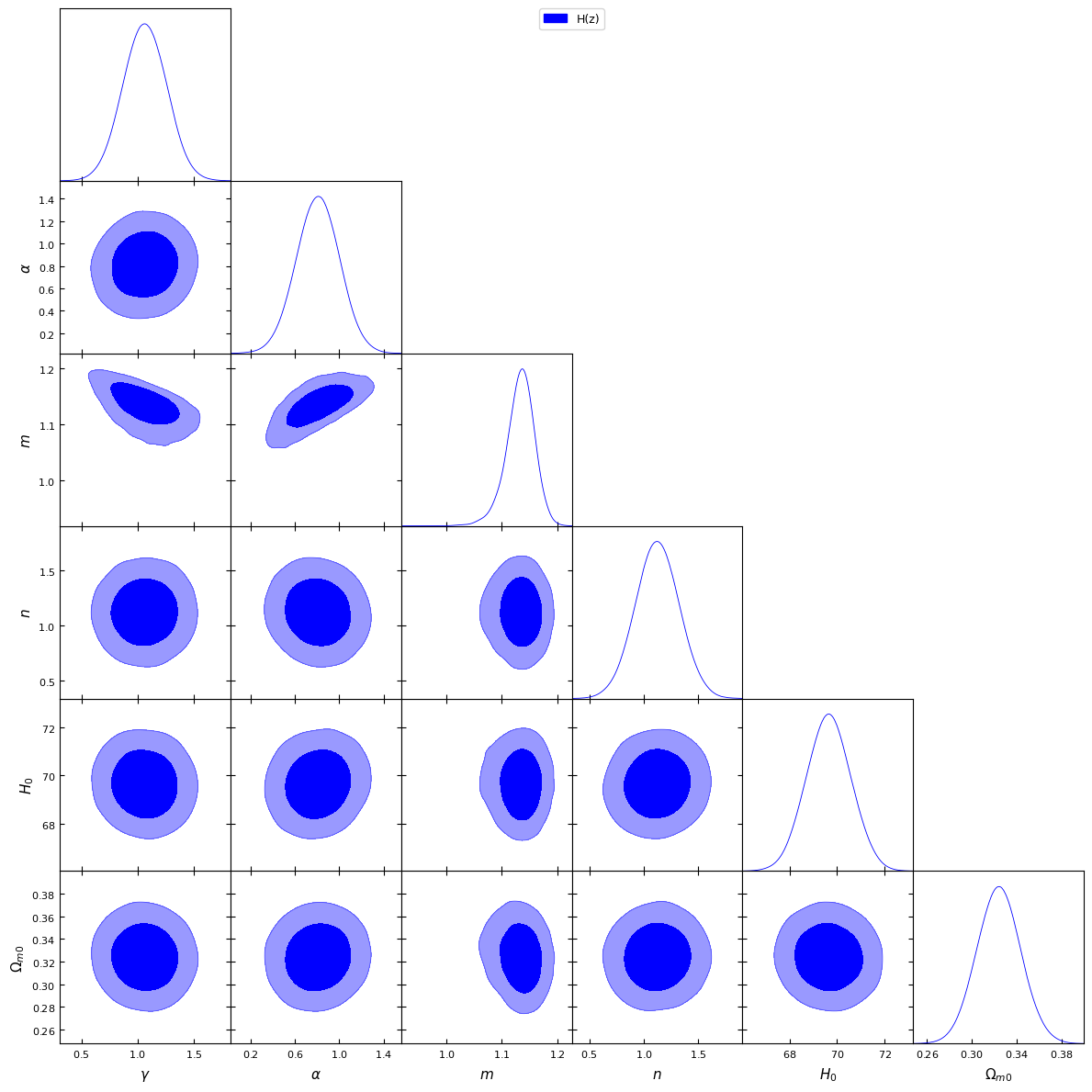
Figure 3: Two-dimensional parameter contours derived from DESI DR2 BAO analysis, showing the constraint region for f(T)=αT−βu−n+γum6.
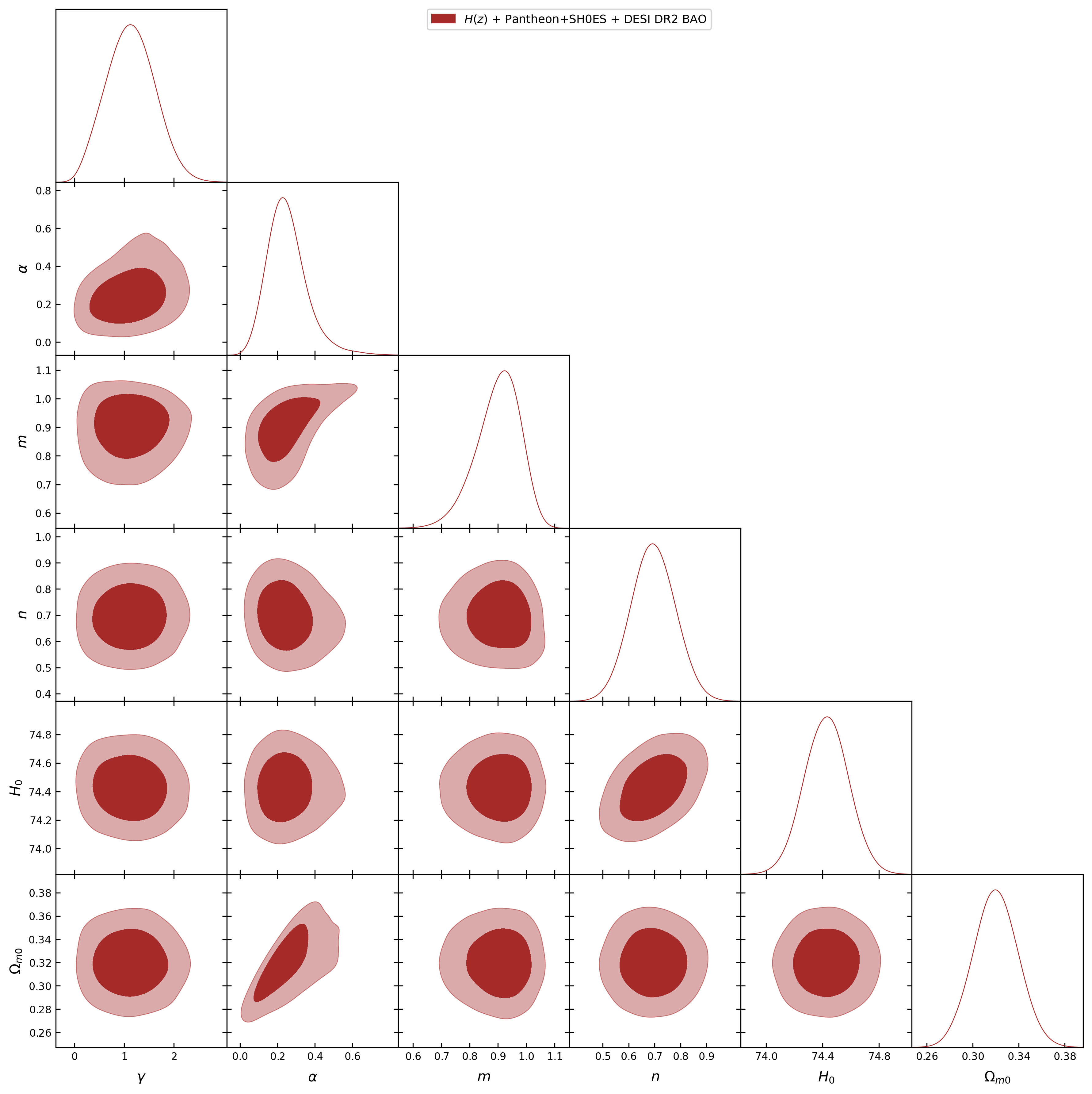
Figure 4: Combined constraints from f(T)=αT−βu−n+γum7, Pantheon+SH0ES, and DESI DR2 BAO, illustrating the overlap region and the precision reached for the f(T)=αT−βu−n+γum8 model parameters.
A further cross-dataset comparison indicates that the f(T)=αT−βu−n+γum9 model's best-fit parameters are consistently compatible with current expansion history and distance modulus observations. Hubble diagrams and distance modulus residuals confirm close alignment with the standard u=−T/60CDM prediction.
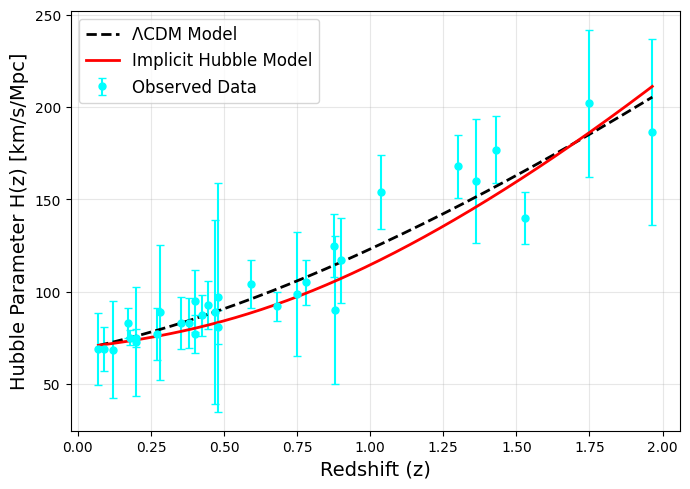
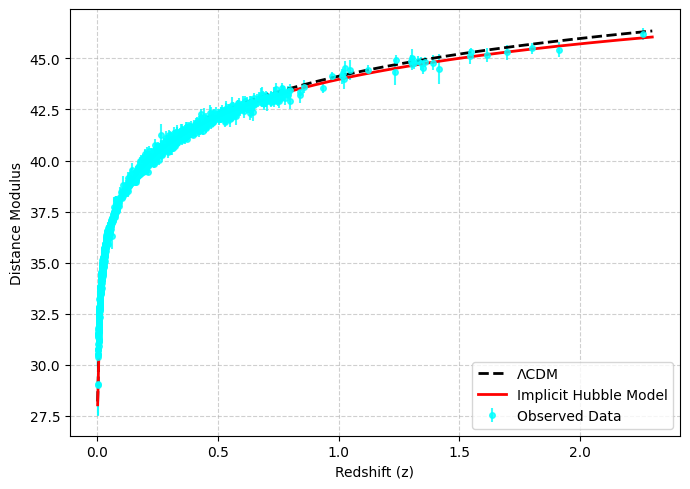
Figure 5: Left: Redshift evolution of the Hubble parameter with error bars. Right: Distance modulus as a function of redshift, both compared to observational data.
Implications and Future Directions
The paper establishes that the specific u=−T/61 model considered efficiently reproduces the observed cosmic acceleration while providing a more general theoretical foundation than the cosmological constant. Its ability to transition through all cosmic epochs, reproduce the observed Hubble rate, and match density parameter values (u=−T/62, u=−T/63) underscores its phenomenological plausibility. The non-trivial evolution of u=−T/64, including phantom crossing, may offer signatures distinguishable from u=−T/65CDM in future, higher-precision surveys.
From a theoretical standpoint, the simultaneous satisfaction of dynamical system stability and data-driven parameter constraints highlights the appropriateness of the chosen u=−T/66 form. The methodology—dynamical analysis followed by high-dimensional MCMC observational fitting—is generalizable to broader u=−T/67 and related torsional gravity models.
Prospective research directions include:
- Examining structure growth and perturbation spectrum consistency,
- Extension to non-flat cosmologies or inclusion of non-minimal couplings,
- Investigation of potential small-scale anomalies or distinguishing signatures relative to u=−T/68 gravity,
- Deeper comparison with upcoming Stage IV survey data.
Conclusion
By integrating thorough dynamical systems analysis with multifaceted observational constraints, the study demonstrates that the considered u=−T/69 gravity model is both theoretically viable and observationally consistent as an alternative to α,β,γ,n,m0CDM. The parameter space supporting cosmological transitions and late-time acceleration is sharply delineated, and empirical datasets validate the model’s efficacy in fitting key cosmological observables. The work therefore reinforces the case for α,β,γ,n,m1 gravity as a credible extension framework, meriting continued investigation with forthcoming high-precision cosmological data.

