- The paper presents a comparative study of optomechanical, electro-optic, and magneto-optic platforms, quantifying efficiency, added noise, and bandwidth for coherent state transfer.
- It details methodologies such as radiation pressure, the Pockels effect, and Zeeman interactions, citing key metrics like 93% and 99.5% internal efficiencies alongside minimal added noise.
- The findings imply that integrating diverse transduction approaches is essential for achieving scalable quantum networks, highlighting advances in nanofabrication and material engineering.
Introduction and Motivation
Scalable quantum networks depend critically on high-fidelity interfaces that coherently convert microwave photons harnessed in superconducting quantum processors to optical photons suitable for low-loss fiber transmission. This interface is required to bridge the technological divide between superconducting qubit platforms, which exhibit fast gates and compatibility with integrated circuit fabrication, and optical communication links, which natively support long-distance quantum state transfer with minimal loss and environmental noise. No single hardware or physical system is capable of simultaneously supporting the requirements of high-coherence quantum logic, quantum memory, and large-scale photonic transport. Consequently, heterogeneous quantum networking architectures that integrate multiple physical layers via quantum transduction have become a central focus in the quest for a practical quantum internet.
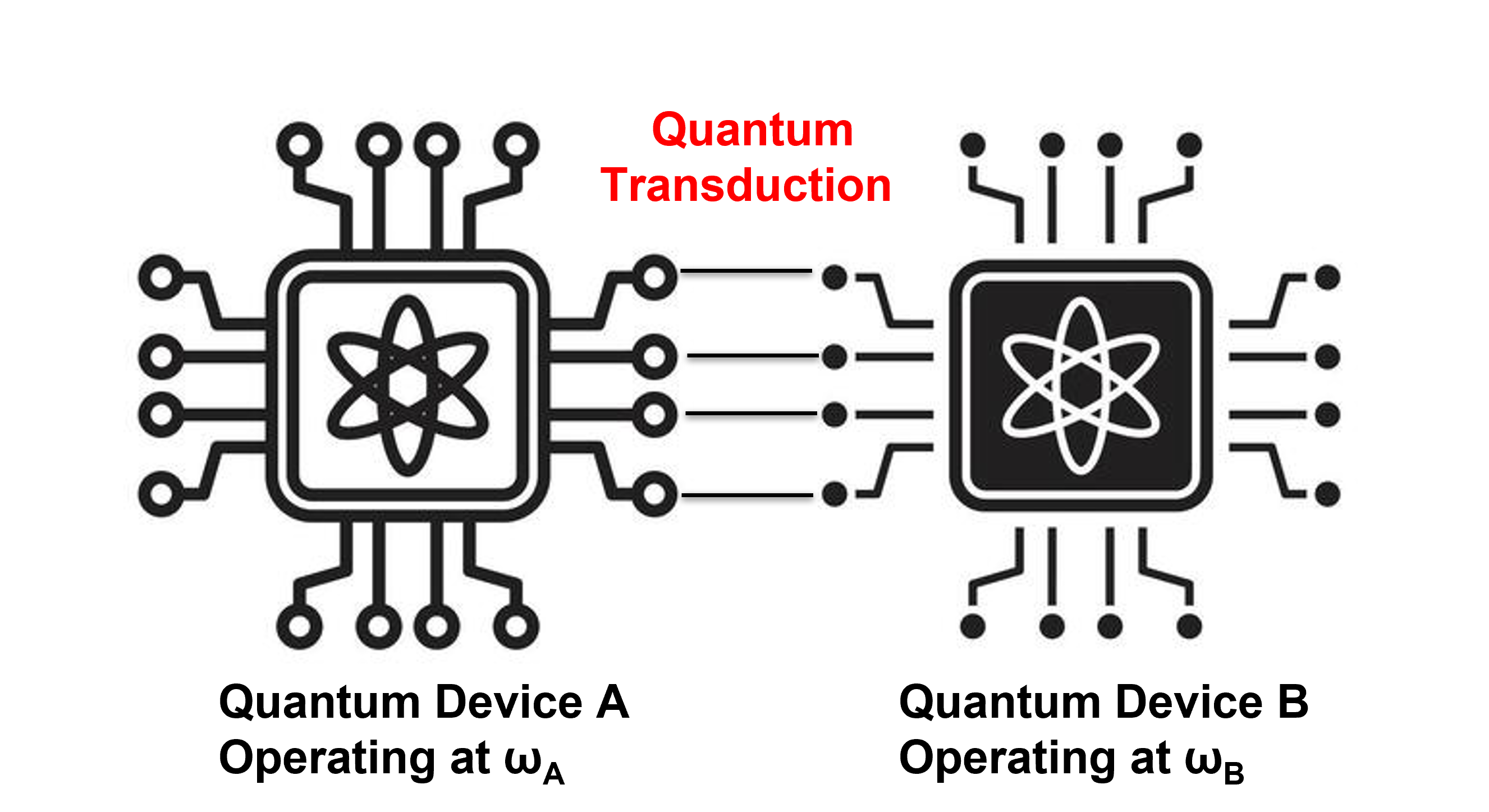
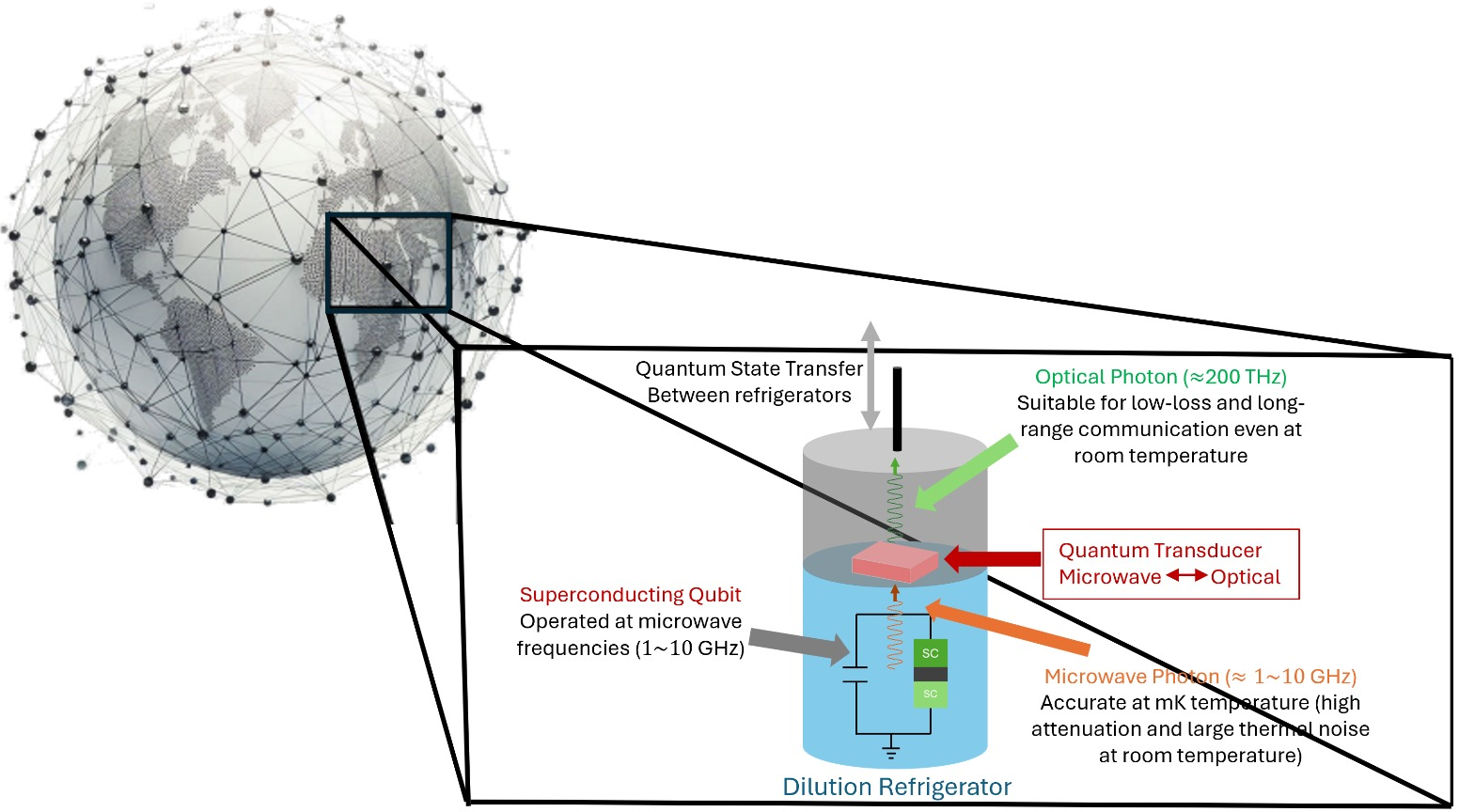
Figure 1: Schematic illustration of heterogeneous quantum networks connected via a quantum transduction interface (left); microwave-to-optical state transfer inside a dilution refrigerator for modular quantum communication (right).
The direct frequency gap between microwave (~1–10 GHz) and optical (~200 THz) domains spans five orders of magnitude, presenting formidable constraints. Coherent transduction must operate without measurement or amplification, due to the no-cloning theorem and the destructive nature of quantum measurement, which rule out all classical strategies for frequency conversion. Only schemes based on reversible, quantum-coherent physical interactions are viable.
Physical Principles and Transducer Architectures
The paper systematically reviews three leading paradigms for microwave-optical quantum transduction: optomechanical, electro-optic, and magneto-optic (optomagnonic) platforms. Each architecture can be rigorously modeled as either direct coherent photon–photon interaction (N=0 stages), or via a single intermediate bosonic mode (N=1), such as a phonon or magnon, which mediates the quantum state transfer.
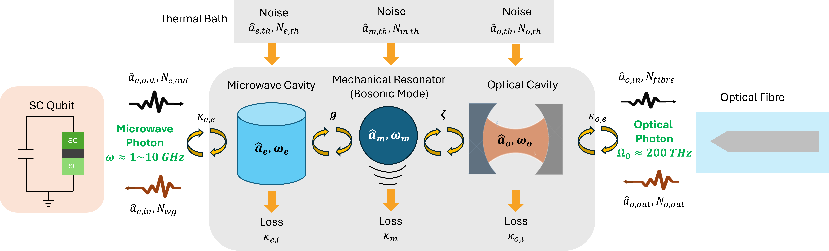
Figure 2: Physical quantities underlying single-stage quantum transduction with losses, mode frequencies, coherent coupling rates, and intrinsic channels; for all platforms, added noise is predominantly thermal at gigahertz frequencies, while optical noise is negligible near 200 THz.
Key system parameters:
- Efficiency (η): Probabilistic transfer of a quantum excitation from input microwave to output optical mode.
- Added noise (Nadd): Mean number of spurious noise photons, after referencing all noise sources to the microwave input.
- Cooperativity (C): Governs strong-coupling regime and is quadratic in the interaction rate and inversely proportional to dissipation.
- Bandwidth: Determined by the rate at which quantum state transfer can occur, set by the relevant loss rates and couplings.
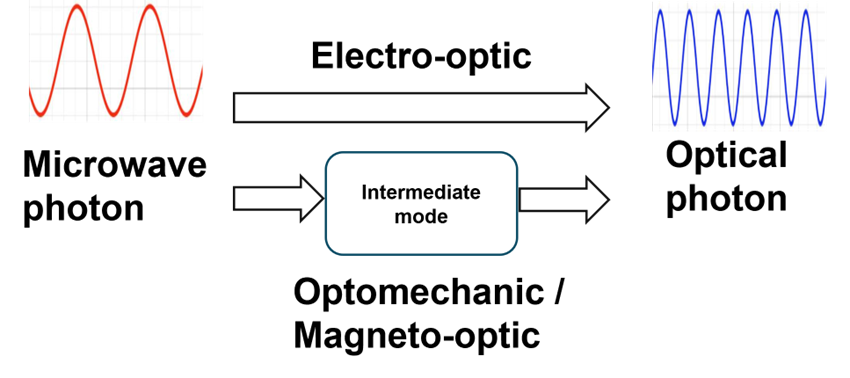
Figure 3: Schematic comparison among transduction schemes. Top: direct zero-stage electro-optic (Pockels effect); bottom: one-stage platforms based on optomechanical and magneto-optic intermediaries.
Optomechanical Systems
Optomechanical quantum transducers exploit strong coupling via radiation pressure to coherently exchange excitations between microwave, mechanical, and optical modes, typically enabled by a highly engineered membrane or nanobeam. Significant advances include the realization of 93% internal efficiency and sub-quantum-limited added noise (Nadd=0.25) at dilution refrigerator temperatures in 2D silicon optomechanical crystals, with MHz-scale mechanical frequencies facilitating cryogenic ground-state operation.
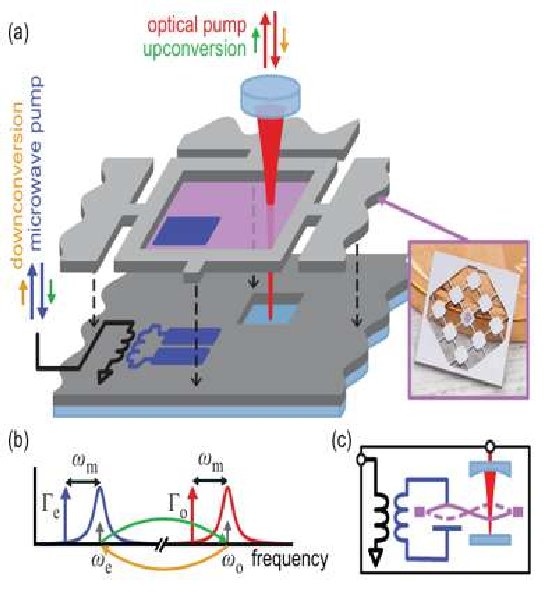
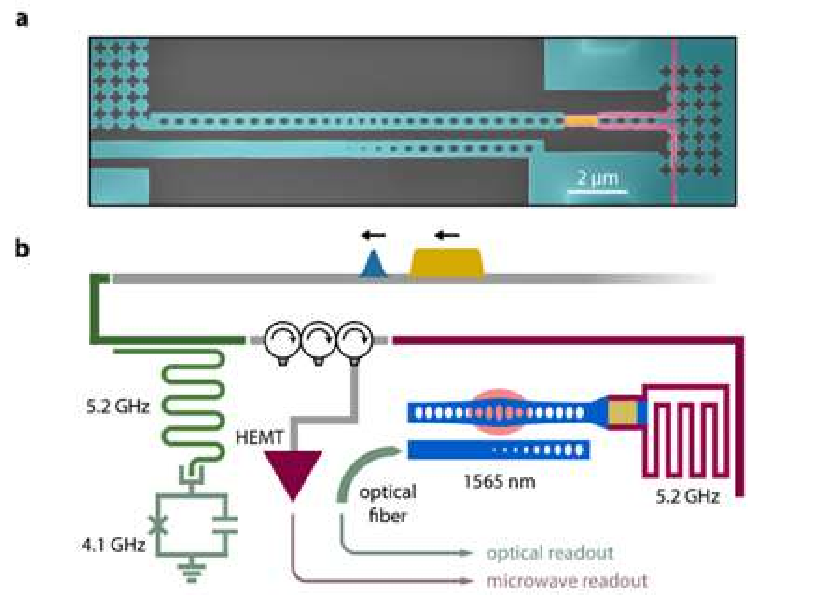
Figure 4: Left: SiN membrane platform; right: nanobeam OMC with co-localized microwave and telecom cavity. Both demonstrate quantum-coherent mechanical state transfer.
The principal limitation is bandwidth, as resonator linewidths restrict conversion to tens–hundreds of kHz, and scalability is challenged by thermal management of co-integrated mechanical and superconducting circuits. Pulsed operation, advanced phononic shielding, and material engineering have progressively reduced heating, but simultaneous optimization of bandwidth, noise, and efficiency remains challenging.
Electro-Optic Systems
Electro-optic (EO) transducers leverage the Pockels effect, directly coupling microwave and optical photons in materials with nonzero second-order susceptibility (χ(2)), notably LiNbO3 and AlN. Planar thin-film devices co-localize high-Q optical and microwave modes, while design optimization enhances modal overlap and internal cooperativity. Recent experiments have achieved internal efficiencies approaching 99.5% with <0.16 added noise photons at 60 mK, and measured bandwidths in the range of 10–100 MHz. Notably, all-optical coherent control and readout of superconducting qubits has been demonstrated, strongly motivating EO platforms for scalable superconducting qubit readout and quantum interfacing.
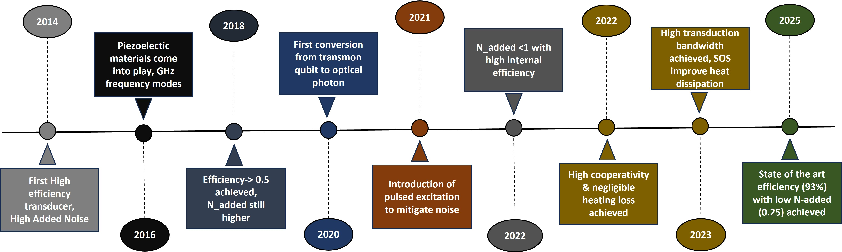
Figure 5: Timeline overview of major milestones in optomechanical transduction (2014–2025).
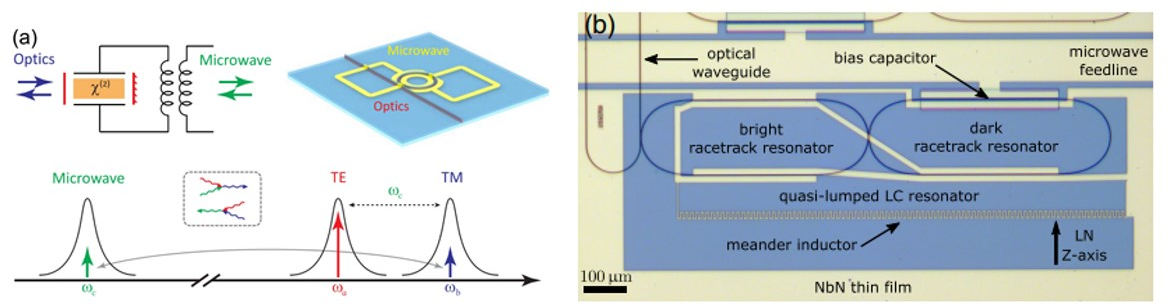
Figure 6: Electro-optic transducer architectures—left: AlN cavity platform; right: thin-film LiNbO3 racetrack with co-integrated LC resonator.
The bottleneck is external coupling: fiber-chip and microwave-port inefficiencies suppress total (external) efficiency relative to impressive internal values. Additionally, optical pump absorption can induce excess thermal occupation at milliKelvin operation, limiting duty cycles and coherence.
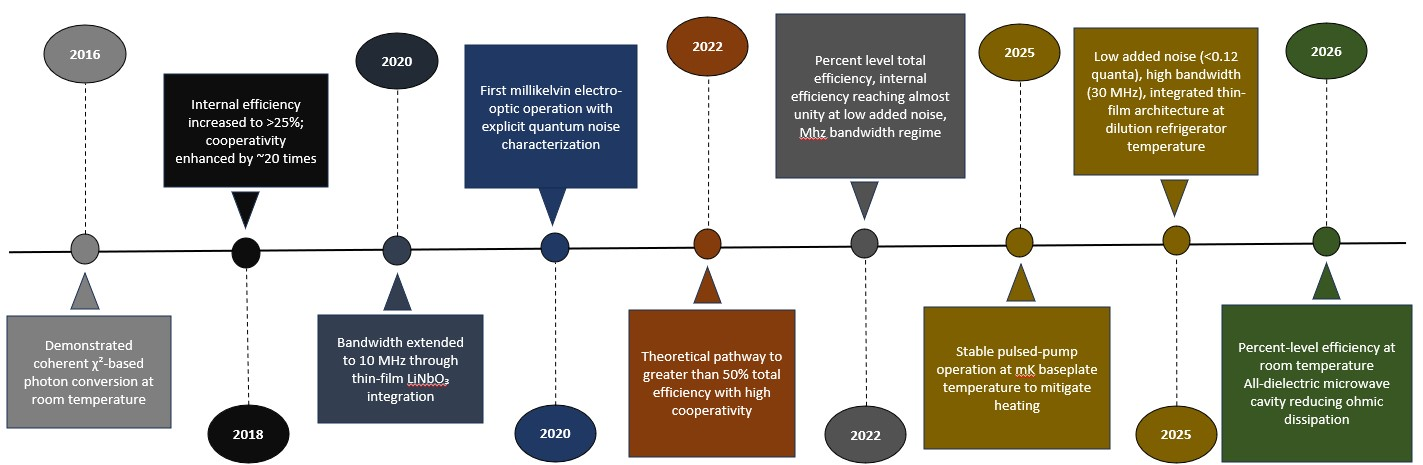
Figure 7: Timeline of electro-optic platform advances (2016–2026).
Magneto-Optic (Optomagnonic) Systems
Magneto-optic interfaces employ collective magnon modes in ferromagnetic materials (YIG, antiferromagnets), coupling to microwave photons via Zeeman interaction and to optical photons via the Faraday effect. The major distinguishing features are non-reciprocity (due to broken time-reversal symmetry), continuous frequency tunability via external magnetic fields, and potential for THz-wide bandwidths. However, the optomagnonic cooperativity N=10 is orders of magnitude below unity (N=11—N=12 predicted), fundamentally constraining efficiency (maximum measured N=13). Topological heterostructures and magnon squeezing are proposed to increase coupling strength, but these approaches have not yet achieved experimental validation in the quantum regime.
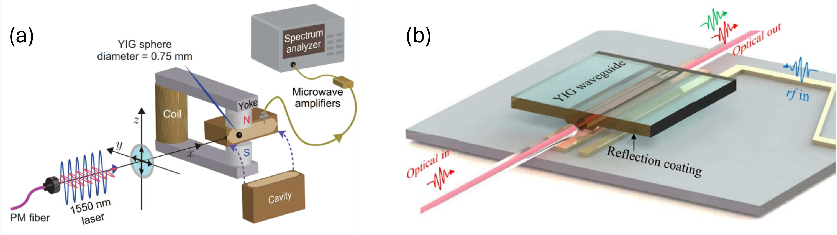
Figure 8: Left—YIG sphere coupled via microwave cavity and laser field; right—integration of YIG in nanophotonic waveguide cavity.
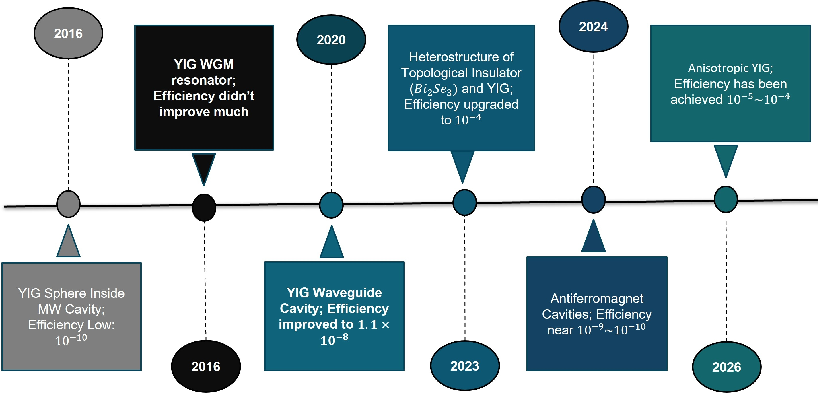
Figure 9: Progress timeline for magneto-optic transduction platforms (2016–2026).
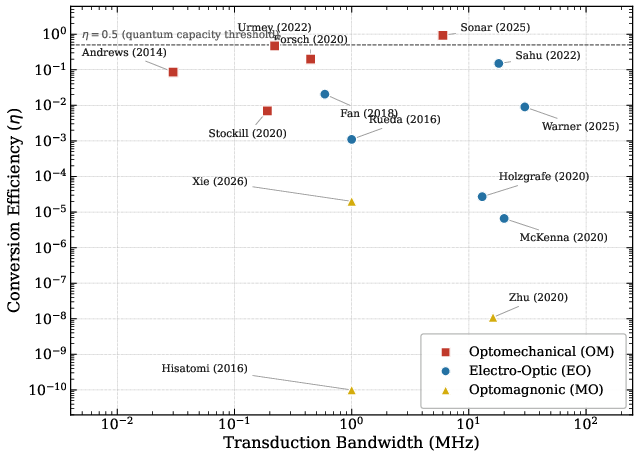
Figure 10: Efficiency-bandwidth performance comparison: Optomechanics (squares) yield highest conversion efficiency; EO (circles) realize the broadest bandwidths; magneto-optics (triangles) unique for non-reciprocity and broadband potential, but with low conversion efficiency.
Key quantitative findings:
- Optomechanical: Up to 93% internal efficiency, N=14, but kHz–MHz bandwidth [10_Sonar2025].
- Electro-optic: 99.5% internal efficiency, external N=15 up to 15%, N=16 (best in class), bandwidth up to 100 MHz [Sahu2022, Warner2025].
- Magneto-optic: Measured efficiencies N=17, N=18, unique non-reciprocal behavior and magnetic tuning, with THz bandwidths theoretically accessible, but require advances (topological enhancement, squeezing) for practical utility [Zhu2020, Sekine2023TI, Xie2026].
No single platform concurrently achieves high efficiency, low noise, wide bandwidth, and room temperature operation. Optomechanical devices remain the benchmark for quantum-limited state transfer; EO is optimal for bandwidth and chip-scale integration; magneto-optic elements are indispensable for non-reciprocal network topologies and fast frequency tuning.
Theoretical and Practical Implications
The authors propose two cross-platform comparison figures of merit:
- Internal efficiency (N=19): Allows fair benchmarking independent of external port and fiber losses.
- Magnon decay rate (η0): Governs the complex trade-off space of bandwidth, thermal noise, and efficiency in magnonic transducers; its reporting is strongly advocated for future experimental literature.
The findings imply that future quantum network architectures will necessitate a heterogeneous approach—deploying optomechanical converters for local quantum memory and high-fidelity links, EO devices for wideband quantum multiplexing, and magneto-optic components for routing, isolation, and nonreciprocity. Progress in nanofabrication, nonlinear materials (e.g., BaTiOη1), topological engineering, and noise control will be decisive for breaking the remaining trade-off constraints.
Conclusion
This review provides a precise comparative framework for heterogeneous quantum transduction and demonstrates that the major platforms—optomechanical, electro-optic, and magneto-optic—each independently realize crucial but distinct capabilities. The simultaneous optimization of efficiency, noise performance, bandwidth, and temperature robustness is not presently achievable in any single transduction architecture. The integration of these techniques, guided by comprehensive cross-platform benchmarking, is the definitive route toward modular, scalable quantum networks and distributed quantum computing (2605.26976).