- The paper introduces a resonant transduction paradigm using magnon-exciton coupling in 2D CrSBr to achieve coherent MW-to-optical conversion.
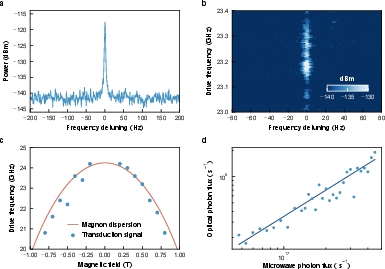
- It reports a conversion bandwidth of ~300 MHz with optical sidebands linearly scaling with the microwave photon flux.
- The study highlights potential enhancements through polariton engineering and microcavity integration for scalable quantum transduction architectures.
Microwave-to-Optical Transduction via Magnon–Exciton Coupling in Layered Antiferromagnetic CrSBr
Introduction
Microwave-to-optical (MW–optical) quantum transduction constitutes a critical bottleneck for integrating superconducting quantum processors operating at microwave (GHz) frequencies with optical links that enable low-loss, long-distance quantum communication. Existing approaches—including electro-optic, optomechanical, and atomic ensemble-based transducers—are limited by efficiency, bandwidth, added noise, and device integrability. Recent developments have explored magnon-based interfaces, but most implementations leverage fundamentally weak off-resonant magneto-optical effects, resulting in large requirements for device volume and/or cavity enhancement.
This work introduces and experimentally demonstrates a new transduction paradigm based on resonant magnon–exciton coupling in the layered van der Waals antiferromagnetic semiconductor CrSBr. The core innovation is the exploitation of the strong light–matter interaction at excitonic transitions, which offers a resonantly-enhanced, intrinsically broadband MW–optical interface. The experiment combines GHz-frequency magnon modes with high-oscillator-strength excitons, yielding coherent microwave field imprint on the optical probe via a two-step mechanism: microwave-driven magnon precession modulates the exciton resonance, generating optical sidebands. This process is investigated via direct optical reflectance measurements and homodyne detection, providing quantitative insight into conversion bandwidth, efficiency, and coupling parameters.
The platform consists of a bulk CrSBr crystal integrated on a CPW for microwave driving, characterized at cryogenic temperatures with the b-axis aligned to the waveguide center conductor. CrSBr exhibits an A-type antiferromagnetic ground state below its Néel temperature, with tunable canting angle θ between sublattices under an external magnetic field. This geometry allows for the excitation of optical (out-of-phase) and acoustic (in-phase) magnon modes in the few-GHz regime, even at zero field due to large intrinsic anisotropy.
The band structure and, crucially, the exciton energies are highly sensitive to θ. Interlayer hopping and exciton delocalization are controlled by the magnetic configuration, yielding large and magnetically-tunable energy shifts (∼120 meV for high-energy exciton XH, ∼20 meV for low-energy exciton XL). This mediates a strong coupling between the magnon and excitonic subsystems.
The conversion process involves two steps:
- RF driving near magnon resonance induces coherent spin precession and periodic modulation of the canting angle.
- This time-dependent modulation shifts the exciton resonance and thus the local dielectric function, imprinting sidebands on the reflected optical probe light at the drive frequency offset.
These processes are schematized and validated via microwave transmission (ΔS21) and optical reflectance (R/RBG) measurements.
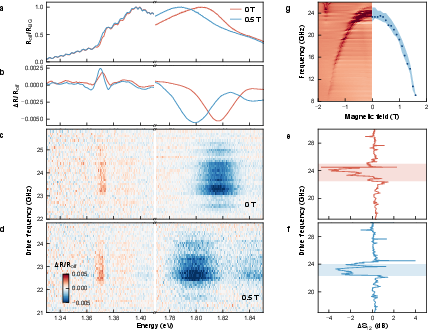
Figure 1: Magnon-induced reflectance change at excitonic transitions, confirming resonant magnon–exciton coupling in CrSBr.
Experimental reflectance under microwave drive reveals strong, field-tunable sideband signals precisely at the magnon-exciton resonance intersection. The response is highly selective for light polarized along the b-axis, consistent with the excitonic dipole orientation.
Coherent Conversion and Bandwidth Characterization
Homodyne detection is employed to quantify the coherence and efficiency of the MW–optical transduction process. Probe and LO beams at the exciton resonance are mixed after reflection from the CrSBr sample; the resultant homodyne beat note is measured by a spectrum analyzer.
Key observations include:
The measured external conversion efficiency is θ2 in the current bulk configuration without photonic or microwave cavity enhancement. The low efficiency is attributed to volume mismatch between optical and magnon excitation regions and the use of an unoptimized bulk crystal.
Transduction Physics and Strategies for Enhancement
The underlying physics is described by a linearized magnon–exciton Hamiltonian where the single-particle coupling rate θ3 depends on both the sensitivity of the exciton frequency to the canting angle and the magnitude of zero-point spin fluctuations θ4. In bulk, θ5 kHz for θ6, already θ71000× stronger than in traditional YIG. Critically, this coupling scales inversely with θ8, indicating substantial enhancement potential in nanostructures with reduced magnetic volume.
The calculated single-exciton cooperativity in the bulk geometry is small (θ9), mainly limited by large excitonic linewidths. Nevertheless, CrSBr's two-dimensional nature enables dramatic confinement and, together with microcavity or microwave resonator integration, projected cooperativity values of θ0 (few-layer flakes) and up to θ1 (ideal bilayers) are attainable. These regimes would support strong, quantum-coherent MW–optical transduction.
Further mitigations for dissipative loss and bandwidth enhancement are realized through polariton engineering. CrSBr forms natural Fabry-Pérot microcavities due to index contrast, resulting in multiple self-hybridized exciton-polariton resonances with reduced optical loss (lower θ2) and significant magnon coupling inherited from the excitonic component.
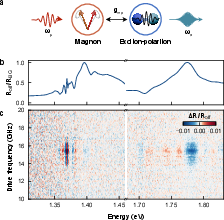
Figure 3: Multiple polariton-assisted magnon–exciton transduction resonances, highlighting the engineering of bandwidth and loss via exciton–photon hybridization.
Polariton transduction features broaden the usable optical detuning window, enhance bandwidth, and allow tailoring of the magnon–polariton coupling θ3 via Hopfield coefficients. This approach avoids the Faraday-effect's reliance on bare excitonic resonances and offers both practical and engineering advantages for scalable architectures.
Implications and Outlook
The demonstration of resonantly-enhanced, broadband MW–optical transduction via magnon-exciton coupling in a layered antiferromagnetic semiconductor establishes a scalable and integrable interface platform. The ability to engineer optical, magnetic, and polaritonic properties in 2D materials such as CrSBr creates new opportunities:
- On-chip, cavity-enhanced transducers supporting near-unity efficiency and low added noise.
- Tunable, multi-frequency conversion interfacing for hybrid quantum networks.
- Architectures that can simultaneously address bandwidth, noise, and integration demands currently limiting state-of-the-art quantum transduction schemes.
Anticipated future developments include the incorporation of microcavities for Purcell enhancement, integration into superconducting microwave circuitry, and exploiting monolayer or few-layer CrSBr for ultra-strong coupling. The coupled magnon–polariton system also opens up new avenues for exploring non-equilibrium magnonics, coherent nonlinear optics, and magnon-mediated quantum operations in van der Waals magnets.
Conclusion
This work provides a thorough experimental and theoretical foundation for MW–optical quantum interfaces leveraging magnon–exciton coupling in layered CrSBr. By moving beyond weak off-resonant effects, the approach unlocks resonantly-enhanced, broadband, and potentially highly efficient transduction mechanisms. Polariton engineering, device miniaturization, and microcavity integration point towards practical quantum interconnects compatible with emerging quantum network demands. This establishes magnon-coupled vdW magnets as a competitive and versatile material platform for future quantum technologies.