- The paper introduces ReTri, a co-designed communication strategy that reduces phase count to ⌈log₃ n⌉ via tailored ternary block propagation.
- It leverages bidirectional exchanges with two transceivers per node to achieve up to 10× speedup over static methods while minimizing reconfiguration overhead.
- Simulation studies demonstrate enhanced scalability and performance across network sizes, outperforming conventional methods like Bruck's algorithm.
Revisiting Bruck: Phase-Efficient All-to-All Communication in Reconfigurable Networks
Context and Motivation
All-to-All communication constitutes a critical bottleneck in distributed machine learning and high performance computing infrastructures. This pattern is intrinsic to workloads such as Mixture-of-Expert token dispatch and embedding synchronization, where dense, destination-oriented traffic saturates interconnects, often accounting for over half of total training time. As accelerator counts escalate in hyperscale datacenters, conventional electrically switched fabrics struggle with power and bandwidth constraints. Optical Reconfigurable Networks (ORNs), offering programmable physical topologies with bidirectional high-bandwidth links, present a new path to mitigate these bottlenecks; however, the benefit is tightly bound to the structure and phase decomposition of communication collectives, since each topology adjustment incurs non-negligible reconfiguration delay.
Bruck's Algorithm and the Pitfalls of Conventional All-to-All
Traditional All-to-All algorithms, including Bruck's, decompose communication into structured phases with one-directional ring-based block propagation. While they are conducive to ORNs, these algorithms ignore the advantage of bidirectional optical links by treating each direction independently or mirroring the workload. Bandwidth utilization can be doubled, but minimizing the number of communication phases is paramount since each phase may necessitate a network-wide reconfiguration. Direct, destination-oriented All-to-All is ill-suited for ORNs because it lacks structured phase exposure, fails to partition traffic according to optical port constraints, and results in suboptimal topology adaptation.
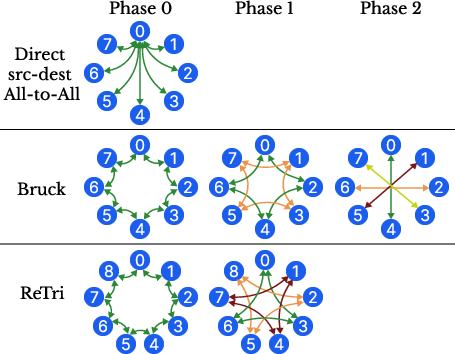
Figure 1: Communication phases for Bruck, ReTri, and direct src-dest All-to-All; ReTri eliminates one phase relative to Bruck.
ReTri: Bidirectional, Ternary, Phase-Optimized All-to-All
The paper introduces ReTri, a co-designed All-to-All communication schedule and reconfiguration strategy optimized for ORNs with two transceivers per node. ReTri leverages a ternary block propagation inspired by the Trivance approach, wherein each node participates in pairwise bidirectional exchanges in every phase, reducing the phase count to ⌈log3n⌉. The ternary pattern guarantees symmetrical communication with two peers per phase—one to the left and one to the right—forming persistent connected subrings that align precisely with the optical port constraints.
This structure shortens propagation paths and reduces hop counts compared to ring-based schedules, minimizing congestion and latency. The algebraic properties of balanced ternary representation enable deterministic block forwarding and minimal subring formation, ensuring future phase reachability and efficient reuse of topology states. Correctness proofs rooted in combinatorics validate that every source-destination block follows a unique path with balanced load per phase.
Reconfiguration Schedules and Cost Model
ReTri's topology schedule configures degree-two subrings for each phase, matching physical link directionality and maintaining minimal mutual connectivity. The paper develops an extended Hockney α-β model, characterizing the cost of All-to-All as a sum of per-phase delay, per-hop latency, transmission delay, and reconfiguration overhead. By structuring phases to maximize per-topology block traffic, ReTri amortizes reconfiguration costs across multiple phases and segments. When the number of reconfigurations R is fixed, the optimal schedule balances the segment lengths. For large systems, frequent reconfiguration is advantageous when the reduction in communication distance and congestion outweighs the reconfiguration delay—a condition increasingly satisfied in the presence of large networks, sizable messages, or limited bandwidth.
Numerical Evaluation
Simulation studies (using Astra-Sim and ns-3) demonstrate that ReTri achieves up to 10× speedup relative to a static All-to-All, even under millisecond-scale reconfiguration delays, and sustains 2.1× improvement over Bruck's reconfiguration strategy. For small message sizes and low reconfiguration delay (1μs), ReTri's reduced phase count and efficient link utilization provide substantial gains. The speedup persists or grows for larger messages and higher node counts, highlighting scalability.
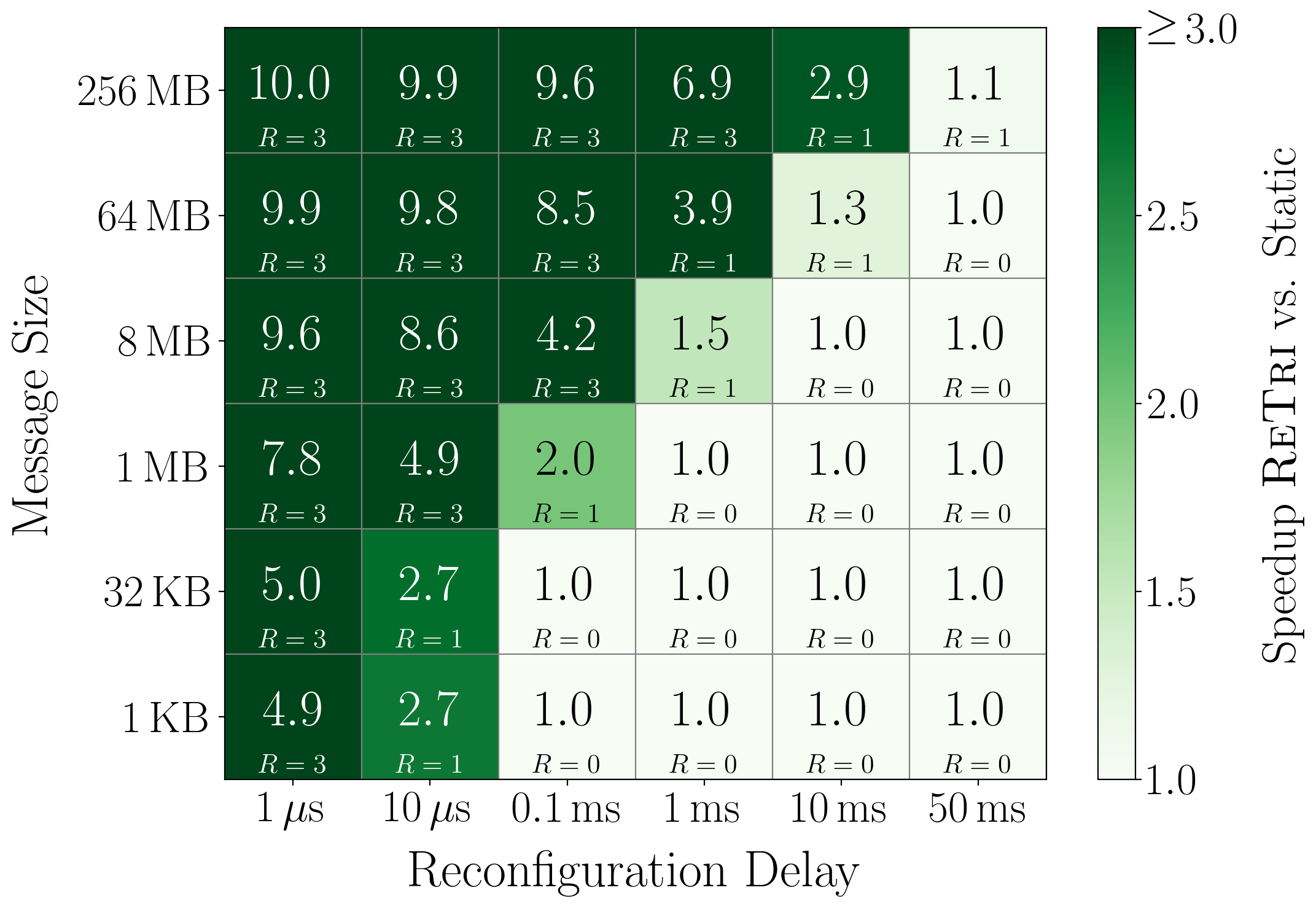
Figure 2: Heatmap of ReTri speedup vs static All-to-All in the n=81 vs n=64 configuration, as a function of message size and reconfiguration frequency.
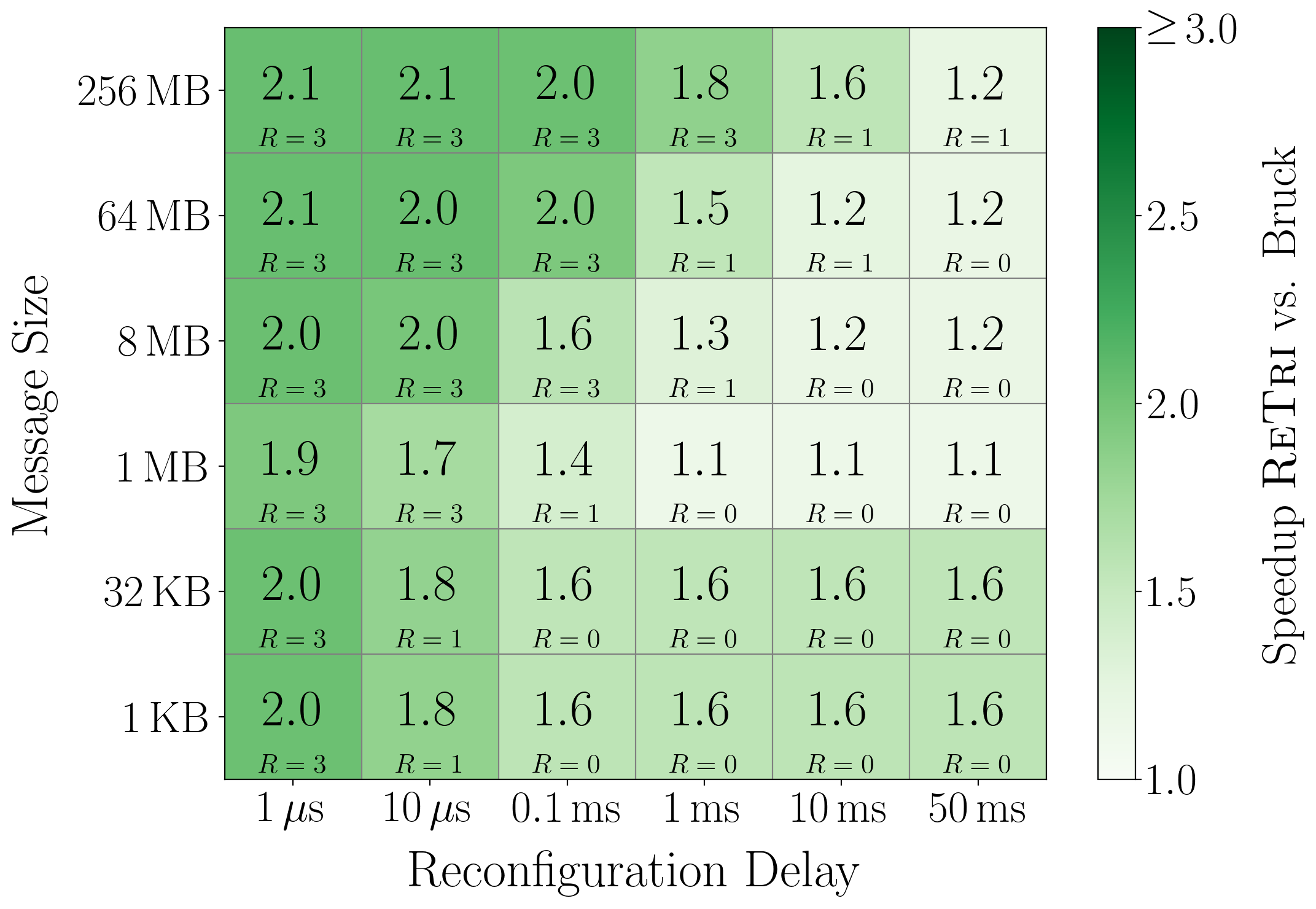
Figure 3: Heatmap of ReTri speedup vs Bruck's Bridge schedule, indicating consistent gains across network scales.
Additional evaluation across varying network sizes (Figures 5 and 6) confirms that ReTri remains competitive or superior even as reconfiguration delays reach 50ms, which is especially relevant for large payloads or slow optical hardware.
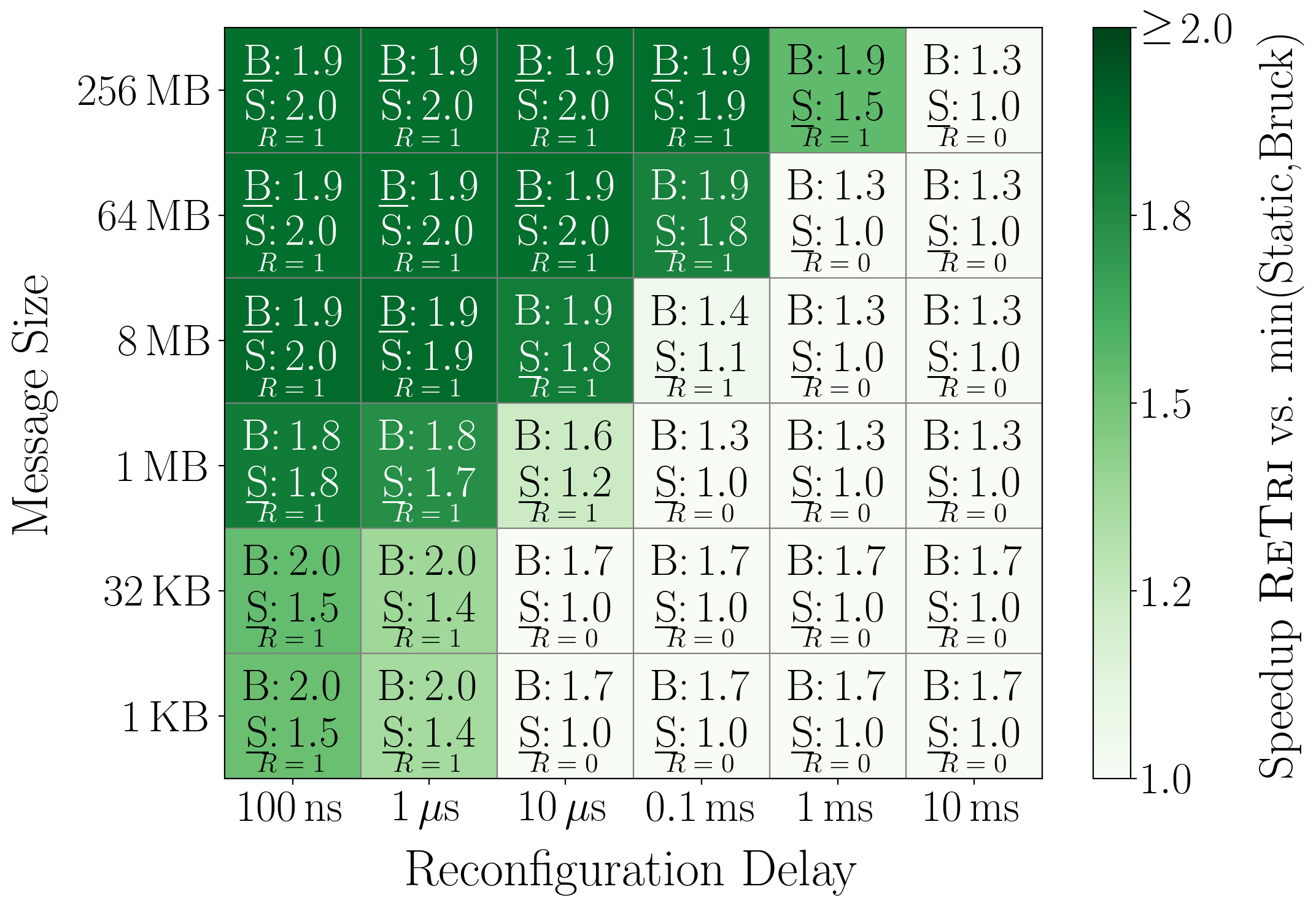
Figure 4: Comparison of ReTri and baseline schedules for α0 and α1, showing underlined speedups where ReTri outperforms.
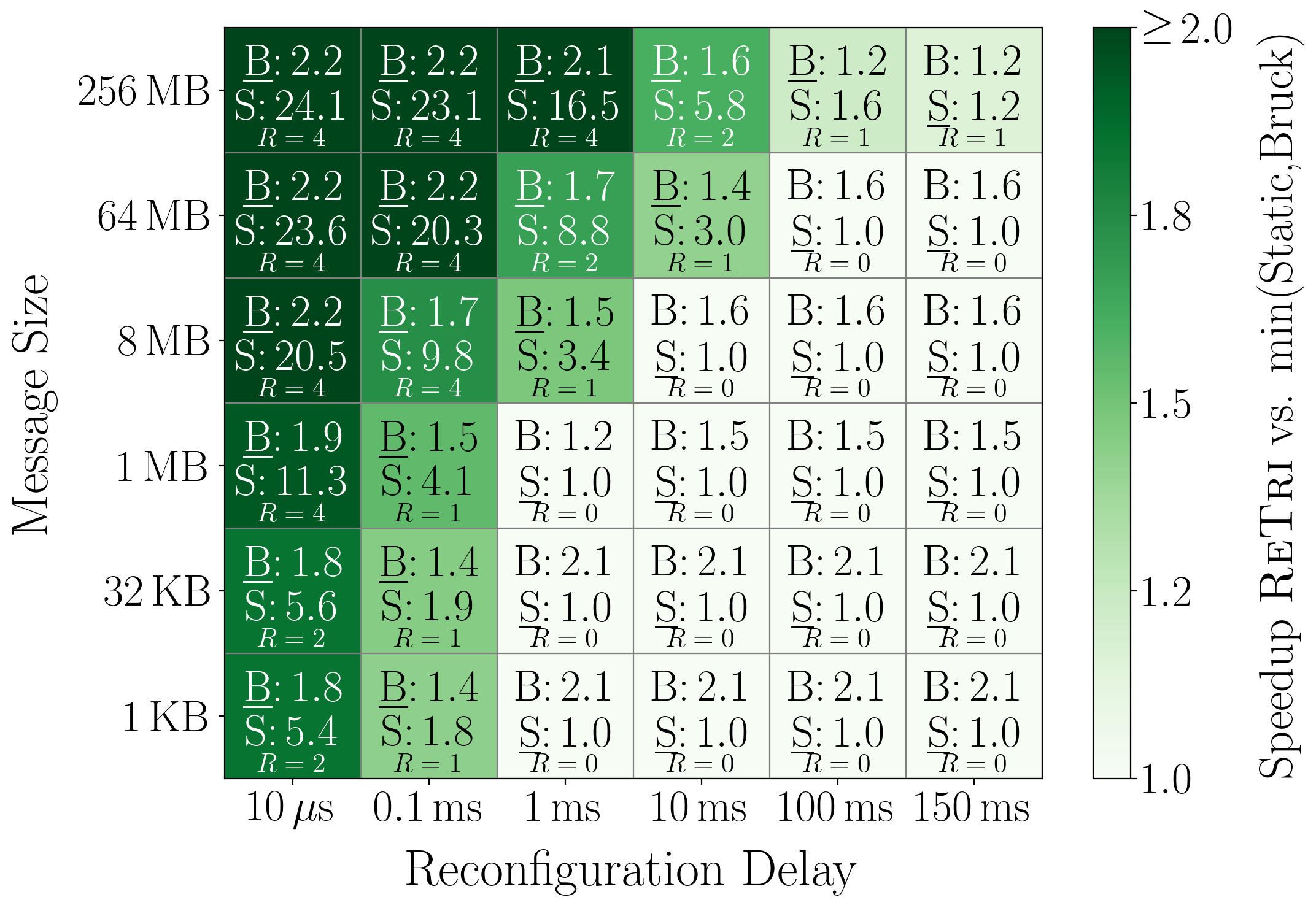
Figure 5: Normalized speedup for α2 (ReTri) and α3 (Bruck), highlighting performance across scale.
Implications and Open Research Directions
The co-design principle underlying ReTri opens new avenues for collective communication optimization in optical domains, not only for All-to-All but potentially for AllReduce and other structured collectives. Its algebraic, reusable topology states directly translate into deterministic reconfiguration schedules, obviating the need for complex independent topology optimization. Practical deployment will require adaptation for non-power-of-three sizes, more general topologies, and integration with overlapping computation phases.
Synchronization, barrier costs, and control-plane latency pose additional challenges: the benefit of topology reconfiguration is coupled to the ability to align phase transitions with computation or data preparation. ReTri’s deterministic structure is particularly amenable to such overlap, which could further improve practical throughput.
Conclusion
ReTri presents a formal advancement for structured All-to-All scheduling in reconfigurable optical networks. By reducing the number of communication phases via tailored ternary block propagation and co-designing the schedule with the physical topology, ReTri minimizes both communication latency and reconfiguration overhead. Results show strong, quantifiable speedups versus static and Bruck's All-to-All, with advantages that grow in proportion to network size, message volume, and optical switch characteristics. The design principles established here are poised to inform scalable communication architectures for the next generation of distributed ML and HPC systems.

Figure 6: ERC funding acknowledgment for FortifyNet project (2026–2027), supporting this research.