- The paper introduces a novel parameter-level dual-view adaptation framework that unifies behavioral and semantic signal integration using DPMoE and adaptive cross-view fusion.
- Empirical results on industrial and Amazon datasets show significant gains in Recall@10 and NDCG@10 over seven state-of-the-art baselines.
- Ablation studies and online A/B testing confirm that each adaptation component and routing mechanism is crucial for achieving robust performance and data efficiency.
L2Rec: Parameter-Level Dual-View Adaptation for LLM-Based Personalized Recommendation
LLMs have demonstrated robust capabilities in recommendation settings, particularly in contextual reasoning and semantic understanding. However, integrating user behavioral signals (e.g., item interaction sequences) and item semantic information (e.g., textual content) remains challenging. Prevailing methods either fuse both modalities at the input (token embedding projection) or output (frozen LLM feature extraction for downstream models) levels. These approaches are prone to distributional misalignment and lack of end-to-end supervision, leading to suboptimal task alignment and limited exploitation of the LLMs' capacity.
The paper proposes a shift in integration paradigm: instead of reconciling these heterogeneous signals in representation space, it advocates parameter-level adaptation, where the LLM backbone is modified through personalized, view-specific, low-rank perturbations. This enables the model to leverage Transformer parameters as a unified medium for both behavioral and semantic views.
Methodological Framework
The L2Rec framework introduces Dual-view Personalized Mixture-of-Experts (DPMoE) for parameter-efficient, user-aware adaptation. The strategy is illustrated in the overall architecture:
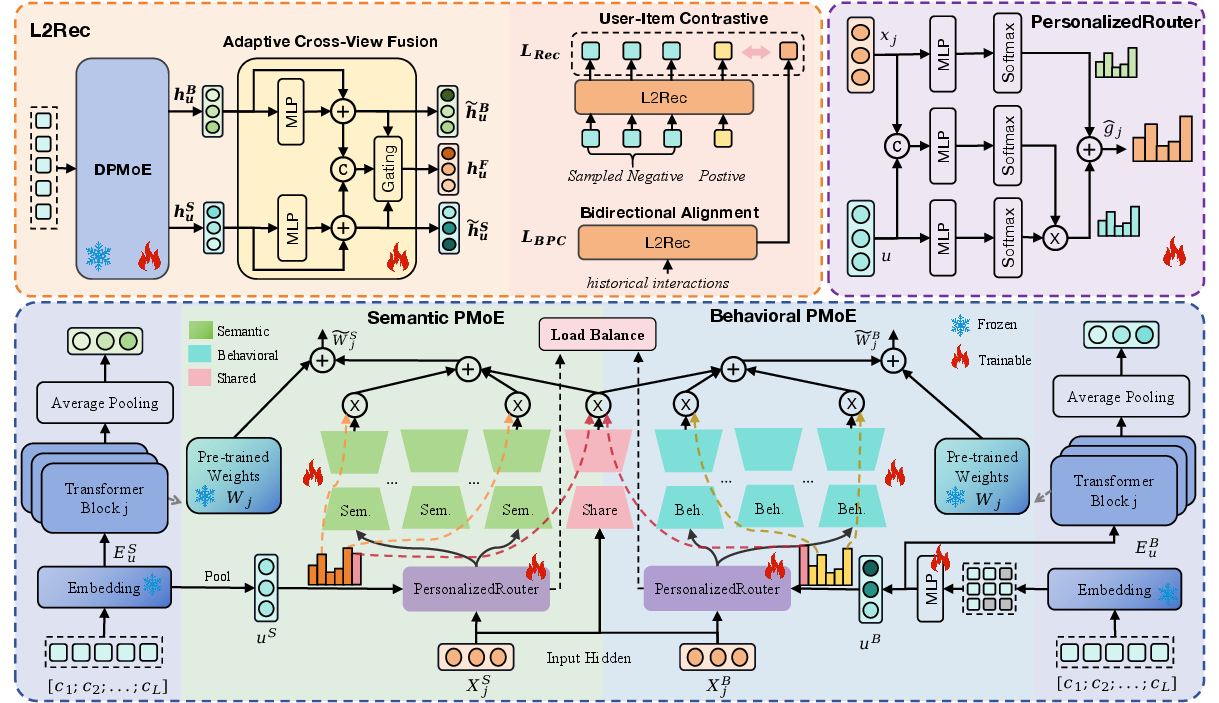
Figure 1: The L2Rec framework, unifying behavioral and semantic view-specific adaptation on a frozen LLM backbone via DPMoE and adaptive cross-view fusion.
The methodological pillars include:
- Dual-View Input Construction: Semantic inputs concatenate item descriptions to capture fine-grained preferences, whereas behavioral inputs compress item pools to model dynamic sequential patterns.
- DPMoE Mechanism: LoRA-based expert pools (shared and view-specific) provide low-rank parameter modifications. User-aware routing—incorporating context, user, and interaction signals—selects a sparse subset of experts per view, thus generating individualized parameter adjustments without backbone retraining.
- Adaptive Cross-View Fusion (ACF): Residual projections and dynamic gating integrate dual-view outputs, yielding a unified user preference representation. The fusion exploits the shared parameter neighborhood established by DPMoE, minimizing representation-level misalignment.
- Training Objectives: The model is optimized through a combination of contrastive recommendation loss, bidirectional preference contrastive loss for cross-view alignment, and expert load balancing loss to prevent routing collapse. Only DPMoE and ACF parameters are updated; the backbone remains fixed.
Empirical Evaluation
L2Rec is evaluated on a large-scale industrial dataset (42M interactions, 1.5M users) and Amazon Review domains with leave-one-out splits. Compared to seven state-of-the-art baselines (ID-based, text-enhanced, and LLM-based), L2Rec consistently delivers superior Recall@10 (R@10) and NDCG@10 (N@10), achieving relative N@10 gains from 3.87% to 8.02% across datasets.
Notable comparisons include the outperforming of LEARN (Baichuan2-7B) and LLaRA (Llama2-7B) baselines even when L2Rec is instantiated on matched backbone architectures, stressing that the improvement is attributed to the proposed design rather than backbone scale alone.
Ablation Analysis
Component ablations demonstrate:
- Removal of any adaptation leads to substantial performance loss (up to -39.4% N@10 on Industry).
- Excluding behavioral or semantic pathways degrades N@10 up to 17.9%, confirming their non-substitutable contributions.
- Removing bidirectional preference contrastive loss or user-aware routers reduces task alignment and specialization, confirming their necessity for stable dual-view adaptation.
Data Efficiency Analysis
Under limited training data regimes, L2Rec manifests strong generalization, surpassing LEARN with only 10% of data on Scientific (~0.1071 N@10 vs 0.1060 at 100% for LEARN) and outperforming by +17.3% at 1% data on Instruments. Text-enhanced methods deteriorate quickly with data scarcity, while LLM-based methods exhibit flatter degradation curves. The superior performance under low-resource conditions is attributed to DPMoE's view-specific adaptation ability.
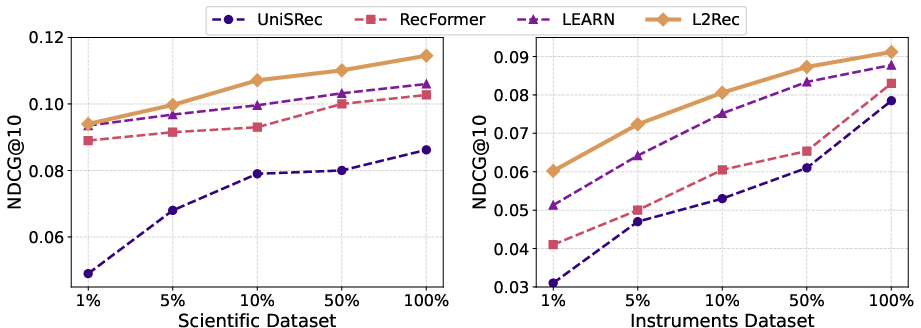
Figure 2: Data efficiency analysis of L2Rec against baselines, showing robust performance even with scarce training data.
Hyperparameter Sensitivity
Incrementally increasing LoRA rank and expert pool size leads to performance gains that saturate as capacity enlarges, indicating diminishing returns and supporting mid-range settings for practical deployment.
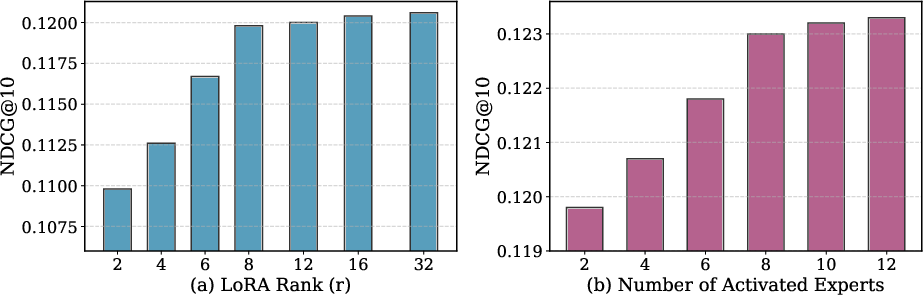
Figure 3: Hyperparameter analysis depicts the trade-off between adaptation rank/expert count and recommendation performance.
Online A/B Testing
Deployment in a production setting (1.5M DAU, homepage feed) demonstrates +9.24% CTR and +3.15% reply rate improvements over a long-term optimized DLRM baseline, validating that dual-view parameter-level adaptation translates to substantial gains in user engagement metrics under real-world constraints.
Theoretical and Practical Implications
L2Rec provides a principled bridge between general-purpose language modeling and personalized recommendation. By operating in the parameter space with dual-view personalized adaptation, the framework circumvents distributional mismatches inherent to input/output-level fusion and unlocks end-to-end task supervision without retraining large LLMs. This positions L2Rec as a scalable, flexible foundation for future development in recommendation domains requiring sophisticated signal integration and user-specific specialization.
The strong empirical results and data efficiency suggest that parameter-level adaptation with expert routing is a promising avenue for downstream applications of LLMs beyond recommendation, including personalized content generation and multimodal integration.
Conclusion
L2Rec innovates on the integration boundary for LLM-based recommenders by shifting signal fusion from the representation to the parameter space. Utilizing DPMoE for view-specific adaptation and adaptive cross-view fusion, it achieves robust alignment of behavioral and semantic signals with significant improvements across metrics and real-world engagement. The implications extend to scalable, parameter-efficient personalization in LLM-powered applications, with future prospects in expanding modular adaptation regimes and cross-domain signal integration.