- The paper introduces a cubic contest success function that explicitly models strategic feedback via a parameter controlling suppression versus empowerment.
- It derives closed-form equilibria under both complete and incomplete information, revealing a single-peaked equilibrium effort response to varying suppression levels.
- The model links optimal contest design to information disclosure policies, with practical implications for R&D races, political campaigns, and related settings.
Suppression and Empowerment in Contests: An Expert Synthesis
Overview and Motivation
This paper introduces a cubic contest success function (CSF) that enables the explicit modeling of strategic feedback in two-player contests: the "empowerment" regime, where the leader's effort increases the marginal effectiveness of the trailing player's effort, and the "suppression" regime, where the converse is true. Unlike the standard Tullock or lottery CSF, which globally build in suppression as a functional property, the cubic CSF achieves both phenomena via a single parameter (a). The authors provide closed-form equilibria under both complete and incomplete information, establish new comparative statics on the effect of strategic feedback, uncertainty, and information disclosure, and recast canonical results of contest theory as artifacts of suppressive primitives rather than robust to general contest environments (2605.26639).
The Cubic Contest Success Function
The authors' benchmark contest adopts the following truncated antisymmetric cubic polynomial for the win probability:
P(x,y)=21+(x−y)[c−b(x+y)+axy]
where x and y are player efforts, c>0 the baseline return, b>0 own-effort decay, and a is the feedback parameter. The model’s focus is on the cross-derivative:
∂x∂y∂2P=2a(x−y),
so the sign of a determines whether a leader’s effort suppresses or empowers the follower.
Standard Tullock (lottery) functions have Pxy>0 for P(x,y)=21+(x−y)[c−b(x+y)+axy]0, so they always impose suppression. The cubic CSF, by contrast, permits either regime and thus enables genuine comparative statics in the direction of strategic feedback.
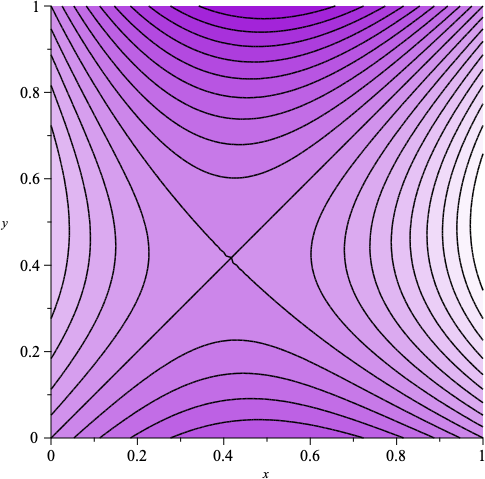
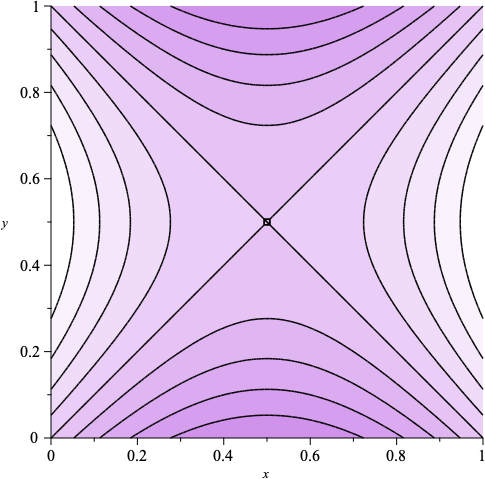
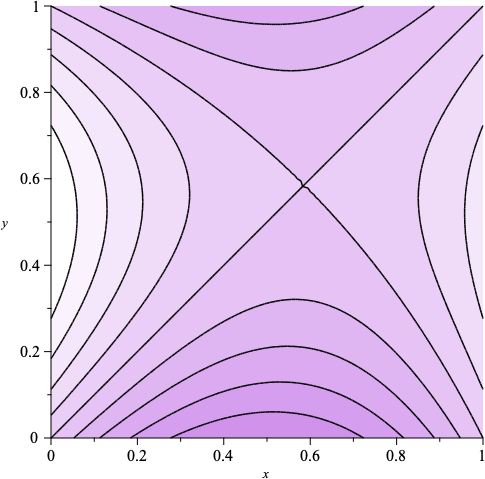
Figure 1: Contours of cubic CSF for P(x,y)=21+(x−y)[c−b(x+y)+axy]1 (empowerment regime); the symmetric admissible domain surrounds the diagonal, highlighting that strategic interaction is locally governed by the sign of P(x,y)=21+(x−y)[c−b(x+y)+axy]2.
Under complete information, the paper delivers the following closed-form characterizations:
- For P(x,y)=21+(x−y)[c−b(x+y)+axy]3 (empowerment), unique symmetric pure-strategy Nash equilibrium exists for all parameters.
- For P(x,y)=21+(x−y)[c−b(x+y)+axy]4 (suppression), a threshold P(x,y)=21+(x−y)[c−b(x+y)+axy]5 determines the regime: if P(x,y)=21+(x−y)[c−b(x+y)+axy]6, the equilibrium is symmetric and pure; if P(x,y)=21+(x−y)[c−b(x+y)+axy]7, only mixed equilibria exist, pinned by mean and variance, but not the full distribution.
A striking comparative static is that expected equilibrium effort is single-peaked in P(x,y)=21+(x−y)[c−b(x+y)+axy]8: as suppression initially strengthens, effort rises, but further suppression pushes the equilibrium into the mixed region and effort falls. Hence, maximal rent dissipation occurs at an interior value of suppression.
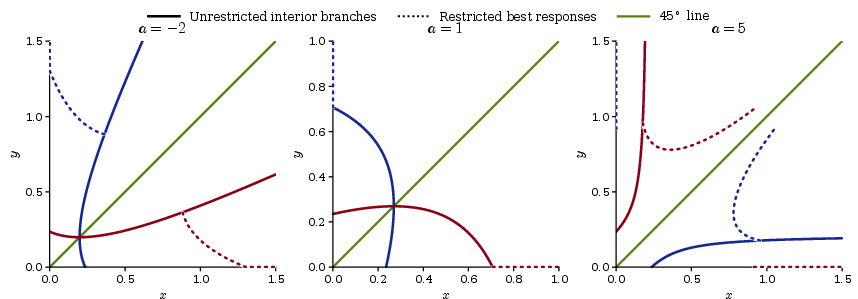
Figure 2: Best-response correspondences for various P(x,y)=21+(x−y)[c−b(x+y)+axy]9. Concavity and convexity structure shifts as suppression increases, with a transition from pure to mixed equilibrium as x0 grows.
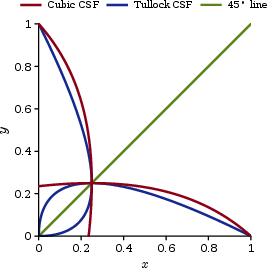
Figure 3: Comparison of best responses for cubic CSF versus Tullock. Cubic is smooth at zero, facilitating tractable mixing, whereas Tullock exhibits a singularity.
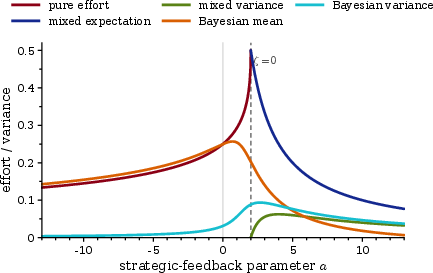
Figure 4: Total equilibrium effort as a function of x1. The effort curve is strictly single-peaked, peaking at the suppression level where the equilibrium transitions from pure to mixed.
Notably, this mechanism clarifies that classical results—such as monotonicity between contest intensity and rent dissipation—are not generic features of contests, but artifacts of suppression-locked models.
Under incomplete information with IID cost types, the cubic CSF retains remarkable tractability. There exists a unique affine symmetric Bayesian Nash equilibrium, mapping types to efforts linearly. Expected effort remains a function of only the first two moments (mean and variance) of the type distribution, a robustness that does not hold in Tullock-type lottery families.
Crucially, the behavior of effort in response to increased uncertainty (type variance) switches character: under suppression, increasing uncertainty reduces effort, but under empowerment, increasing uncertainty boosts effort. At x2, uncertainty is neutral.
Similarly, the design of information structure (persuasion/disclosure by a principal) is clean: under suppression, the principal maximizes effort by disclosing nothing; under empowerment, by fully disclosing.
Dropout and Multi-Peak Effort Paths
Under strong suppression, the model predicts endogenous dropout: high-cost (weak) types stop competing. The nonnegative-effort equilibrium is cutoff-affine, with only low-cost types competing, generalizing previous partial-participation results in the contest literature. Interestingly, with sufficient heterogeneity in types and strong enough suppression, the aggregate effort path can develop multiple local maxima as suppression rises, driven by the interaction of intensified competition among surviving types and mass dropout.
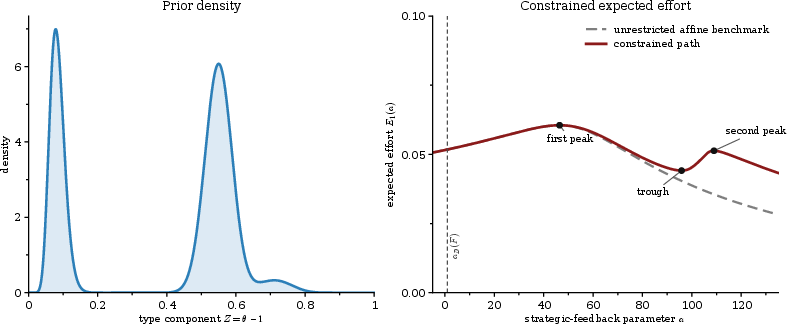
Figure 5: Density of type distribution and expected effort as suppression increases, illustrating a two-peak structure in aggregate effort due to strategic dropout of high-cost types.
A major implication is that classical advice for contest designers—such as "conceal information to maximize effort"—only applies where the contest technology is suppressive. In empowered contests, maximal effort is achieved by revealing all information. The model directly links optimal disclosure to the sign of the cross-effect, closing the literature’s open question regarding the information-effort comparative static under general contest technologies.
Alignment with Economic and Political Applications
The paper discusses well-known settings such as R&D races, lobbying, and political campaigns, showing that the underlying institutional environment can flip the nature of feedback (empowerment vs suppression), governed via spillovers, media orientation, or appropriability regimes. This renders the feedback parameter x3 as the distilled economic channel through which these institutions operate in the contest environment.
Theoretical Implications and Directions for Future Research
The cubic CSF provides the first tractable, analytically explicit framework capturing both suppression and empowerment as endogenously parameterized features, not fixed by functional form. It realigns contest theory with auction theory in terms of analytical tractability for both equilibrium and comparative statics (including disclosure/persuasion design and incomplete information), and highlights entire classes of results as structure-driven rather than universally valid for contests.
This work suggests several directions for further inquiry:
- Robust empirical identification of x4 in real-world contests and comparative design across suppressive/empowering institutional arrangements;
- Expanding the approach to multi-player contests, group structures, or dynamic repeated contest settings;
- Analyzing welfare and efficiency comparatives across the full range of x5, especially in applications where institutional changes can flip the sign of feedback.
Conclusion
The paper substantially enriches the analytical toolkit for contests by unveiling a tractable benchmark that unifies and contrasts suppression and empowerment. Many canonical comparative statics in rent-seeking, innovation, campaign competition, and other domains are shown to be non-generic, conditional on a suppressive environment. By providing closed-form mixed and Bayesian Nash equilibria that flexibly accommodate both regimes, the cubic CSF enables systematic institutional interpretation and comparative design, and brings contest theory closer to the level of analytical clarity long enjoyed in (symmetric) auction theory.
(2605.26639)

