Recursive Flow Matching
Abstract: Generative models have emerged as a powerful paradigm for solving physics systems and modeling complex spatiotemporal dynamics. However, achieving high physical accuracy without incurring high computational cost remains a fundamental challenge, as existing approaches face a critical speed-fidelity trade-off. In this work, we introduce Recursive Flow Matching (RecFM), a generative framework for forecasting complex spatiotemporal dynamics. RecFM enforces self-consistency to align trajectories across discretization scales, reducing discretization errors and improving performance across metrics for physics-based tasks. To our knowledge, this is the first method to achieve high-fidelity one- and few-step (2-4 step) dynamic generation for scientific systems with performance comparable to state-of-the-art multi-step solvers. Across challenging scientific benchmarks, RecFM achieves up to a 20$\times$ speedup over leading diffusion-based emulators while improving predictive accuracy. Furthermore, RecFM reduces mean squared error by over 15% compared to vanilla flow matching, offering a scalable and efficient solution for real-time scientific emulation.
Paper Prompts
Sign up for free to create and run prompts on this paper using GPT-5.
Top Community Prompts
Explain it Like I'm 14
Explaining “Recursive Flow Matching” in simple terms
Overview
This paper introduces a new way to predict how physical systems change over time, like ocean temperatures or how fluids flow. The method is called Recursive Flow Matching (RecFM). It aims to make predictions both fast and accurate, so scientists can simulate complex systems quickly without losing important details.
Key objectives
The researchers set out to do three main things, in plain language:
- Make predictions faster without giving up accuracy.
- Keep the shape and details of physical patterns correct over time (for example, not smoothing out sharp waves or swirls).
- Work well in “one or few steps,” meaning the model can jump from the start to the prediction in just 1–4 steps instead of hundreds.
How the method works (with analogies)
First, two ideas you need:
- Generative model: Think of a robot artist that can create new images or states that look realistic. In science, this robot tries to recreate future snapshots of a physical system.
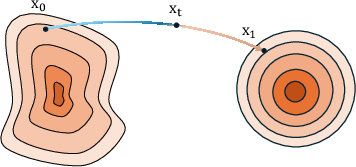
- Flow Matching: Imagine a gentle wind field that pushes a point from “noise” (a messy version) to “data” (a realistic version). The model learns the wind directions and strengths at each moment so it can move points smoothly from messy to realistic.
The usual problem: If you take tiny steps along this wind field, you’re accurate but slow. If you take big steps, you’re fast but often wrong. This is the speed-versus-accuracy trade-off.
What RecFM changes:
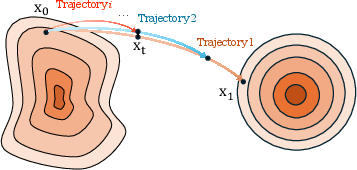
- Multiple paths with shared checkpoints: Picture walking from point A to point B. You can take small steps or big leaps, but you should reach the same places along the way. RecFM trains several “step-size” versions of the path at once (like walking with short strides and long strides) and makes sure they all pass through the same checkpoints.
- Self-consistency: Whether you travel the path in one big jump or a few smaller jumps, you should end at the same spot. RecFM teaches the model to be consistent across different step sizes.
- Pendulum analogy: Think of a pendulum hitting a wall and bouncing back slower each time. RecFM uses this idea: it trains “slower” versions of the path that are smaller, scaled-down copies of the main path. This gives the model extra guidance and makes its predictions steadier.
In practice:
- The model learns a “velocity” at each point and time (like the wind direction and strength).
- It trains those velocities at different scales (fast and slow versions) so they line up.
- During prediction, it can do just one or two steps and still land close to the right answer because the path has been “straightened” and made consistent.
Main findings and why they matter
Across several challenging tests (real ocean temperatures, fluid dynamics with turbulence, and a special wave equation), RecFM showed strong results.
Here’s what stood out:
- Much faster: Up to 20 times speedup compared to a strong diffusion-based baseline, while keeping or improving accuracy.
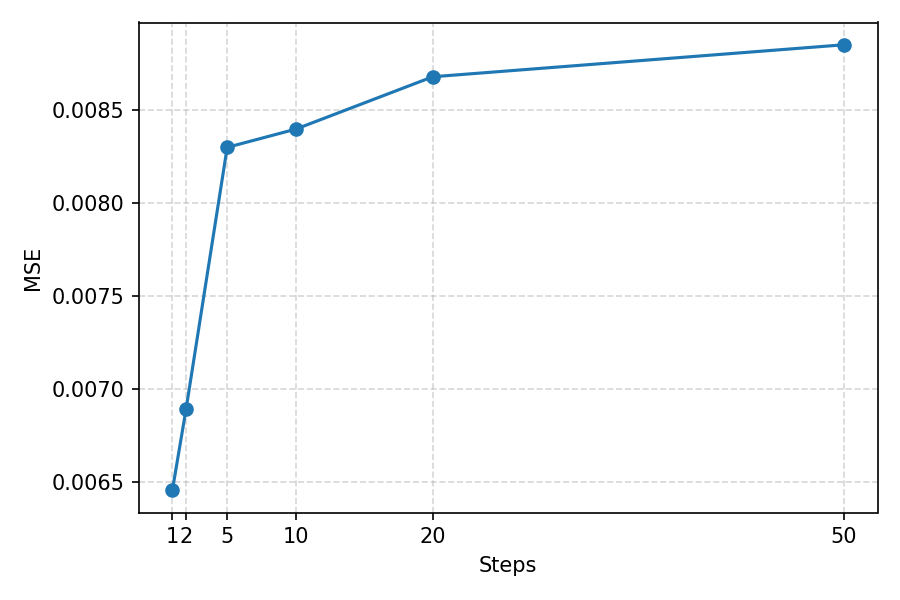
- More accurate in fewer steps: RecFM reduced error (mean squared error) by over 15% compared to standard flow matching, even when using just 1–2 steps.
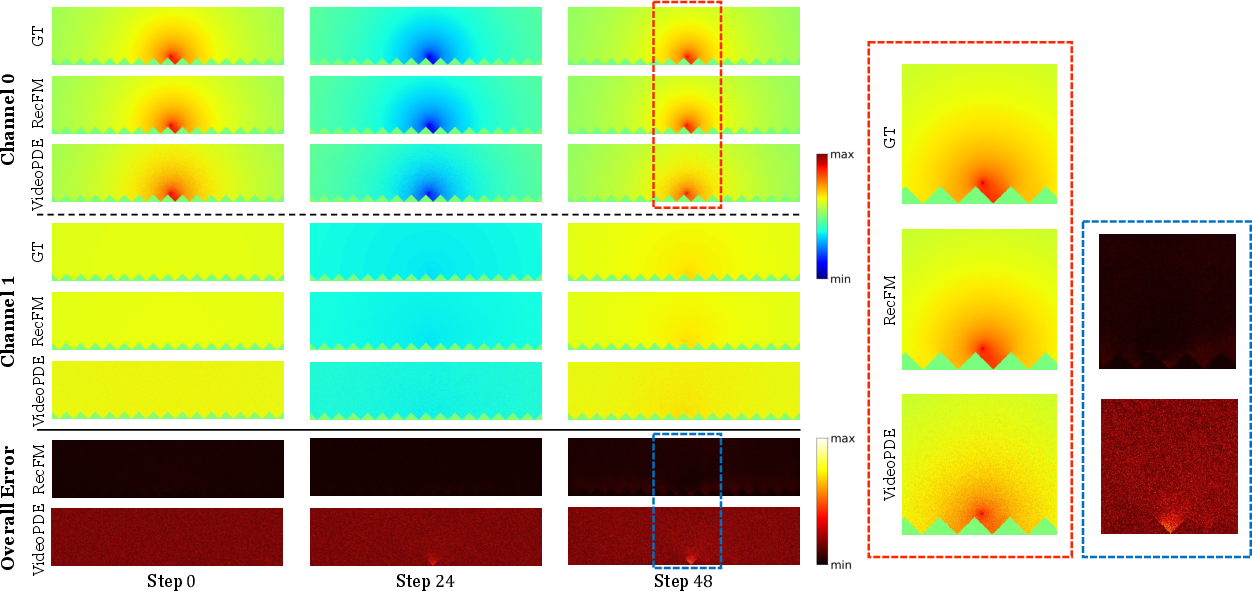
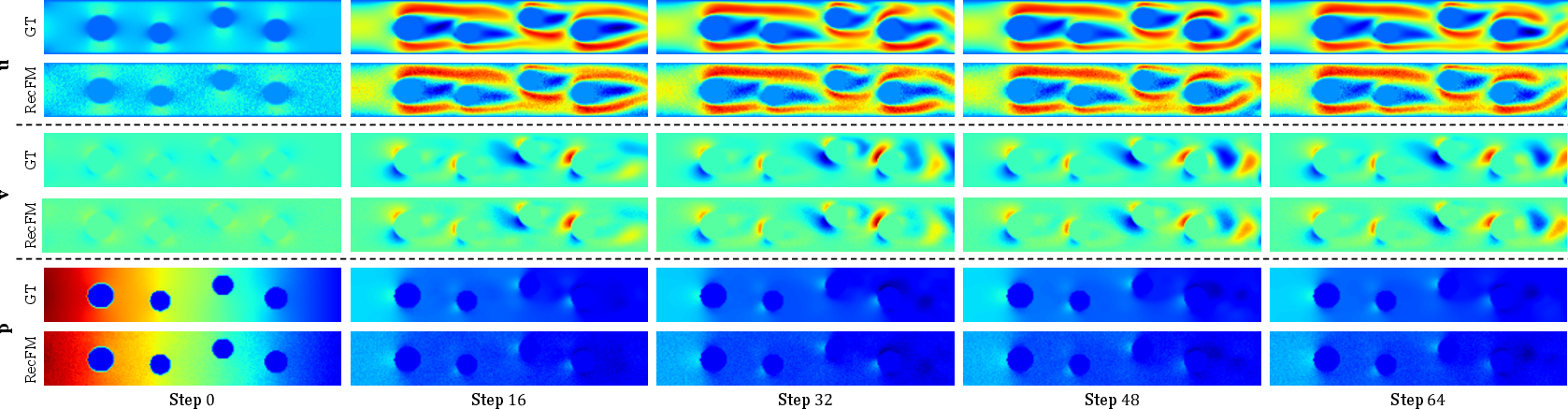
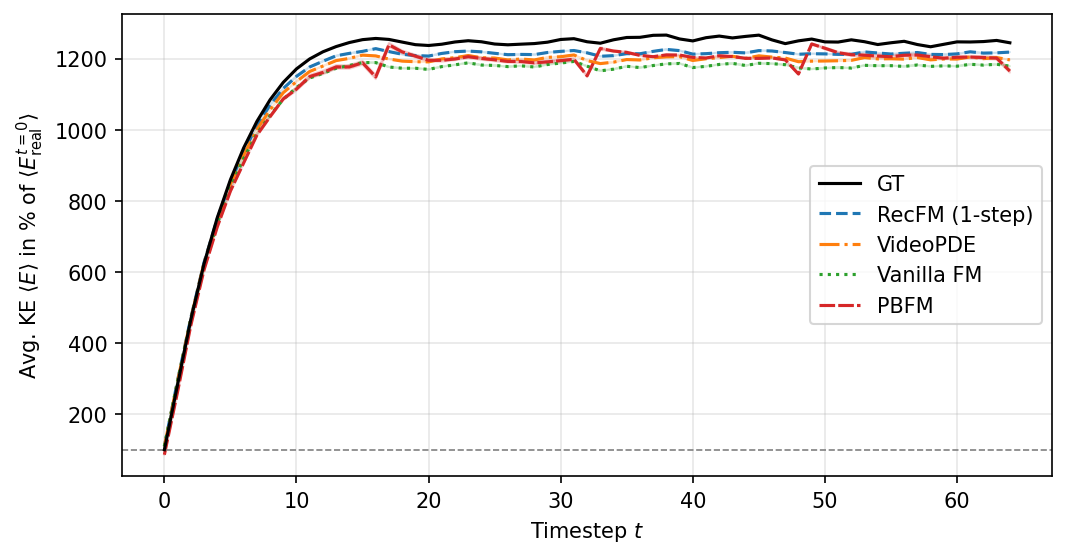
- Stable rollouts: It kept the detailed patterns in physical fields, like circular wave fronts or swirly fluid flows, more faithfully than many baselines.
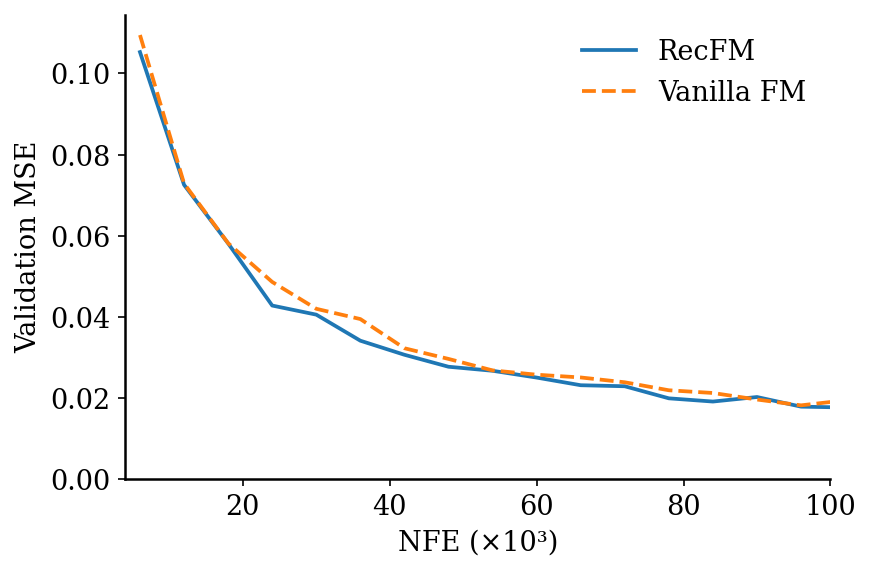
- Training stays steady: It converged faster during training and maintained lower validation errors compared to a diffusion-based model.
Why this is important:
- Real-time or near-real-time forecasting becomes more possible, which is key for applications like weather alerts, climate research, and fluid flow control.
- It bridges a gap: many scientific systems are too complex to write exact equations for, but RecFM can learn from data while still respecting the system’s structure.
Implications and potential impact
RecFM suggests a new way to think about fast scientific prediction: instead of taking many small steps, make the path itself easier to traverse. If models can be trained to be self-consistent across step sizes, we can:
- Simulate physical systems quickly and reliably.
- Use fewer computing resources, which saves time and energy.
- Get better forecasts in areas like climate, ocean monitoring, and engineering.
The paper also notes a limitation: scaling RecFM to complex, real-world videos (which have lots of semantic content, not just physics) is hard and needs more research. Still, for physics-driven problems, RecFM is a promising step toward fast, accurate, and stable scientific emulators.
Knowledge Gaps
Knowledge gaps, limitations, and open questions
Below is a focused list of what remains uncertain or unexplored in the paper, phrased as actionable gaps for future work:
- Theoretical guarantees beyond heuristics:
- Formal conditions under which minimizing the cross-scale consistency loss implies the stated PDE constraint t∂t v + v = ∂α v, and whether this suffices to ensure semigroup/self-consistency of the induced flow map.
- Convergence and stability guarantees of few-step RecFM for stiff or chaotic systems, including bounds that account for model misspecification (vθ ≠ true vector field) and long-horizon autoregressive rollouts.
- Clarification and proof of the referenced Theorem “marginal” (Theorem 2 in the text), which is cited but not provided, especially regarding preservation of marginal distributions across scales.
- Choice of probability path:
- Impact of using the linear interpolation path x_t = (1−t)x_0 + tx_1 on staying on (or near) the physical data manifold; comparisons with dynamics-informed or learned transport paths that may better preserve invariants and spectral content.
- Scale-parameter design and sensitivity:
- Systematic study of the α sampling strategy (α ∼ U(t,1)), its effect on training dynamics and generalization, and whether alternative or adaptive α schedules improve performance or calibration.
- Comprehensive exploration of recursion depth D > 2, trade-offs with compute, and principled criteria for selecting D and α values.
- Uncertainty quantification and calibration:
- How to obtain well-calibrated probabilistic forecasts when the learned flow is largely deterministic (especially in the 1–2 step regimes); decomposition of CRPS into reliability vs. sharpness and reliability diagrams to diagnose SSR deviations from 1.
- Extensions to stochastic flows (e.g., SDE-based RecFM) to model aleatoric uncertainty in intrinsically stochastic systems like climate.
- Long-horizon stability and error growth:
- Analysis of error accumulation in autoregressive rollouts (beyond 49–64 steps), especially for chaotic/turbulent regimes; comparison of teacher-forcing vs. free-running training and methods (e.g., scheduled sampling) to mitigate drift.
- Physical fidelity and constraints:
- Quantitative evaluation of physical consistency (e.g., mass/energy conservation, incompressibility, boundary adherence) and spectral fidelity (e.g., power spectral density errors, structure functions) beyond MSE/CRPS/SSR.
- Mechanisms to incorporate hard or soft physics constraints (e.g., divergence-free projections, PDE residuals) without sacrificing general applicability to systems with unknown/partial equations.
- Generalization and OOD robustness:
- Robustness to parameter shifts (e.g., viscosity/Reynolds number, forcing strength, obstacle geometry), domain shifts, and unseen initial/boundary conditions.
- Transfer across spatial resolutions, grid types (irregular/unstructured meshes), and partial or noisy observations; integration with data assimilation settings.
- Integrator and solver choices:
- Effect of replacing Euler with higher-order ODE solvers (e.g., RK2/4) or adaptive-step integrators and how RecFM’s cross-scale straightening interacts with solver order and step-size control.
- Local error control and predictor–corrector variants for RecFM to address the observed cases where multi-step variants underperform single-step models.
- Computational scaling and efficiency:
- Detailed profiling of training cost (time, memory, NFEs) vs. baselines, scaling with resolution and dimensionality (e.g., 3D flows), and performance on constrained hardware.
- Breakdown of speedups attributable to fewer steps vs. architecture/backbone choices, and fairness of runtime comparisons under equal optimization budgets.
- Backbone and architecture dependence:
- Validation of gains across diverse model classes (e.g., neural operators, UNets/CNNs, continuous-time neural fields) and latent-space versions; sensitivity of RecFM to backbone capacity and inductive biases.
- Baseline coverage:
- Inclusion of strong few-step/self-consistency baselines tailored to dynamics (e.g., Shortcut/Consistency, Rectified/MeanFlow variants adapted to time series) in the main comparisons for a fair assessment.
- Ensemble generation details:
- Clear specification of how ensembles are produced under RecFM (choice of p1, sampling diversity, seed strategies) and analysis of how the prior and sampling scheme affect calibration and coverage.
- Path consistency vs. semigroup property:
- Empirical tests and theory on whether cross-scale velocity alignment at shared spatial points suffices to induce a coherent semigroup (flow-map) structure over time, not just local velocity alignment.
- Applicability to complex real-world video:
- Strategies for extending RecFM to natural video with rich semantics and non-physical dynamics (e.g., latent trajectories, semantics-aware conditioning), and benchmarks that probe temporal coherence and content diversity.
- Sensitivity to hyperparameters beyond λ:
- Ablations on α distribution, recursion depth, prior p1 choice, step sizes, and training-time vs. inference-time discretizations; guidelines or automated tuning strategies.
- Physical benchmarks breadth:
- Evaluation on additional PDE families (e.g., reaction–diffusion, advection–reaction, magnetohydrodynamics), stiffer regimes, and higher Reynolds numbers to stress-test stability and fidelity.
- Boundary conditions and constraints handling:
- Explicit treatment of boundary conditions in RecFM (e.g., wall/no-slip, periodic), especially for pixel-space models; analysis of boundary violations and remedies.
- Failure modes and diagnostic tools:
- Characterization of when multi-step RecFM underperforms one-step (as observed), identification of root causes (e.g., bias vs. numerical truncation), and development of targeted regularizers or training curricula.
- Reproducibility and missing proofs:
- Provision of complete proofs (including the missing Theorem on marginals) and precise algorithmic details (normalization, preprocessing, training schedules) to facilitate replication and rigorous validation.
Practical Applications
Immediate Applications
Below are concrete, deployable use cases that can be implemented with today’s capabilities, leveraging RecFM’s few-step, high-fidelity generative forecasting and demonstrated speedups on spatiotemporal physics tasks.
- Sector: Engineering (Aerospace, Automotive, Civil); Software/CAE
- Use case: Real-time CFD surrogate for design iteration and parametric sweeps
- What it enables: 10–20× faster turnarounds for flow fields, pressure, and vorticity prediction to accelerate shape optimization, drag reduction, and design-of-experiments
- Tools/workflows: RecFM plugin for OpenFOAM/ANSYS/CFX; Python API for batch sweeps; on-demand cloud microservice to serve emulations; integration into CAD-in-the-loop validation loops
- Assumptions/dependencies: High-quality training pairs from trusted solvers; coverage of the design space to avoid domain shift; careful rollout horizon (few-step) to limit error accumulation; validation against wind-tunnel/CFD baselines
- Sector: Energy (Wind/Solar), Grid Operations
- Use case: Fast probabilistic short-horizon forecasts (e.g., wind ramp, irradiance nowcasting) for plant-level or regional dispatch
- What it enables: Low-latency ensemble generation for scheduling, reserve allocation, and curtailment decisions
- Tools/workflows: RecFM-based forecasting service integrated with SCADA and EMS/DERMS; rolling updates with streaming data; quantile forecasts from ensembles for risk-aware dispatch
- Assumptions/dependencies: Domain adaptation to site-specific conditions; reliable sensor/EO data feeds; calibration checks for stochastic regimes (SST-like behavior shows smaller gains)
- Sector: Climate/Ocean; Public Agencies; Policy
- Use case: Rapid ensemble SST or regional ocean forecast generation for decision support (shipping routes, fisheries, coastal management)
- What it enables: More ensembles at lower cost for uncertainty-aware planning and what-if scenarios
- Tools/workflows: Sidecar emulator in existing pipelines (NOAA, ECMWF, CMIP-aligned workflows); API to generate probabilistic ensembles; integration with data assimilation for initialization
- Assumptions/dependencies: Continual retraining to handle seasonal shifts; strict validation against reanalysis; policy use requires documented error bars and bias audits
- Sector: Manufacturing (Combustion, Additive Manufacturing, HVAC); Industrial Digital Twins
- Use case: Real-time emulation for monitoring, anomaly detection, and what-if simulation in plant digital twins
- What it enables: Faster root-cause analysis and control tuning with on-the-fly simulation surrogates
- Tools/workflows: RecFM inference engine embedded in digital twin platforms (e.g., through OPC UA/Kafka bridges); active learning loops to enrich training sets with flagged anomalies
- Assumptions/dependencies: Sufficient coverage of operational conditions; retraining as processes drift; guardrails for extrapolation
- Sector: Robotics/Control (Aerial/Underwater)
- Use case: Model predictive control with in-the-loop fast fluid/wake emulation
- What it enables: Greater MPC horizons at fixed compute budgets; scenario rollouts under disturbance
- Tools/workflows: Lightweight RecFM inference on edge GPUs; closed-loop benchmarking against CFD-informed baselines; contingency fallback when uncertainty spikes
- Assumptions/dependencies: Robustness to real-world noise; tight latency budgets; safety validation for controller stability
- Sector: Healthcare/Medical Imaging R&D
- Use case: Physics emulators for wave/field propagation (e.g., ultrasound, EM fields akin to Helmholtz-type equations) for sequence/protocol design
- What it enables: Rapid design-space exploration for research prototypes; reduced reliance on full solvers
- Tools/workflows: Research-grade RecFM modules in PyTorch/JAX; parameter-sweep dashboards for imaging labs
- Assumptions/dependencies: Research-only unless clinically validated; domain-specific datasets; careful uncertainty reporting
- Sector: Academia/Scientific Computing
- Use case: Surrogate modeling for parameter studies and uncertainty quantification (UQ) across PDE testbeds (Navier–Stokes, Helmholtz, etc.)
- What it enables: Larger ensemble sizes, faster ablations, reduced compute/carbon footprint
- Tools/workflows: RecFM library with DiT backbones; reproducible pipelines; plug-and-play with UQ toolkits (CRPS/SSR monitoring)
- Assumptions/dependencies: Training data from accurate reference solvers; multi-resolution training for better generalization
- Sector: Earth Observation/Data Curation
- Use case: Spatiotemporal gap-filling and super-resolution for geophysical fields (missing frames/sensors)
- What it enables: Higher-quality datasets for downstream assimilation and analysis
- Tools/workflows: Batch imputation pipelines; uncertainty maps for quality control
- Assumptions/dependencies: Bias checks in poorly observed regions; OOD detection for rare events
- Sector: Education
- Use case: Interactive PDE sandboxes to teach dynamics and numerical errors (truncation, stability)
- What it enables: Real-time sliders for “step count vs. fidelity”; visualization of cross-scale consistency
- Tools/workflows: Web demos, Jupyter widgets; small models for classroom laptops
- Assumptions/dependencies: Didactic datasets; simple problem classes first
- Sector: Software/ML Infra
- Use case: Faster experimentation for spatiotemporal generative models (few-step FM vs. iterative diffusion)
- What it enables: Lower training/inference costs; rapid A/B testing; green AI initiatives
- Tools/workflows: RecFM training scripts, logging MSE/CRPS/SSR; model cards emphasizing rollout horizons and stability
- Assumptions/dependencies: Careful hyperparameter tuning (e.g., λ≈1, depth=2 found effective); monitoring long-horizon drift
Long-Term Applications
These are higher-impact deployments that require further research, scaling, integration with complex systems, or regulatory acceptance.
- Sector: National Weather Prediction (NWP)/Ocean Modeling; Public Policy
- Use case: Surrogate components inside 4D-Var/EnKF data-assimilation cycles for operational forecasting
- Potential impact: Reduce HPC cost of ensemble forecasting; increase ensemble sizes and update rates for extreme event preparedness
- Tools/products: Hybrid physics–RecFM modules; standards-compliant validation suites; certification-ready uncertainty reporting
- Assumptions/dependencies: Rigorous verification/validation (V&V); robust handling of stochastic regimes; governance frameworks for AI-in-the-loop forecasts
- Sector: Urban Planning/Environmental Health
- Use case: City-scale digital twins for microclimate, urban heat islands, pollutant dispersion with near real-time updates
- Potential impact: Dynamic zoning decisions; heat mitigation strategies; emission controls
- Tools/products: Sensor-integrated RecFM services; policy dashboards with scenario ensembles
- Assumptions/dependencies: Dense sensor networks; transfer learning to heterogeneous urban geometries; policy processes for uncertainty use
- Sector: Energy Systems and Markets
- Use case: Grid-level stochastic optimization with RecFM-driven probabilistic forecasts (unit commitment, reserve sizing, congestion management)
- Potential impact: Improved reliability and lower operating cost under high renewables penetration
- Tools/products: Co-optimization stacks (forecast → optimization → dispatch); market simulators with emulator-in-the-loop
- Assumptions/dependencies: Regulatory alignment; robust calibration under rare ramps; cyber-physical security and fail-safes
- Sector: Aerospace/Autonomous Systems
- Use case: Onboard aero-thermal digital twins for trajectory planning, aeroelastic monitoring, and adaptive control
- Potential impact: Safer, more efficient autonomous flight with predictive awareness
- Tools/products: Certifiable embedded RecFM runtimes; redundancy with physics-based monitors
- Assumptions/dependencies: Safety certification; extreme OOD robustness; formal guarantees on stability and bounded error
- Sector: Fusion/Plasma Control and High-Energy Physics
- Use case: Real-time PDE emulation in feedback controllers (e.g., plasma boundary control)
- Potential impact: Faster control loops, improved stability, exploration of advanced regimes
- Tools/products: Low-latency RecFM inference on specialized hardware; co-design with control theorists
- Assumptions/dependencies: Extreme reliability; tight jitter bounds; models trained on high-fidelity simulators and experimental shots
- Sector: Personalized Medicine/Clinical Digital Twins
- Use case: Patient-specific hemodynamics/respiratory flow surrogates for procedural planning and intraoperative guidance
- Potential impact: Reduced procedure times and radiation; tailored interventions
- Tools/products: Hospital-integrated emulators; simulation-backed decision support
- Assumptions/dependencies: Regulatory pathways (FDA/CE); large labeled cohorts; bias and fairness evaluations; human-in-the-loop oversight
- Sector: General-Purpose Multi-Physics Foundation Models
- Use case: A single RecFM-style backbone pre-trained across fluid, wave, elastic, and thermo-chemical regimes with zero/few-shot transfer
- Potential impact: “Universal” PDE emulation API for research and industry; reduced data demands per task
- Tools/products: Foundation checkpoints; adapters/LoRA for specialization; evaluation leaderboards across physics tasks
- Assumptions/dependencies: Massive curated corpora of solver outputs; standardized meshes/grids or mesh-aware architectures; scalable training
- Sector: Edge/Satellite/Drone Platforms
- Use case: On-device environmental modeling for wildfire spread, flood evolution, or plume tracking
- Potential impact: Autonomy and rapid response in areas with poor connectivity
- Tools/products: Quantized RecFM models; streaming updates from onboard sensors
- Assumptions/dependencies: Model compression without loss of stability; robust OOD detection; power/thermal constraints
- Sector: Scientific Discovery/Inverse Design
- Use case: Coupling RecFM emulators with Bayesian optimization or differentiable design for materials, metamaterials, and photonics
- Potential impact: Orders-of-magnitude faster design cycles; broader exploration of design spaces
- Tools/products: Optimization stacks with emulator gradients and uncertainty-aware acquisition functions
- Assumptions/dependencies: Smoothness and gradient fidelity; validated post-hoc with high-accuracy solvers; safeguards against overfitting surrogate artifacts
- Sector: Standards, Governance, and Risk Management
- Use case: Certification frameworks and model-risk governance for AI-based scientific emulators
- Potential impact: Safe adoption in safety-critical and policy contexts; interoperable benchmarking
- Tools/products: Domain-specific test suites (long-horizon drift, shock/rare event response); documentation standards for SSR/CRPS/MSE and stability bounds
- Assumptions/dependencies: Multi-stakeholder consensus; open datasets and baselines; continuous auditing infrastructure
Notes on Feasibility and Dependencies (Cross-Cutting)
- Data and coverage: RecFM’s accuracy depends on representative training data spanning operating conditions; domain shift can degrade performance.
- Horizon length: Few-step regimes are most reliable; long autoregressive rollouts can accumulate error—use ensembles, periodic re-initialization, or hybrid physics coupling.
- Uncertainty calibration: Gains are larger on deterministic PDE-like tasks; stochastic systems (e.g., SST) may require additional calibration and assimilation.
- Physical constraints: RecFM does not explicitly enforce PDE residuals; for safety-critical use, consider hybrid training with physics-informed penalties or constraints.
- Compute profile: Training needs quality solver outputs; inference is lightweight and amenable to edge/cloud deployment.
- Hyperparameters: Moderate consistency weighting (e.g., λ≈1) and shallow recursion (depth=2) are effective starting points.
- Integration: Provide APIs that align with existing solver mesh/grids and data assimilation interfaces; include OOD and drift detection.
Glossary
- Advective term: The component of acceleration arising from spatial variation advected by the flow, often written as (∇x v) v. "The acceleration decomposes into a temporal component and an advective term, ."
- Autoregressive rollout: A forecasting strategy where future frames are predicted by feeding previous model outputs back as inputs. "To manage these long-range sequences, models are applied autoregressively: Navier-Stokes models predict $16$ frames each time, while Helmholtz models generate $7$ frames, unless specified."
- Conditional Flow Matching (CFM): A training objective for flow models that regresses a learned velocity field to a target conditional velocity given sample endpoints. "To ensure tractability, Conditional Flow Matching (CFM) utilizes a per-sample regression objective:"
- Consistency models: Generative models that enforce self-consistency across steps so that multi-step and one-step mappings agree. "Consistency models, such as Shortcut Diffusion \cite{frans2024one}, introduce self-consistency constraints that enable direct mapping along the probabilistic path in a single step, while distillation techniques aim to compress multi-step generation into an efficient student model \cite{song2024multi}."
- Continuous Normalizing Flows (CNFs): Generative models that define continuous-time transformations between distributions via ODEs parameterized by neural vector fields. "continuous normalizing flows (CNFs) \cite{mathieu2020riemannian} and flow matching (FM) \cite{chen2024flowmatchinggeneralgeometries, geng2025mean, lipman2022flow} have emerged as efficient alternatives, learning continuous vector fields that define probability paths without requiring simulation during training."
- Continuous Ranked Probability Score (CRPS): A strictly proper scoring rule for evaluating the accuracy of a predictive cumulative distribution against an observed value. "A strictly proper scoring rule to measure the accuracy of the cumulative distribution function relative to the observation :"
- Equivariant neural fields: Neural representations designed to respect symmetry transformations (e.g., rotations) while modeling continuous spatiotemporal fields. "Equivariant Neural fields \cite{knigge2024spacetimecontinuouspdeforecasting} use functional mappings between infinite-dimensional spaces."
- Euler step: A first-order numerical integration method for ODEs that updates states using the current velocity times the step size. "For single-step generation, using a first-order Euler step of size , RecFM maps a noise sample to the data manifold in one function evaluation:"
- Flow map: The operator that transports a state from one time to another along a flow governed by a vector field. "For a flow map that transports a state from time to time , self-consistency requires that all points along a single trajectory map to the same endpoint."
- Flow Matching (FM): A training paradigm that learns a time-dependent vector field by regressing to target velocities, enabling simulation-free training of continuous flows. "Flow Matching (FM) \cite{lipman2022flow} is a simulation-free paradigm for training Continuous Normalizing Flows by regressing onto a target vector field."
- Fourier Neural Operator (FNO): A neural operator architecture that learns mappings between function spaces using Fourier transforms to model global interactions. "neural operators like Fourier Neural Operators \cite{li2020fourier} and DeepONet \cite{lu2021learning}"
- Helmholtz Staircase equation: A benchmark PDE setup modeling acoustic scattering near a periodic “staircase” boundary, used for evaluating spatiotemporal solvers. "On the Helmholtz Staircase equation, RecFM achieves a reduction in error compared to VideoPDE, which is the best-performed baseline."
- Kinematic viscosity: A fluid property (ν) quantifying viscous diffusion of momentum, influencing turbulence and flow patterns. "The kinematic viscosity is set to , and simulations are conducted on a grid."
- Monte Carlo dropout: An approximate Bayesian inference technique that uses dropout at inference time to generate predictive ensembles. "DYffusion leverages Monte Carlo dropout to produce probabilistic ensembles during inference."
- Navier-Stokes Flow: Fluid dynamics governed by the Navier–Stokes equations, used here as a benchmark for turbulence and pressure/velocity forecasting. "We measure training progress of Navier-Stokes Flow in terms of the number of function evaluations (NFE), defined as the total number of vector field evaluations (i.e., forward passes) during optimization."
- Number of function evaluations (NFE): The total count of vector field (or model) calls during optimization or sampling, often used as a measure of computational cost. "We measure training progress of Navier-Stokes Flow in terms of the number of function evaluations (NFE), defined as the total number of vector field evaluations (i.e., forward passes) during optimization."
- Optimal Transport (OT) path: A transport plan—often realized here as linear interpolation—connecting two distributions while minimizing a transport cost. "A prevalent choice is the Optimal Transport (OT) path, which utilizes linear interpolation to yield a constant target velocity ."
- Ordinary Differential Equation (ODE): An equation involving derivatives with respect to a single independent variable, governing continuous-time dynamics. "The transformation of a sample to is governed by the ordinary differential equation (ODE):"
- Physics-Informed Neural Networks (PINNs): Neural networks trained with loss terms that penalize PDE residuals to enforce physical laws. "Physics-Informed Neural Networks (PINNs) \cite{raissi2019physics} penalize PDE residuals at randomly sampled collocation points,"
- Riemannian manifolds: Smooth curved spaces endowed with a metric, on which few-step generative flows can be defined. "Generalized flow maps \cite{davis2026generalisedflowmapsfewstep} show few-step generation on arbitrary Riemannian manifolds."
- Semigroup condition: A composition property of flow maps ensuring consistency across intermediate times: X_{u,t}(X_{s,u}(x)) = X_{s,t}(x). "This is formally described by the semigroup condition:"
- Self-consistency: A property requiring that different traversal schemes of a trajectory yield the same endpoint, enabling stable one- or few-step generation. "To overcome the iterative bottleneck of FM, recent work has introduced the self-consistency property \cite{frans2024one, xu2023inversion}."
- Spread-Skill Ratio (SSR): A calibration metric comparing ensemble spread to forecast error; values near 1 indicate well-calibrated uncertainty. "Lower values are better for MSE and CRPS, while the optimal SSR is 1."
- Truncation error: Numerical error arising from discretizing a continuous-time process when integrating with finite step sizes. "This is an advanced regularization that can ``straighten'' the ODE trajectory and minimize the common truncation errors in accelerator solvers."
- Vorticity: A measure of local rotation in a fluid, important for characterizing turbulent structures. "The environment consists of an incompressible channel flow past four randomly generated circular obstacles, inducing complex turbulence and vorticity patterns."
Collections
Sign up for free to add this paper to one or more collections.