- The paper presents a novel metric derived from normalized effective diameter and closeness centrality to quantify network structural stress.
- It employs graph-based analysis and PCA to isolate independent topological features and robustly validate anomalies in Hedera transactions.
- Quantitative results reveal distinct inefficiency windows that correlate with major macroeconomic events and structural reconfigurations.
Authoritative Summary of "A Network Inefficiency Metric for Structural Stress Detection in Hedera Transactions" (2605.26417)
Introduction and Motivation
The analysis of decentralized ledger transaction networks requires topological metrics that transcend surface-level financial indicators, such as transaction volume or TVL, which are often decoupled from internal network utility due to speculative noise, concentrated capital movements, or wash trading. The paper addresses this deficiency by introducing the Inefficiency Metric (I), a deterministic structural indicator tailored to quantify the organization and routing tension within the Hedera transaction network, a distributed ledger integrating DAG and aBFT protocols. The goal is to provide an interpretable detection framework for structural stress arising from macroeconomic shocks, algorithmic events, and institutional dynamics, leveraging quantitative network science methodologies.
Methodological Framework
The Hedera network is modeled weekly as a directed graph, considering only the largest weakly connected component to isolate cohesive economic structures. A suite of topological metrics is employed:
- Effective Diameter (Deff): Captures spatial extension, reflecting the number of directed hops required for capital to traverse 90% of the network. Monte Carlo sampling and breadth-first search are used to compute this metric robustly, avoiding sensitivity to anomalous transaction chains.
- Closeness Centrality (⟨C⟩): Quantifies global routing efficiency, representing how rapidly liquidity can propagate across the ecosystem.
- Other Metrics: Degree Gini coefficient (G) for structural inequality, assortativity (r) to distinguish institutional loops from retail activity, network density (ρ), and average degree (⟨k⟩) are calculated to provide context for macro-state evolution but are excluded from the inefficiency formulation due to redundancy or indirect relevance.
Principal Component Analysis (PCA) is conducted on standardized features to identify independent structural dimensions underlying the network's evolution.
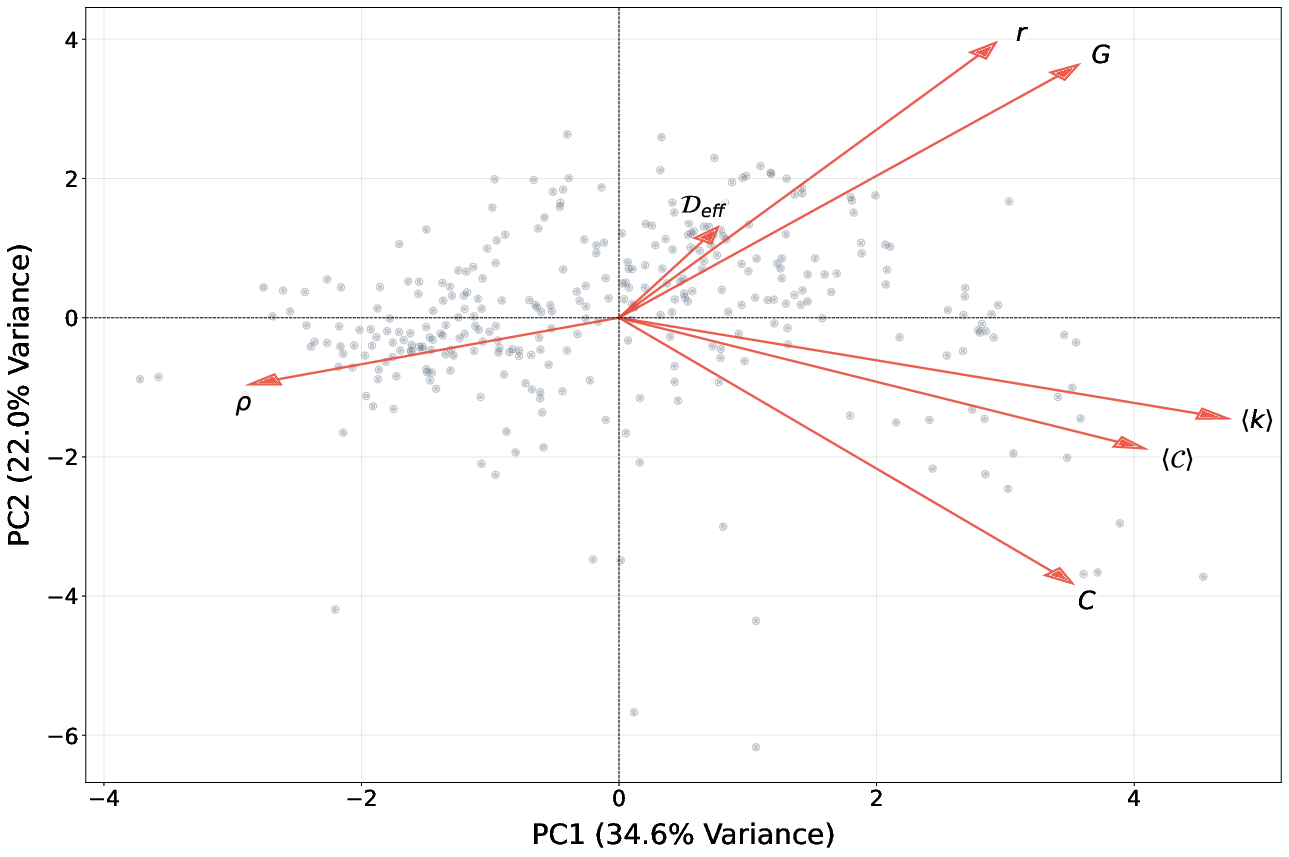
Figure 1: PCA bi-plot separates topological macro-state features and loading vectors, clarifying dimensional independence and redundancy.
A Pearson correlation matrix complements PCA for objective collinearity diagnostics, ensuring selected features measure fundamentally independent physical properties.
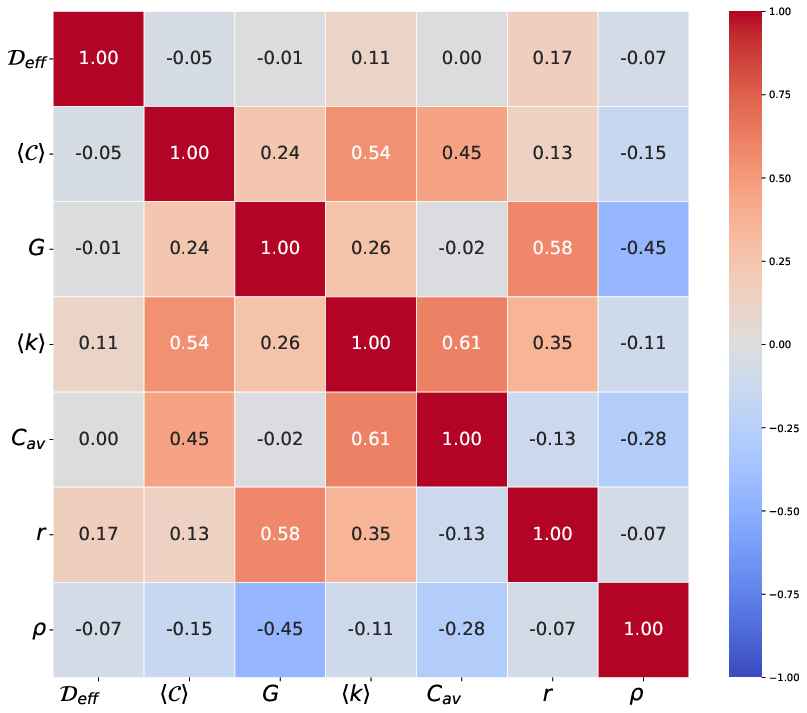
Figure 2: Pearson correlation heatmap quantifies structural linearity between network metrics, guiding variable selection for the inefficiency score.
Construction of the Inefficiency Metric
The Inefficiency Metric is defined as:
I(t)=Deff~(t)−C~(t)
where Deff~ and C~ are min-max normalized over the timeline to Deff0 for scale invariance. High Deff1 signals maximal spatial stretch with poor liquidity accessibility; low Deff2 denotes compact, accessible routing dominated by central hubs.
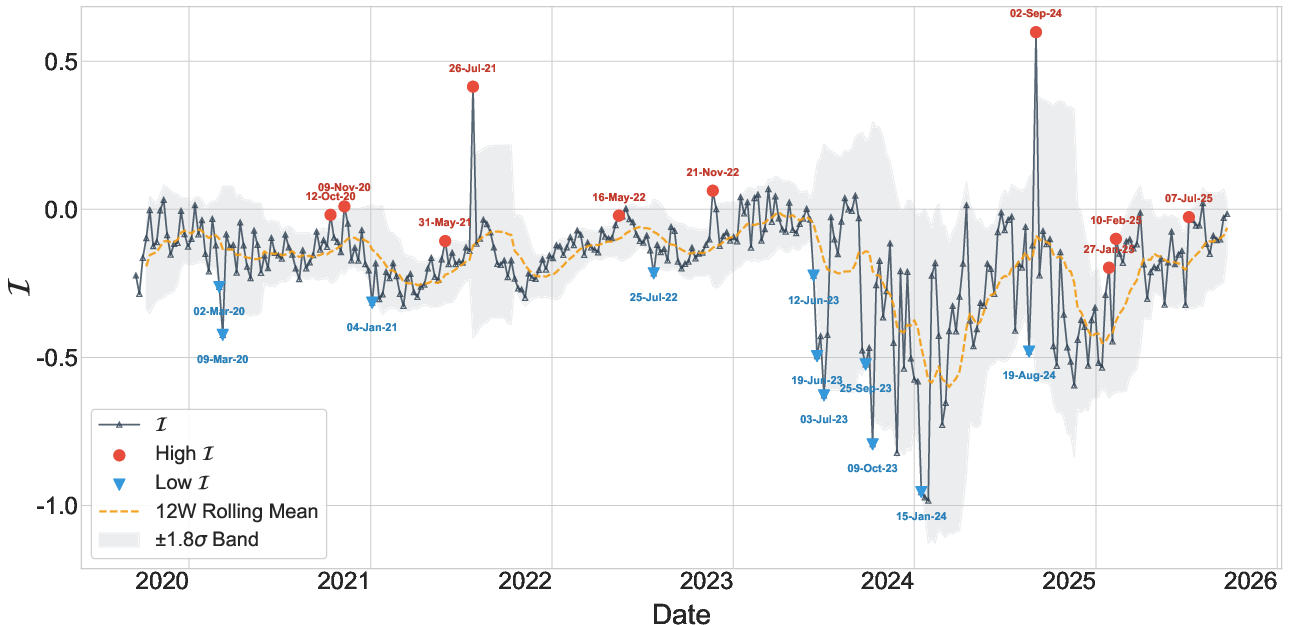
Figure 3: Temporal evolution of the inefficiency score Deff3 demonstrates rolling Z-score thresholding for anomaly localization.
Unsupervised Isolation Forest is employed as a high-dimensional anomaly detection baseline across seven features, providing independent validation of the metric's capacity to detect genuine structural anomalies.
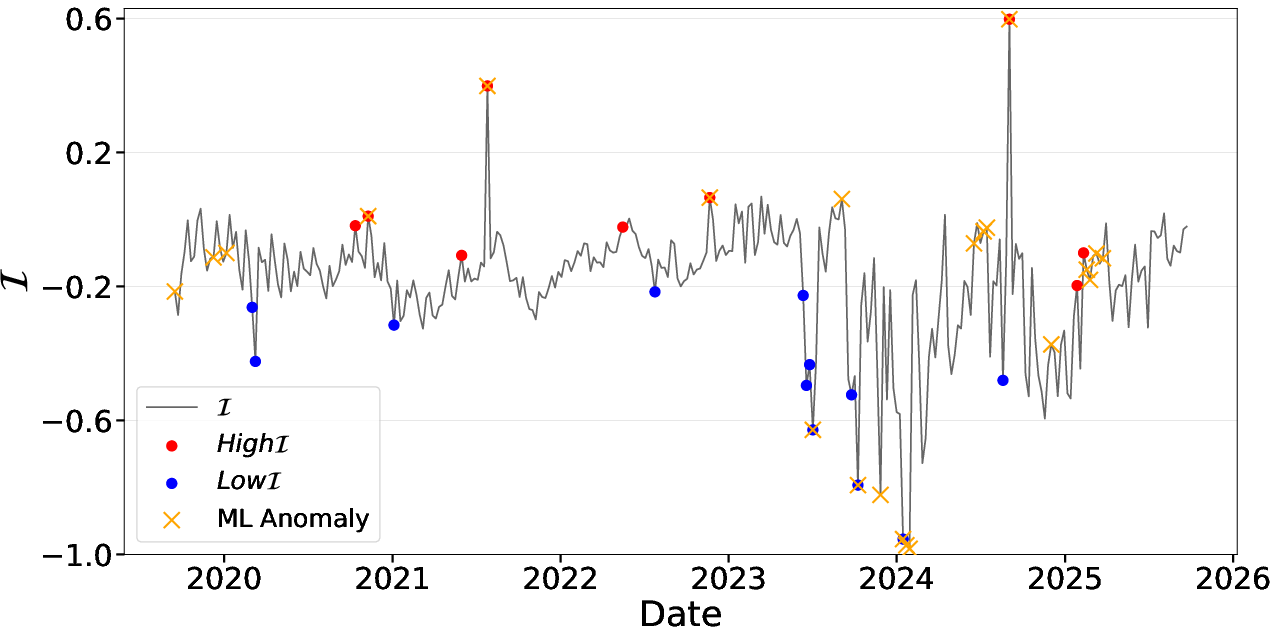
Figure 4: Isolation Forest anomalies are overlaid with inefficiency score peaks, highlighting cross-validation of acute topological disruptions.
Numerical Results and Empirical Insights
6 years of Hedera transaction data reveal:
- High Inefficiency Windows: Occur during periods of intermediary fragmentation, rapid smart-contract expansion, and major macroeconomic failures (e.g., Terra/LUNA, FTX collapse). These episodes coincide with expansion of non-central routing pathways and reduced closeness centrality, as capital circumvents failed institutional nodes.
- Low Inefficiency Windows: Correspond to network compaction, such as market stress and institutional convergence (e.g., Spot BTC ETF rollout, native staking). Here, transaction activity concentrates into a handful of central hubs, dramatically increasing core accessibility while reducing routing diversity.
Quantitative cross-referencing with Isolation Forest results demonstrates that Deff4 triggers in tandem with multidimensional outliers precisely during universally recognized stress events. However, the high-dimensional ML model is prone to micro-noise-induced false positives, flagging routine wallet rebalancing or localized hackathons as macro-anomalies. By focusing strictly on effective diameter and closeness centrality, Deff5 filters out such artifacts, confining structural stress detection to meaningful, network-wide shifts.
Strong numerical results include persistent elevation of the degree Gini coefficient and negative assortativity, confirming Hedera's hierarchical, core-periphery topology dominated by institutional nodes.
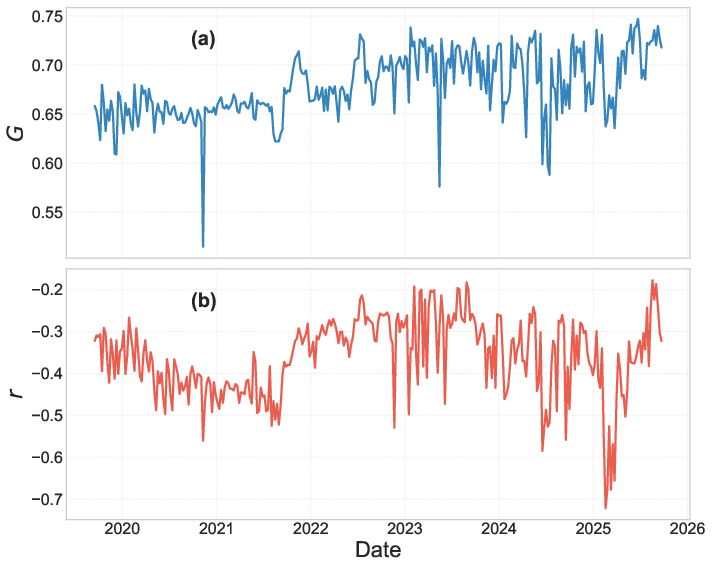
Figure 5: Degree Gini coefficient and assortativity evolution evidence sustained centralization and hub-dominated hierarchy.
Network density and average degree metrics confirm healthy expansion rather than structural distress, further supporting the topological rationale for metric construction.
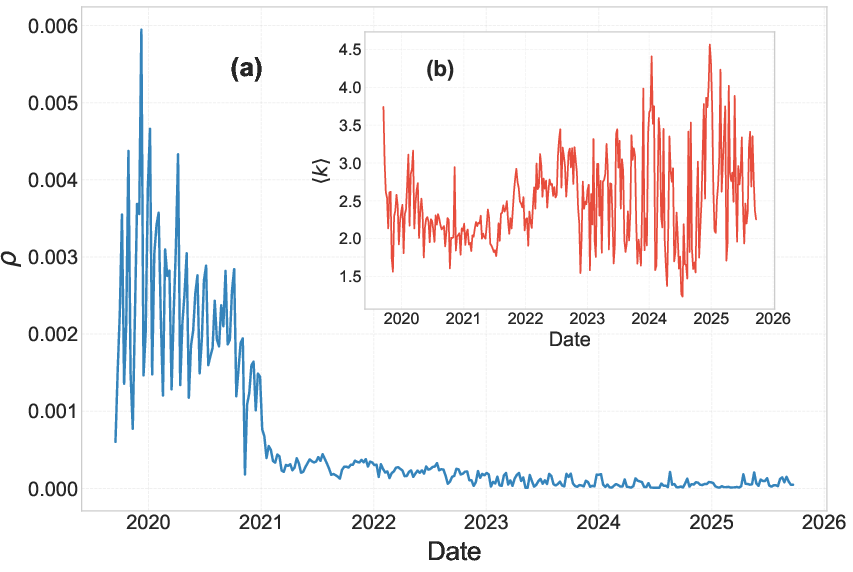
Figure 6: Density drops with network expansion while average degree remains stable, validating growth-driven dynamical trajectories.
Practical and Theoretical Implications
The Inefficiency Metric (Deff6) provides a parsimonious, interpretable gauge of network-wide routing stress, distinguishing between periods of decentralized complexity and institutional compaction. For practitioners, this offers real-time detection of ecosystem-level instability, presenting an actionable diagnostic tool for DLT governance, platform management, and institutional risk modeling.
Theoretically, the work advances the mapping of complex system phase states in decentralized economies, validating the utility of dimensionality reduction and correlation analysis for anomaly detection. It also demonstrates the limitations of unsupervised ML in structural event attribution within transaction networks, advocating for physically interpretable, domain-aware metrics.
Application to other DLT architectures is proposed as an essential future direction, enabling cross-comparative evaluation of inefficiency-driven stress detection as a universal diagnostic.
Conclusion
The paper presents a robust framework for quantifying and detecting structural stress in distributed ledger transaction networks via a focused Inefficiency Metric grounded in effective diameter and closeness centrality. Extensive empirical analysis of Hedera validates its capability to capture major macroeconomic and institutional shifts, outperforming high-dimensional ML methods in physical interpretability. The approach offers a scalable template for future topological health diagnostics in decentralized ecosystems, with implications for stress detection, anomaly attribution, and stability assessment across diverse DLT technologies.

