- The paper demonstrates that network-derived features significantly improve forecasting accuracy, boosting R² by up to 8.8 percentage points and reducing RMSE by 27.4%.
- The paper employs advanced network metrics such as betweenness centrality and clustering coefficients to quantify inter-industry systemic importance among 89 sectors.
- The paper highlights that network analysis retains predictive power during economic disruptions, offering actionable insights for real-time measurement and macroprudential surveillance.
Network Structure in UK Payment Flows: Structural Interdependencies and Real-Time Measurement
Introduction
This paper presents a rigorous network-theoretic analysis of inter-industry payment flows in the United Kingdom using high-frequency ONS experimental data from 2017 to 2024. By representing payment flows as weighted, directed graphs among 89 industry sectors, the study systematically investigates the predictive value of network-structural features—centrality, clustering, and topology—for real-time economic measurement, particularly in the context of economic disruptions such as the COVID-19 pandemic.
Methodology
The methodological core involves constructing a quarterly sequence of directed, weighted graphs from 532,346 raw payment transactions, encoding sector-to-sector flows. Normalization procedures are applied to control for scale effects, focusing analytical attention on proportional relationships rather than raw transaction volumes.
The study extracts an array of graph-theoretic features:
- Centrality measures (degree, strength, betweenness, eigenvector): Quantify both direct and indirect structural importance. Betweenness centrality, in particular, is deployed to identify intermediary roles that mediate multi-hop payment pathways.
- Clustering coefficients: Quantify the extent of supply chain integration within sectors.
- Network density and average path length: Characterize macro-level economic integration and structural “distance” among industries.
- Multi-hop connectivity: Computed via the square of the adjacency matrix, this exposes linkages invisible to bilateral analyses.
Forecasting experiments are constructed as a rigorous out-of-sample evaluation using quarter-on-quarter growth rates rather than payment levels, imposing a substantially more difficult predictive task. Ensemble machine learning algorithms (Random Forest, Gradient Boosting) are trained in a rolling expanding-window setup, assessing the incremental value of network features over traditional time-series inputs (lags, seasonality, fixed effects).
Structural Findings on UK Payment Networks
The payment network is characterized by systematic differentiation in both transaction volume and structural centrality. While Financial Services, Wholesale Trade, and Manufacturing dominate payment volumes, network centrality analysis reveals divergent structural importance; notably, sectors such as Professional Services and IT exhibit disproportionately high betweenness and eigenvector centrality relative to raw volumes. This underscores the network’s ability to expose systemic relevance not captured by aggregate flow statistics.
The network’s topological evolution is salient: from 2017 to 2024, density increases from 0.689 to 0.775, implying a pronounced trend toward deeper economic integration across the UK sectoral landscape. The relational distance between sectors (average path length) decreases, reflecting increasingly direct and efficient inter-industry linkages.
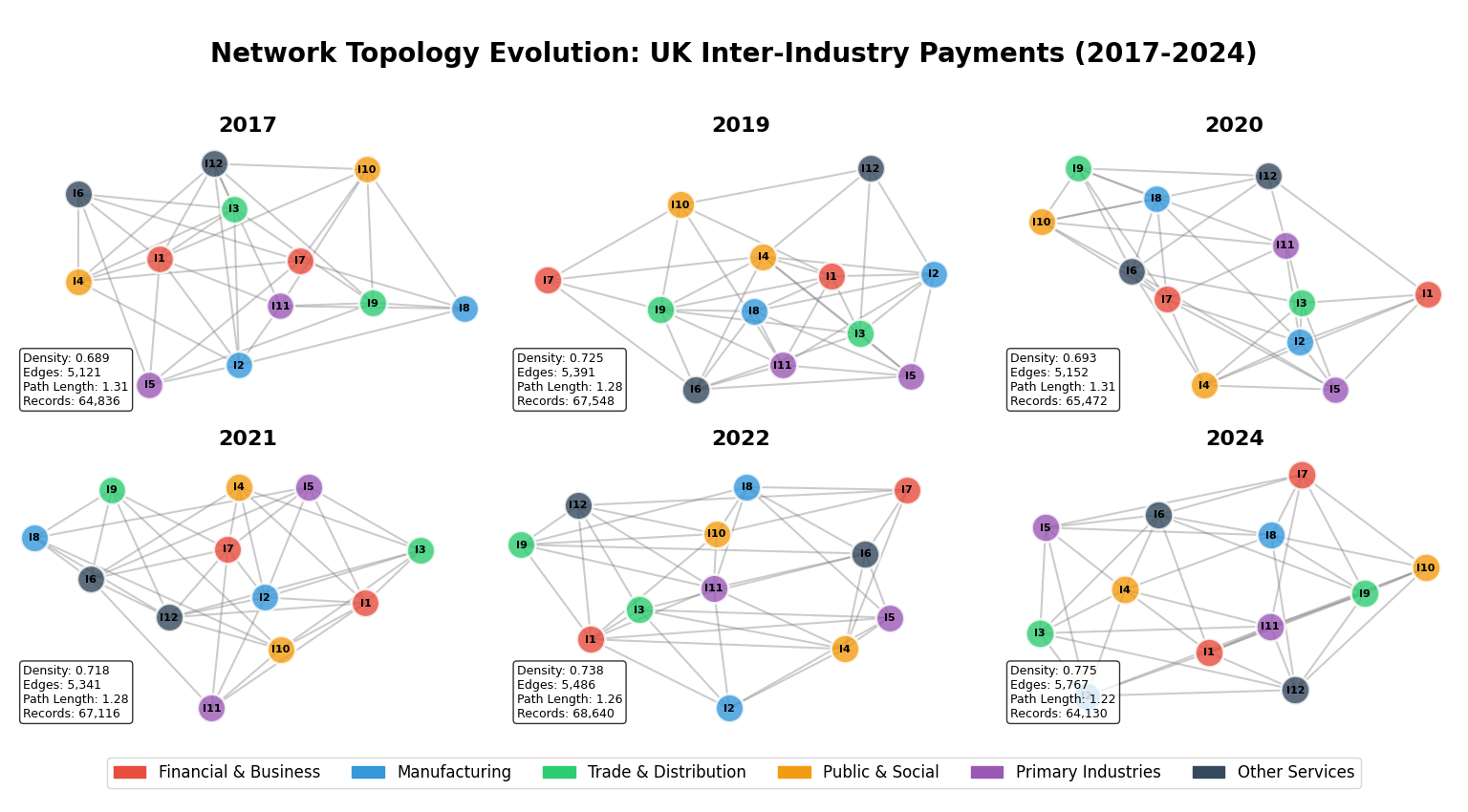
Figure 1: Network topology evolution in UK inter-industry payment flows from 2017 to 2024, highlighting increased density, directness, and the temporary COVID-19 disruption.
The addition of network-derived features yields a statistically significant improvement in payment flow growth forecasting. The combined (network + traditional) model achieves an out-of-sample R2 of 0.412, a +8.8 percentage point gain over baseline temporal models, with a corresponding 27.4% reduction in RMSE. This is robust on multiple dimensions: alternative network metrics, prediction algorithms, and forecast horizons.
Most notably, the incremental value of network features amplifies during economic turbulence. During the pandemic period (2020–2021), when traditional models’ R2 collapsed from 0.378 to 0.186, network contributions rose sharply: +13.8 percentage points. This property is of direct policy significance, as network monitoring retains predictive power precisely when historical time-series patterns fail.
Implications for Official Statistics and Economic Monitoring
The research demonstrates that structural monitoring of sectoral payment networks yields actionable signals not accessible via legacy bilateral statistics. Specifically:
- It enables real-time identification of systemic intermediaries whose structural importance exceeds what is visible in their aggregate flows, enhancing the granularity of macroprudential surveillance.
- By capturing stable economic relationships that persist through regime-breaks, network analytics provide a robust foundation for nowcasting and early-warning systems, particularly during crises.
- Structural evolution metrics (density, clustering, path lengths) facilitate continuous measurement of economy-wide integration and fragmentation trends.
These methodological advances suggest the ONS and comparable agencies could substantially augment existing real-time indicators by integrating network features. The feasibility of this integration is facilitated by the ongoing expansion and granularity of digital payment datasets.
Theoretical and Practical Extensions
Theoretically, the work substantiates the proposition that network topology is a first-order determinant of economic resilience and systemic risk propagation. The benefit persists even under abrupt temporal regime changes, which undermines traditional autoregressive modeling paradigms. Practically, these findings position network analysis as a central component for any future “beyond-GDP” measurement architecture, combining micro/data richness with macro/structural interpretability.
Future Developments
Anticipated future work includes:
- Extension to cross-border flows to capture international interdependence and financial shock transmission.
- Dynamic network models incorporating endogenous adaptation of links in response to major shocks (e.g., sectoral adaptation during crises).
- Integration with firm-level microdata and alternative digital traces (e.g., VAT, payroll, transport payments).
Advancing these directions would further entrench network analysis as an indispensable technology for structural economic measurement and crisis diagnostics.
Conclusion
This paper establishes that network structure in inter-industry payment flows encodes information crucial for real-time economic measurement, outperforming purely temporal methods—especially during periods of structural change or discontinuity. Network features enable improved nowcasting, richer systemic risk monitoring, and inform the evolution of national statistical systems toward comprehensive, high-frequency, structurally-aware economic intelligence.

