- The paper demonstrates that black hole entropy fluctuations are fundamentally bounded by the inverse photon number as captured by a precise trade-off relation.
- It employs stochastic semiclassical gravity and DSW decoherence to analytically derive the link between quantum fluctuations in infalling matter and entropy variance.
- The findings impose limits on horizon memory and quantum area fluctuations, bridging quantum gravity insights with thermodynamic uncertainty principles.
Trade-off Relation for Black Hole Entropy Fluctuations
Context and Motivation
The study addresses a fundamental problem in black hole thermodynamics—how quantum fluctuations in infalling matter impact the stochastic response of a black hole’s entropy. Historically, semiclassical gravity models the gravitational field’s response to quantum matter through the expectation value of the stress-energy tensor, neglecting the underlying quantum fluctuations. The stochastic semiclassical gravity framework, governed by Einstein-Langevin equations, takes these fluctuations into account, enabling a quantification of the entropy variance induced by quantum matter. The analysis leverages the black hole-induced decoherence mechanism of Danielson-Satishchandran-Wald (DSW), where a black hole records which-path information via photonic entanglement, contextualizing the trade-off between entropy variance and accessible quantum information.
Stochastic Semiclassical Gravity and DSW Decoherence
The essential model builds on a pure dephasing interaction between a localized quantum system and a quantum field, abstracting the DSW decoherence scenario. The DSW mechanism formalizes how a spatially superposed charged particle generates entangling photons that are ultimately absorbed by the black hole horizon, resulting in the loss of quantum coherence in the external region. This can be structurally reduced to: (i) an effective two-level system, (ii) electromagnetic four-potential as a vector analog to the scalar field, (iii) a pure dephasing channel, and (iv) a stress-energy tensor with scalar field structure.
The dynamical evolution under this model is analytically tractable; the interaction unitarily induces an entangled coherent state between the system and the field. The mean number of entangling photons ⟨N^⟩ and their variance characterize the decoherence strength and number fluctuations, subject to the universal inequality Var[N^]≥⟨N^⟩. The stress-energy operator evolution encodes the energy and its fluctuation in the outgoing quantum flux, and these moments, computed on a Cauchy slice, are tied to horizon memory effects and entropy response.
Main Result: Trade-off Relation for Entropy Fluctuations
A central lemma relates the normalized variance of the Killing energy deposited by the quantum flux (photons) to the photon number:
(E[ΔδS])2V[ΔδS]≥4⟨N^⟩1
This trade-off relation (Eq. (BH TUR)) specifies that a black hole cannot record which-path information with arbitrarily small entropy fluctuations; the relative variance of the entropy response is fundamentally lower-bounded by the inverse photon number. This constraint derives from stochastic semiclassical gravity, expressing the imprecision in the entropy change that arises from horizon memory effects. In the context of DSW, the photon number ⟨N^⟩ serves as a measure of horizon information acquisition capability. For any given ⟨N^⟩, the entropy variance in the black hole is unavoidable and quantifiable.
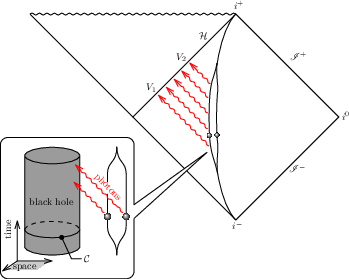
Figure 1: Penrose diagram illustrating stationary trajectories of the superposed charge in the DSW experiment; all radiation propagates towards the horizon when conducted adiabatically, with V1 and V2 marking horizon times and C denoting a horizon cross-section.
Analytical Implications and Consequences
The trade-off relation offers several insights:
- Uncertainty Principle Analog: It leads to a quantum uncertainty relation, showing that the product of photon number fluctuation and entropy variance exceeds $1/4$.
- Area Fluctuation Bound: For Bekenstein-Hawking entropy S≈A/(4GN), the variance in horizon area fluctuation is lower-bounded, Var[N^]≥⟨N^⟩0, with Var[N^]≥⟨N^⟩1 the horizon radius and Var[N^]≥⟨N^⟩2 the Planck length.
- Mutual Information Bound: The lower bound can be expressed in terms of quantum mutual information Var[N^]≥⟨N^⟩3 between infalling charge and horizon radiation, showing that as more information is acquired (Var[N^]≥⟨N^⟩4), the entropy fluctuation can be minimized, though only asymptotically as Var[N^]≥⟨N^⟩5.
Theoretical and Practical Implications
This result has extensive implications for the stochastic formulation of black hole thermodynamics:
- Black Hole Information Storage: The trade-off quantifies the precision and uncertainty with which a black hole can record quantum information, imposing theoretical limits on the horizon’s memory and information-processing capability.
- Quantum Gravity and Thermodynamic Fluctuation Relations: The relation bridges stochastic gravity with thermodynamic uncertainty relations, suggesting deeper connections with fluctuation theorems and quantum statistical mechanics in curved spacetimes [Barato.TUR.2015, Hasegawa.QTURgeneral.2021, Cai.Fluctuation.2025].
- Quantum Area Fluctuations: It provides explicit, nontrivial bounds for area fluctuations, contextualizing prior work on quantum geometric uncertainty [Parikh.area.uncertainty.2025, Ciambelli.area.fluc.2025, Sorkin.wrinkled.1996, Marolf.quantum.width.2005].
Future Directions
The formalism elucidated herein can be generalized to other quantum channels recording information on the horizon, such as non-Abelian fluxes or gravitational wave memory. Incorporating generalized entropy functionals, higher-order quantum corrections, and extending to dynamic or rotating horizons constitute pertinent future extensions. The results also motivate the exploration of quantum fluctuation theorems and stochastic thermodynamic bounds in fully quantum gravity scenarios, possibly influencing holographic approaches to black hole information.
Conclusion
The paper rigorously establishes a fundamental trade-off law between black hole entropy fluctuation and the quantum information encoded in infalling photons. The stochastic semiclassical gravity framework, combined with DSW decoherence, provides analytic structure and quantifiable bounds, furthering the understanding of stochastic thermodynamic aspects in black hole physics. This advances theoretical limits on quantum information processing by horizons and opens the pathway to future investigation into quantum gravity fluctuation relations and quantum thermodynamic uncertainty principles (2605.26214).