- The paper demonstrates that Killing horizons induce decoherence in quantum superpositions by emitting entangling photons that encode which-branch information.
- The authors derive a functional relationship linking the average number of entangling photons to decoherence, highlighting bounded energy flux and finite entropy injection.
- The study clarifies that static modifications of the horizon’s electromagnetic field store irretrievable information, challenging standard interpretations of black hole thermodynamics.
Horizon-Induced Decoherence of Quantum Superpositions: Entangling Photons and Black Hole Thermodynamics
Context and Motivation
Recent theoretical developments have established that Killing horizons, such as those of black holes, inherently induce decoherence in quantum systems prepared in spatial superposition. This effect emerges even under nearly adiabatic operations, with decoherence functional rates proportional to the duration over which the superposition persists. The paradigm stems from extended versions of the celebrated which-path interference gedanken experiments wherein information about a quantum system leaks across causal boundaries. Specifically, for electrically-charged systems near black hole horizons, entangling photons traversing the horizon carry branch information about the superposition, instigating decoherence.
Such processes challenge conventional interpretations of causality and complementarity. If observers (Alice and Bob) operate in causally disconnected regions with Bob hidden behind a horizon, the emission of photons encoding which-branch information ensures correct decoherence dynamics: coherence cannot be restored due to irretrievable information storage on the horizon. This phenomenon manifests even when Alice recombines her system adiabatically, with loss of coherence attributed to horizon-induced entangling photon dynamics.
The decoherence effect is quantified by the average number of entangling photons, ⟨N⟩, emitted by the charge in superposed positions. The functional relationship is given by:
\begin{equation}
\mathcal{D}
= 1 - e{-\frac{1}{2} \langle N \rangle}
\end{equation}
These photons correspond to the field sourced by the current difference of the branches—essentially a dipole field at the horizon. The photon number grows linearly with the proper time T during which the superposition is maintained, for generic Killing horizons, including Schwarzschild and Rindler cases.
Energy and entropy dynamics associated with entangling photons are non-trivial. Explicit calculation shows that the total energy carried by these photons (ΔE) can be arbitrarily small if Alice is sufficiently far from the horizon (Figure 1), but the associated entropy injection into the black hole remains finite (δS=ln2), triggering challenges for the generalized second law and the holographic entropy bound.
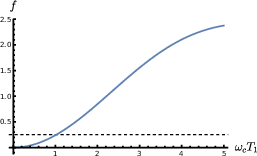
Figure 1: Plot of the integration term in equation (energy) quantifying entangling photon energy, f(ωcT1), illustrating that even for ωcT1≤1, the energy remains bounded above by f≈0.25.
For situations where T1 is chosen such that ⟨N⟩=1, the energy associated with the emission is bounded by:
ΔE≤0.05Cκ
with T0 encoding geometric data, surface gravity T1, and system parameters. Physical examples (e.g., superposed charges at astronomical distances) confirm that this energy is minuscule relative to what would be required by the black hole Clausius relation (T2). This apparent violation is not resolved by considering standard or non-entangling photon modes, whose energy contributions are negligible in large T3 limits.
The essay proposes that entangling photons do not actually constitute an energy flux across the horizon. Instead, the modification of the static electromagnetic field at the horizon—manifested as photons “hovering” at the horizon—stores branch information irretrievably for external observers. From the perspective of the outside, these photons maintain energy density at the horizon corresponding to a static field, not a dynamical energy transfer. Inside the horizon, the radiation arises due to the dipole field beyond, but this is not ascribable to external energy flux. This duality is reminiscent of the field description for uniformly accelerated charges in Minkowski spacetime, wherein co-accelerating observers detect no radiative energy flux despite field configurations suggesting otherwise.
This absence of horizon-crossing energy flux allows one to evade the area quantum threshold, ensuring consistency with black hole thermodynamics and the generalized second law. The deposited entropy in the black hole is fully accounted for by information-theoretic storage, without violations of energetic or holographic bounds.
Implications and Future Directions
This analysis clarifies the nature of horizon-induced decoherence in charged quantum systems, specifically reconciling the loss of coherence with the strictures of black hole thermodynamics. It establishes that entangling photons offer a mechanism for permanent information storage at the horizon, not through energetic transfer but static field modification—the branch information encoded in the Coulomb field at the horizon is permanently inaccessible to external observers.
Practically, this insight refines our understanding of quantum information loss and retrieval in gravitating systems, providing a robust theoretical foundation for quantum protocols near horizons. It further motivates generalizations of entropy bounds and thermodynamic relations in settings that include entanglement and irretrievable information deposition. Future investigations may extend this framework to scenarios involving non-Abelian charges, gravitational superpositions, and collapsing backgrounds, potentially illuminating the interplay between quantum information and dynamical spacetime structure.
Conclusion
The essay presents a rigorous analysis of horizon-induced decoherence for electrically-charged systems in spatial superposition. Even with vanishingly small energy carried by entangling photons, the finite entropy encoded in horizon-modified fields ensures irreversible decoherence, consistent with black hole thermodynamics. The proposed mechanism avoids energy flux constraints by associating information storage with static field configurations at the horizon, clarifying the quantum-gravitational interplay governing coherence loss. This framework provides a foundation for future work on quantum information in curved spacetime, with implications for the theoretical landscape of black hole entropy and quantum gravity.