Asymptotically Optimal Depth Fermionic Permutation on 2D Grid Quantum Architecture without Ancillas
Published 25 May 2026 in quant-ph | (2605.26041v1)
Abstract: Simulating fermionic systems on qubit hardware involves many nonlocal interactions, and efficient routing of these interactions is critical to the overall cost of fermionic simulation algorithms. Recent works reduce this Jordan-Wigner routing overhead to polylogarithmic depth under all-to-all connectivity, but degrade to $O(\sqrt{N}\,\mathrm{polylog}\,N)$ for $N$ fermionic modes on 2D nearest-neighbor architectures. We present a fermionic permutation protocol tailored to 2D grid architectures that achieves the optimal $O(\sqrt{N})$ depth with $O(N\sqrt{N})$ nearest-neighbor gates and no ancilla qubits, mid-circuit measurements, or classical feedforward. This matches the $Ω(\sqrt{N})$ lower bound, which holds even when $O(N)$ ancillas and classical feedforward are permitted. We further construct an $O(\sqrt{N})$-depth transformation between the Jordan-Wigner, Bravyi-Kitaev, and Parity encodings on the 2D grid via a Hilbert-curve layout, extending our result to all three encodings. Benchmarks on the fermionic fast Fourier transform and Trotter simulation of sparse SYK model demonstrate consistent reduction in depth, spacetime volume, and infidelity for system sizes $N \gtrsim 100$ in the early fault-tolerant regime.
The paper presents an ancilla-free fermionic permutation protocol that achieves O(√N) depth on a 2D grid.
The method integrates Hall’s row-column-row decomposition with a novel Γ circuit that corrects vertical FSWAP phase errors using nearest-neighbor gates.
The protocol optimizes resource usage in quantum simulations and extends to Bravyi–Kitaev and Parity encodings without increasing circuit depth.
Asymptotically Optimal Fermionic Permutation on 2D Grids Without Ancillas
Motivation and Problem Statement
Efficient simulation of interacting fermionic systems is fundamental for quantum chemistry, condensed matter physics, and lattice gauge theory. Qubit-based quantum hardware, however, faces a critical challenge: fermionic operators are nonlocal under Jordan–Wigner (JW) and related encodings, whereas interactions on typical hardware are limited to nearest-neighbor connectivity. Dynamic fermion routing—realizing arbitrary fermionic permutations—becomes a dominant bottleneck for large-scale quantum simulation. Prior works have shown polylogarithmic permutation depth is achievable for all-to-all connectivity, but on fixed 2D planar architectures they incur an $O(\sqrt{N}\polylog N)$ overhead for N fermionic modes, exceeding the strict Ω(N) lower bound imposed by grid expansion. The paper establishes a protocol matching this lower bound with no ancillas, mid-circuit measurements, or feedforward, and extends the result to Bravyi–Kitaev (BK) and Parity encodings.
Overview of Fermionic Encoding and Permutation
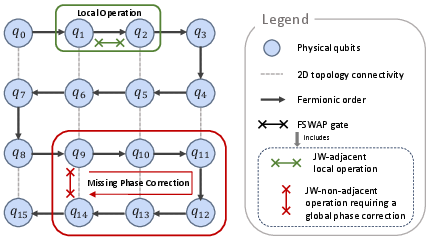
Fermionic modes are mapped to qubits via JW, BK, or Parity transformations. JW serializes modes, producing Pauli-Z strings whose length reflects the nonlocality; BK and Parity improve weight and locality via tree-structured parity bookkeeping, but still require dynamic permutations for interaction locality in circuit simulation steps. Fermionic permutation differs fundamentally from ordinary qubit permutation: the antisymmetry must be respected, and every swap between modes whose JW order changes requires phase corrections over intermediate qubits.
Figure 1: Snake JW order on an L×L grid. Vertical swaps cross row turns, requiring nonlocal phase corrections along the JW chain.
The base primitive is the fermionic SWAP (FSWAP). On JW-adjacent qubits, it is local; for non-adjacent pairs, notably vertical grid neighbors, the operation involves a parity string traversing intermediate qubits.
Algorithmic Contributions
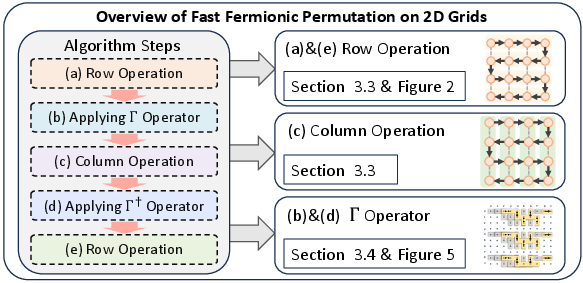
The protocol achieves O(N) depth for arbitrary fermionic permutations on an L×L grid, using O(NN) nearest-neighbor gates and zero ancillas. The construction consists of two integrated components: (i) a classical three-stage permutation decomposition tailored to 2D grid geometry through Hall’s Row-Column-Row (RCR) routing, and (ii) an ancilla-free phase-correction unitary Γ enabling vertical FSWAP correction via conjugation.
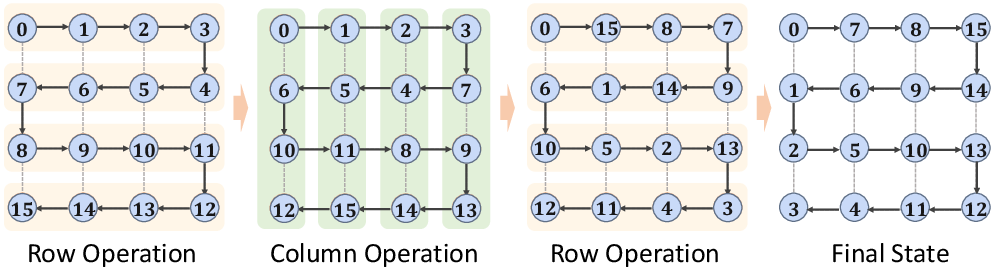
Figure 2: Sequential stages of the ancilla-free fermionic permutation protocol. The Γ sandwich converts bare vertical FSWAPs to full anticommuting SWAPs.
Hall’s Row-Column-Row Decomposition
Any permutation is factored as within-row (horizontal) sorting, within-column (vertical) sorting, and final within-row sorting. Under the JW snake order, horizontal neighbors are JW-adjacent and can be sorted directly; vertical swaps are nonlocal and require parity correction.
Figure 3: Hall’s Row-Column-Row decomposition maps permutation routing to source/destination rows and columns, aligning with grid structure.
Ancilla-Free Gamma Circuit and Decomposition
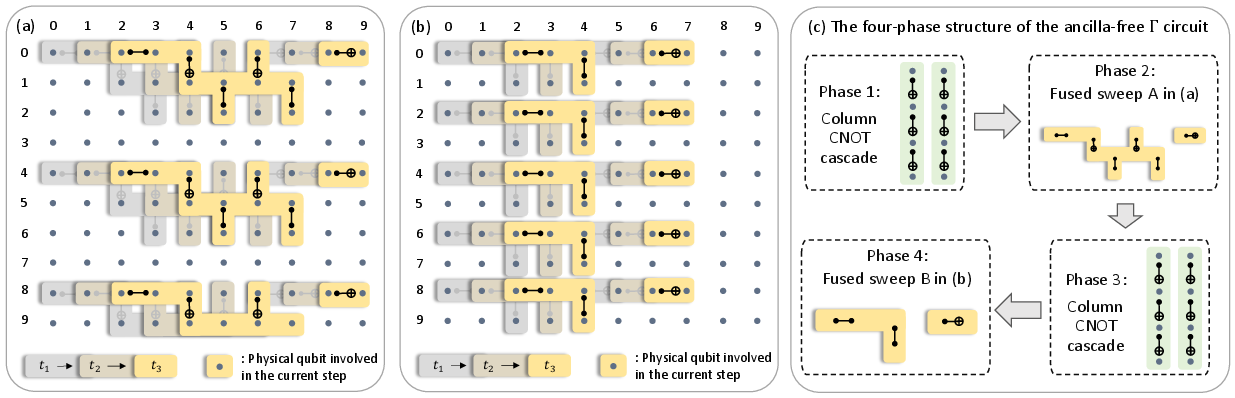
The N0 operator is a polynomial diagonal unitary, implementable in N1 depth with strictly nearest-neighbor gates. Its action is to absorb all vertical parity corrections, so conjugation by N2 converts bare vertical FSWAPs (which are hardware-native) into full fermionic SWAPs. The construction leverages a binary decomposition of phase monomials, pipelined sweeps along rows, and vertical CNOT cascades to realize all required phase terms with zero ancillary overhead.
Figure 4: The ancilla-free N3 circuit structure. Pipelined sweeps and basis changes compress the phase polynomial construction to N4 depth per N5 application.
Asymptotic Optimality
The protocol saturates the N6 lower bound for permutation depth imposed by grid expansion, even in the LOCC model (with classical communication and N7 ancillas). The total circuit depth is N8, and the gate-count is N9, both optimal in the absence of extra resources.
Extension to Bravyi–Kitaev and Parity Encodings
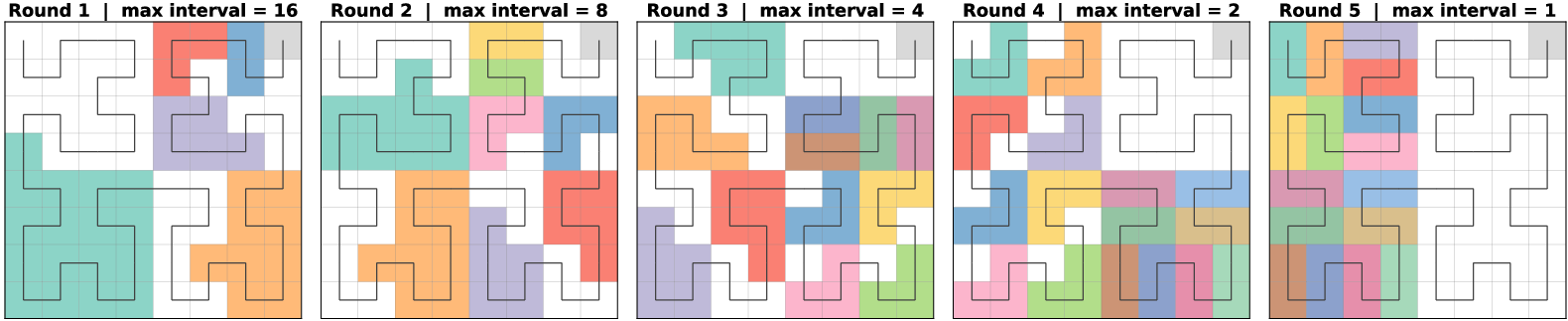
The technique generalizes to BK and Parity encodings via efficient ternary-tree transformations. These basis changes are implemented as sequences of parallel CNOT-based tree rotations. By laying out the qubits along a Hilbert space-filling curve, the conversion is realized in Ω(N)0 depth on the 2D grid, as disjoint intervals map to compact grid regions.
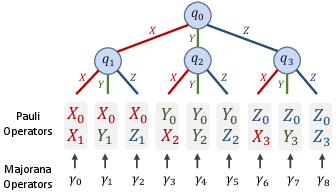
Figure 5: Ternary tree encoding. Root-to-leaf paths specify Pauli strings, with tree shape, node labeling, and Majorana labeling representing JW, BK, and Parity variants.
Figure 6: Parallel basis transformation between Parity, BK, and JW encodings via tree rotations, utilizing Ω(N)1-depth intervals on grid.
Figure 7: Visualization of BKtoJW conversion rounds for Ω(N)2, showing spatially compact, non-overlapping cascades mapped via Hilbert curve ordering.
Numerical Results and Benchmarking
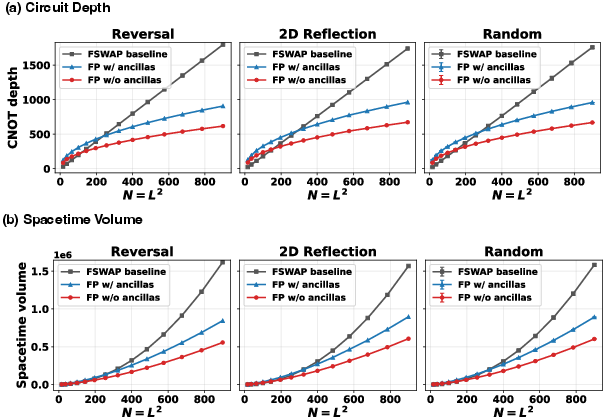
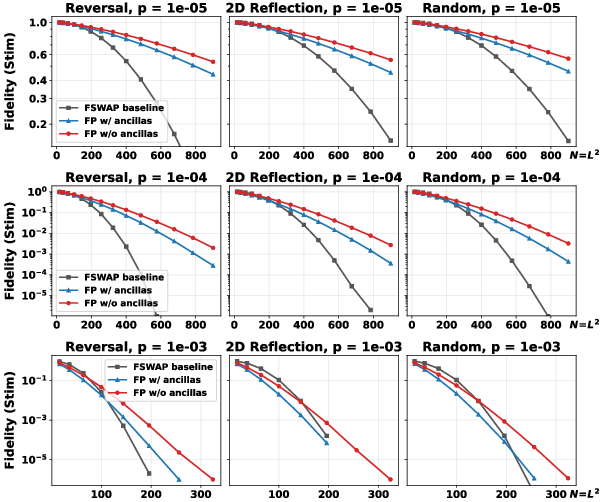
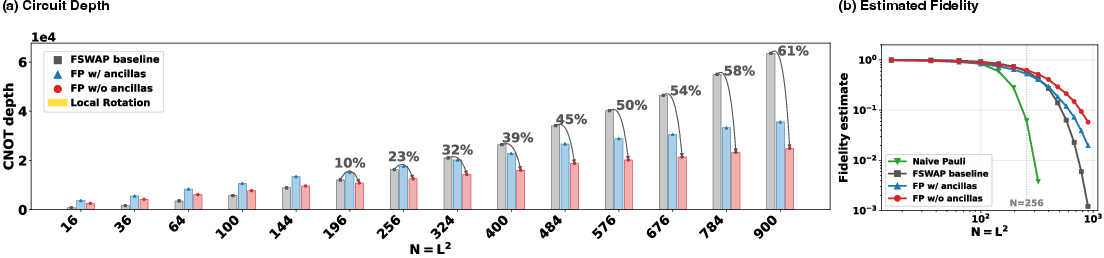
Extensive simulations conducted on Ω(N)3 grids (Ω(N)4 up to 900) reveal that the ancilla-free protocol consistently outperforms prior baselines in CNOT depth, spacetime volume, and fidelity for Ω(N)5. Benchmarks cover three workloads:
Standalone fermionic permutations (random, reversal, 2D reflection): For Ω(N)6, the 2D grid methods are strictly superior in scaling and absolute resource usage, with the ancilla-free variant achieving the lowest depths and highest fidelities.
Figure 8: Circuit resources for major permutations. For Ω(N)7, the ancilla-free method substantially reduces both depth and spacetime volume.
Figure 9: Stim-simulated Clifford fidelity. The ancilla-free approach yields the highest fidelity for Ω(N)8 under realistic error rates.
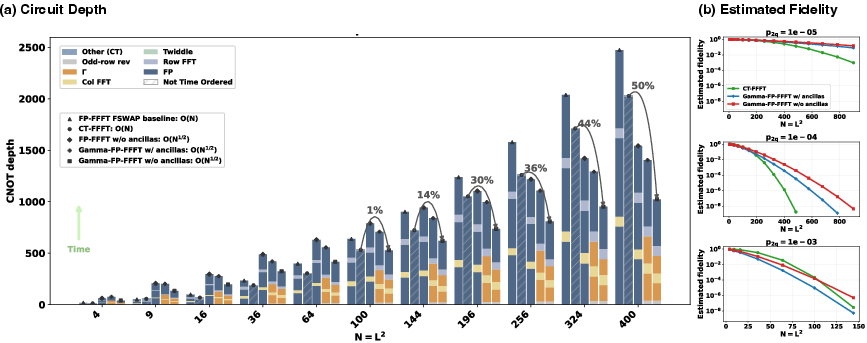
2D fast fermionic Fourier transform (FFFT): The protocol achieves a quadratic improvement over textbook Cooley–Tukey variants, with Ω(N)9 depth and significant reductions in logical budget.
Figure 10: FFFT CNOT-depth ablation. The ancilla-free Z0 sandwich in the column stage tightens the overall circuit depth and resource profile.
Sparse SYK Trotter simulation: The routing cost dominates complexity; the protocol scales sublinearly and surpasses 1D and ancilla-based methods for Z1, translating into a Z2 reduction in gate depth at Z3.
Figure 11: SYK Trotter step benchmarking. The ancilla-free method maintains fidelity and depth scalability, outperforming 1D and ancilla-based baselines.
Theoretical and Practical Implications
The results demonstrate that dynamic fermionic routing can be performed optimally on practical 2D nearest-neighbor hardware without ancillary qubits, classical feedforward, or measurement. The approach is algorithmically generic and extensible to BK and Parity encodings (and possibly more general product-preserving ternary-tree mappings), making it directly applicable to quantum simulations of chemistry and physics in the early fault-tolerant regime. Eliminating routing overhead reduces logical qubit and gate count requirements, sharpening projected resource estimates for quantum advantage in fermionic workloads.
Two theoretical questions remain open: whether the Z4 ancilla-free bound generalizes to all product-preserving ternary-tree encodings, and whether further architectural schedule optimization can tighten constant prefactors.
Conclusion
The paper presents a formal algorithm achieving asymptotic optimality for fermionic permutation on 2D grids without ancillary resources (2605.26041). By integrating Hall’s grid-local decomposition with an efficient phase-polynomial Z5 circuit, the protocol saturates depth and gate-count lower bounds and advances the state of practical quantum simulation resource compilation. The implications extend to broader fermionic encoding paradigms and highlight algorithm–architecture co-design as a critical enabler for scalable quantum many-body simulation.
“Emergent Mind helps me see which AI papers have caught fire online.”
Philip
Creator, AI Explained on YouTube
Sign up for free to explore the frontiers of research
Discover trending papers, chat with arXiv, and track the latest research shaping the future of science and technology.Discover trending papers, chat with arXiv, and more.