Fermion lattices can be simulated by same-size qubit lattices with $\mathcal{O}(1)$ interaction overhead
Published 12 May 2026 in quant-ph | (2605.12600v1)
Abstract: Local interactions among electrons underlie many complex properties of correlated materials. While the Jordan-Wigner transformation can preserve this locality along one spatial dimension, interactions along the remaining dimensions typically incur substantial overhead. We show how to simulate all geometrically local interactions on an $N$-site two-dimensional fermion lattice with no asymptotic overhead in the number of interactions and no space overhead. The primary overhead of our method is circuit depth, which on a qubit lattice matches that of fermionic swap networks, scaling as $\mathcal{O}(\sqrt{N})$, but reduces to $\mathcal{O}(\log N)$ on reconfigurable qubit arrays and to $\mathcal{O}(1)$ in lattice-surgery-based surface-code architectures. This is enabled by dynamically reorienting the Jordan-Wigner transformation to switch the lattice dimension along which locality is preserved. Furthermore, we study fermion routing, as required for the simulation of non-local interactions. When using qubit lattices, we reach resource scaling that asymptotically matches that of qubit routing, whilst on fully connected qubit devices, a depth scaling arbitrarily close to $\mathcal{O}(\log N)$ is reached. This allows the fermionic fast Fourier transform to be implemented on qubit lattices with asymptotically optimal resource scaling under these locality constraints. Notably, all of our constructions naturally extend to $d$-dimensional lattices. Beyond scaling improvements, we show explicit examples of our method, including Fermi-Hubbard-model simulations of the square-, Lieb- and kagome lattice and the fermionic fast Fourier transform.
The paper demonstrates dynamic reordering between complementary JW encodings to map fermionic interactions onto local qubit gates with O(1) overhead.
It shows asymptotically optimal circuit depth scaling for d-dimensional lattices, reducing simulation cost for Hubbard and related models.
The method achieves simulation efficiency without extra qubit overhead, making it compatible with advanced hardware like lattice-surgery surface codes.
Efficient Simulation of Fermion Lattices Using Same-Size Qubit Lattices with Constant Overhead
Introduction
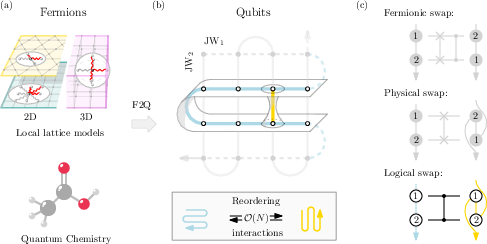
The simulation of interacting fermionic lattice systems on qubit-based quantum hardware is central to quantum algorithms in strongly correlated electron systems, quantum chemistry, and condensed matter physics. A recurring challenge is mapping local fermionic interactions onto qubit hardware with minimal overhead, both in terms of required interaction locality and circuit depth. Traditional mappings such as the Jordan-Wigner (JW) transformation impose a severe one-dimensional constraint that creates nonlocal qubit interactions in higher dimensions, whereas locality-preserving encodings reduce nonlocality at the expense of substantial qubit overhead. The paper "Fermion lattices can be simulated by same-size qubit lattices with O(1) interaction overhead" (2605.12600) presents a dynamical encoding mechanism that overcomes these limitations, enabling simulation of fermion lattices by same-size qubit lattices with constant interaction overhead, and without the scaling cost in qubit number.
Figure 1: Overview of central concepts: (a) need for F2Q (fermion-to-qubit) mappings for lattice models, (b) the limitation of single JW encoding, (c) dynamic reordering and encoding switching via CZ and SWAP gates.
Background and Motivation
The JW transformation provides an efficient and compact mapping of fermionic operators onto qubit Pauli operators, but it enforces an ordered path (JW path) across the qubits, rendering any interaction nonlocal unless the two modes are adjacent on that path. In 2D and higher dimensions, this drastically increases Pauli string lengths and simulation cost, yielding overheads in both circuit gate count and depth. Fermionic swap networks (FSN) have been a mainstay in addressing some of these losses by permuting fermionic modes locally. Still, even optimal FSN constructions deliver a depth overhead of O(N) for 2D systems, and the gate count can scale as O(N3/2) for a system of N modes.
Emerging alternatives, such as compact encodings and polylogarithmic depth encoding switches, previously required either O(N) ancilla qubits or globally nonlocal hardware connectivity, which are not practical in most hardware realizations.
Dynamical Encoding Primitives and Boustrophedon Patterns
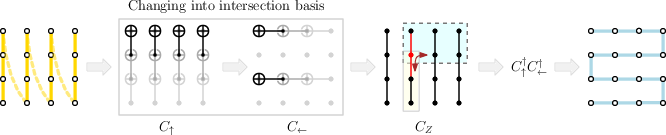
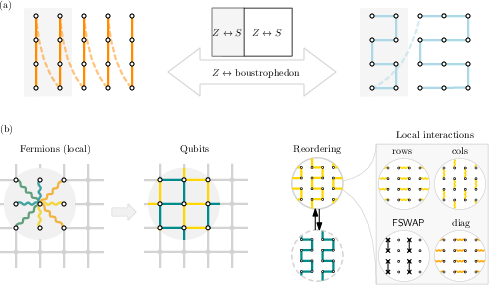
The approach in (2605.12600) exploits the vast freedom in JW orderings by developing efficient circuits to switch between multiple, complementary JW encodings, each preserving locality along a different axis of a qubit lattice. The core mechanism is dynamic reordering, particularly by alternating between "row-major" and "column-major" JW encodings (e.g., "Z" and "S" patterns; see Fig. 2 and 3 below). By employing Clifford circuits composed of CNOT ladders and carefully orchestrated CZ gates, the method enables efficient basis transitions aligning qubits with the local structure of fermionic interactions along any spatial direction of interest.
Figure 2: Example of efficient JW reordering in 2D, transforming from a Z-pattern (column-major) to an S-pattern (row-major), implemented via CNOT ladders and CZ gates.
Figure 3: Construction of two-dimensional boustrophedon (“ox-plowing”) encodings: switching between global “Z” and “S”–type orderings to ensure locality for all nearest-neighbor fermionic interactions.
A minimal set of two such complementary encodings suffices to ensure that all local interactions are mapped to local qubit gates with only constant increase in interaction range, as proven via the parity flow formalism. The resource cost for switching between encodings matches the light-cone lower bound set by the hardware geometry: O(N) depth on 2D lattices, O(logN) on reconfigurable arrays permitting nonlocal CNOTs, and O(1) in lattice-surgery surface code architectures.
Asymptotic Optimality: Locality-Conserving Simulation in Arbitrary Dimension
The paper provides a construction, generalized to d-dimensional lattices, where the combination of d different JW encodings (one per lattice direction) and associated boustrophedon partitionings facilitate constant-overhead simulation in both gate count and "physical" interaction range, with circuit depth scaling as O(N)0. Notably, all nonlocal fermionic permutations can be implemented with no more overhead than the optimal classical routing schedule for data movement on the same hardware graph [(2605.12600), Annexstein & Baumslag].
Resource Analysis and Numerical Results
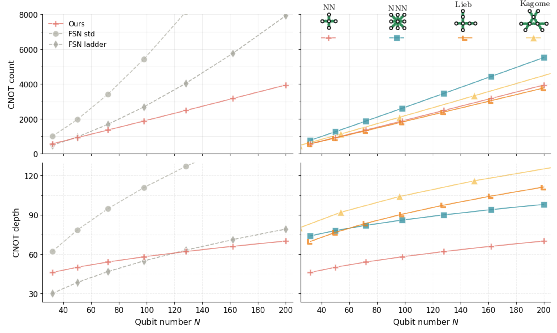
A strong feature of the approach lies in sharply reduced gate counts and depths compared to previous techniques. For example, in Fermi-Hubbard simulations (Fig. 5):
Figure 5: Gate count (upper) and CNOT depth (lower) for simulating different Hubbard model variants—NN, NNN, Lieb, and kagome lattices—on 2D qubit lattices. The method achieves clear reductions compared to standard FSN approaches at moderate O(N)1.
The numerical analysis in (2605.12600) highlights that:
For standard 2D Hubbard models, the proposed method outperforms both the canonical FSN and ladder-graph optimized FSNs in gate count from O(N)2, and surpasses FSNs in depth for O(N)3.
The interaction depth overhead remains governed primarily by the encoding switches, hence any hardware advancement that improves logical CNOT depth (e.g., lattice surgery) directly benefits the overall simulation cost.
As geometrical complexity increases (e.g., with NNN couplings, Lieb, and kagome lattices), the overhead remains additive and constant in both gate count and depth—unlike FSNs whose prefactor scales with interaction range.
Application to Fermion Routing and Fast Fermionic Fourier Transform
By utilizing dynamic encoding switches, the optimal classical permutation-routing algorithm (offline routing via factorizable row/column permutations) becomes directly applicable, yielding permutation routing for fermions with the same asymptotic cost as in classical data routing:
On an O(N)4 2D qubit array: O(N)5 depth for arbitrary permutations.
On fully connected hardware, depth approaches O(N)6.
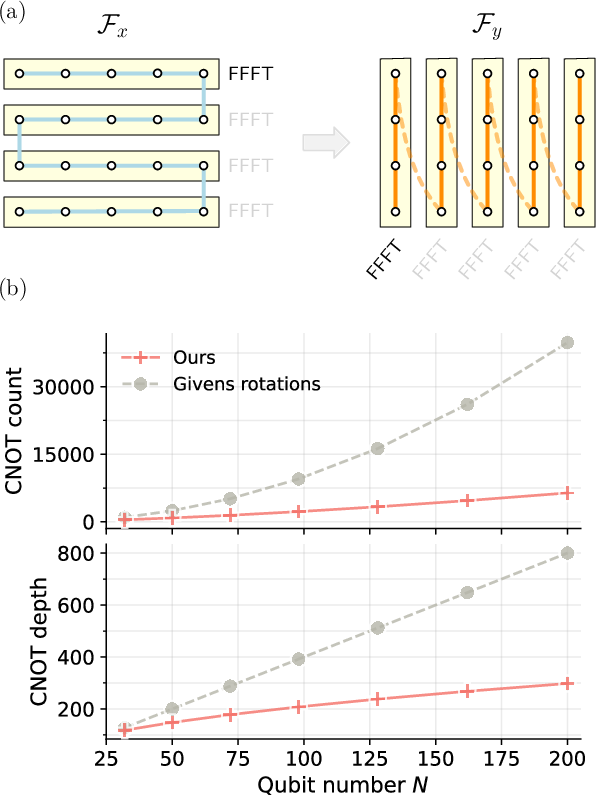
This leads to an asymptotically optimal implementation of the fermionic fast Fourier transform (FFFT) (Fig. 6), with resource costs that dramatically improve upon existing Givens-rotation based methods and previous ancilla-free approaches.
Figure 4: (a) Decomposition of the 2D \textsf{FFFT} into parallel 1D transforms along complementary axes, supported by dynamic encoding. (b) Results showing reduced gate count and depth compared to prior techniques.
Fault-Tolerant Implementation via Lattice Surgery
A significant theoretical implication is that, in lattice-surgery surface codes, all required CNOT ladders arising in encoding switches can be implemented in O(N)7 depth, as multi-target Pauli measurements and corrections can be parallelized with feed-forward logic. This matches the theoretical lower bound for simulation depth permitted by the hardware.
Extensions, Implications, and Outlook
The dynamical encoding framework combines locality-preservation with the flexibility of dynamic encodings, resulting in zero qubit overhead, asymptotically optimal physical gate scaling, and gate depth that matches the hardware’s light-cone. Notably:
For current superconducting qubit platforms, the method efficiently exploits lattice-like hardware graphs.
In neutral-atom arrays permitting fast row/column permutations, encoding changes become highly efficient, potentially enabling low-constant, near-optimal depth for large-scale fermion simulations.
The approach provides a template for moving beyond traditional F2Q mapping constraints, opening the path to efficient, scalable quantum simulation of strongly correlated materials, frustrated geometries, and large quantum chemistry systems. In particular, resource bottlenecks previously induced by Pauli string lengths and nonlocal JW interactions become negligible for both Trotterization and variational approaches (e.g., VQE, ADAPT-VQE, SqDRIFT), shifting the practical limitations towards hardware-native connectivity and coherence times.
Conclusion
The construction in (2605.12600) demonstrates that it is possible to simulate O(N)8-dimensional, geometrically local fermionic lattice systems on same-size qubit lattices with only a constant increase in interaction range and no increase in space overhead. The primary cost is in encoding switch depth, which achieves light-cone-limited scaling matching the best possible for given hardware topology, and reduces to constant or logarithmic depth in advanced or reconfigurable architectures. This positions the method as the current state of the art for efficient fermionic simulation, bridging the gap between physical constraints of qubit hardware and the spatial locality of physical fermion lattices—without requiring qubit overhead, ancillas, or prohibitively nonlocal connectivity.
References:
Aigner, G., Klaver, B., Lanthaler, M., & Lechner, W. (2026). "Fermion lattices can be simulated by same-size qubit lattices with O(N)9 interaction overhead" (2605.12600).
“Emergent Mind helps me see which AI papers have caught fire online.”
Philip
Creator, AI Explained on YouTube
Sign up for free to explore the frontiers of research
Discover trending papers, chat with arXiv, and track the latest research shaping the future of science and technology.Discover trending papers, chat with arXiv, and more.