Strategic Non-Shareability of Quantum Correlations
Published 25 May 2026 in quant-ph | (2605.25516v1)
Abstract: Correlations distributed by a mediator are usually valued for the coordination they enable between authorized agents, but in adversarial settings a more decisive property is whether the same coordination can be inherited by an outside colluder without disturbing the authorized marginal. Classical shared randomness is freely copyable, so a hidden seed coordinating two agents can be duplicated for a third; entanglement is constrained by monogamy, which can forbid such lossless extensions in strongly nonlocal regimes. We turn this asymmetry into an operational resource for private-information games. For a fixed authorized behavior $P_{12}$, we define its \emph{collusive shadow} as the set of relabelled behaviors a colluder can reproduce in any admissible tripartite extension preserving $P_{12}$, and we identify \emph{strategic non-shareability} with the distance from this shadow. We prove that, on finite alphabets, the game-optimized anti-collusion capacity equals the total-variation distance to the shadow; a fixed game provides a task-specific separating witness, while optimization over relabelled games recovers the full distance. In the CHSH score slice, Toner--Verstraete monogamy yields the exact certified frontier, so the Bell local bound $S_{12}=2$ is the sharp onset of positive certified anti-collusion power, saturating at $1/(2\sqrt{2})$ for the maximally entangled CHSH strategy. Classical hidden-variable mediators have zero capacity in this slice. We complement these results with two operational tools: a Hoeffding-based finite-data certification protocol that turns observed Bell scores into confidence-bounded anti-collusion certificates, and a level-2 NPA semidefinite relaxation that extends certified upper envelopes to tilted Bell inequalities. These results recast entanglement monogamy as a measurable shareability deficit for quantum-mediated strategic networks.
The paper introduces an operational framework using total-variation distance to quantify anti-collusion capacity in quantum correlations.
It demonstrates that quantum mediators, constrained by entanglement monogamy, achieve strictly positive non-shareability compared to classical counterparts.
Finite-data certification protocols and semidefinite relaxations extend the framework, enabling robust testing of non-shareability in adversarial quantum networks.
Strategic Non-Shareability in Mediated Correlations
Operational Framework and Collusive Shadow
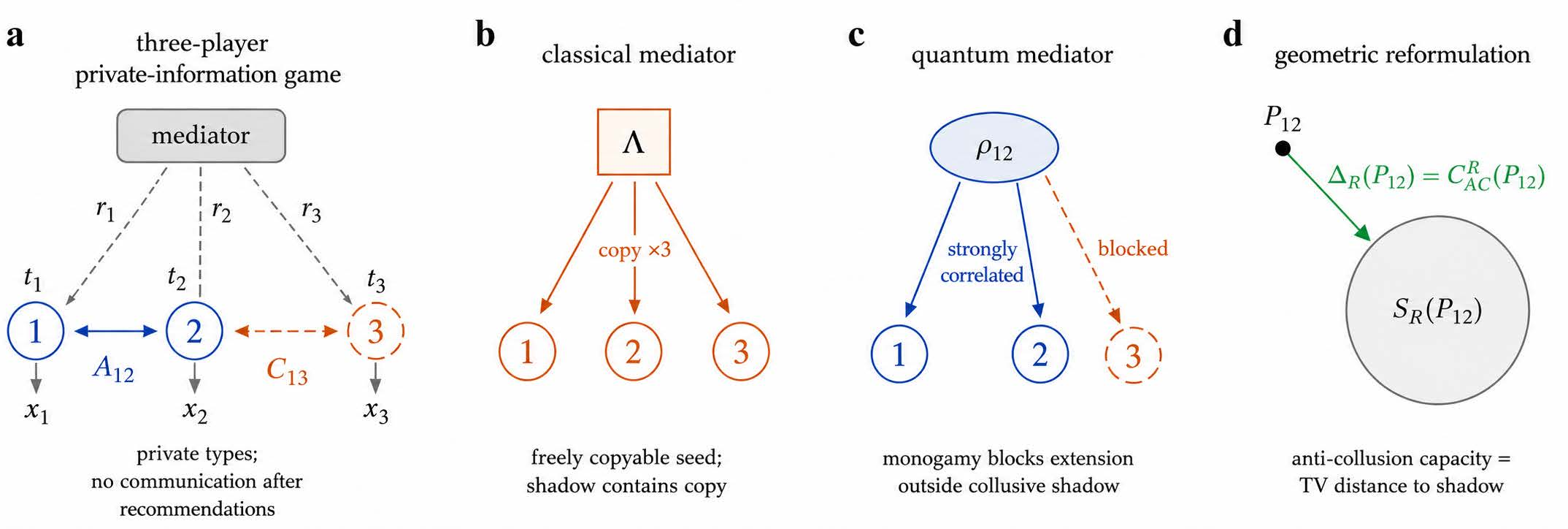
The paper "Strategic Non-Shareability of Quantum Correlations" (2605.25516) introduces a rigorous operational framework for quantifying the extension geometry of mediated correlations in adversarial settings, specifically focusing on anti-collusion properties. The framework formalizes the concept of the "collusive shadow," which is the set of all behaviors a colluder can generate with an authorized agent in any admissible extension preserving the authorized marginal. The fundamental operational resource is the distance of the authorized correlation from its collusive shadow; this measures its strategic non-shareability.
For finite-alphabet games and compact extension sets (classical, no-signalling, and quantum), the game-optimized anti-collusion capacity is exactly the total-variation distance between the authorized behavior and its collusive shadow. This operational distance provides a task-specific separating witness, allowing for certification of collusion resistance via observable behavior.
Classical vs Quantum Mediators: Shareability and Monogamy
The extension geometry exhibits a stark classical-quantum dichotomy. Classical correlation mediators, generated via shared randomness, are freely shareable: hidden seeds can be copied losslessly, and colluders can always reproduce the authorized score in any relabelled test. Consequently, classical mediators have zero anti-collusion capacity in relabelled private-information games, demonstrating strategic vulnerability.
Quantum mediators utilizing entangled states are constrained by entanglement monogamy and the no-cloning theorem. The monogamy of Bell correlations, formalized via inequalities such as Toner-Verstraete, prevents lossless extension of strongly nonlocal pairwise correlations. This enables quantum advantage: certain quantum correlations cannot be inherited by colluders without disturbing the authorized marginal. The anti-collusion capacity, quantified via total-variation distance, is strictly positive in these regimes.
CHSH-Certified Frontier and Exact Separation
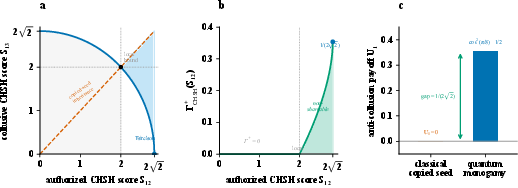
The operational framework is solved exactly in the CHSH score slice. The authorized and collusive CHSH scores S12, S13 are bounded by monogamy: S122+S132≤8. The certified anti-collusion power is
ΓCHSH+(S12)=[8S12−8−S122]+
with S12=2 as the threshold and maximum 1/(22) at Tsirelson's bound. Classical hidden-variable mediators saturate the diagonal S13=S12, whereas quantum strategies fall inside the monogamy frontier, delineating a positive anti-collusion region.
Figure 2: Exact CHSH score frontier; quantum monogamy restricts collusive scores, yielding a positive anti-collusion gap beyond the classical bound.
The payoff separation is maximal for the CHSH game at λ=1: classical mediators achieve zero capacity, while maximally entangled quantum strategies attain U1=1/(22).
Finite-Data Certification and Noise Robustness
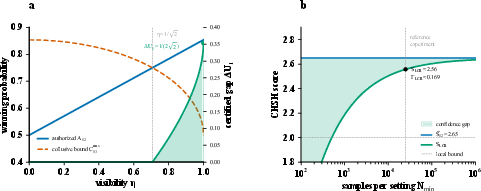
Experimentally, certification protocols are provided: observed Bell scores are mapped via Hoeffding concentration to finite-data confidence bounds on anti-collusion power. The framework remains robust to moderate noise, with a sharp onset in anti-collusion power at the CHSH nonlocality threshold (η=1/2 for Werner noise). For finite samples, statistical bounds allow confidence certification of strategic non-shareability.
Figure 3: Noise-induced transition and finite-data CHSH certification; anti-collusion power emerges above the CHSH threshold and is quantifiable from observed data.
Semidefinite Relaxations Beyond CHSH
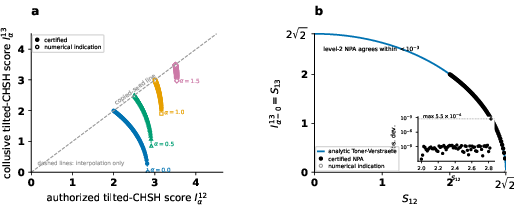
The general collusive vulnerability is a quantum correlation optimization problem. Semidefinite relaxations, such as level-2 NPA, are employed to numerically bound collusive scores for tilted-CHSH and other inequalities. These relaxations yield certified upper envelopes on collusive vulnerability, providing operational anti-collusion bounds outside analytically solvable cases.
Figure 4: NPA upper envelopes for tilted-CHSH; level-2 relaxation bounds the collusive score for given authorized tilted-CHSH scores, extending the framework beyond CHSH.
Resource-Theoretic Implications and Extension Geometry
The results recast monogamy as a measurable shareability deficit—a resource in strategic adversarial networks. Freely shareable correlations (classical copied seeds) form the free set; non-extendible, non-shareable correlations are operationally valuable. The anti-collusion power is tightly linked to extension geometry and the marginal compatibility problem, yielding a game-weighted operational perspective distinct from standard S130-extendibility.
Practical and Theoretical Implications
Practically, the framework provides a certification toolkit for quantum internet architectures and device-independent cryptography—quantum-mediated strategic networks can guarantee measurable collusion resistance. Theoretically, it unifies self-testing, monogamy, semidefinite relaxations, and operational distinguishability. The anti-collusion capacity is operationally defined, measurable from empirical Bell scores, and robust to statistical and environmental noise.
The separation between the analytic frontier (CHSH), finite-data certification, and semidefinite relaxations (NPA) delineates multiple levels of achievable anti-collusion guarantees. Extending the approach to multipartite, non-CHSH inequalities and developing memory-tolerant certification protocols are natural directions, as is identifying monotones with respect to shareability-preserving operations.
Conclusion
The paper establishes strategic non-shareability as a quantifiable, certifiable operational resource for quantum correlations in adversarial strategic games. The anti-collusion capacity is precisely the total-variation distance to the collusive shadow. Quantum mediators achieve strictly positive anti-collusion power precisely when Bell nonlocality is certified, and this power is robustly measurable using finite-data protocols. Semidefinite relaxations extend the framework to more general nonlocal games. The results bridge foundational quantum principles and operational needs in quantum-mediated network security, opening avenues for further resource-theoretic investigations and experimental certifications.