All pure entangled states can lead to fully nonlocal correlations
Published 29 Apr 2026 in quant-ph | (2604.26605v1)
Abstract: It is a well-established fact that some quantum correlations can be nonlocal, meaning that they cannot be described by a local hidden variable model. Certain quantum correlations have a form of nonlocality so strong that they cannot be reproduced even by models having an arbitrarily small local hidden variable component. These correlations are called fully nonlocal and lead to Bell inequalities in which the maximum quantum value saturates the non-signaling bound. A well-known example of this effect, which is also referred to as quantum pseudo-telepathy or all-versus-nothing proofs of nonlocality, is the quantum distribution fulfilling the Peres-Mermin square, in which the underlying state is a $4\times4$ dimensional maximally entangled state. Other examples of full nonlocality are known but, so far, all of them are for maximally entangled states and it is an open question whether maximal entanglement is necessary for full nonlocality. In this work, we first establish a link between full nonlocality and the concept of antidistinguishability of quantum states. We use this connection to show that in every bipartite $d\times d$ Hilbert space, with $d\geq3$, there are non-maximally entangled states that are fully nonlocal. In fact, we derive simple sufficient conditions for full nonlocality that are only based on the smallest and largest Schmidt coefficients. We also show that in every dimension there exist pure entangled states that do not exhibit full nonlocality. Finally, we show that all pure entangled states can be activated to show full nonlocality in the many-copy scenario.
The paper demonstrates that full nonlocality can be certified for a wide class of pure entangled states using an antidistinguishability criterion, even for non-maximal cases.
It derives explicit analytic bounds based on Schmidt coefficients and mutually unbiased bases to guarantee fully nonlocal quantum correlations in both single and many-copy regimes.
The work underlines practical implications for device-independent protocols such as DI-QKD and randomness generation by broadening the range of usable entangled states.
Summary of "All pure entangled states can lead to fully nonlocal correlations"
Bell Nonlocality and Full Nonlocality
Bell nonlocality epitomizes the most foundational quantum phenomenon where measurement statistics from spatially separated parties cannot be simulated by any LHV (local hidden variable) model. Full nonlocality is a strengthened variant: correlations are said to be fully nonlocal when their quantum realization saturates the maximal value permitted by general non-signaling distributions, i.e., their quantum violation of a Bell inequality attains the non-signaling bound. Famous exemplars include GHZ states and the Peres-Mermin square scenario with maximally entangled states. Previous knowledge suggested that only maximally entangled states exhibit full nonlocality, with non-maximal pure bipartite entanglement incapable of achieving this property.
Antidistinguishability as a Criterion for Full Nonlocality
This work establishes a direct correspondence between full nonlocality and the antidistinguishability of post-measurement quantum states. Antidistinguishability, defined via the existence of measurement operators {Mi} such that Tr[Miρi]=0 for each ρi, is equivalent to the ability to "exclude" a quantum state with certainty upon measurement. The authors show that if, for every local deterministic strategy, the associated post-measurement states are antidistinguishable, then the resulting quantum distribution is fully nonlocal. Thus, full nonlocality is precisely characterized in terms of the existence of antidistinguishing measurements for key subsets of post-measurement states arising in a Bell scenario.
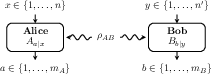
Figure 1: Bell scenario with two parties generating joint distributions p(a,b∣x,y) via measurements on a shared entangled state.
Sufficient Conditions for Nonmaximal Entanglement to Achieve Full Nonlocality
The central technical results leverage recent theorems bounding antidistinguishability via overlaps of post-measurement states, particularly those derived from MUBs (mutually unbiased bases). For a pure bipartite state in Schmidt form ∑iλi∣ii⟩, the authors demonstrate that full nonlocality can be certified for a broad range of non-maximally entangled states, dependent only on the largest and smallest Schmidt coefficients. For systems of local dimension d≥3, explicit analytic bounds are provided—if max(λmax,1−(d−d)λmin)≤(n−2)/(2n−2) (with n the number of MUBs), the state is guaranteed to generate fully nonlocal correlations.
The existence of fully nonlocal non-maximally entangled states is thus proven for every dimension d≥3, overturning the prior assumption that maximal entanglement is a necessary condition. Furthermore, explicit examples are constructed with relatively large Schmidt coefficients (λmax>1/2), which cannot be LOCC-transformed to maximally entangled states, invalidating any LOCC-centric explanation of full nonlocality.
Activation of Full Nonlocality in the Many-Copy Regime
A major claim in the paper is the universality of full nonlocality in the many-copy scenario: for any pure bipartite entangled state, there exists an integer Tr[Miρi]=00 such that the Tr[Miρi]=01-fold tensor product of the state will generate a fully nonlocal quantum distribution given suitable local measurements. This is achieved by observing that tensoring reduces the effective overlap among post-measurement states, satisfying antidistinguishability constraints even when the single-copy scenario fails. This activation does not depend on the specific state and only requires a finite number of local measurements.
Identification of States with Positive Local Content
Not all pure entangled states exhibit full nonlocality in the single-copy regime—even allowing for general (non-projective) measurements. Using a constructive bound based on the maximal Schmidt coefficient and measurement outcome counts, the authors analytically identify families of pure states with strictly positive local content, confirming that full nonlocality is not a universal property across the entire parameter space for single-copy regimes.
(Figure 2)
Figure 2: Geometric depiction of the local (L), quantum (Q), and non-signaling (NS) sets; fully nonlocal points lie on the NS boundary, away from L vertices.
Practical and Theoretical Implications
Full nonlocality functions as a unique resource for DI-QKD, robust randomness generation, and shallow quantum circuit tasks, often outperforming standard nonlocal strategies. The extension to non-maximally entangled states substantially broadens the class of states usable for device-independent protocols. The antidistinguishability connection likewise enables more efficient certification criteria for full nonlocality, providing computationally tractable checks via semidefinite programming.
The activation result implies that all pure entanglement can be harnessed for maximal nonlocality in practical settings utilizing multiple copies. Moreover, the nonlocality-antidistinguishability link opens the prospect of extending these results to multipartite settings, mixed states, and beyond, potentially enabling novel resource-theoretic formulations.
Conclusion
This paper rigorously establishes that full nonlocality is not the exclusive domain of maximally entangled states; sufficient conditions based on antidistinguishability guarantee its presence for a large class of non-maximal pure states in all dimensions Tr[Miρi]=02. Universality in the many-copy regime is proven, and analytic bounds are provided for states with strictly positive local content. These results dissolve previously held limitations on the structure of fully nonlocal quantum correlations in bipartite systems. Future work should focus on the precise boundary between nonlocal and fully nonlocal states, extension to multipartite and mixed-state scenarios, and implications for device-independent cryptography and certification tasks.