Dispersive readout of cavity-coupled solid-state sensor with near-unity readout fidelity
Published 24 May 2026 in quant-ph | (2605.25152v1)
Abstract: Solid-state quantum sensors based on ensembles of nitrogen-vacancy (NV) centers in diamond have emerged as powerful platforms for high-precision metrology. Coupling the NV ensemble to a microwave cavity mode in a cavity quantum electrodynamics (cQED) configuration enables spin readout that surpasses the limitations of conventional optical detection, achieving sub-picotesla magnetic sensitivities. However, existing continuous-wave cQED approaches remain far from the intrinsic spin-projection-noise limit due to spin saturation and power broadening. Here, we introduce a dispersive cQED readout technique to overcome these fundamental limitations in NV ensemble sensing. We develop a comprehensive theoretical framework describing the dispersive interaction and analyze the time-domain dynamics of a strongly-coupled NV-cavity system. Our results indicate near-unity inverse readout fidelity and femtotesla-level sensitivity using a commercially available diamond NV ensemble. Importantly, the dispersive readout exhibits a distinct sensitivity scaling that improves as 1/N with increasing number of spins N, providing a practical pathway toward approaching the standard quantum limit for solid-state spin-ensemble sensors.
The paper presents a dispersive cQED readout protocol that achieves near-unity inverse readout fidelity and femtotesla sensitivity for NV ensemble quantum sensors.
It employs a Maxwell-Bloch framework to model the NV-cavity dynamics and accurately account for thermal and phase noise effects.
The method minimizes destructive measurement back-action, enabling scalable SQL-limited sensitivity for advanced quantum metrology applications.
Dispersive Readout Protocol for Cavity-Coupled Solid-State Quantum Sensors
Overview of NV Ensemble Magnetometry and Cavity QED Readout
Ensembles of nitrogen-vacancy (NV) centers in diamond constitute a robust platform for high-sensitivity quantum sensing, notably magnetometry, due to their favorable spin coherence properties, room-temperature operation, and environmental resilience. Conventional optical readout mechanisms are fundamentally constrained by photon collection inefficiency, resulting in inverse readout fidelities (σe) well above the optimal quantum limit. To overcome these limitations, cavity quantum electrodynamics (cQED) schemes using a microwave cavity coupled to NV ensembles have been explored. These approaches have enabled sub-picotesla sensitivities, yet remain bounded by power broadening and spin-state depolarization under continuous-wave driving. A decisive enhancement is sought to achieve near-unity readout fidelity, enabling femtotesla magnetometric precision and approaching the standard quantum limit (SQL) for ensemble spin sensors.
Dispersive cQED Readout: Theoretical Foundation and Experimental Configuration
The protocol developed in this work employs a dispersive cQED readout, operating off-resonance to avoid destructive measurement back-action and preserve ensemble coherence. This technique infers spin states from the microwave cavity frequency or phase shift, as opposed to direct excitation, minimizing spin depolarization and power broadening. A complete Maxwell-Bloch framework is constructed to describe the time-domain evolution of the coupled NV-cavity system, capturing both signal accumulation and noise sources (thermal and phase noise).
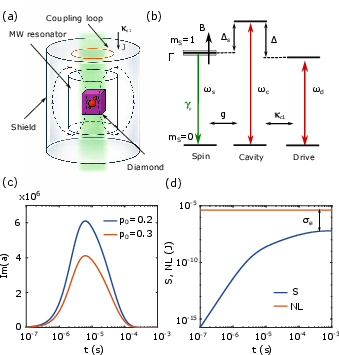
The physical setup places a diamond with an NV ensemble at the core of a high-Q dielectric resonator, with cavity field output detected via a coupling loop.
Figure 1: NV-cQED system schematic and time-domain response illustrating dispersive readout and non-destructive dynamics.
Signal, Noise, and Fidelity Modeling: Achieving Near-Unity Readout
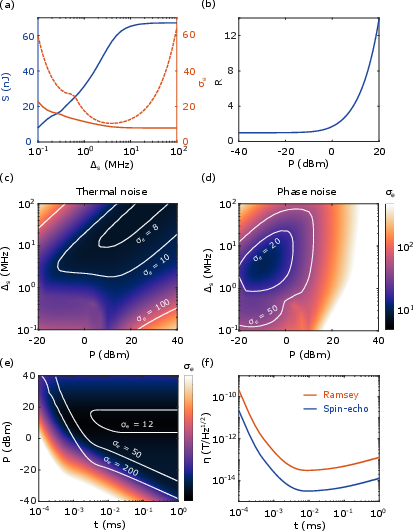
In the dispersive regime, the spin-cavity detuning (Δs) is leveraged to suppress active spin flips and maintain coherence during measurement. An analytic treatment yields expressions for the cavity field evolution and accumulated signal, with noise contributions separated into thermal and phase noise. When phase noise is negligible, the model predicts an inverse readout fidelity approaching σe=8 for N=1015 NV spins, representing an order-of-magnitude improvement over prior continuous-wave schemes.
Figure 2: Simulated signal and inverse readout fidelity as functions of spin-cavity detuning, input power, and measurement time; optimal σe emerges for moderate detuning with phase noise constraints.
Notably, optimal dispersive readout performance is obtained in an intermediate detuning regime. Excessive detuning necessitates higher drive power, amplifying phase noise and degrading fidelity. A critical result is that phase noise can become the limiting factor, thus experimental realization must carefully manage input power and microwave source purity.
Sensitivity Scaling and Approaching the Standard Quantum Limit
The SQL for quantum sensors is defined as η=1/(γeNT2∗), with γe the gyromagnetic ratio, T2∗ the ensemble dephasing time, and N the number of spins. Single NV centers realize high fidelity but are inherently limited by low N. Ensemble methods, while theoretically capable of SQL scaling, have historically suffered from deteriorating Δs0 due to optical readout bottlenecks.
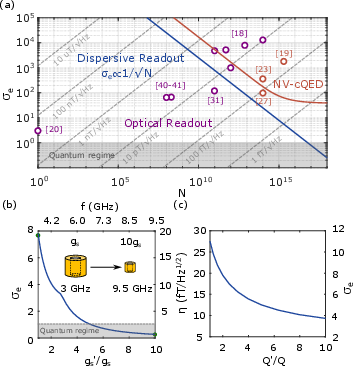
Dispersive cQED readout preserves the favorable sensitivity scaling, with Δs1. The model demonstrates femtotesla sensitivity (Δs2 for spin-echo sequences at Δs3) and maintains SQL scaling for large Δs4, in contrast to the saturation observed in continuous-wave readout. Practical boundaries are imposed by optical polarization efficiency and nonlinear dynamics (saturation and power broadening) even in the dispersive regime, which are systematically explored.
Figure 3: Inverse readout fidelity as a function of ensemble size Δs5, showing dispersive protocol maintains SQL scaling and substantial gains over optical and continuous-wave readout.
Implications, Practical Deployment, and Future Directions
The dispersive readout strategy offers substantial improvements in readout fidelity and sensor sensitivity for NV ensemble-based quantum magnetometers. The practical pathway toward SQL is enabled by the Δs6 scaling, unrestricted by the size of spin ensembles under dispersive conditions. The framework is generalizable to other sensing modalities (gyroscopes, atomic clocks, electrometry) by virtue of the non-destructive and scalable microwave interface.
Further advancements will require:
Extension to fully quantum mechanical models for large NV ensembles, capturing quantum and semiclassical transition regimes.
Comparative studies with dispersive readout in superconducting qubits.
Optimization of cavity designs (frequency, quality factor) to enhance single-spin coupling strength and suppress residual nonlinearities.
Experimental demonstration with commercial systems, carefully controlling phase noise and thermal environments.
The protocol underlines that phase noise and thermal noise must be jointly optimized, with detector and microwave source technology playing a critical role. The scaling results indicate practical scenarios where SQL-limited sensitivity is achievable with current diamond ensembles, with broad applications across quantum metrology.
Conclusion
This work establishes a dispersive cQED readout protocol for NV ensemble quantum sensors, demonstrating near-unity inverse readout fidelities and femtotesla sensitivity, with scalable Δs7 performance up to Δs8 spins. The theoretical framework and numerical modeling provide clear guidance for experiment and device development, supporting the practical realization of quantum-limited solid-state sensors. The findings will inform future research into fully quantum models, advanced cavity engineering, and deployment across next-generation quantum sensing platforms.
“Emergent Mind helps me see which AI papers have caught fire online.”
Philip
Creator, AI Explained on YouTube
Sign up for free to explore the frontiers of research
Discover trending papers, chat with arXiv, and track the latest research shaping the future of science and technology.Discover trending papers, chat with arXiv, and more.