- The paper presents a theoretical NIQB framework that uses XFEL π-pulses and STIRAP protocols to efficiently charge nuclear isomer states.
- The methodology demonstrates orders-of-magnitude improvements in energy density (up to 10^5 eV per nucleus) and charging power (watt-scale) over atomic systems.
- The work highlights anti-aging energy stability with nearly complete ergotropy, paving the way for robust quantum batteries in extreme environments.
Introduction
This work introduces the concept and theoretical architecture of Nuclear Isomer Quantum Batteries (NIQBs), exploiting x-ray free electron lasers (XFELs) to drive coherent population transfer in two- and three-level nuclear systems incorporating nuclear isomers. The scheme leverages the high energy scale and ultra-long lifetimes of nuclear isomer states, aiming to overcome the limited energy capacity and rapid self-discharging of atomic and molecular quantum battery (QB) architectures.
The construction, control, and extraction protocols for NIQBs are grounded in contemporary advances in nuclear quantum optics, XFEL coherent manipulation, and quantum thermodynamic metrics, notably ergotropy. Strong numerical evidence for orders-of-magnitude improvements in stored energy density, charging power, and energy retention time is presented, and the implications for high-efficiency, high-density quantum energy science are rigorously analyzed.
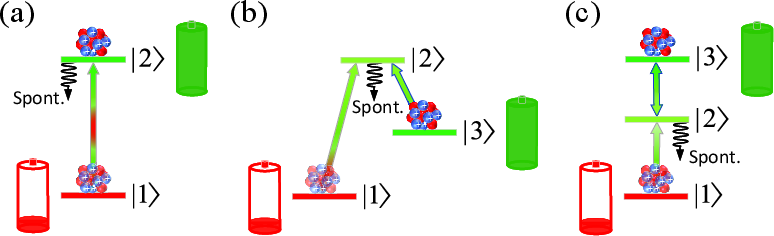
Figure 1: Schematic illustration of two-level and three-level (Lambda and ladder) nuclear isomer quantum battery setups, where energy is stored in long-lived nuclear isomeric states.
Model Architecture: Two- and Three-Level Nuclear Systems
The NIQB framework models the battery cell as a d-level (with d=2 or d=3) nuclear system. The ground state and one (or two) excited levels are chosen such that at least one transition terminates on a nuclear isomer --- a metastable nuclear state with suppressed decay due to selection rule hindrance. Charging is implemented via x-ray laser driving, ensuring population transfer into the isomer.
For two-level NIQBs, the ground and isomer states are directly connected and coupled through a resonant XFEL π-pulse, allowing deterministic population inversion. For three-level (Λ or ladder type) NIQBs, the protocol uses stimulated Raman adiabatic passage (STIRAP), minimizing excited state occupation and thus spontaneous emission, which is critical for nuclei with finite intermediate state lifetime.
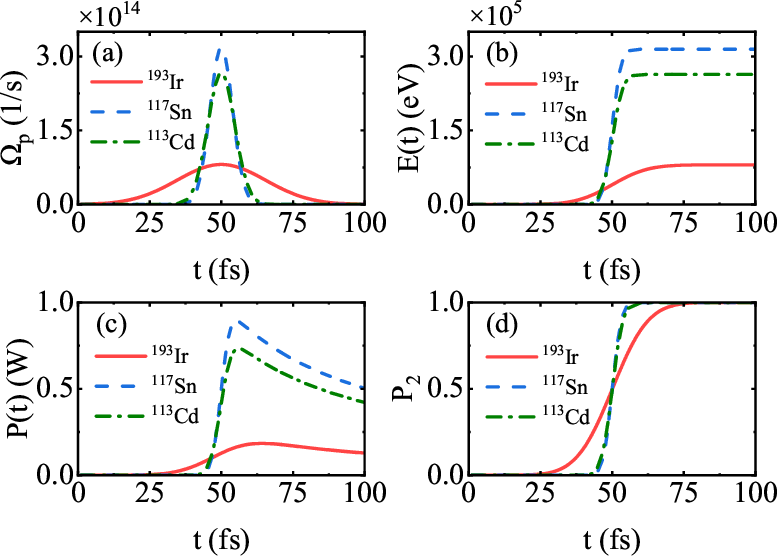
Figure 2: Pulse shaping, time evolution of stored energy, average charging power, and target state population for selected two-level nuclear systems, demonstrating rapid and robust charging to isomeric population.
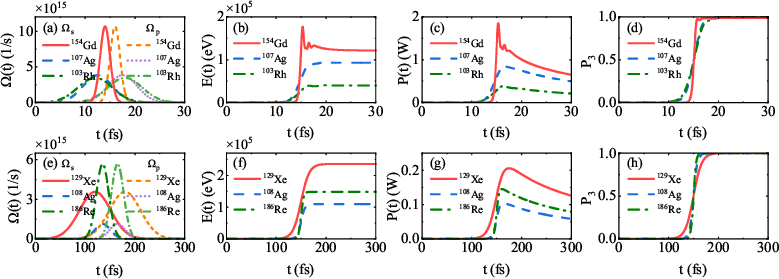
Figure 3: Controlled charging dynamics in three-level NIQBs (Lambda and ladder configurations), showing pulse sequences, energy storage, charging power, and final population transfer into the isomeric state.
Stored Energy and Power: The stored energy E(t) and charging power P(t) for both two- and three-level nuclear isomer batteries surpass traditional (atomic-level) quantum batteries by several orders of magnitude. Calculated values reach stable storage on the order of 105~eV per nucleus (e.g., 117Sn NIQB stores 3.15×10⁵ eV) and demonstrate watt-scale charging power due to the femtosecond-scale interaction time with the XFEL. This is in stark contrast with the d=20 eV storage and d=21 W charging power of typical atomic QBs.
Lifetime and Stability: The adoption of isomer states, whose lifetimes span from microseconds to up to d=22 years, yields energy storage stabilities that are fundamentally inaccessible to electronic or atomic systems. This anti-aging property implies negligible self-discharge on technologically relevant timescales.
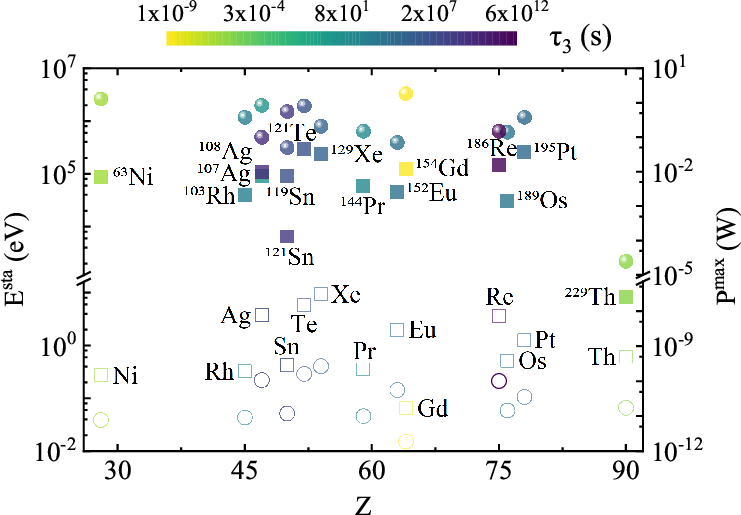
Figure 4: Comparison of stored energy and maximum average charging power for three-level NIQBs and atomic QBs as functions of nuclear species and neutron number, highlighting the orders-of-magnitude advantage for nuclear systems; colors encode isomer lifetime.
Work Extraction and Quantum Thermodynamic Metrics
Ergotropy and Extractable Work: The study evaluates the extractable work (ergotropy) d=23 and the extraction ratio d=24, leveraging the formal quantum thermodynamic principles for finite quantum systems. A robust connection between system purity and maximal work extraction is established: for most NIQB species, the combination of ultrafast coherent charging and long isomer lifetime ensures the state remains close to pure, leading to d=25.
Decoherence due to quantum noise and spontaneous emission is negligible in scenarios where the isomer lifetime far exceeds the laser-matter interaction time. For specific nuclear species with short-lived intermediates (such as the d=26-type d=27Gd system), incomplete charging and reduction of purity manifest, setting limits on energy extraction not apparent in the majority of isomeric schemes.
Practical Considerations and Nuclear Selection
Extensive tables provided in the supplemental material outline the level structures, decay branches, and transition matrix elements for a range of candidate nuclei. Application-specific choices can be made; e.g., d=28Ir, d=29Sn, d=30Cd, and d=31Ag are highlighted for realizing NIQBs with high natural abundance, favorable matrix elements, and minimal extraneous decay channels. Exotic species such as d=32Th are uniquely attractive for low-voltage, ultra-compact storage implementations due to their low excitation energy and recent advances in nuclear clock technology.
The approach is highly adaptable: both the nuclear species and the energy level structure (two-level, three-level d=33, three-level ladder) can be tuned for targeted requirements (storage time, power, quantum state control). The absence of significant additional radiative decay from the isomer significantly simplifies energy management in a practical device context.
Theoretical and Practical Implications
This work provides the first full realization, analysis, and benchmarking of quantum batteries constructed from nuclear isomer states. The numerical evaluation confirms enhancements in stored energy and average power by factors of d=34 and d=35, respectively, compared to atomic QBs. The anti-aging advantage and nearly complete energy extractability move these systems decisively beyond the primary thermodynamic and decoherence limitations of atomic/molecular designs.
From a theoretical perspective, NIQBs introduce the possibility of super-exponential miniaturization coupled with extreme energy density, potentially enabling integration with quantum computing and quantum metrology hardware. Practically, NIQBs could be fundamental for realizing ultra-long-lived, micro-to-milliwatt power supplies in extreme environments or for powering future quantum network nodes and remote sensors, especially where recharge intervals are measured in decades.
Future Directions
Optimization of population transfer and quantum control remains an area of active development. Beyond STIRAP and d=36-pulse protocols, shortcut-to-adiabaticity and machine-learning-based quantum control methods show promise for further improving charging speed, efficiency, and robustness to parameter uncertainty [gdpq-k6lj]. The ongoing progress in x-ray laser and nuclear quantum optics lays a foundation for the experimental realization and technology transfer of NIQBs.
Moreover, the unique properties of isomeric nuclear states might stimulate cross-disciplinary research in quantum energy science [Metzler_2023], particularly in coupling to quantum information and quantum sensing protocols via nuclear transitions with optical accessibility.
Conclusion
The theoretical proposal and detailed analysis of NIQBs confirm their superiority over conventional atomic quantum batteries. By leveraging the properties of nuclear isomers, these batteries provide high energy density, robust quantum coherence, exceptional longevity, and high charging power, settling several open challenges in quantum energy storage. The work outlines a concrete path for experimental realization, opening avenues for future development of quantum energy devices at the nuclear scale.
Reference: "Towards a nuclear isomer quantum battery" (2605.24935)