- The paper demonstrates how thermal fluctuations form subcritical bubbles that challenge the homogeneous nucleation assumption in weak first-order phase transitions.
- The paper employs the Gelmini-Gleiser kinetic framework and a detailed parameter scan to quantify subcritical bubble volume fractions, classifying regimes from safe to dilute breakdown.
- The paper identifies significant cosmological implications, influencing gravitational wave spectra, baryogenesis, dark matter, and primordial black hole formation.
Subcritical Bubble Prehistory in Weak First-Order Phase Transitions
Overview
"Subcritical bubble prehistory in weak first-order phase transition" (2605.24891) systematically addresses the validity of homogeneous nucleation backgrounds in cosmological phase transition calculations, specifically in the presence of subcritical bubbles generated by thermal fluctuations before the critical nucleation temperature Tn. The work quantitatively evaluates the extent to which the standard assumption—that critical bubbles nucleate within a homogeneous symmetric phase—is self-consistent, and establishes numerical criteria identifying when a mixed background must be considered. The analysis leverages the Gelmini-Gleiser kinetic framework for subcritical bubble formation/erasure, implements a detailed parameter scan, and highlights phenomenological implications across cosmological observables.
Motivation and Conceptual Framework
Standard treatments of cosmological first-order phase transitions (e.g., electroweak) assume that critical bubble nucleation occurs in a spatially homogeneous symmetric (false vacuum) background. This is justified when phase transitions are strong; however, in weak transitions, thermal fluctuations induce subcritical bubbles—broken phase regions smaller than the critical size—which may persist and overlap, yielding a mixed background. Such prehistory challenges the standard calculation's initial condition, possibly impacting gravitational waves, baryogenesis, dark matter, and primordial black hole (PBH) formation.
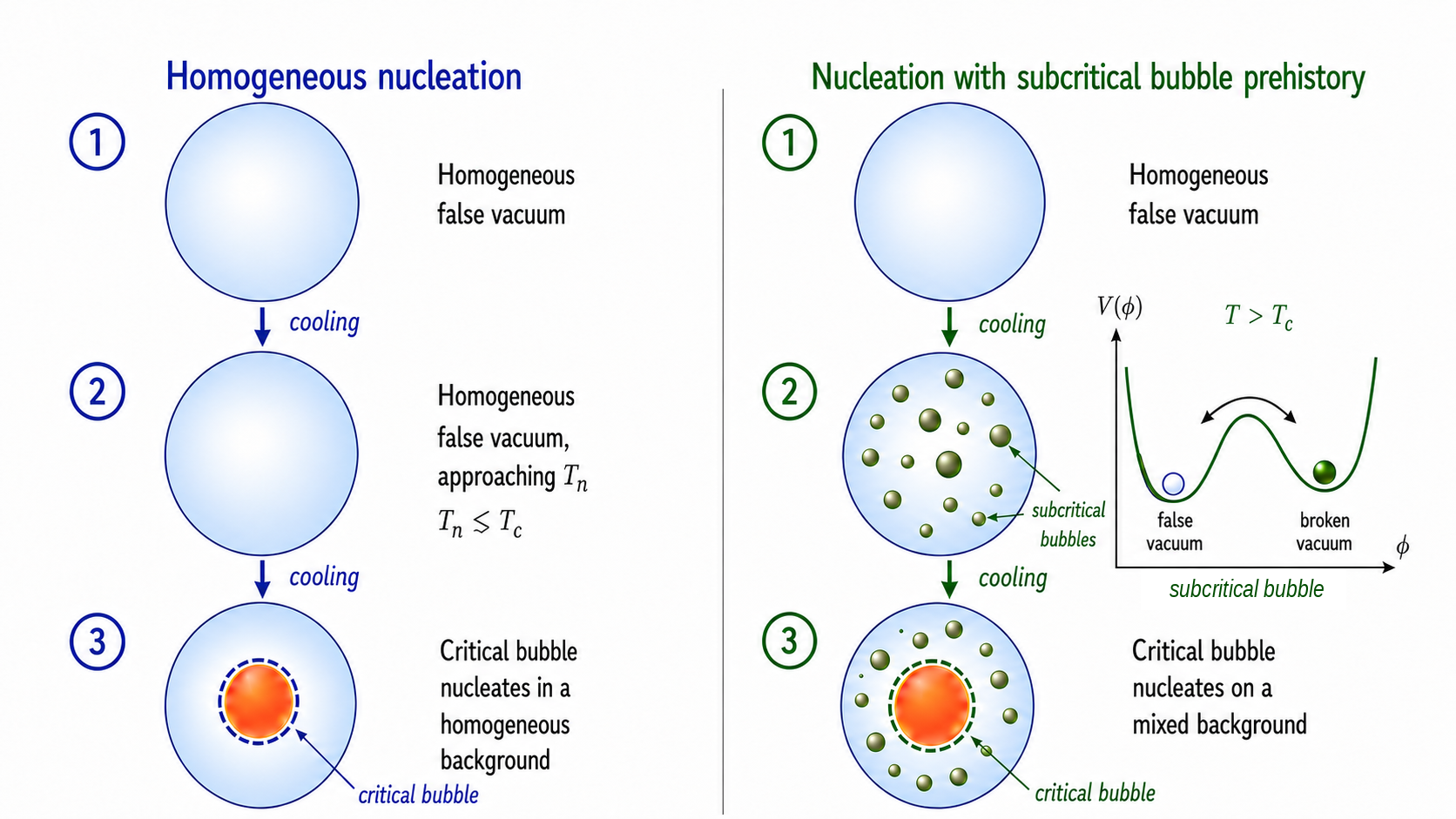
Figure 1: Conceptual comparison of homogeneous nucleation versus nucleation with subcritical bubble prehistory; critical bubbles can nucleate on a mixed background of subcritical bubbles.
Finite-Temperature Scalar Potential
The analysis employs a minimal single scalar field model:
V(ϕ,T)=D(T2−T02)ϕ2−ETϕ3+4λϕ4
Here, the structure of the finite-temperature potential determines the emergence of a broken-phase minimum, the barrier, and eventual bubble nucleation.
Critical Bubble Nucleation
The critical bubble profile (O(3) bounce) and its Euclidean action S3(T) produce a nucleation rate Γc(T)∼T4exp[−S3(T)/T], leading to standard determination of Tn (where one critical bubble forms per Hubble volume). The fraction of converted volume via critical bubbles and the transition strength αn (vacuum energy released) are tracked for diagnostic purposes.
Subcritical Bubble Kinetics
The homogeneous nucleation assumption is challenged by subcritical bubbles: thermal fluctuations producing localized broken phase regions below the critical size. The Gelmini-Gleiser kinetic equation is solved for the number density n(R,t) of subcritical bubbles of radius R, incorporating expansion, formation, shrinkage, reverse nucleation, and erasure. The broken-phase fraction due to subcritical bubbles is given by:
pbsub(T)=1−e−fb(T),fb(T)=∫dR(34πR3n(R,t))
The criterion for the validity of the homogeneous assumption is then linked to V(ϕ,T)=D(T2−T02)ϕ2−ETϕ3+4λϕ40.
Parameter Scan Methodology
A comprehensive parameter scan explores weak first-order transitions, varying V(ϕ,T)=D(T2−T02)ϕ2−ETϕ3+4λϕ41 across theoretical and phenomenological plausible ranges. Each point is retained only if a first-order transition occurs, and multiple scan diagnostics are employed to assess subcritical bubble volume fractions and the extent of mixed backgrounds.
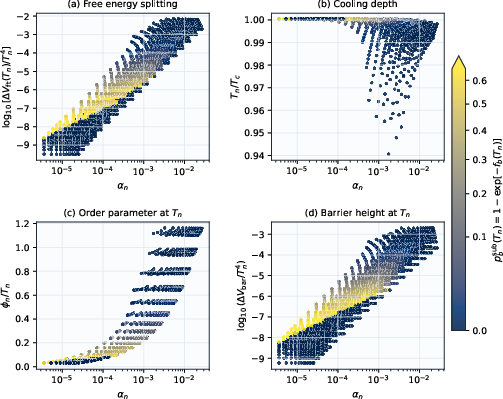
Figure 2: Survey of scan points showing the relationship between potential properties and subcritical bubble volume fraction at nucleation.
Numerical Results and Classification
A fourfold classification emerges from scan results:
- Safe Critical (V(ϕ,T)=D(T2−T02)ϕ2−ETϕ3+4λϕ42): Homogeneous background remains valid
- Subcritical Correction (V(ϕ,T)=D(T2−T02)ϕ2−ETϕ3+4λϕ43): Minor corrections apply
- Prehistory Relevant (V(ϕ,T)=D(T2−T02)ϕ2−ETϕ3+4λϕ44): Mixed background required
- Dilute Breakdown (V(ϕ,T)=D(T2−T02)ϕ2−ETϕ3+4λϕ45): Dilute assumption fails, nonlinear effects dominate
Scan results identify the regions in parameter space where subcritical bubbles constitute a non-negligible portion of the volume at V(ϕ,T)=D(T2−T02)ϕ2−ETϕ3+4λϕ46. Large subcritical fractions coincide with nearly degenerate vacua at nucleation, low barrier heights, modest free energy splitting, and weak transition strength (V(ϕ,T)=D(T2−T02)ϕ2−ETϕ3+4λϕ47).
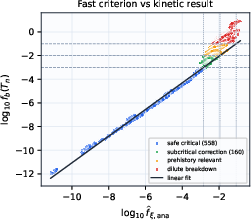
Figure 3: Correlation between fast single-bin criterion and full kinetic evaluation; threshold for percent-level subcritical bubbles established.
Analytical Criterion for Subcritical Prehistory
A fast, physically motivated single-bin criterion successfully predicts the subcritical fraction:
V(ϕ,T)=D(T2−T02)ϕ2−ETϕ3+4λϕ48
This threshold demarcates the transition to mixed backgrounds (percent level volume fraction). The criterion encodes the combined effects of bubble volume, formation rate, and erasure rates, and correlates strongly with the full kinetic numerical results.
Implications for Cosmology
Gravitational Waves
Mixed backgrounds from subcritical bubble prehistory introduce additional small-scale structure, which can impact the high-frequency tail of the gravitational wave spectrum. In weak transitions, where V(ϕ,T)=D(T2−T02)ϕ2−ETϕ3+4λϕ49 is small and signals are sound-wave dominated, the subcritical contribution could produce discernible deviations from standard predictions [Bian:2026xdm].
Baryogenesis
In the present parameter scan, sizable subcritical fractions primarily arise in weak transitions (O(3)0), so they are unlikely to assist electroweak baryogenesis, which demands stronger transitions to avoid sphaleron washout.
Subcritical bubbles modify particle filtering histories during phase transitions, potentially altering relic abundances and exposure timing in filtered dark matter models [Baker:2019ndr]. For PBH formation, stochastic subcritical bubbles can disturb regions that would otherwise persist longer in the symmetric phase, possibly altering PBH abundance and clustering.
Numerical Robustness and Model Dependence
Extensive numerical validation and robustness checks show the classification boundaries are mildly sensitive to kinetic details (e.g., erasure rates, source normalization, shrink velocity), but the qualitative behavior is stable. The scan utilizes a single-field benchmark, but the methodology applies readily to more realistic multi-field models.
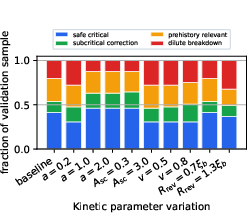
Figure 4: Numerical validation of kinetic assumptions; classification robustness against variations in kinetic parameters.
Conclusion
The homogeneous nucleation background assumption underlying standard calculations for cosmological first-order phase transitions fails for sufficiently weak transitions. In these cases, subcritical thermal fluctuations populate the broken phase before the standard nucleation temperature—and the critical bubble can nucleate in a mixed background. The percent-level volume fraction threshold, O(3)1, provides a practically useful criterion for distinguishing between regimes of validity. The implications cascade to gravitational wave spectra, filtered dark matter, and PBH formation, motivating the inclusion of subcritical prehistory in cosmological modeling. Future work should extend this formalism to realistic multi-field potentials and implement full real-time simulations in regimes of dilute breakdown.