- The paper provides a comprehensive analysis of bubble nucleation and critical dynamics in a holographic first-order superfluid transition.
- It demonstrates that bubble wall dynamics reach a terminal velocity driven by dissipative coupling, supporting strong-coupling predictions.
- The study reveals systematic violations of the geodesic rule with vortex-antivortex pair formation during multibubble collisions.
Introduction
This work presents a comprehensive analysis of non-equilibrium dynamics in first-order superfluid phase transitions using a holographic setup, with particular focus on bubble nucleation, wall dynamics, and vortex formation. The authors employ a (3+1)-dimensional holographic superfluid model with spontaneous U(1) symmetry breaking, leveraging the AdS/CFT correspondence to study the strong-coupling regime. The investigation extends across three phases: nucleation near the critical threshold, expansion characterized by terminal bubble-wall velocity, and topological defect production during multibubble collisions. This approach provides theoretical insight and robust simulation evidence of phenomena relevant for both condensed matter and cosmology.
Holographic Model and Thermodynamics
The bulk action incorporates a U(1) gauge field and a complex scalar field with quartic and sextic interactions to realize the first-order phase transition. The probe limit is adopted to ignore metric backreaction. Thermodynamics are studied in the canonical ensemble, with charge density ρ controlling the phase structure. The free energy landscape Figure 1 demonstrates a discontinuity signaling the first-order transition, and supports the existence of metastable, unstable, and globally stable phases.
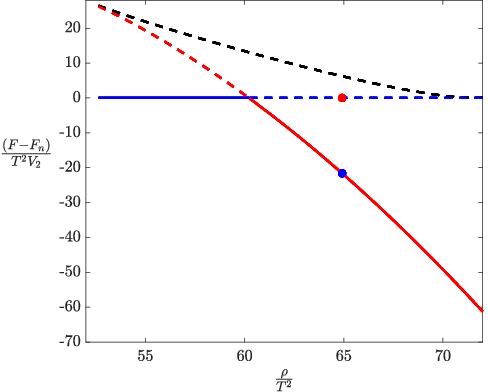
Figure 1: Free energy density T2V2F−Fn as a function of normalized charge density, showing (meta)stable and unstable solution branches and the nucleation-initiated transition pathway.
Bubble Nucleation and Critical Dynamics
The nucleation process is explored via localized Gaussian perturbations of the condensate amplitude. The simulations confirm the existence of a "critical solution" at a threshold amplitude hc, which separates supercritical (transition-inducing) from subcritical (decaying) evolutions. Evolution close to this threshold exhibits a prolonged near-critical phase, characterized by universality and a single unstable mode. The sojourn time near the critical point shows logarithmic scaling with ∣h−hc∣, analogous to critical phenomena in gravitational collapse.
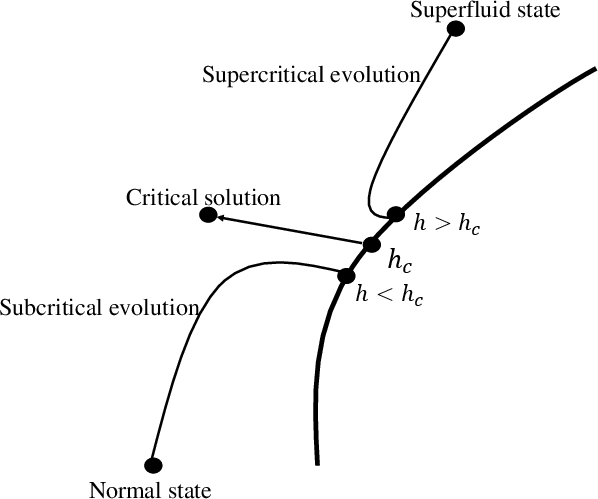
Figure 2: Dynamical evolution under different initial perturbation amplitudes, illustrating subcritical decay, metastable residence at h=hc, and supercritical bubble growth.
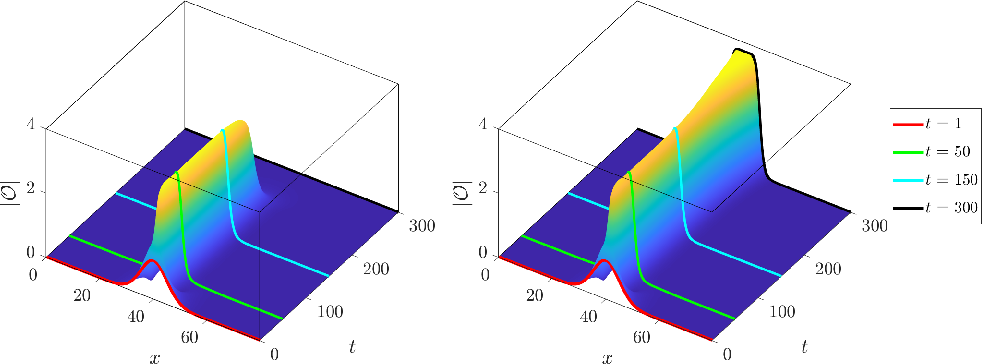
Figure 3: Condensate profiles in subcritical and supercritical regimes near the nucleation threshold, highlighting the universal critical evolution.
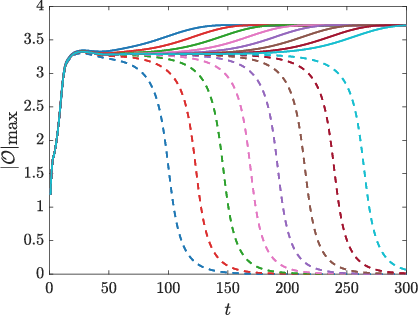
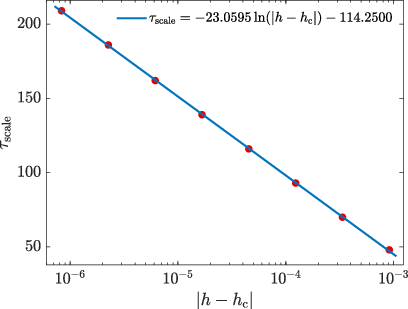
Figure 4: Left—temporal maxima of the condensate for a range of ∣h−hc∣. Right—linear dependence of the scaling time τscale on ln∣h−hc∣, confirming the dominance of a single unstable mode.
Bubble Wall Dynamics and Terminal Velocity
The evolution of a single superfluid bubble reveals that the wall velocity undergoes initial acceleration before saturating at a terminal value due to dissipative coupling with the environment. The terminal velocity U(1)0 increases monotonically with U(1)1 but remains non-relativistic, consistent with theoretical predictions for phase transitions in strongly coupled media. This feature underscores the essential distinction between strong-coupling holographic models and weak-coupling effective theories, with implications for cosmological phase transition modeling.
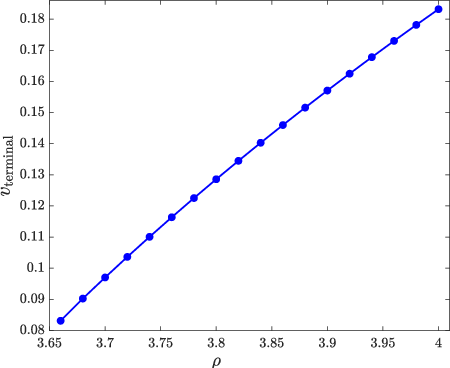
Figure 5: Terminal bubble-wall velocity U(1)2 as a function of charge density U(1)3, demonstrating monotonic increase and strong-coupling-induced dissipation.
Geodesic Rule and Parameter Sensitivity
Vortex formation during three-bubble collisions is systematically investigated. The geodesic rule posits that phase interpolation between colliding domains follows shortest paths on U(1)4, predicting a U(1)5 probability for vortex production with uncorrelated random phases. However, the paper demonstrates significant, dynamical deviations from this rule in strongly non-equilibrium settings.
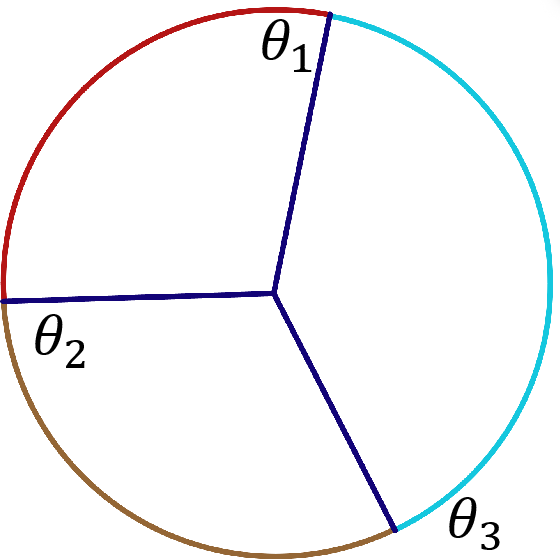
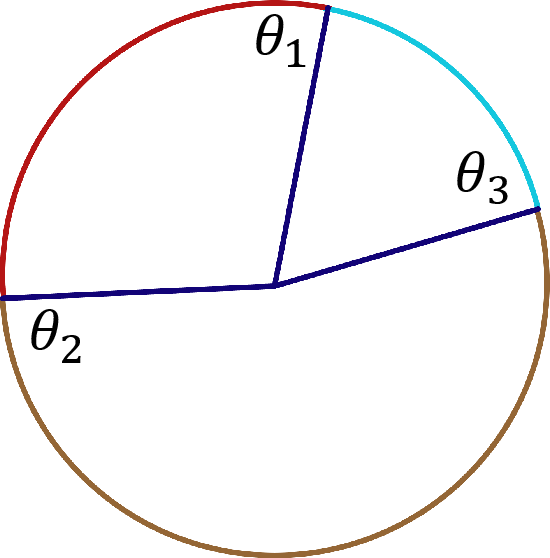
Figure 6: Schematic of the geodesic rule for three-bubble collisions; left shows a net winding (vortex formation), right a trivial configuration (no vortex).
The U(1)6 parameter space for vortex formation (with U(1)7 fixed) exhibits strong sensitivity to the initial phases, and not all theoretically allowed initial conditions yield a stable vortex due to subsequent non-equilibrium effects.
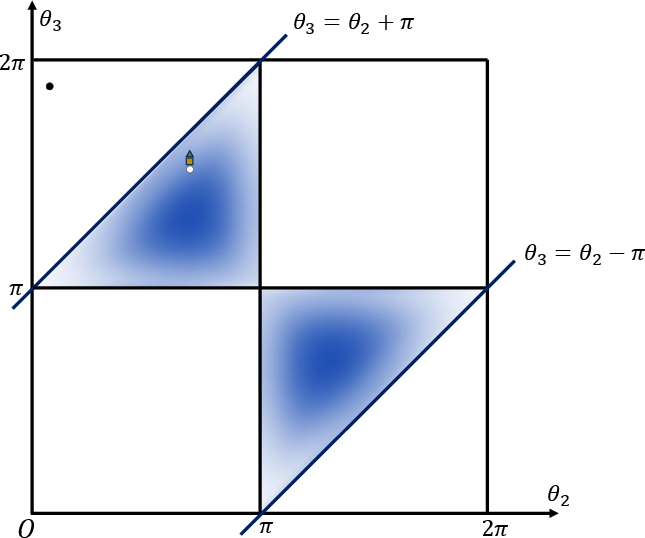
Figure 7: Vortex-formation region in U(1)8 space, with color gradient reflecting the probability of evolving to a single-vortex state for given initial phases.
Dynamical Vortex–Antivortex Pair Production and Annihilation
The simulations reveal a pronounced regime—unanticipated by the geodesic rule—wherein vortex–antivortex pairs are dynamically produced during three-bubble collisions and ultimately annihilate, resulting in a vortex-free final state. The formation and subsequent annihilation probability depends on both the initial phase separation and bubble collision kinematics (radius and wall velocity). The lifetime of the transient pairs scales logarithmically as the collision radius approaches a critical value from below, representing a dynamical threshold for persistent defect formation.
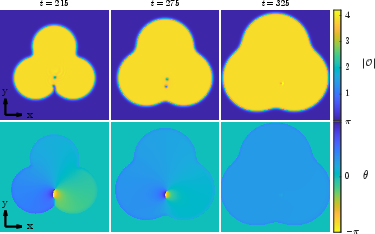
Figure 8: Bubble collision exhibiting nontrivial vortex–antivortex pair dynamics for initial phases within the blue region of Figure 7. The sequence of condensate and phase snapshots reveals pair emergence and annihilation.
Dynamical Phase Diagram and Vortex Identification
A detailed phase diagram in the U(1)9 plane (collision velocity vs. radius) delineates the regimes leading to stable vortex formation, vortex–antivortex pairs, and trivial outcomes. Initial conditions near the center of the phase diagram's triangular region consistently favor single-vortex formation, while peripheral cases are more susceptible to vortex-free relaxation. The identification of topological defects utilizes both phase winding on the discretized grid and the sustained suppression of the condensate's magnitude at the core to distinguish persistent vortices from transient fluctuations.
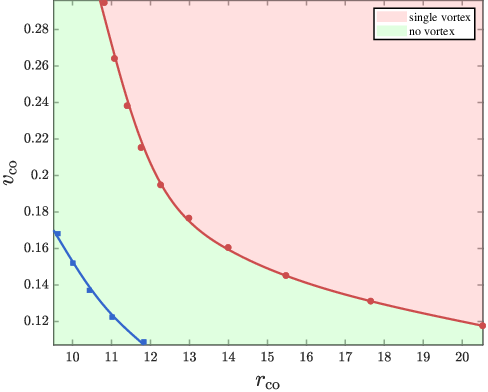
Figure 9: Phase diagram for vortex generation, showing the boundary between persistent vortex, vortex–antivortex pair, and vortex-free regions across collision parameter space.
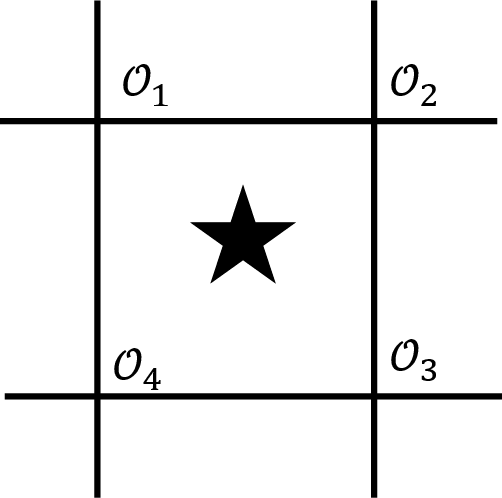
Figure 10: Illustration of vortex identification methodology—computing phase winding numbers around lattice plaquettes allows robust defect detection.
Conclusions
This study elucidates non-equilibrium bubble dynamics and topological defect formation in holographic first-order superfluid phase transitions. Critical dynamics near the nucleation threshold are dominated by a universal, single unstable mode with characteristic logarithmic scaling. Bubble wall expansion is strongly dissipative, precluding relativistic velocities and aligning with a hydrodynamic description of the plasma.
In multibubble collisions, the results showcase systematic violations of the geodesic rule due to the emergence of transient vortex–antivortex pairs and provide a quantitative account of the parameters governing persistent defect formation. The probability of stable vortex generation is determined not solely by initial bubble phases but also by collision kinematics, with the phase diagram demarcating the relevant regions.
These findings have significant implications for theories of topological defect production in both condensed matter and cosmological phase transitions, especially under strong coupling. Future directions include characterizing the full probability distribution for vortex outcomes, extending the analysis to more complex symmetry-breaking patterns, asymmetrical bubble nucleation geometries, and clarifying the universality of the transient pair production mechanism across diverse physical contexts.

