- The paper introduces a GNSS-derived acceleration integration into the EKF, improving INS/GNSS state estimation for UGVs.
- It achieves significant PRMSE reductions (up to 20.74%) by leveraging a least-squares fit on historical GNSS positions to extract acceleration.
- The method enhances the observability of orientation and bias errors without extra hardware, demonstrating robustness in dynamic and low-mobility scenarios.
Enhanced INS/GNSS State Estimation via GNSS-Based Acceleration Integration
Introduction and Motivation
The paper "Enhanced INS/GNSS State Estimation using GNSS-Based Acceleration Measurements" (2605.24767) targets the limits of conventional inertial navigation system (INS) and global navigation satellite system (GNSS) fusion frameworks for unmanned ground vehicles (UGVs. Specifically, the standard position-aided error-state extended Kalman filter (ES-EKF) suffers from degraded orientation and inertial error state observability, particularly under low-dynamic or stationary motion. The study proposes augmenting conventional position updates with acceleration information extracted from historical GNSS measurements via a least-squares (LS) method. Incorporating this auxiliary update within the EKF yields improved robustness and accuracy in state estimation.
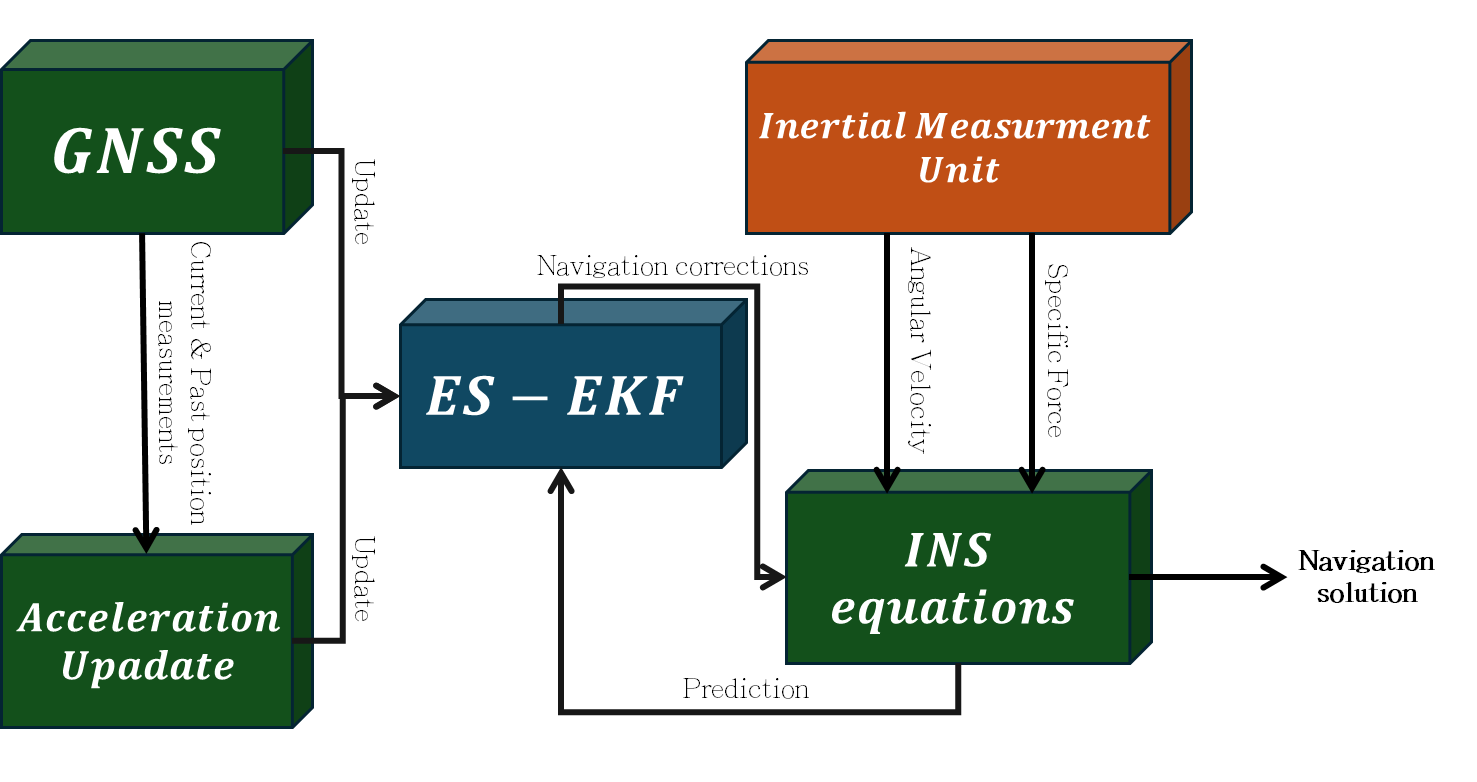
Figure 1: Flowchart illustrating the integration of GNSS-derived acceleration updates into the INS/GNSS filter alongside conventional position updates.
Methodology
Historical GNSS position records are subjected to a second-order polynomial LS fit over a sliding window (three seconds, three measurements). The resulting coefficients yield a smoothed estimate of vehicle acceleration. This approach avoids additional sensor deployment and leverages causality by referencing the window to its initial time instance. The derived acceleration estimate is formulated in the navigation frame, ready for integration into the filter.
Accelerometer-Aided Measurement Model
A linearized measurement residual is constructed:
δza=Rbnab−a~n,
where a~n is the GNSS-derived acceleration and Rbnab represents the INS-inferred acceleration in the navigation frame. The measurement matrix explicitly couples the orientation (ϕn) and accelerometer bias (ba) error states to the acceleration residual, enhancing their observability relative to position-only updates. The resulting EKF measurement matrix combines both position and acceleration components:
H=[I30000 00Rbn^[fibb~×]−Rbn^0]
Evaluation Setup
Two real-world datasets were utilized:
- ROOAD dataset: Waterhog-UGV platform equipped with a VectorNav VN-300 INS and dual-antenna GNSS (RTK), spanning 45 minutes.
- Custom dataset: ROSbot-XL platform with Arazim EX-300 IMU and dual-antenna GNSS, 15 minutes duration.
Platforms and sensor configurations are illustrated below.
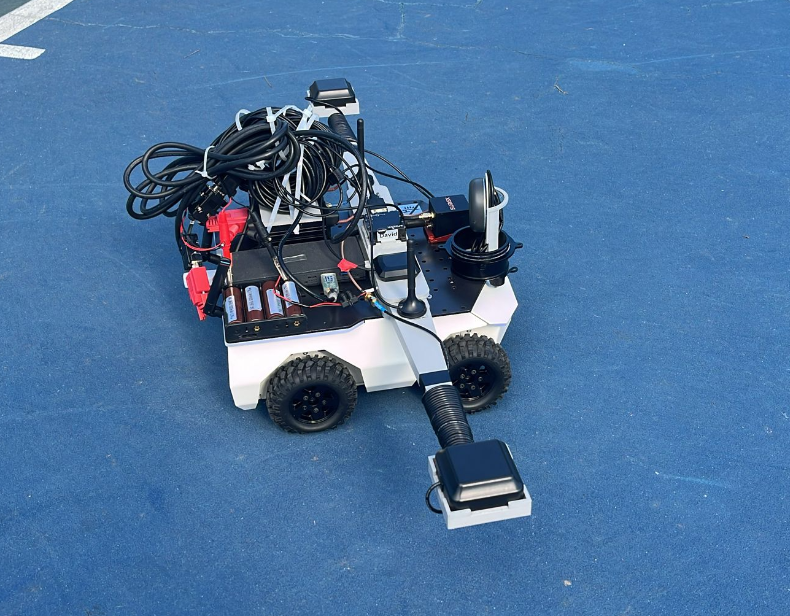
Figure 2: ROSbot-XL platform setup used for the custom dataset, illustrating the sensor suite.
Representative trajectories from the ROOAD and custom datasets are presented as follows:
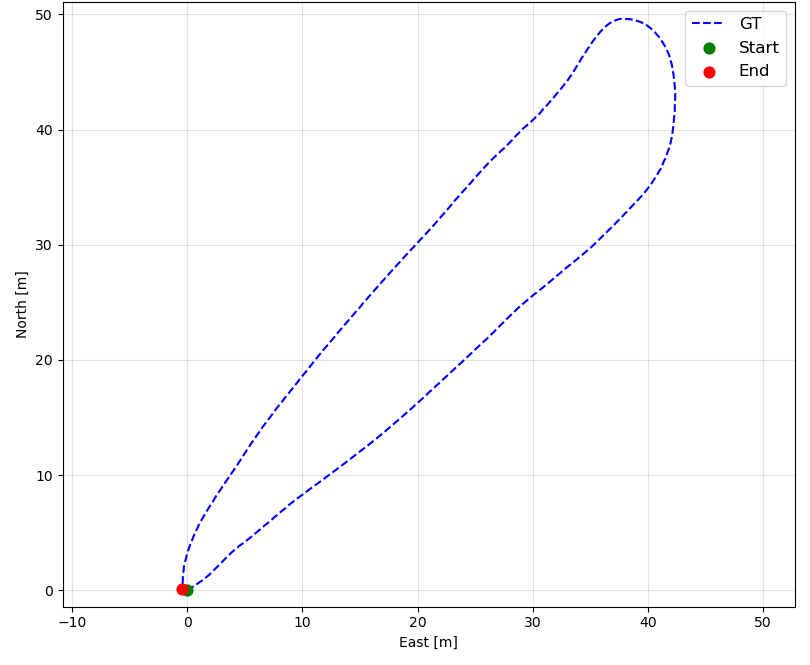
Figure 3: Trajectory number 1 from the ROOAD dataset.
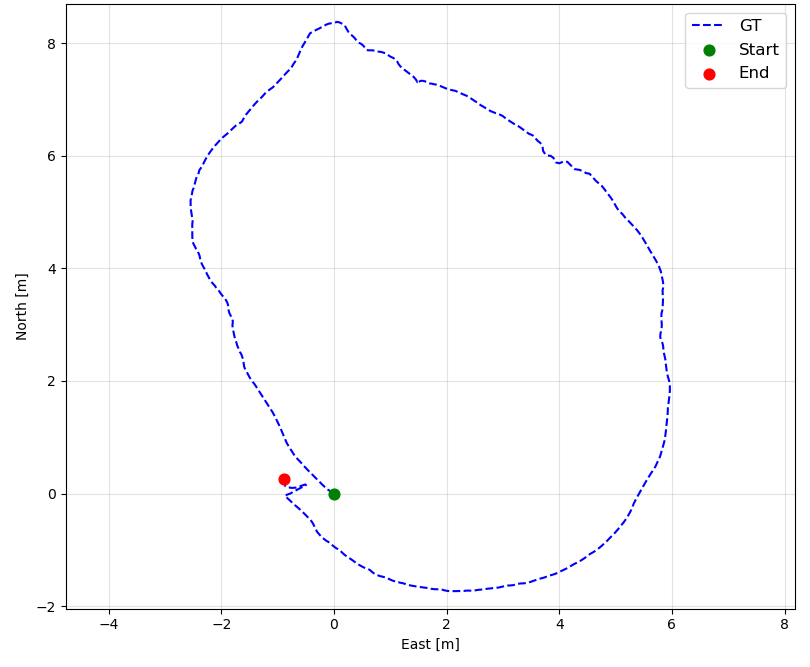
Figure 4: Trajectory number 8 from the custom dataset.
The datasets facilitate evaluation of filter performance across distinct vehicles and sensor grades.
Results and Numerical Analysis
Position root mean square error (PRMSE) was computed versus ground-truth (GNSS-RTK). Key findings:
- ROOAD dataset: Mean PRMSE reduction from 5.00 m (position-only) to 4.39 m (acceleration-aided), representing 11.40% improvement. Notably, Trajectory 3 exhibited a significant drop from 7.15 m to 5.97 m.
- Custom dataset: Mean PRMSE decreased from 4.34 m to 3.44 m, a 20.74% improvement. Trajectory 9 showed the most pronounced enhancement, a 23.9% reduction in error.
Figure 5 visualizes trajectory estimation for Trajectory 4, contrasting baseline and acceleration-aided outputs against ground truth.
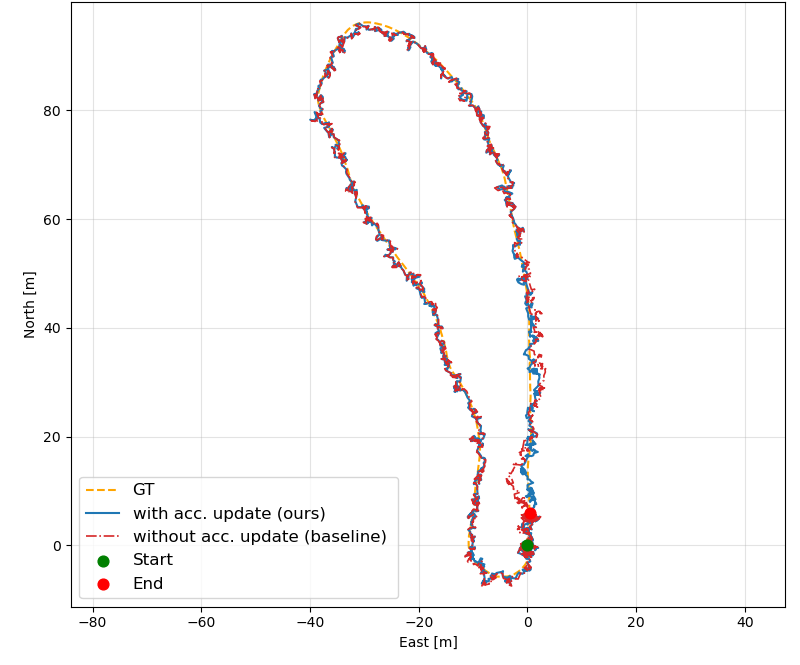
Figure 5: Trajectory 4 comparison—baseline, acceleration-aided, and ground-truth—for the custom dataset.
The improvements are most pronounced for trajectories with high baseline estimation error and under dynamic conditions, confirming the efficacy of acceleration updates in challenging scenarios.
Implications and Future Directions
The approach demonstrates a practical route to augmenting state observability in INS/GNSS fusion, particularly for bias and orientation states poorly observable through position alone. By leveraging GNSS-derived acceleration via LS fitting, sensor redundancy is circumvented, minimizing hardware complexity and operational cost. The methodology is compatible with real-time deployment and diverse motion profiles in UGVs.
Future theoretical work should address neglected measurement correlation between GNSS position and acceleration, as the latter is derived from historical position data. Incorporating correlation-aware updates may yield further gains. Additionally, integration with adaptive covariance techniques and learning-based fusion frameworks could exploit temporal context and sensor noise structure for further robustness.
Conclusion
In summary, this study proposes and validates an EKF augmentation strategy utilizing GNSS-derived acceleration for enhanced state estimation in UGV navigation. Across two real-world datasets, the approach yielded consistent PRMSE improvements of 11.40% and 20.74%, with pronounced gains in trajectories with baseline weaknesses. The method is operationally viable, hardware-independent, and directly improves inertial error state observability. Future research should refine measurement update correlation handling and explore synergistic integration with adaptive and learning-based navigation filters.