- The paper presents an algebraic framework reconstructing the structure of non-Hermitian Floquet systems from observable traces.
- Methodology includes the decomposition of spectral skeletons and observable dressing via trace sequence data for detailed spectral analysis.
- Implications extend to process tomography, challenging existing symmetries to expand reconstructible information domains.
Algebraic Tomography of Non-Hermitian Floquet Systems from Observable Traces
Introduction and Framework Overview
This work develops a comprehensive algebraic tomography framework for finite-dimensional non-Hermitian Floquet systems, with dynamics governed by monodromy matrices M∈GL(N,C). Given that direct access to M is rarely possible in realistic experimental settings, the framework formulates the inverse problem: reconstructing the underlying Floquet structure from observable-dependent time-discrete traces, specifically from sequences ζn(O)=Tr(OMn). The central insight is that these sequences are algebraically constrained by the characteristic polynomial of M, rendering the inverse problem a finite algebraic reconstruction, not a generic exponential fit.
The framework systematically separates similarity-invariant spectral skeletons—encoded in the characteristic polynomial and its eigenvalues—from observable-dependent dressing factors. This is achieved by organizing observable trace sequence data into analytic objects: the observable resolvent (ORS), observable spectral determinant (OSD), and observable Dirichlet spectral data (ODSD). The OSD captures the global spectral structure, the ORS exposes the skeleton/dressing decomposition with a common denominator determined by M, and the ODSD provides mode-resolved spectral visibility. Extensions to multi-observable and Liouville-space settings connect the framework with quantum process tomography and MIMO realization theory.
Structural limitations in reconstructability are exposed when the accessible observable algebra is restricted: only those operator sectors reached by the observable-generated algebra are reconstructible, and exact symmetries protect trace-invisible sectors. Micromotion (Floquet gauge shifts) can expand the observable algebra but cannot remove symmetry-protected invisible blocks.
Analytic Architecture: Skeleton/Dressing and Inverse Problem
Given a finite-dimensional monodromy M and observable O, the primary objects are:
- Observable Trace Sequence (OTS): ζn(O)=Tr(OMn).
- Characteristic Polynomial: Δ(z)=det(IN−zM)=a=0∑N(−1)aeaza.
- Cayley–Hamilton Recurrence: Enforces algebraic closure on traces and underlies all reconstructions.
- Observable Spectral Determinant (OSD): h(O)(z)=exp(−Tr[Olog(IN−zM)]).
- Observable Resolvent (ORS):
M0
where the numerator M1 encodes observable dressing and the denominator M2 encodes the spectral skeleton.
- Observable Dirichlet Spectral Data (ODSD): M3, polylogarithmically weighted eigenmode contributions.
The inverse problem is organized such that the OTS provides raw data, the ORS is reconstructed first (Hankel-based), and higher-level descriptors such as OSD/ODSD are composed for further analytic and physical readout.
Spectral skeleton/dressing decomposition:
The monodromy M4's spectrum is similarity-invariant; dressing arises from the observable's left/right eigenvector overlaps. Numerically, Hankel/Prony methodology identifies the minimal M5-dimensional system and characteristic coefficients, from which both the eigenvalues and dressing coefficients are reconstructed.
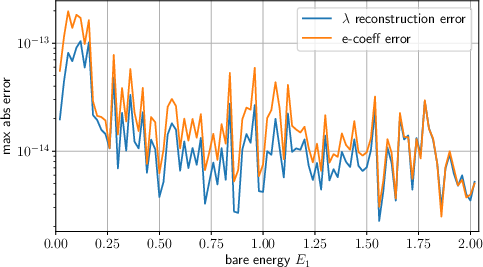
Figure 1: Reconstruction errors for the DTQ3 from a single observable M6, confirming machine-level precision in eigenvalue and characteristic coefficient recovery.
Partial Realization, Symmetry, and Micromotion
A major contribution of this work is formalizing what information is fundamentally reconstructible given the observable algebra M7. Via operator algebra analysis, the trace data determine only the projection of M8 into the bicommutant M9; the remaining components are invisible to any OTS generated by ζn(O)=Tr(OMn)0. Exact symmetries commuting with both the observables and the dynamics guarantee the existence of such invisible sectors and impose algebraic deficiencies in the observable dimension ζn(O)=Tr(OMn)1.
The framework uses micromotion—observable orbits ζn(O)=Tr(OMn)2 generated by time-periodic gauge— to expand ζn(O)=Tr(OMn)3, increasing the number of reconstructible operator components. However, this enlargement cannot resolve blocks protected by commuting symmetries.
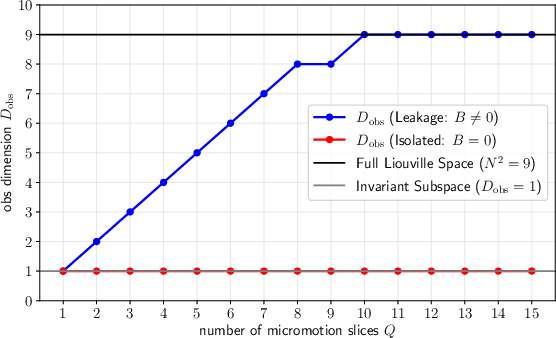
Figure 2: Sampled observable dimension ζn(O)=Tr(OMn)4 as a function of the number of micromotion slices ζn(O)=Tr(OMn)5; leakage induces expansion from an invariant (qubit) sector to full qutrit visibility.
Floquet Algebraic Tomography: Examples and Numerical Demonstrations
Example 1: Driven Transmon Qutrit
- Model: Three-level system (qutrit) with periodic drive; investigated as an open quantum system with leakage and non-Hermitian decay.
- Reconstruction: Single observable suffices to algebraically recover the full ζn(O)=Tr(OMn)6 skeleton (see Figure 1).
- Physical implication: Observable-dependent dressing can suppress or redistribute spectral phase winding, encoding mode-selective interference and making winding measurements observable-channel dependent.
- Dimension readout: The observable dimension ζn(O)=Tr(OMn)7 jumps from 1 (qubit-invariant) to 9 (full qutrit algebra) as leakage is turned on (see Figure 2).
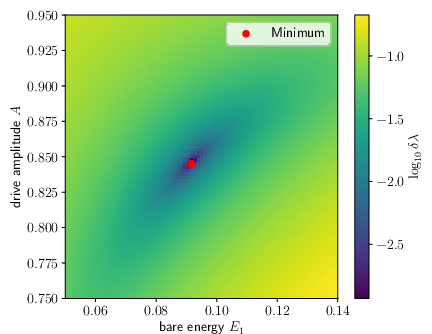
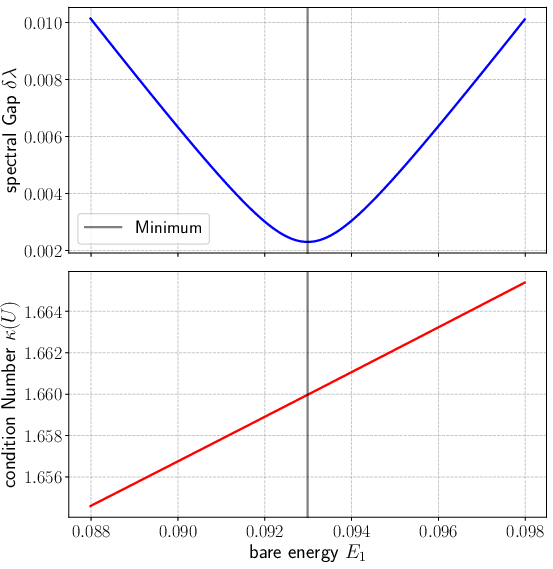
Figure 3: Near-degeneracy point characterized in parameter space; color map shows the minimal spectral gap ζn(O)=Tr(OMn)8.
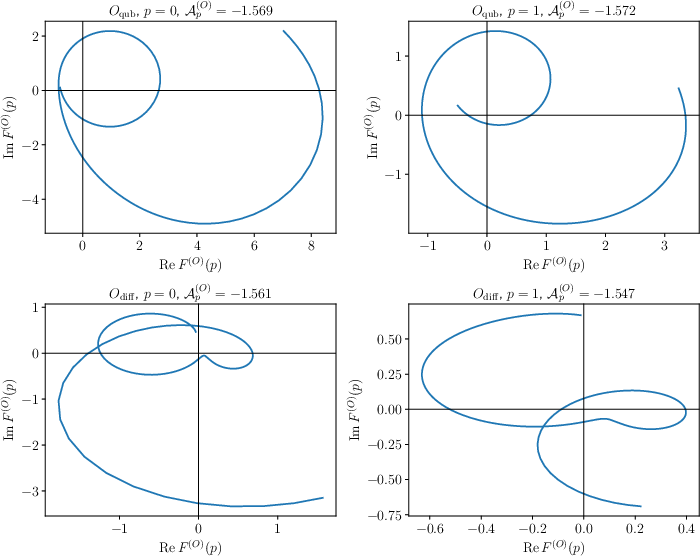
Figure 4: Complex-plane trajectories of the ODSD ζn(O)=Tr(OMn)9, highlighting observable phase accumulation for different channels across parameter scans.
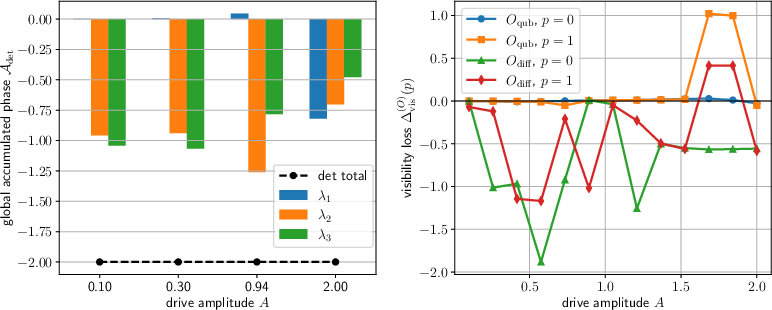
Figure 5: Drive-induced redistribution of the mode-wise phase accumulation, illustrating mode hybridization and observable-dressing effects.
Example 2: Non-Hermitian Floquet SSH Chain
- Model: Finite bipartite chain with non-reciprocal hopping and boundary twists, described by an M0 non-Hermitian Floquet monodromy.
- Branch geometry: EP-accessible topology persists as square-root monodromy in eigenvalue exchange around inherited exceptional points, visible in the spectral shadow regardless of observable choice.
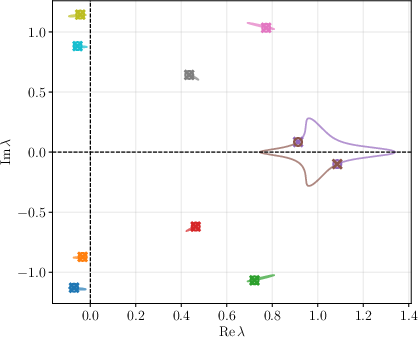
Figure 6: Permutation and exchange of Floquet eigenvalues around the EP-accessible region; trajectories display square-root Riemann topology.
- Observable-channel selectivity: Observable-dependent suppression or survival of topological winding in OSD/ODSD channels; local channels may entirely filter the winding, while appropriate collective probes retain fractional or full visibility.
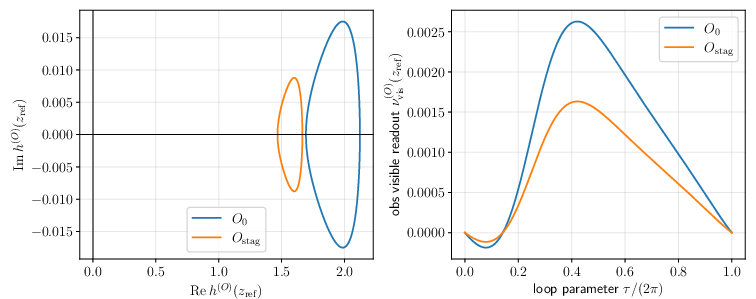
Figure 7: Observable response evaluated from the OSD at M1 in the EP neighborhood; both local and staggered channels exhibit suppressed net winding despite underlying spectral exchange.
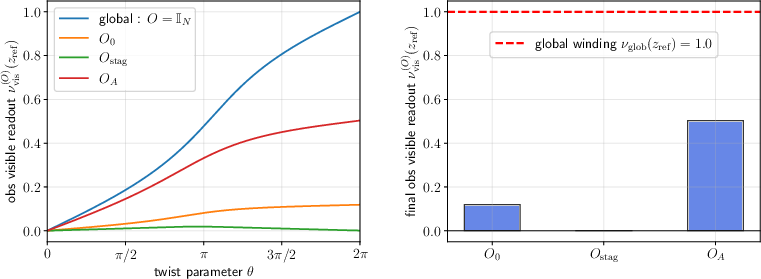
Figure 8: Observable-visible readout of winding-related structure along the twist cycle; observable selection determines the retention or filtering of global winding.
- Disorder and dimension growth: Sampled operator dimension M2 is controlled by underlying symmetry, probe locality, and disorder. Disorder lifts accidental linear dependencies, allowing greater operator-space resolution under collective probes.
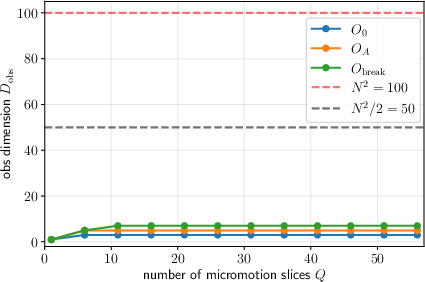
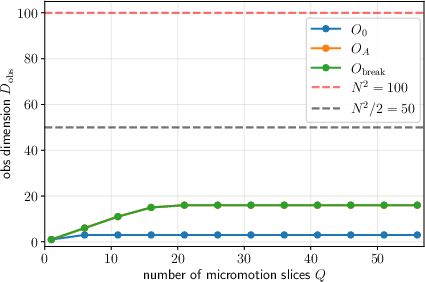
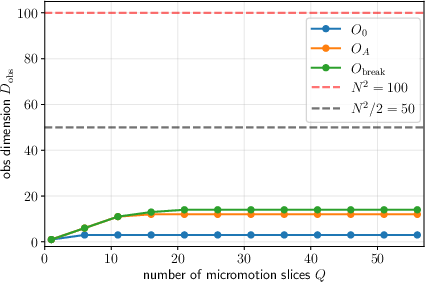
Figure 9: Sampled observable-dimension growth M3 versus micromotion orbits and disorder for various observables; locality severely restricts M4, while global probes and disorder induce significantly larger visible sectors.
Implications and Theoretical Outlook
This algebraic framework rigorously characterizes what parts of Floquet-driven, possibly non-Hermitian finite systems can be reconstructed from experimentally accessible stroboscopic traces. Observable traces are seen not as anonymous data but as algebraically constrained signals, with reconstructability and visibility governed by operator algebra, observability, and dynamical symmetry. This separation clarifies the distinction between the underlying spectral skeleton (observable-independent), observable-derived dressing, and symmetry-protected invisible sectors.
Practically, the techniques connect directly to process tomography, circuit QED, Floquet engineering, and photonic platforms. They provide guidance for experimental protocol design: which observables to measure, what is fundamentally invisible, and how manipulations such as micromotion or input state preparation can (or cannot) break through algebraic limitations.
On a theoretical level, this methodology extends and formalizes classical realization-theoretic approaches (Ho-Kalman, Prony, ESPRIT) in the context of non-Hermitian, finite-size, driven quantum systems. It offers a blueprint for future extensions—robust noisy data recovery, high-dimensional quantum control, and systematic integration with topological and exceptional point analysis.
Conclusion
Algebraic tomography reveals the sharp, observable-constrained structure of finite-dimensional non-Hermitian Floquet dynamics. The framework elucidates how the interplay of observable algebra, symmetry, micromotion, and system size determines what information about the underlying monodromy is algebraically reconstructible. The separation into skeleton, dressing, and invisible sector provides a precise analytic foundation for both experimental design and theoretical analysis of quantum-dynamical inverse problems.