Conditional Score-Based Modeling of Effective Langevin Dynamics
Published 27 Apr 2026 in stat.ML, cs.LG, and nlin.CD | (2604.23952v1)
Abstract: Stochastic reduced-order models are widely used to represent the effective dynamics of complex systems, but estimating their drift and diffusion coefficients from data remains challenging. Standard approaches often rely on short-time trajectory increments, state-space partitioning, or repeated simulation of candidate models, which become unreliable or computationally expensive for high-dimensional systems, coarse temporal sampling, or unevenly sampled data. We introduce a data-driven calibration method based on a novel relationship between the coefficients of a stochastic reduced model and the conditional score of the finite-time transition density, defined as the gradient of the logarithm of the transition density with respect to the initial state. The resulting identity expresses derivatives of lagged correlation functions as stationary expectations over observed lagged pairs involving this conditional score and the unknown model coefficients. This formulation allows the drift and diffusion structure to be constrained directly from finite-lag statistics, without differentiating trajectories, partitioning state space, or repeatedly integrating candidate reduced models during calibration, yielding a least-squares fitting problem over stationary lagged pairs. We validate the approach on analytically tractable and data-driven nonequilibrium diffusions, demonstrating that the inferred models preserve the invariant statistics while accurately reproducing finite-lag dynamical correlations. The framework provides a scalable route for learning stochastic reduced-order models from data that reproduce prescribed statistical and dynamical properties.
The paper presents a new conditional score-based calibration method that directly infers state-dependent mobility from finite-lag statistical observations.
It leverages neural score matching and Koopman-gradient formulation to overcome the challenges of high-dimensional and temporally coarse data.
Empirical benchmarks demonstrate that the learned model preserves steady-state distributions and dynamical correlations, outperforming constant-mobility baselines.
Conditional Score-Based Calibration of Effective Langevin Dynamics
Context and Motivation
The construction of stochastic reduced-order models capable of capturing both invariant and dynamical statistical features from high-dimensional, multiscale systems is a central problem in nonequilibrium statistical physics and applied mathematics. Traditional approaches—including Kramers–Moyal expansions, finite-difference drift/diffusion estimation, simulation-based inference, or operator-theoretic reconstruction—become unreliable or computationally prohibitive in high-dimensional or temporally coarse datasets. This work introduces a new data-driven framework that leverages the conditional score of finite-lag transition densities to directly infer the mobility structure of effective Langevin dynamics from empirically accessible stationary distributions and finite-lag statistics.
Theoretical Formulation
The target is an effective Itô diffusion
dx(t)=F(x(t))dt+2Σ(x(t))dWt,
parametrized through a mobility field M(x)=D(x)+R(x), that exactly enforces the stationary distribution (via the score s=∇logpss) and matches finite-lag dynamical correlation statistics. The crucial innovation is expressing the calibration constraints not in terms of simulation-based or infinitesimal-lag expectations, but using a Koopman-differential identity involving conditional transition scores: C˙m,n(t)=−⟨ϕm(x(t))st∣0(x(t)∣x(0))TM(x(0))∇ϕn(x(0))T⟩,
where st∣0(xt∣x0)=∇x0logpt(xt∣x0). The empirical version defines a linear regression problem in the space of stationary lagged pairs.
This approach bypasses the technical bottlenecks of local-increment methods and explicit forward integration, instead transforming model inference into a batch or minibatch regression using “finite-lag” observables and gradients of the transition log-likelihood.
Both stationary and conditional scores are estimated via denoising score matching over noisy stationary or lagged pairs, employing a neural score network to model ∇x0logpt(xt∣x0). This enables scalable application to high-dimensional processes without explicit density estimation or clustering.
The mobility is split into a mean baseline (estimated from short-lag coordinate correlation derivatives) and a state-dependent correction δM(x), parameterized as a neural field with constraints to enforce symmetry, antisymmetry, and positive semidefiniteness of the (symmetrized) diffusion tensor. The objective is the least-squares matching of observed and modeled derivatives of lagged correlations across a rich set of observable channels and lags, with regularization terms enforcing mean-correction.
Benchmarks and Numerical Validation
The framework is first validated on the Cox–Ingersoll–Ross (CIR) process, for which the analytic structure of the stationary/conditional scores, transition density, and observable correlations is computable. The formulation is shown to uniquely recover the state-dependent mobility from nonlinear correlation probes, highlighting that the expressivity of the observable library is pivotal for nullspace elimination and parameter identifiability.
A high-dimensional (2D) nonreversible diffusion with affine multiplicative noise and rotational drift is then considered. The calibration task is to learn a neural mobility field from lagged statistics alone such that the reconstructed score-based Langevin model preserves both steady-state distribution and the finite-lag correlations of nonlinear observables.
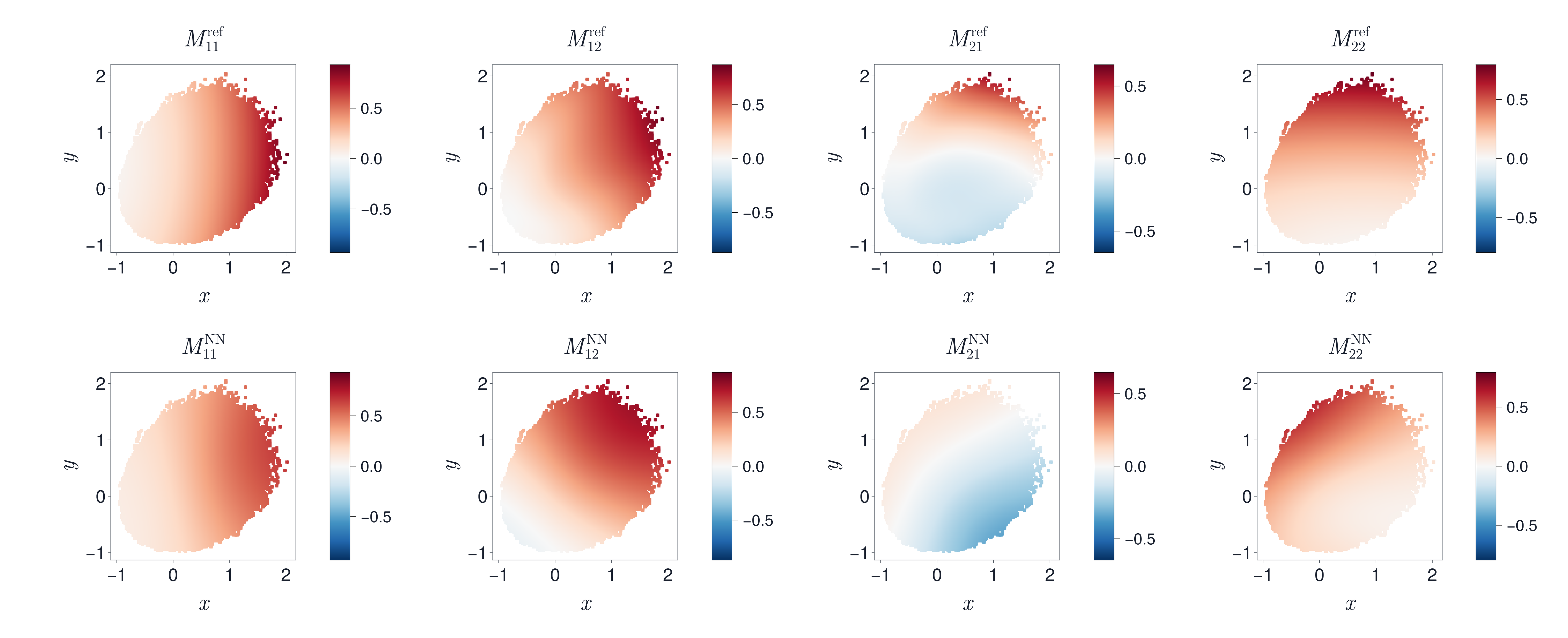
Figure 1: Reference and learned score-based mobility fields for the two-dimensional affine multiplicative-noise benchmark.
The learned mobility field successfully reconstructs the spatial structure of the mobility components, on the support sampled by the data.

To assess dynamical fidelity, the learned reduced model and a constant-mobility baseline are forward-simulated and compared with the true process on stationary and dynamical statistics.
Figure 2: Forward validation for the learned reduced Langevin model; blue dashed is the calibrated model, red dotted is the constant baseline, and black is the reference process.
The state-dependent mobility model matches both the invariant density and coordinate correlation functions, outperforming the constant-mobility closure on lagged dynamical metrics.

For a richer probe, 18 observable channels—including all coordinate, quadratic, and cubic cross-terms—are used as training and test constraints.
Figure 3: Lagged observable correlations for the 18 channels used to constrain the mobility fit.
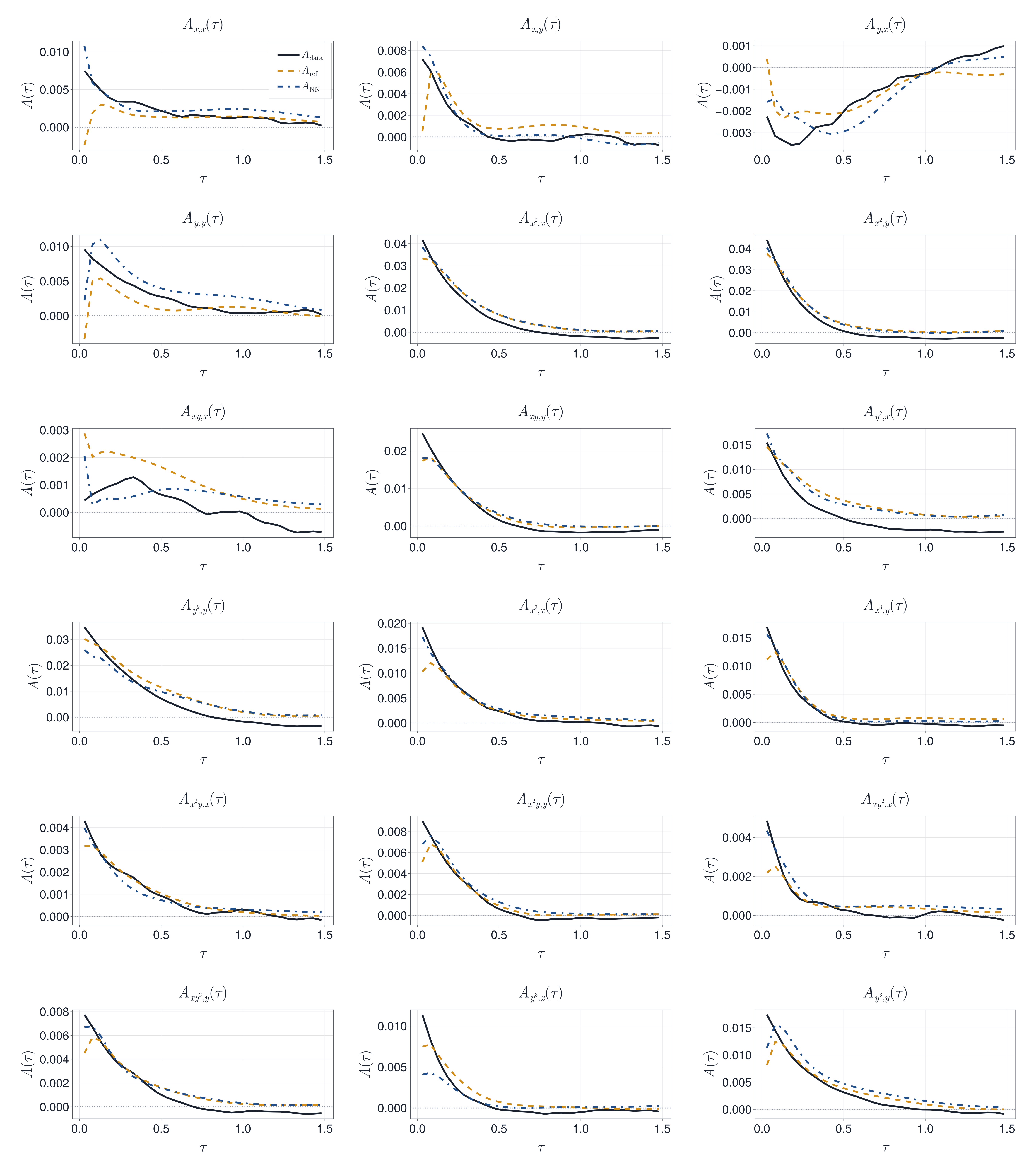
Consistently, the learned model nearly matches target lagged correlations across all observable channels, indicating that the neural mobility fit achieves observable-level adequacy without sacrificing invariant statistics. Further, training loss channels exhibit convergence to observational residuals.
Figure 4: Training residual channels for the two-dimensional affine multiplicative-noise benchmark, comparing targets, diagnostic reference, and learned predictions.
The learned model achieves a mean RMSE of 1.64×10⁻³ over all channels, with a normalized RMSE of $0.405$.
Structural and Practical Implications
A key claim, substantiated by the results, is that pointwise identifiability of the mobility field is neither necessary nor well-posed—a continuum of mobility fields exists that yields identical lagged statistics for any finite observable set. Thus, model calibration should focus on reproducing finite-time statistics in the observable family relevant to applications, rather than matching all microphysical parameters.
The Koopman-gradient formulation is inherently compatible with high-dimensional settings, since it requires only empirical averages over stationary trajectories and score gradients, and is thus scalable with modern deep learning architectures for score estimation.
The work also clarifies that the constant-mobility closure—frequently adopted in reduced modeling—is generically insufficient outside the affine conditional mean regime, and higher-order or nonlinear temporal structure can only be imposed via state-dependent mobility.
Broader Theoretical Connections and Future Prospects
The conditional score identity subsumes several perspectives: fluctuation–dissipation relations, Koopman operator theory for non-equilibrium response, and recent score-based generative modeling. The framework connects rigorous stochastic model reduction with practical, scalable generative surrogates and Koopman-based linear response theory.
This approach offers new directions for scalable, interpretable, and constrained data-driven stochastic modeling in high-dimensional systems with non-trivial noise and memory structure. Extensions to richer constraints, adaptive observable libraries, structured mobility parameterizations, and partially observed or multiscale input processes are suggested as natural future work. In particular, the coupling of differentiable surrogate modeling (conditional score networks) with Koopman-theoretic diagnostics offers a computationally viable alternative to basis-expansion and spectral methods in operator-theoretic model reduction.
Conclusion
This paper presents a rigorous, scalable methodology for the inference of stochastic reduced-order models via conditional score-based calibration, directly matching finite-lag dynamical statistics and invariant measures without reliance on simulation-based or local-increment methods. Empirical and analytic results validate the expressivity, numerical tractability, and observable-level adequacy of the approach in both low- and high-dimensional benchmarks. The method advances the practical construction of interpretable effective models for complex systems, with clear signatures for future research in numerical analysis, operator theory, and generative modeling for dynamical systems.
Reference: "Conditional Score-Based Modeling of Effective Langevin Dynamics" (2604.23952)