- The paper demonstrates that small AdS black holes exhibit non-thermal evaporation behavior due to rapid mass depletion and tunneling effects.
- It employs a dynamic Vaidya-AdS framework and semiclassical Parikh–Wilczek tunneling to model quantum backreaction and time-dependent thermodynamics.
- The findings imply finite luminosity and potential cold remnants, challenging traditional blackbody emission models in black hole physics.
Hawking Atmosphere of Anti-de Sitter Black Holes: A Detailed Analysis
Introduction and Motivation
This paper investigates the nonequilibrium Hawking atmosphere and evaporation dynamics of spherically symmetric black holes in asymptotically anti-de Sitter (adS) spacetimes. The theoretical framework leverages both a dynamical Vaidya-adS geometry and semiclassical treatment of quantum field emission, focusing on the Parikh–Wilczek tunneling formulation. A central aspect is the interplay between the dynamical geometry, quantum backreaction, and the effective thermodynamic variables during evaporation, emphasizing deviations from idealized blackbody emission in the small adS black hole regime.
Dynamical Modeling: Vaidya-adS Framework and Thermodynamics
The authors adopt the Vaidya-adS metric as a dynamical extension of the Schwarzschild–adS solution, describing the geometry of a spherically symmetric black hole evaporating via emission of massless quanta. The mass evolution is encoded in a smooth sigmoid function M(u), with u the outgoing retarded null coordinate. Thermodynamic variables such as the temperature T(u) and luminosity are defined with respect to Hayward’s generalized trapping horizon formalism, ensuring a time-dependent but quasi-equilibrium description.
Figure 1 demonstrates the distinct temperature evolution profiles for both large and small adS black holes. For small black holes (M0<L), the temperature increases rapidly as evaporation proceeds, whereas for large black holes (M0≫L), there is an initial decrease followed by a sharp temperature rise after crossing the thermodynamic stability threshold.
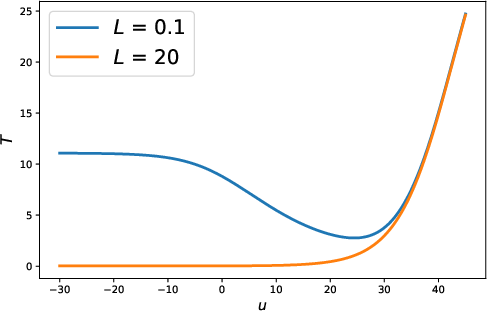
Figure 1: Temperature profiles (T(u)) for small (L=20) and large (L=0.1) anti-de Sitter black holes with initial mass M0=5.
Semiclassical Hawking Emission: Tunneling and Backreaction
In contrast to standard stationary analyses, the evaporation process here is treated in a time-dependent regime. The emission of scalar quanta is modeled as a tunneling effect based on the Parikh–Wilczek approach, which links the tunneling probability directly to changes in the Bekenstein–Hawking entropy: Γ∼exp[ΔS]=exp[S(M−ω)−S(M)] for emission of a quantum of energy u0. Unlike the Boltzmann law, this formalism naturally embodies self-consistent backreaction and enforces an upper cutoff on the emitted energy, strictly imposing energy conservation.
The paper offers a strong claim: for small adS black holes, the luminosity does not monotonically track the temperature as expected from blackbody heuristics. Instead, rapid mass depletion collapses the emission phase space, capping and eventually suppressing luminosity even as temperature diverges.
Figure 2 presents the mass-luminosity relation for both large and small black holes. In the large black-hole regime, tunneling luminosity closely follows the Stefan–Boltzmann scaling, whereas in the small regime, a distinctive peak and subsequent rapid decline are observed, deviating strongly from blackbody expectations.
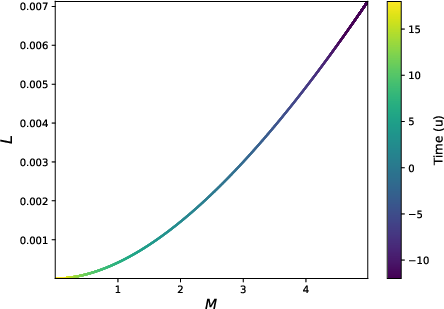
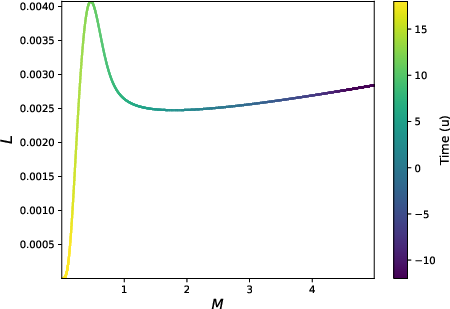
Figure 2: Left—black-hole luminosity versus mass for a large adS black hole (u1, u2). Right—luminosity versus mass for a small adS black hole (u3, u4).
Further comparison between the classical Boltzmann distribution and the full tunneling computation (Figure 3) highlights that only large black holes radiate approximately thermally, while small black holes undergo non-thermal, phase-space suppressed emission during late-stage evaporation.
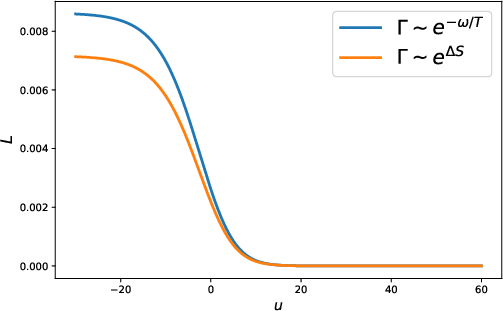
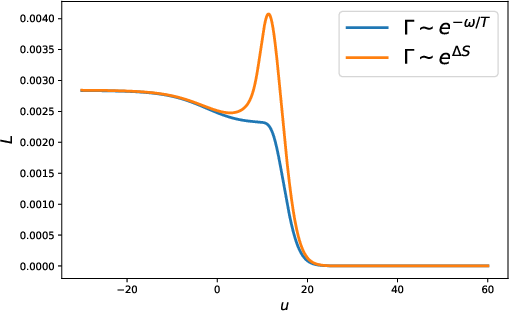
Figure 3: Boltzmann versus tunneling luminosity for u5. Left: large adS regime (u6). Right: small adS regime (u7).
Renormalized Energy–Momentum Tensor and Hawking Atmosphere
The Hawking atmosphere is also analyzed quantitatively via the renormalized energy–momentum tensor (REMT) for massless scalar fields in the Vaidya-adS geometry, adopting a reduction to an effective two-dimensional model with anomaly-induced contributions. The main finding is that the local energy flux near the trapping horizon contains a dominant non-adiabatic negative energy density term proportional to u8, directly reflecting rapid mass loss.
This is numerically illustrated in Figure 4, showing the absolute values of horizon luminosity and mass loss rate as functions of time. In the small adS regime, the REMT contribution of the backreaction (mass loss term) overtakes the thermal piece. In the large adS regime, the thermal u9 term remains dominant, consistent with blackbody emission.
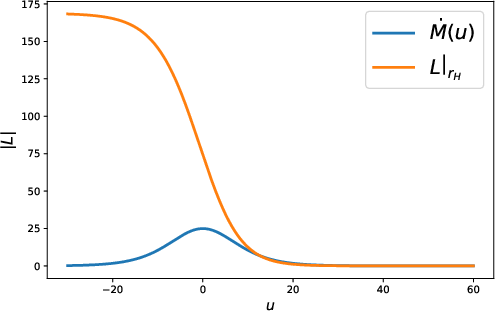
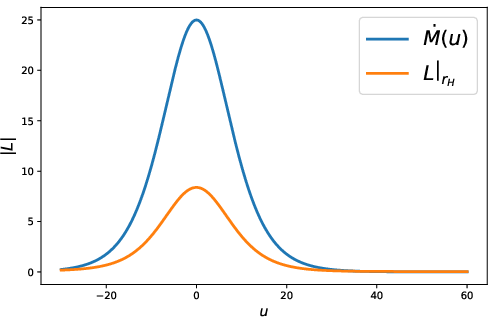
Figure 4: Absolute luminosity at the horizon and mass loss rate for T(u)0. Left: large adS (T(u)1). Right: small adS (T(u)2).
Implications, Numerical Constraints, and Extensions
The strong result that luminosity remains finite and vanishes at late stages for small adS black holes under the tunneling paradigm implies a robust physical cutoff absent from naive blackbody models. This behavior is a direct consequence of incorporating backreaction and energy conservation, challenging previous heuristics for high-temperature, low-mass evaporation.
Practically, these findings impact the classification of black-hole endpoints in adS, suggesting persistence of cold remnants or non-divergent end-stage emission. The results bear on the study of quantum information retention, boundary conditions in holography, and the universality of Hawking evaporation across asymptotic structures.
Theoretically, extensions to higher spin fields, rotating black holes, or inhomogeneous backgrounds (e.g., dynamical de Sitter) are logical next steps. The dynamical approach to REMT and tunneling should generalize to a wider class of spacetimes, supporting investigations at the interface of quantum field theory, semiclassical gravity, and thermodynamic stability.
Conclusion
This paper provides a technically rigorous and quantitatively detailed analysis of Hawking evaporation in dynamical adS spacetimes. By combining the Vaidya-adS framework with the Parikh–Wilczek tunneling method and REMT modeling, the study elucidates key physical departures from traditional blackbody evaporation: energy conservation and backreaction not only cap the luminosity of small adS black holes but generically lead to a vanishing emission at late times despite rising local temperatures. These findings refine our understanding of Hawking atmospheres and have direct implications for semiclassical gravity, quantum thermodynamics, and the holographic principle in anti-de Sitter geometries.