- The paper presents the MCBoost algorithm, a boosting method that enforces multicalibration by iteratively refining predictions using flexible audit functions.
- It establishes theoretical convergence rates and finite-sample guarantees under convex loss settings, highlighting key calibration–risk trade-offs.
- The study demonstrates MCBoost's transferability under covariate shift, ensuring subgroup reliability and fairness across diverse domains.
Multicalibration Boosting: Unified Theory, Convergence, and Transferability
Overview and Motivation
The paper "Multicalibration Boosting: Theory, Convergence, and Transferability" (2605.24364) delivers a rigorous and unified theoretical analysis of multicalibration boosting (MCBoost), subsuming diverse variants such as multiaccuracy, BatchGCP, BatchMVP, and more general multicalibration schemes. Multicalibration strengthens classical calibration by demanding that predictive residuals for a model are unbiased over flexible subpopulations and value stratifications, enforcing uniformity not just globally but locally conditioned on both group membership and prediction buckets.
The authors formalize the MCBoost algorithm, identify structural distinctions between global accuracy and subgroup calibration, and analytically characterize both its stationary limit and convergence rates. They further treat transferability and universal adaptability under covariate shift, clarifying conditions under which multicalibrated predictors remain reliable across domains—a central theme for AI robustness and fairness. Empirical results are supplied to illustrate calibration–accuracy trade-offs and the impact of auditor expressivity, partition structure, and early stopping.
Unified Framework and Algorithmic Structure
MCBoost is framed as a generic post hoc boosting procedure that iteratively refines a pre-trained predictor f(0) via audit-driven updates. Each iteration (i) identifies the most violated calibration direction from an audit class H, (ii) takes a step in that direction, and (iii) optionally projects the predictor to a constrained space (e.g., [0,1] for probability-like outputs).
The audit function h(X,f(X)) is allowed to depend on both features and current predictions, thus enabling flexible partition schemes including group splits, prediction buckets, and their interactions. This unified formalism encompasses prior methods—multiaccuracy uses audits stratified by covariates and prediction intervals; BatchGCP and BatchMVP operate with groupwise quantile corrections; general MCBoost enforces violations over rich collections of audit functions.
The authors emphasize that MCBoost can substantially improve subgroup calibration even when initial predictors are accurate globally.
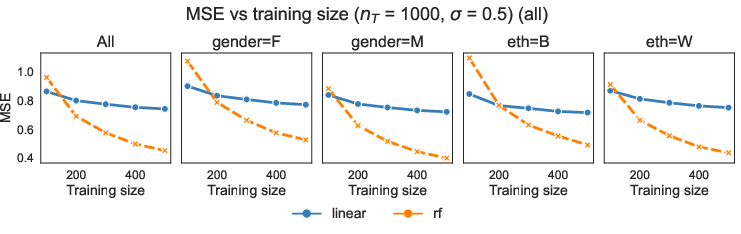
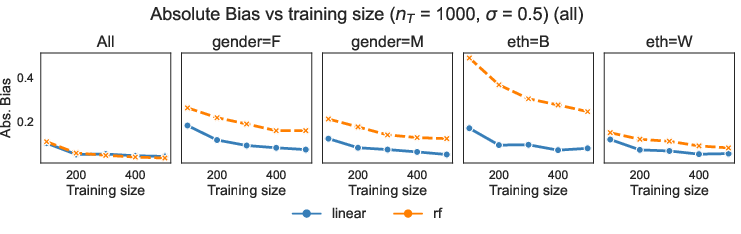
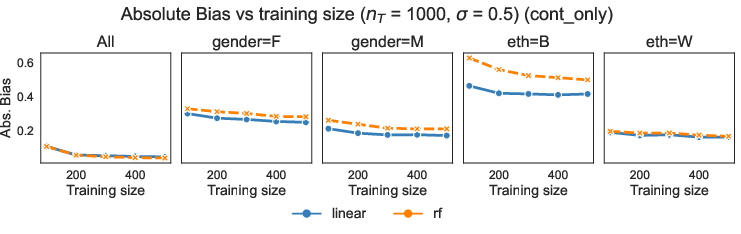
Figure 1: Comparison of test MSE and absolute groupwise bias for random forest vs. linear model; random forests achieve lower global error but exhibit significantly larger subgroup bias.
Limit Characterization and The Multicalibrated Function Space
The key theoretical result is that the boosting trajectory converges to the Bregman projection of the population-optimal predictor f∗ onto the affine span f(0)+F, where F is the closure of cumulatively generated audit directions. The stationary condition is:
⟨g(∞),h⟩=0∀h∈F
with g(∞)(X):=E[s(Y,f(∞)(X))∣X]. This rigorously frames the final multicalibrated class as the functional closure spanned by audit steps, rather than just the original audit class H.
Under convex-loss settings, existence and uniqueness of the limit (subject to step-size schedules and H0-boundedness) are established, and the projection paradigm is generalized to non-smooth losses using Bregman geometry.
Convergence Rates and Finite-Sample Guarantees
For H1-smooth losses (e.g., MSE, pinball), the excess risk decays as H2, where H3 is number of boost steps. If the Polyak–Łojasiewicz condition holds (automatically for H4), geometric convergence is attained:
H5
where H6 is PL constant, H7 is weak-learner edge. Finite-sample guarantees are established via uniform deviation bounds over VC-type audit classes, with sample size scaling as H8 for tolerance H9.
Practical stopping rules are shown to certify empirical multicalibration over the boosting span, with final calibration errors scaling linearly with the audit span norm and [0,1]0. Algorithm termination is guaranteed in time [0,1]1 (sublinear) or [0,1]2 (linear).
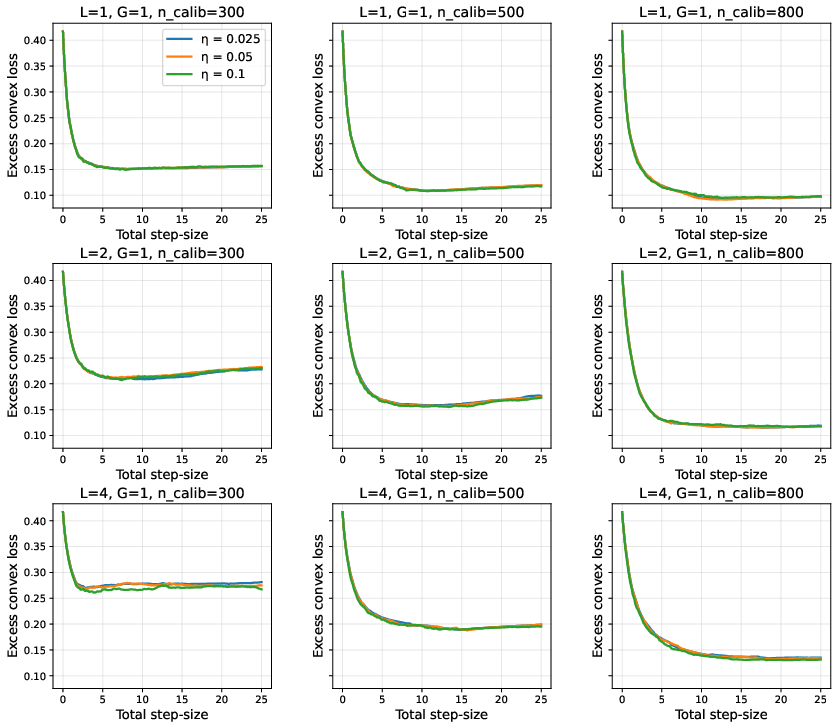
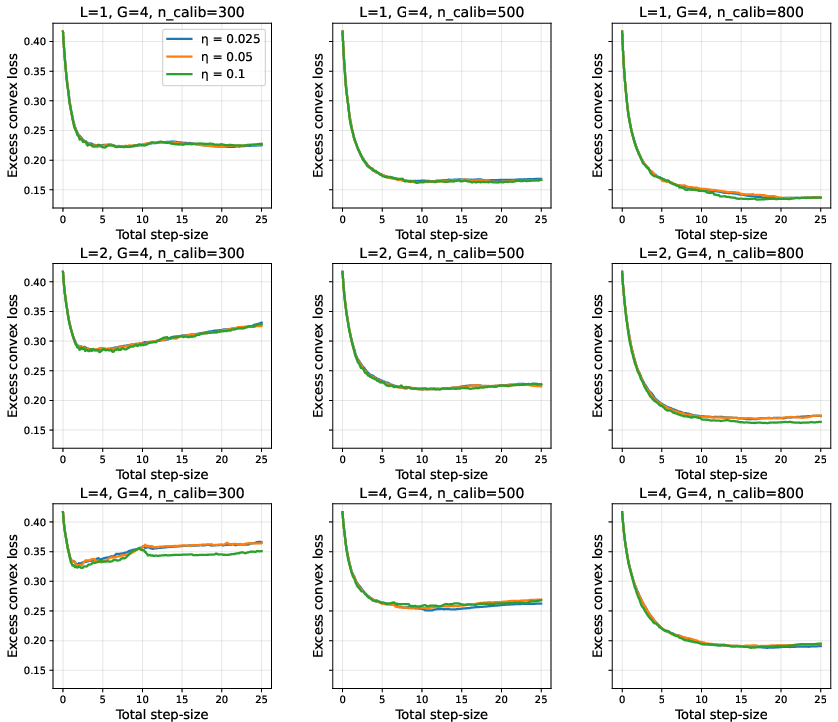
Figure 2: Excess convex loss (y-axis) versus cumulative step size (x-axis); increasing group/bucket granularity yields finer calibration but a visible risk–calibration trade-off.
Empirical Calibration–Risk Trade-Off and Auditor Properties
Empirical studies demonstrate explicit trade-offs between calibration and accuracy: enforcing multicalibration via finer group/bucket partitioning or richer auditors improves subgroup calibration but may increase overall excess risk due to structural constraints. Auditor expressivity is central: tree-based and linear auditors substantially outperform constant correction in both calibration bias and MSE, especially when group features are available.
Early stopping emerges as a crucial regularization mechanism to prevent overfitting—optimal cumulative step budgets are consistent across various nominal step sizes, and cross-validation is robust for practical deployment.
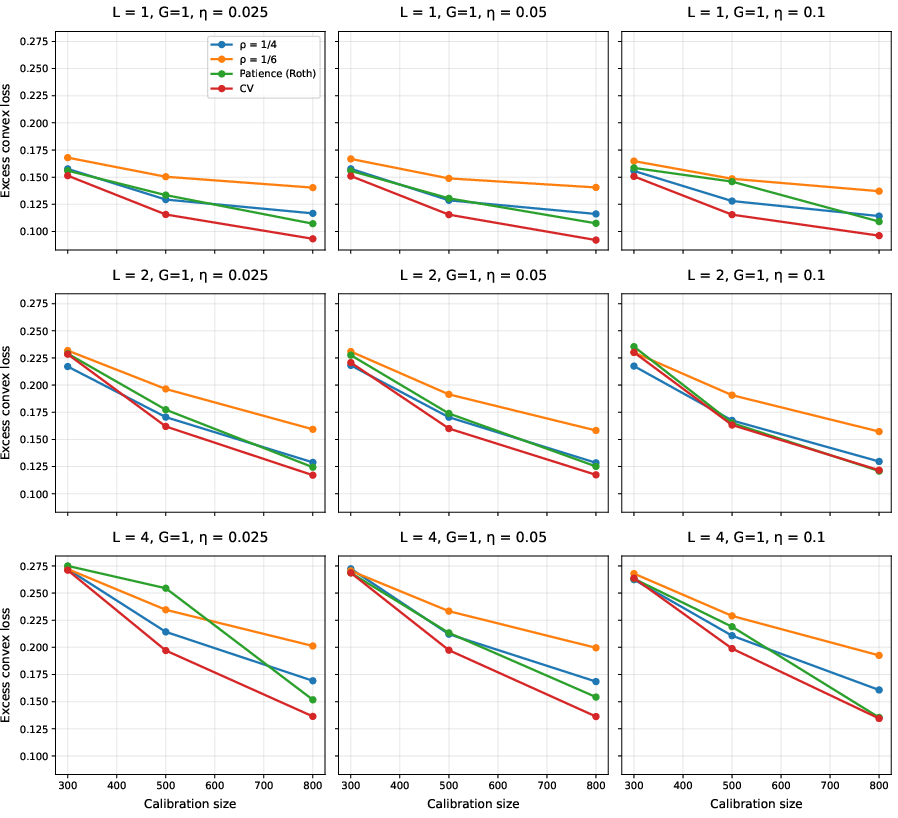
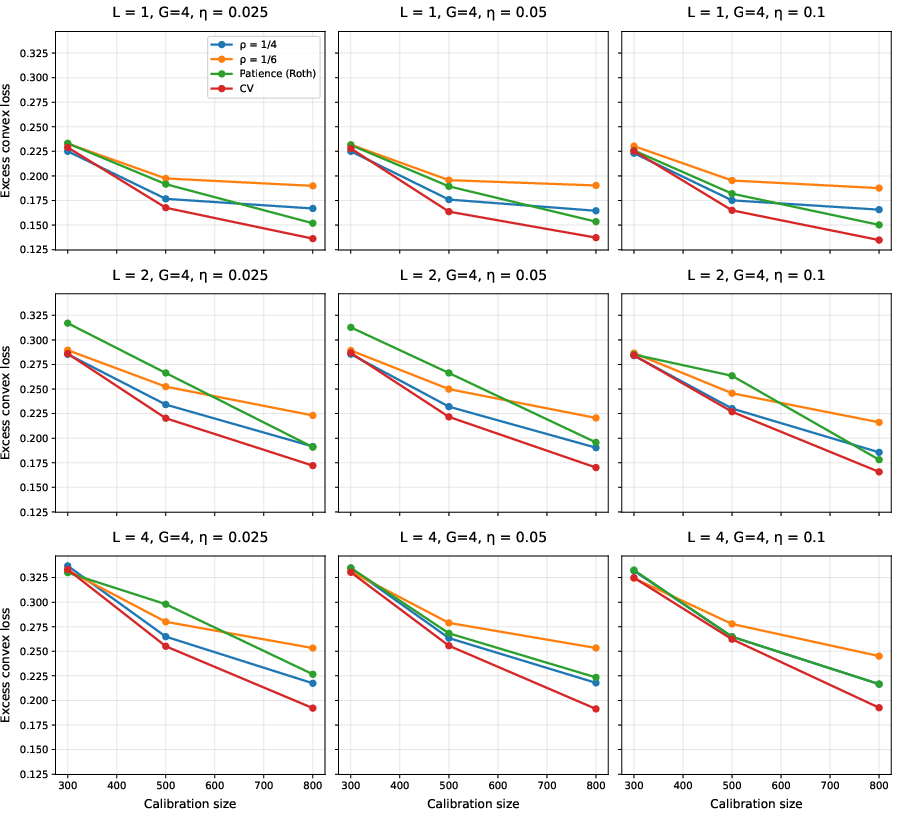
Figure 3: Excess convex loss versus calibration sample size for various group/bucket partitions and stopping strategies; highlights sample-size dependence of calibration efficacy.
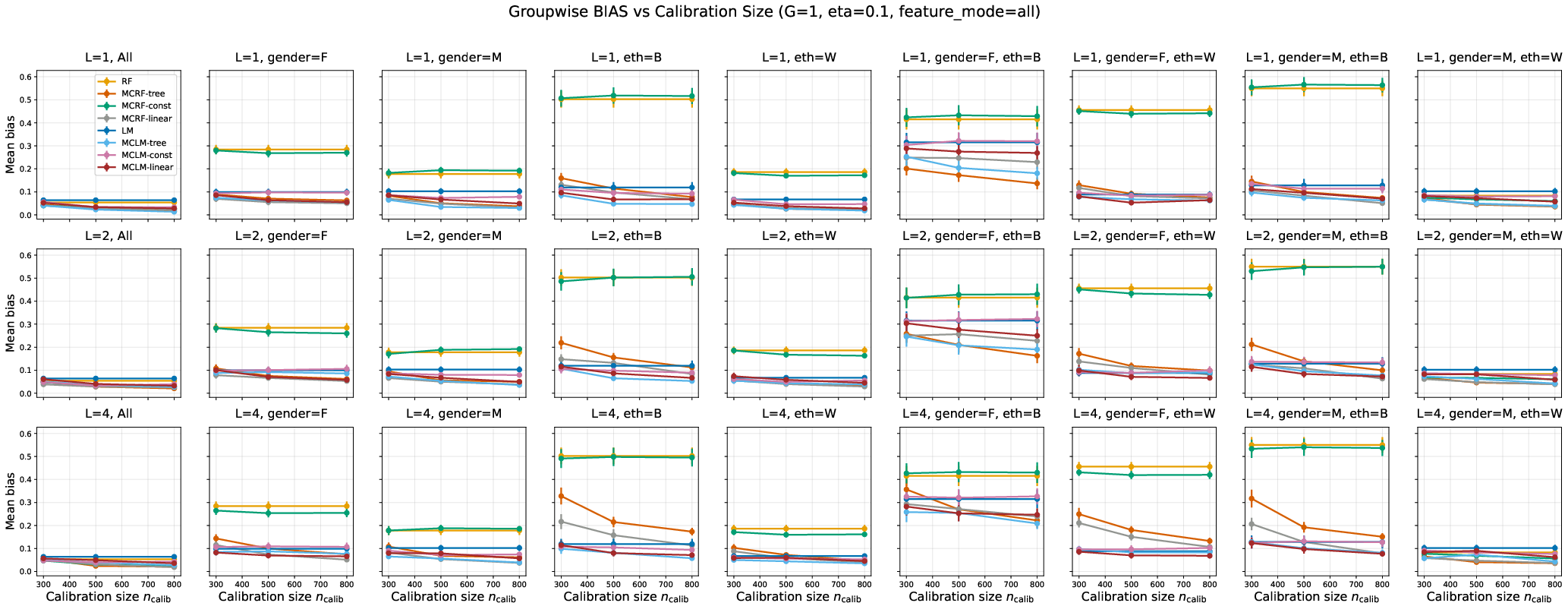
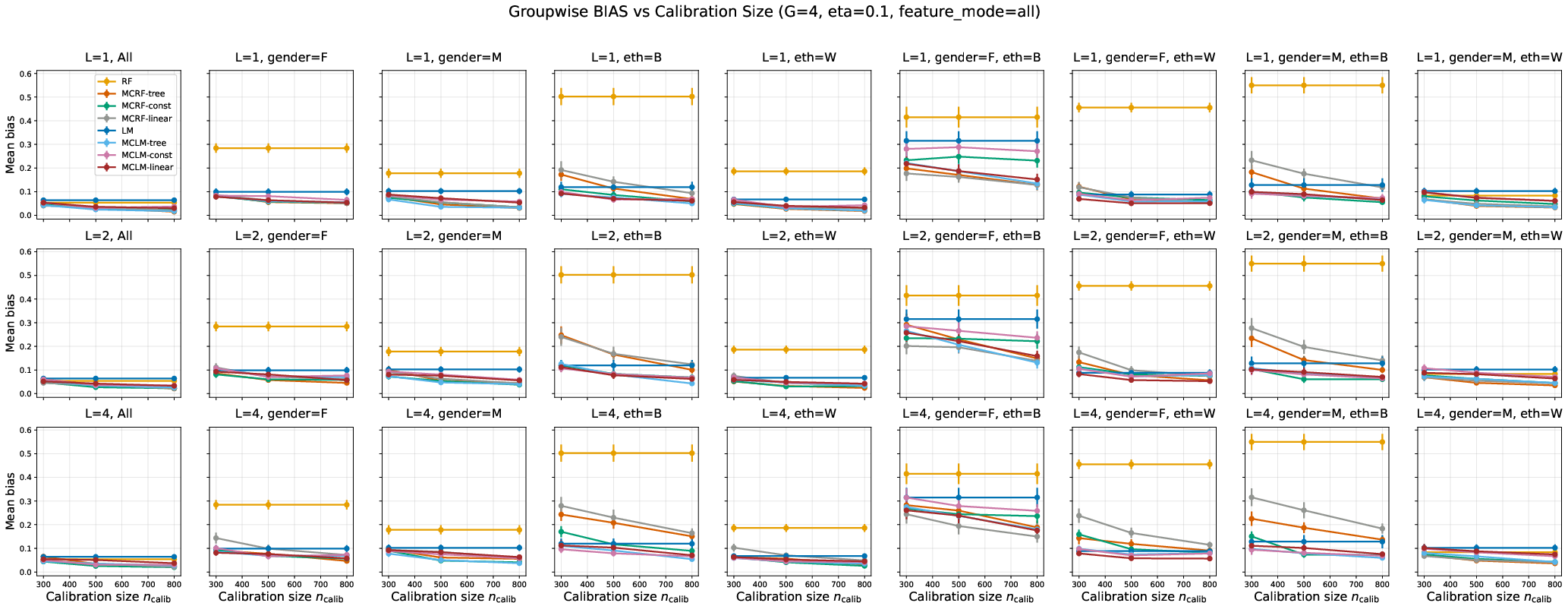
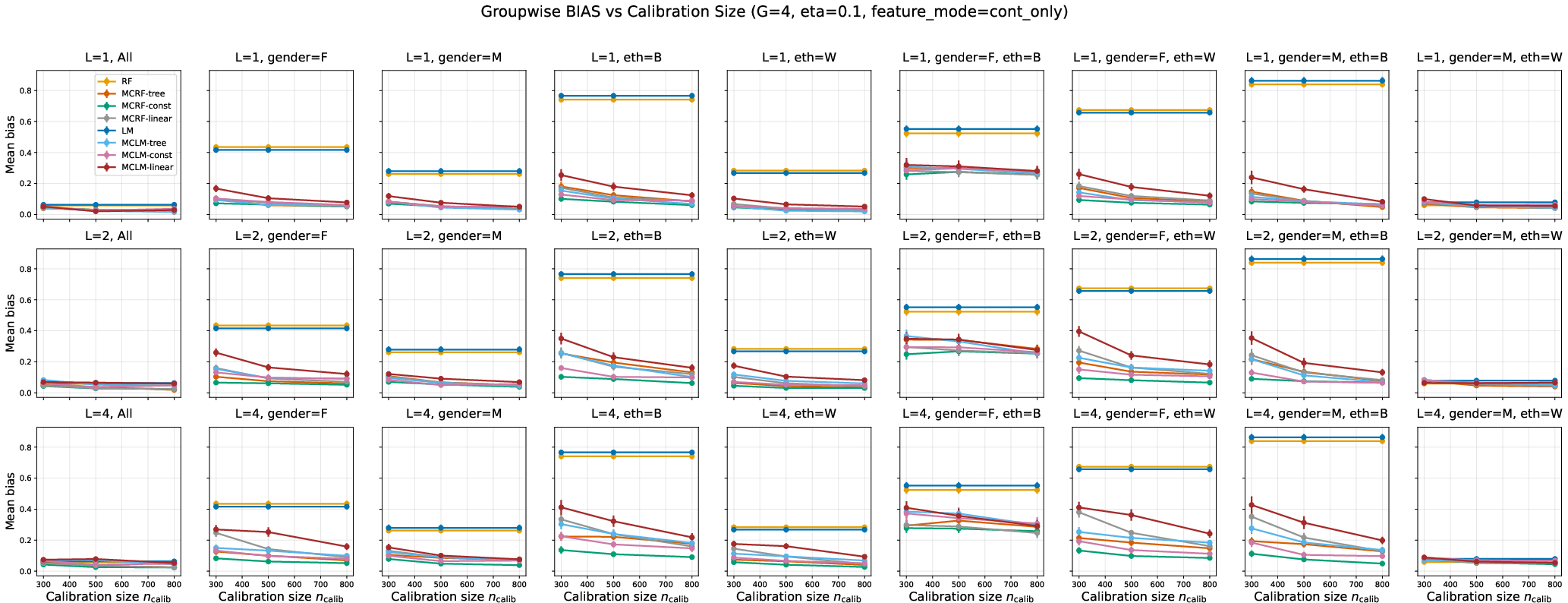
Figure 4: Mean groupwise biases across calibration samples for different predictors/auditors, highlighting the impact of group partitions and auditor expressivity.
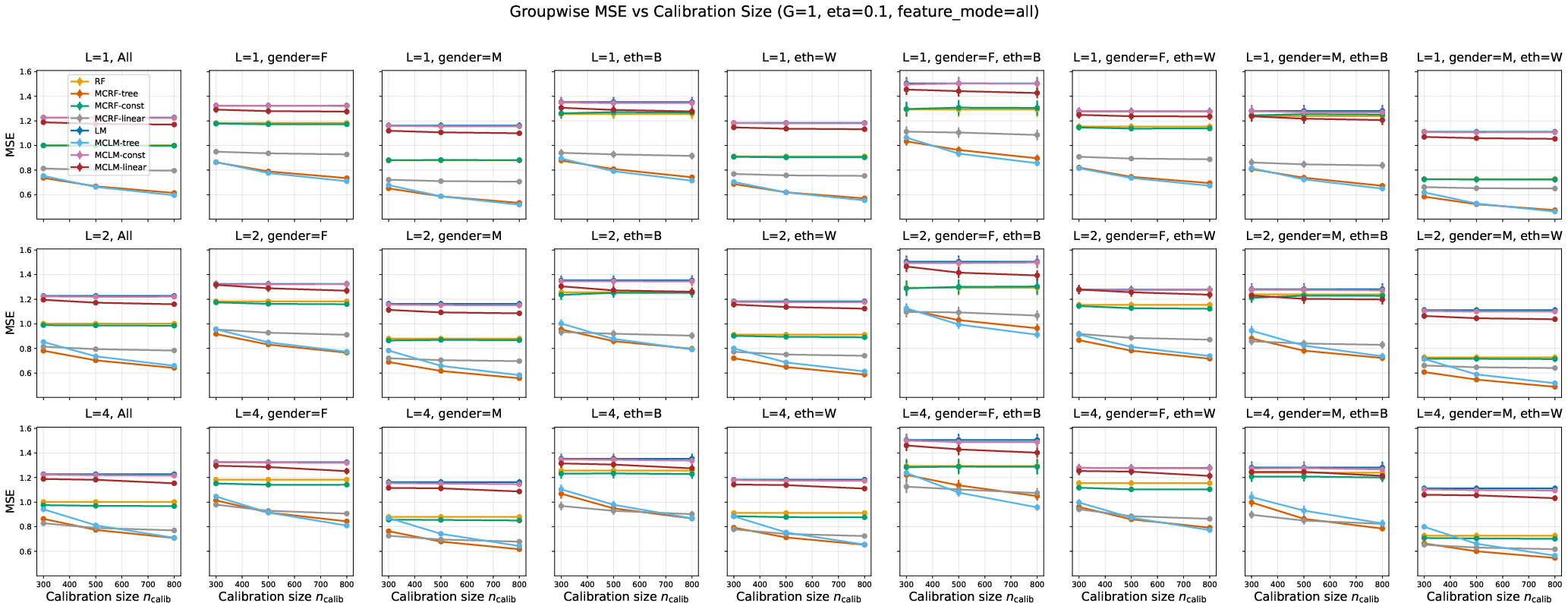
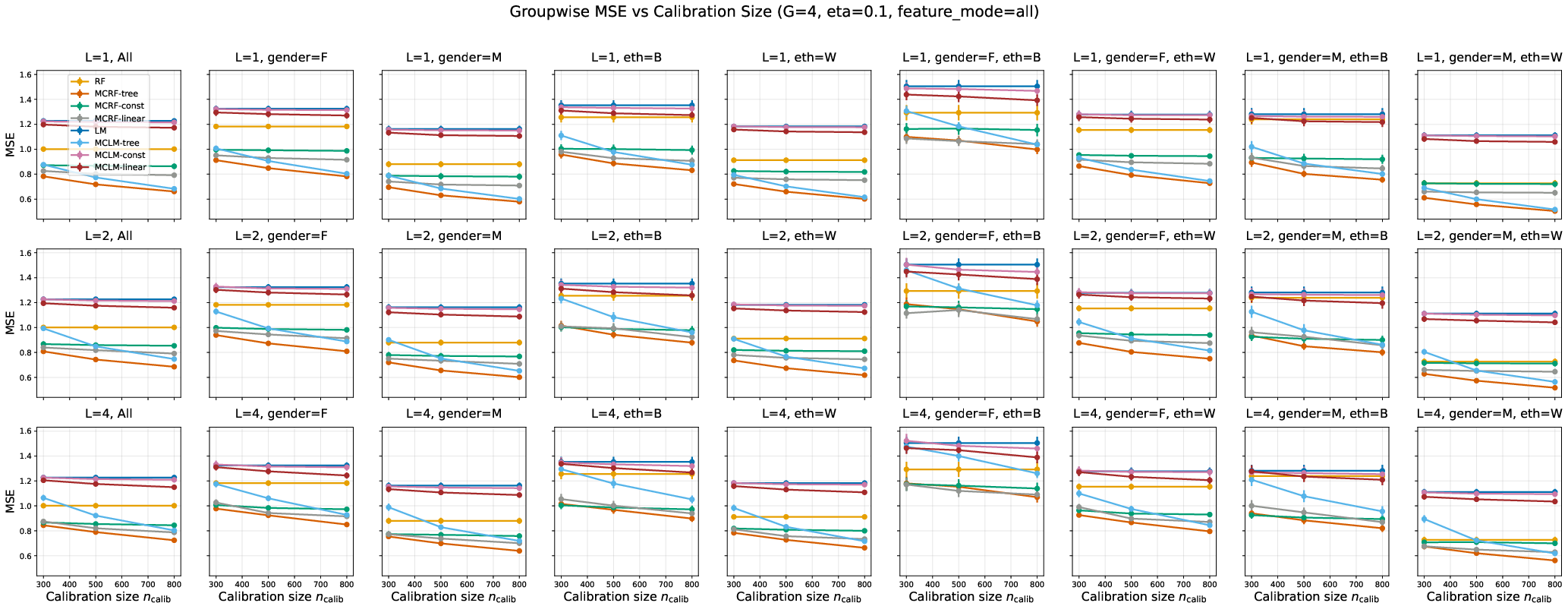
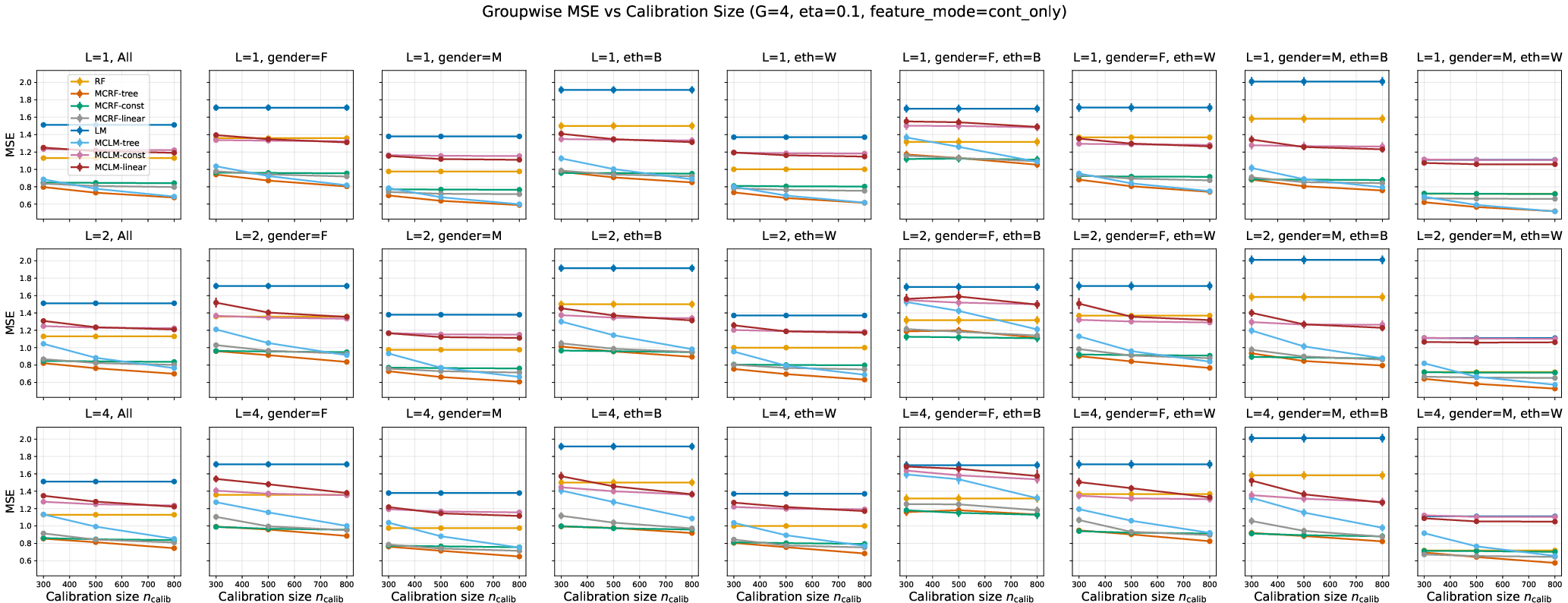
Figure 5: Mean squared errors across calibration samples for different predictors/auditors; demonstrates subgroup MSE improvements via MCBoost.
Transferability and Universal Adaptability Under Covariate Shift
Adaptation under covariate shift is formalized by analyzing density-ratio weighted calibration residuals. The paper proves that if the density ratio function [0,1]3 can be approximated by the boosted audit class, then MCBoost guarantees universal adaptability and transfer of multicalibration to the target domain.
For quantile regression and regression tasks, bounds on target-domain calibration errors are provided as functions of approximation error between [0,1]4 and the learned audit span, plus the tolerance [0,1]5. Multiple source domains are handled via weighted aggregation and shifts.
Empirical results indicate substantial calibration and prediction improvements under structured group shifts and nonlinear covariate perturbations, with more expressive auditors maintaining reliability under domain adaptation.
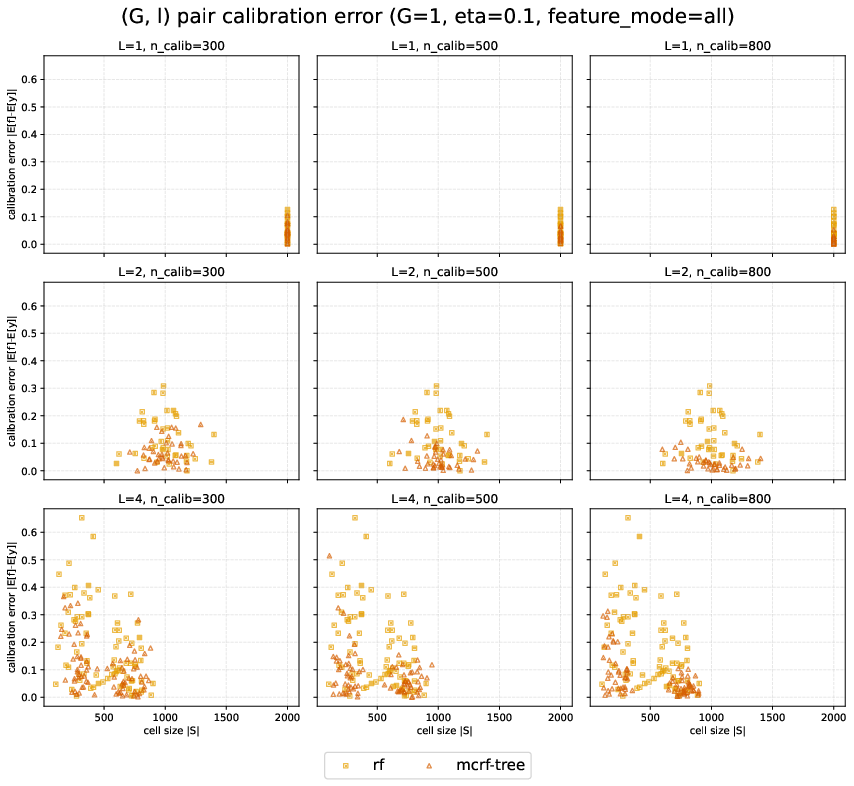
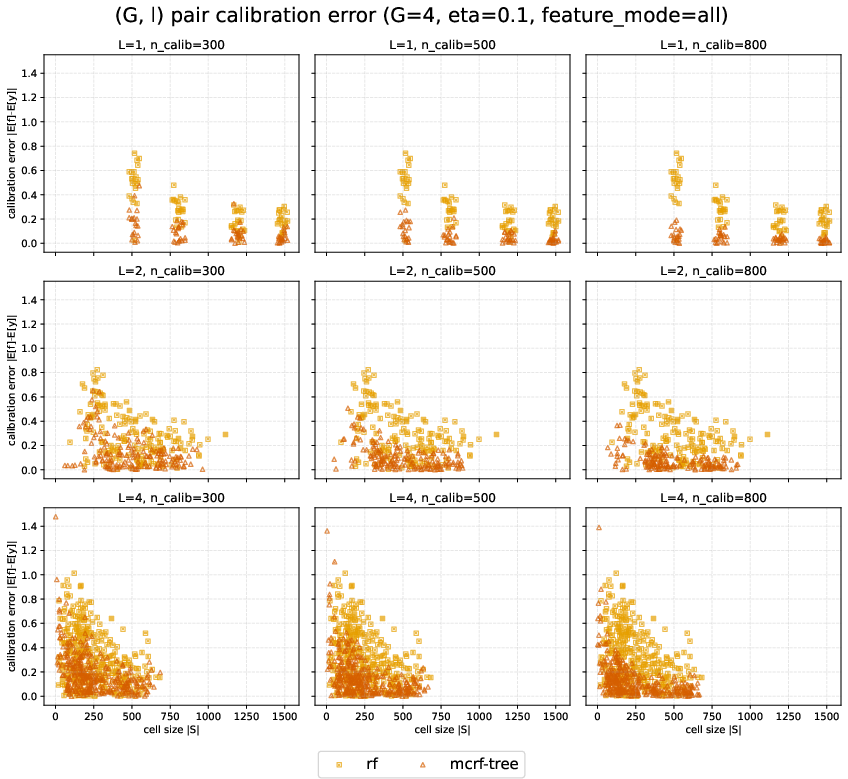
Figure 6: Scatter plot for empirical calibration error over [0,1]6 pairs; left: without group partition, right: with group partition. Indicates finer calibration achieved with explicit group splits.
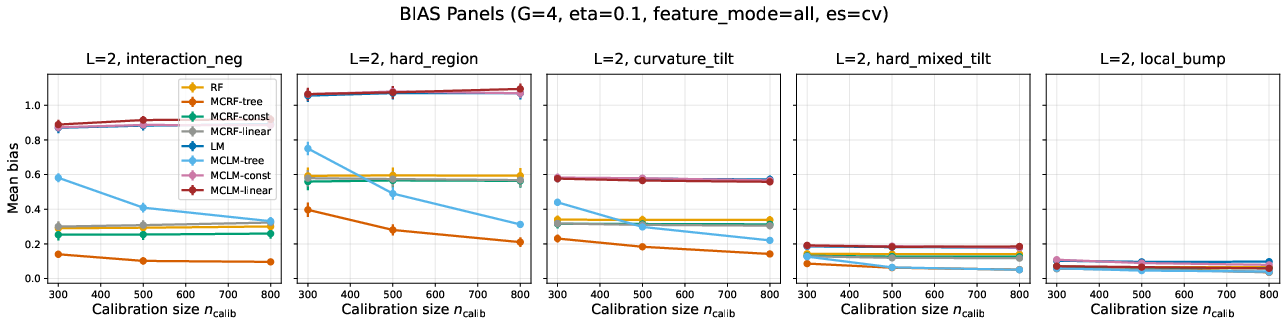
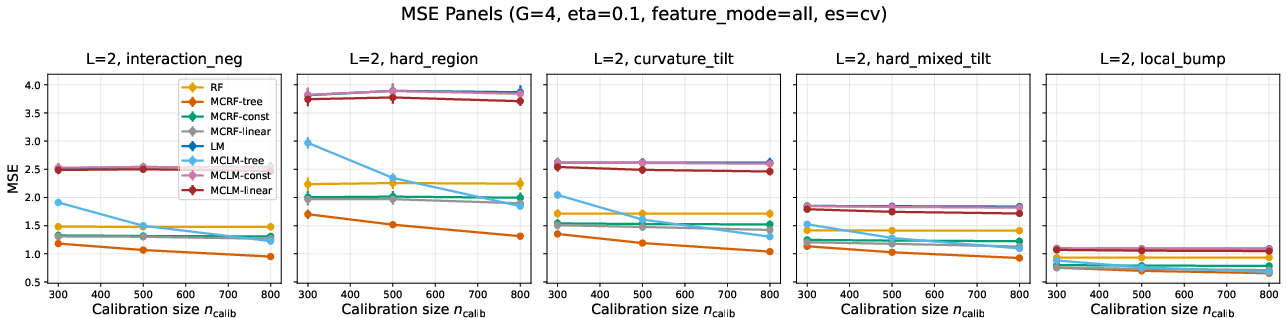
Figure 7: Calibration bias and MSE under structural subgroups and weighted shifts, demonstrating MCBoost’s effectiveness for group and non-group structured distributional shifts.
Practical Implications and Theoretical Perspectives
The MCBoost framework is a general, theoretically grounded post-processing strategy for fairness, calibration, and reliability. It decouples calibration from global accuracy, explicitly quantifies calibration–risk trade-offs, and provides guarantees for adaptivity under distributional heterogeneity. Expressive auditor mechanisms and right feature partitions are necessary conditions for robust subgroup calibration.
Algorithmic regularization via early stopping, cross-validation, and step-size schedules are critical. The Bregman projection characterization explicitly delineates the limits of calibration with respect to audit expressivity, equipping practitioners with principled guidance for algorithm design and fairness auditing.
Conclusion
This paper establishes the theoretical foundations and practical validation for MCBoost as a unifying paradigm for multicalibration across regression, classification, and quantile prediction. The explicit identification of the calibrated function space, convergence rates, and finite-sample bounds position the framework for reliable post hoc calibration and robustness under covariate shift. Extensions to richer auditors, multivariate outputs, and broader applications in uncertainty quantification and fairness are immediate directions, with substantial implications for generalizable and trustworthy AI systems.

