Probing the limits of the semiclassical Einstein equation
Published 22 May 2026 in gr-qc, hep-th, and quant-ph | (2605.24103v1)
Abstract: In the context of semiclassical gravity, the semiclassical Einstein equation is often invoked when backreaction of quantum matter/fields on the spacetime is at stake. It is expected to hold when quantum fluctuations are small. Yet, it is routinely used to justify the central role of the expectation value of the stress-energy tensor of quantum fields, whose fluctuations formally diverge. Here we propose a new way to probe the limits of this approximation by exploiting peculiar nonlinearities of gravity. As a proof of principle, we construct a controlled, analytically tractable setting where the incoherent mixture of weak-gravity states drives the system into a strong-gravity regime. By selecting a branch-degenerate observable, one can compare predictions of quantum and semiclassical gravity, potentially delimiting the validity of the latter.
The paper introduces a novel analytic framework using momentum superpositions to probe the breakdown of the semiclassical Einstein equation via nonlinear gravitational effects.
It demonstrates that branch-degenerate observables can expose significant discrepancies between semiclassical and quantum predictions, particularly under high relativistic boosts.
A boosted cylinder model shows that weak-field branches can produce an effective strong gravitational source when combined semiclassically, challenging standard assumptions.
Probing the Limits of the Semiclassical Einstein Equation
has long served as the standard framework for encoding the backreaction of quantum matter on classical spacetime geometries. The validity of SEE is conventionally assumed to be tied to small quantum fluctuations such that the expectation value ⟨Tab⟩ω provides a suitable source for the gravitational field. Fluctuations of Tab, however, are formally divergent, and the precise circumstances under which the semiclassical approximation holds remain theoretically ambiguous.
This paper introduces a novel analytic setting to probe the breakdown of the SEE by exploiting general relativity's nonlinear structure. Unlike previous proposals centered on position superpositions and their linearized gravitational fields (as in gravitationally mediated entanglement [GME] scenarios), the authors consider coherent superpositions of momentum states, each branch individually associated with weak fields, but whose semiclassical source can enter the nonlinear regime as a consequence of relativistic boosting. This approach reveals strong discrepancies between the predictions of semiclassical and quantum gravity, explicitly in expectation values of specific geometric observables.
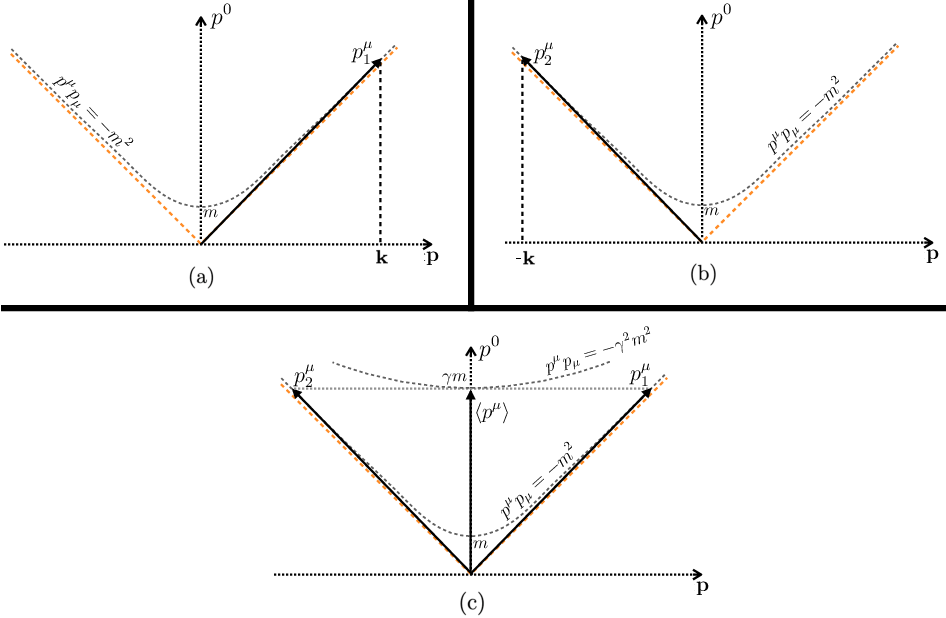
Figure 1: A single particle’s branches with large relativistic boosts individually produce weak fields, but their incoherent mixture results in amplified gravitational content set by ⟨pμ⟩, potentially far from the weak-field regime.
Nonlinear Structure and Branch-Dependent Observables
The analysis hinges on the nontrivial property of the Einstein tensor’s nonlinearity:
Gμν[⟨g⟩]=⟨Gμν[g]⟩.
In linearized gravity, this discrepancy is absent, masking essential nonlinear features. The authors illustrate that for a quantum state
∣Ψ⟩=21(∣+k⟩+∣−k⟩),
with ∣±k⟩ relativistically boosted states of a particle of mass m, each branch (in its own rest frame) sources a weak Schwarzschild metric. However, the semiclassical source constructed from the average ⟨Tab⟩ corresponds to an effective energy much larger than m (specifically, ⟨Tab⟩ω0 in the zero-momentum frame, with boost factor ⟨Tab⟩ω1), and can thus source strong curvature even when ⟨Tab⟩ω2 is small. Figure 1 summarizes this distinction pictorially by showing the relation between individual branch trajectories (mass shell) and the average source.
The key technical requirement is to consider branch-degenerate observables: geometric quantities whose expectation values are identical for each branch, so that their measurement does not induce decoherence. This is essential, as observables revealing branch information would act as which-path detectors, collapsing the superposition and obscuring quantum gravitational effects. The observable must, therefore, be sensitive only to differences arising from the nonlinear combination of the branches in the semiclassical scenario.
Analytic Model: The Boosted Cylinder
To facilitate analytic control, the authors construct a toy model using a cylinder of low linear mass density ⟨Tab⟩ω3 (with corresponding ⟨Tab⟩ω4) placed in a quantum superposition of large equal and opposite boosts along its axis. In the rest frame, the solution exterior to the cylinder is the well-known Levi-Civita (LC) geometry, parameterized by the Tolman mass per unit length ⟨Tab⟩ω5 and a geometric factor ⟨Tab⟩ω6. Under a Lorentz boost, the metric acquires nontrivial transformation properties, but remains stationary in suitably chosen coordinates. For large boosts, the effective Tolman mass (as inferred semiclassically) is enhanced by a factor ⟨Tab⟩ω7,
⟨Tab⟩ω8
allowing the semiclassical source to probe highly nonlinear gravitational regimes even when each branch (boosted cylinder) is individually deep in the weak-field regime.
A geometric observable of particular interest is the rate of change of the proper circumference ⟨Tab⟩ω9 of concentric circles in the cylinder's exterior as a function of proper radial distance Tab0,
Tab1
with Tab2. The authors analyze two scenarios:
Quantum scenario (Q): The expectation value of Tab3 in the quantum superposed state is constant—branch-degenerate—since each branch yields the same value.
Semiclassical scenario (S): The same observable, when evaluated in the geometry sourced by the average energy-momentum, shows nontrivial Tab4-dependence, scaling as
Tab5
This distinction grows with increasing Tab6.
This analytic construction reveals that measuring Tab7 could empirically discriminate between semiclassical and fully quantum gravitational predictions in a genuinely nonlinear regime, a domain inaccessible to linear superposition frameworks exploited by GME-type proposals.
Implications and Prospective Developments
The work establishes a fundamentally new regime where differences between semiclassical and quantum gravity emerge at the level of expectation values for carefully chosen observables, and not merely in correlators or nonlocal probes. The authors argue that the class of branch-degenerate, nonlinear observables offers complementary probes to GME experiments, which are confined to correlation measurements in the linearized theory.
This addresses the open issue of semiclassical gravity's domain of applicability: the results suggest that even when quantum fluctuations of the stress-energy tensor are negligible and the SEE is expected to hold, nonperturbative nonlinearities can amplify differences between quantum and semiclassical predictions. The key condition is the coherence of large-momentum superpositions, with each branch weak-field, but with semiclassically-constructed sources arbitrarily deep in the nonlinear regime via large boosts.
In practical terms, realization of such experiments would require high control over relativistic quantum states of composite bodies, as well as the ability to measure branch-degenerate geometric observables without disrupting coherence. Theoretically, this opens further investigation into other observables and configurations where similar breakdowns of the semiclassical Einstein equation manifest, including extensions to fully dynamical settings or to fields with additional internal structure.
Conclusion
This paper identifies and analyzes a novel, analytically tractable regime exposing the limits of the semiclassical Einstein equation. By constructing quantum superpositions of large-momentum branches, it is possible for the semiclassical source to exit the perturbative gravitational regime—without any corresponding strong fields present in the actual physical branches. The inequivalence of quantum and semiclassical predictions, particularly for branch-degenerate nonlinear observables, underscores the importance of carefully assessing the validity of the semiclassical framework. These results invite new experimental and theoretical investigations into the interplay between quantum coherence and gravitational nonlinearity, and may catalyze progress toward a more complete quantum theory of gravity.
“Emergent Mind helps me see which AI papers have caught fire online.”
Philip
Creator, AI Explained on YouTube
Sign up for free to explore the frontiers of research
Discover trending papers, chat with arXiv, and track the latest research shaping the future of science and technology.Discover trending papers, chat with arXiv, and more.