- The paper introduces a modified Schwarzschild metric that embeds a Hernquist dark matter halo and quantifies the impact of parameters α, rₛ, and ρₛ on the gravitational field.
- It demonstrates that alterations in null geodesics modify photon trajectories, influencing light lensing and shadow profiles near the event horizon.
- Thermodynamic analysis reveals that dark matter parameters stabilize heat capacity and adjust Hawking temperature and phase transitions.
Geodesics and Thermodynamics of a Schwarzschild Black Hole with Hernquist Dark Matter
Schwarzschild–Hernquist Metric Construction
The study examines a Schwarzschild black hole (BH) embedded in a Hernquist dark matter (DM) halo, introducing a metric that incorporates the Hernquist density profile and an auxiliary parameter α. The metric function f(r) explicitly depends on the BH mass M, the Hernquist parameters rs and ρs, and α, yielding a nontrivial deformation of the conventional Schwarzschild spacetime. Specifically, the exponential factor, governed by (rs,ρs), modulates the gravitational field, while α produces a global asymptotic shift in f(r).
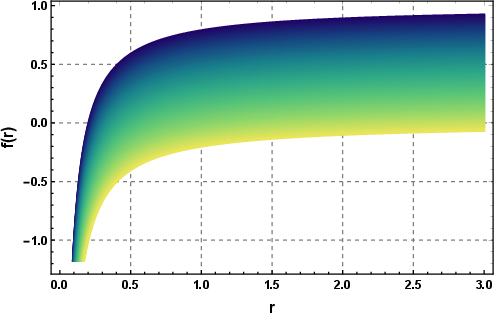

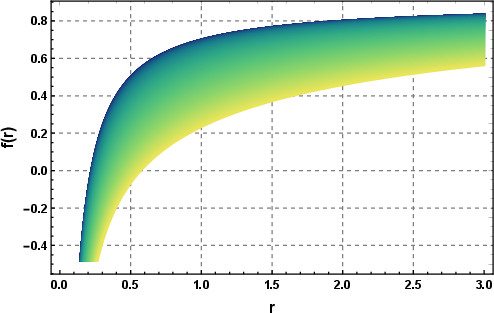

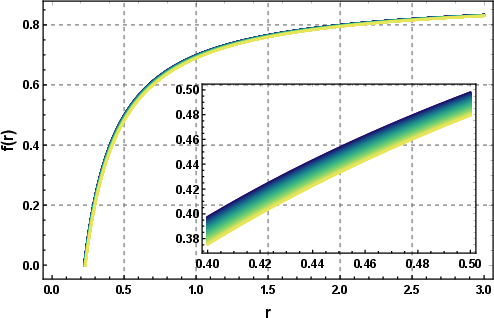

Figure 1: Profile of the metric function f(r) vs. f(r)0 for f(r)1, illustrating modulation by f(r)2, f(r)3, and f(r)4.
Analysis shows that variations in f(r)5 shift the entire metric downward, enhancing gravitational attraction; f(r)6 controls the spatial extent of the halo’s influence; and f(r)7 determines the density-dependent corrections. These three parameters interact to produce significant departures from the Schwarzschild vacuum solution, affecting both the near-horizon structure and the asymptotic regime.
Null Geodesics and Light Propagation
Investigation of null geodesics reveals that the Hernquist parameters and f(r)8 alter the effective potential and photon orbital dynamics. The effective potential f(r)9 demonstrates parameter-sensitive radial profiles, dictating the existence and stability of photon spheres.
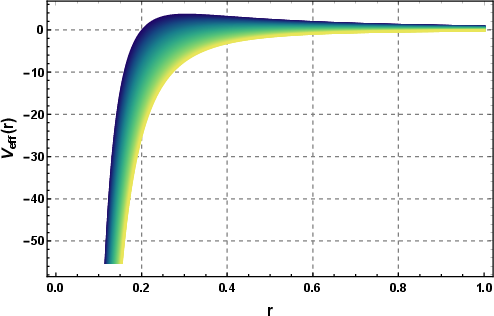
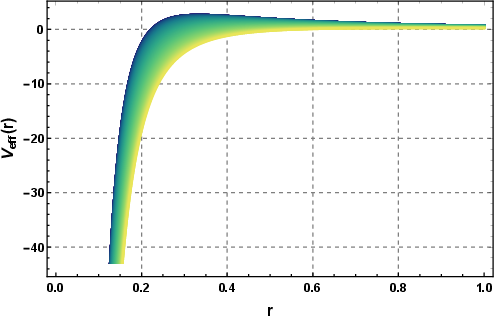
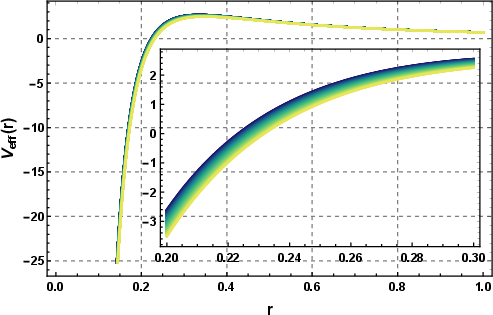
Figure 2: The effective potential M0 vs. M1 for different Hernquist and deformation parameters at M2.
Increasing M3 lowers the potential barrier, shifting unstable photon orbits inward. Larger M4 broadens the spatial domain of the halo’s gravitational effects, whereas higher M5 amplifies the trapping potential for light. Orbital equations show that the lensing and trajectory structure depart from canonical Schwarzschild predictions, especially in the strong-field region.
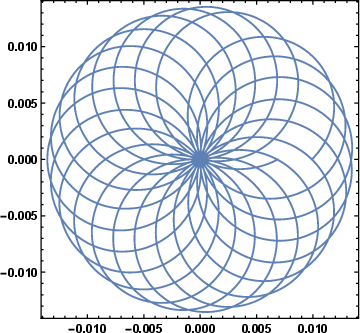
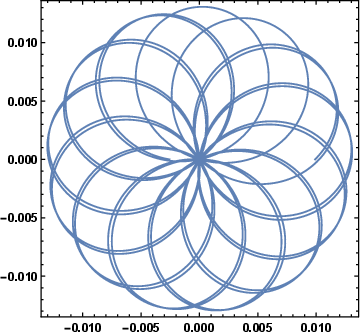
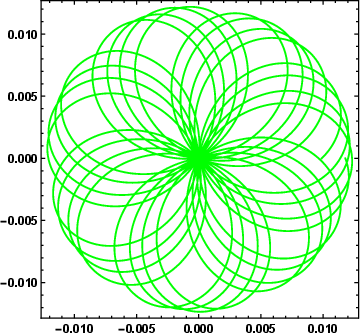
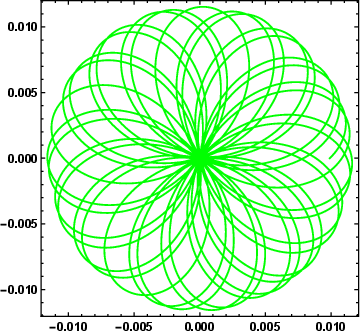
Figure 3: Light trajectories for variations in M6, M7, M8 with M9; halo and geometric deformation deeply affect photon orbits.
Limit analyses demonstrate that for rs0 and/or rs1, the system reduces to a Schwarzschild-like metric with rs2 as a global monopole term, modifying photon sphere radii as rs3. The presence of the Hernquist profile creates a radial-dependent mass correction, affecting both lensing and the shadow structure.
Thermodynamic Properties
The thermodynamics of the Schwarzschild–Hernquist BH feature explicit dependence on the DM halo parameters and rs4. The ADM mass is related to the horizon radius through an exponential term, with rs5 diminishing the mass required for a given event horizon size.
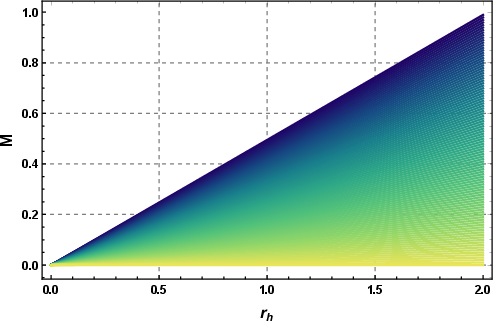
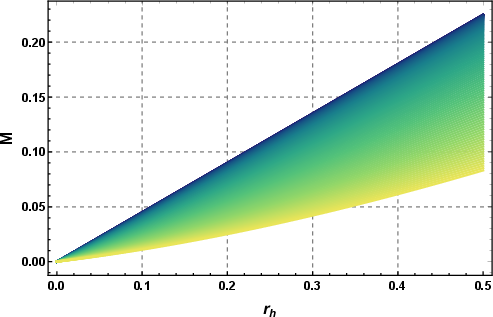
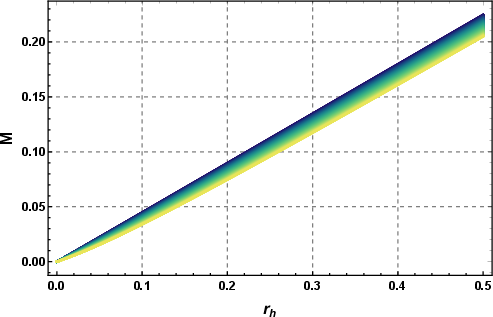
Figure 4: The ADM mass as a function of rs6 for different rs7, with rs8 and rs9 prominently reducing mass for fixed ρs0.
The Hawking temperature inherits corrections from the modified surface gravity; the exponential halo parameterization and ρs1 suppress ρs2, particularly for smaller ρs3. ρs4 and ρs5 have a regularizing effect, smoothing the temperature profile and reducing near-horizon gradients.
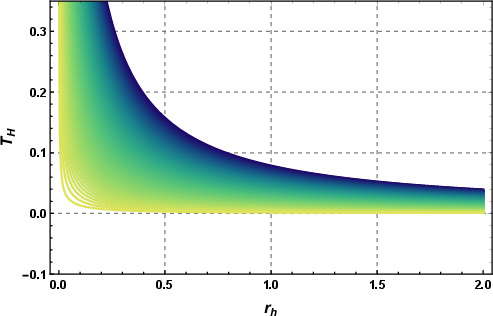
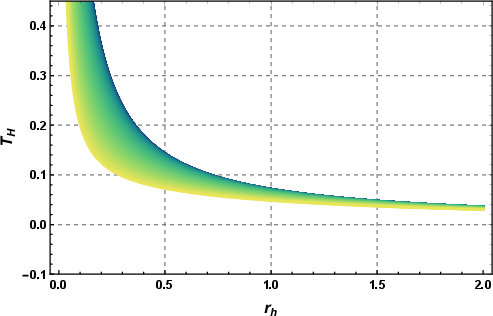
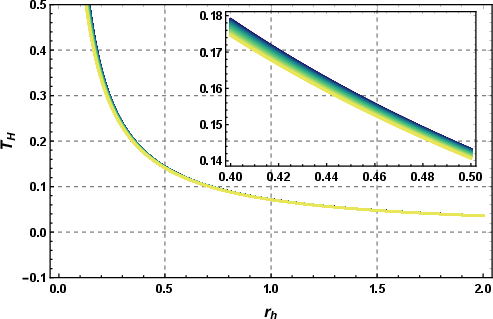
Figure 5: Hawking temperature ρs6 vs. ρs7; ρs8 and ρs9 decrease the temperature, indicating greater thermodynamic stability.
The Bekenstein-Hawking area law remains valid, α0, as the horizon’s geometry is preserved.
Detailed examination of Gibbs free energy α1 reveals negative α2 at large α3, signaling stability and possible Hawking–Page transitions. α4 further shifts α5 downwards at macroscopic horizon sizes.
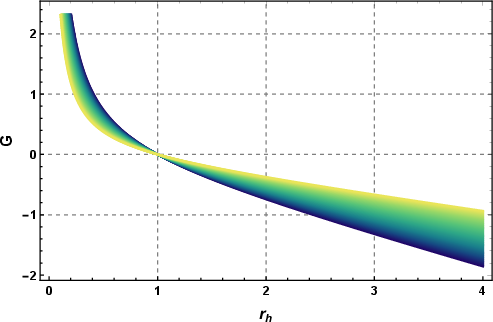
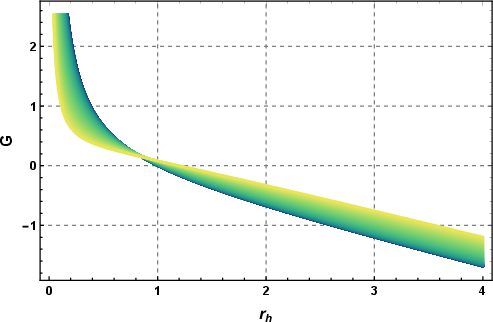
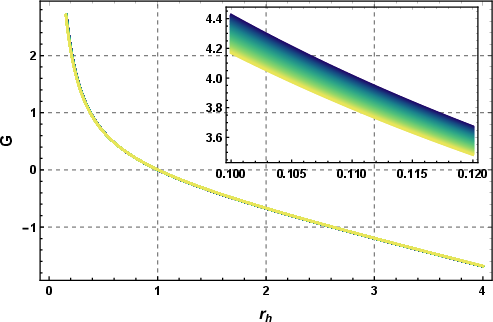
Figure 6: Gibbs free energy vs. α6, showing transition to stable configurations as α7 becomes negative for increasing α8.
Heat capacity analysis identifies second-order phase transitions, with divergence points shifted by α9 and (rs,ρs)0. Negative heat capacity regimes are suppressed as (rs,ρs)1 increases—showing DM halo regularizes thermal instabilities.
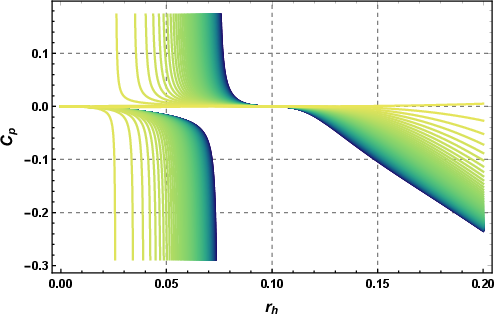
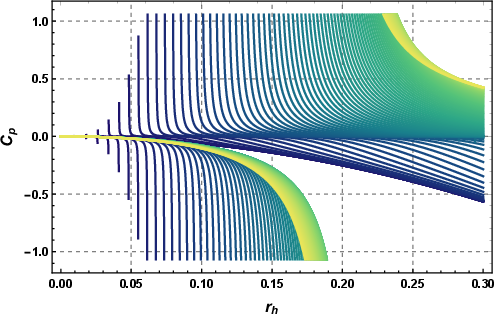
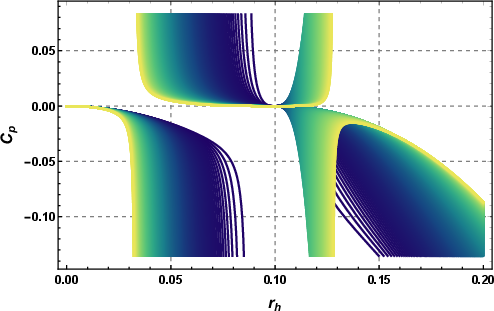
Figure 7: Heat capacity solutions for varying (rs,ρs)2; geometric and halo parameters stabilize BH thermodynamics.
Scalar Perturbations and Stability
The scalar field perturbations governed by the Klein–Gordon equation exhibit effective potentials modulated by (rs,ρs)3 and (rs,ρs)4, causing changes in the quasinormal mode (QNM) spectrum and scattering dynamics. The exponential Hernquist corrections shift the potential barrier height and width, while (rs,ρs)5 alters the global normalization.
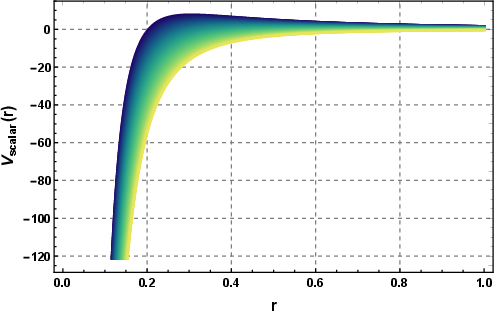
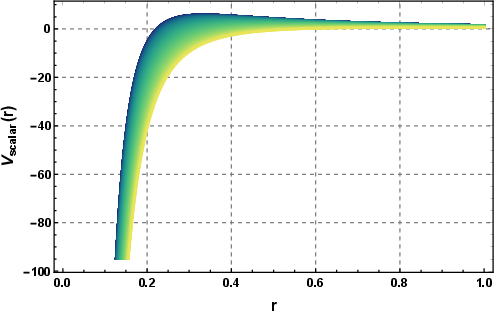
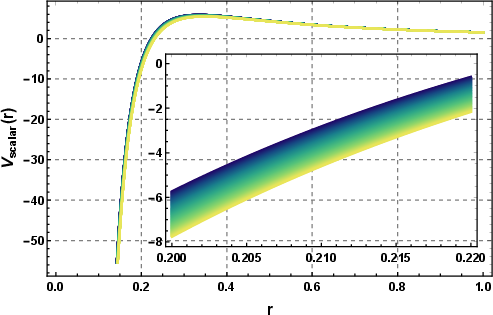
Figure 8: Effective potential for scalar perturbations ((rs,ρs)6), demonstrating parameter-induced modifications in the trapping region.
Large (rs,ρs)7 and (rs,ρs)8 extend and regularize the region of scalar wave interaction, while vacuum and deformation limits adapt the potential to Schwarzschild and monopole-like cases. In the asymptotic regime, the halo supplies an effective mass correction, further impacting QNM frequencies relevant for gravitational wave observatories.
Practical and Theoretical Implications
Parameter-driven modifications of optical, thermodynamic, and perturbation properties in BHs suggest observational signatures in lensing, shadow imaging (EHT/Sgr A*), and gravitational wave QNM detection. The regularizing thermal effects and stable heat capacity branches may imply extended lifetimes for BHs in dense DM environments. The scalar perturbation analysis points to altered QNM spectra, affecting tests of strong-field gravity and constraints on DM distribution in galactic centers.
Theoretical implications include model generalization for extended dark matter environments, incorporation in precision tests of GR, and potential applications in holography and quantum gravity via modified BH thermodynamics. The interplay between halo structure and spacetime deformation provides a framework for exploring non-vacuum gravitational physics with astrophysical relevance.
Conclusion
This work establishes that a Schwarzschild BH embedded in a Hernquist halo and subject to geometric deformation parameter (rs,ρs)9 exhibits significant, quantifiable departures from canonical properties. The combined influence of α0 modulates photon effective potentials, light trajectories, thermal profiles, phase transitions, and scalar perturbative dynamics. These corrections are paramount for modeling astrophysical black holes interacting with DM halos, impacting both observational strategies and theoretical investigations within high-energy astrophysics and gravitational physics (2605.24046).

