- The paper demonstrates that Eu(Ga,Al)4 exhibits dual topology with coexisting skyrmionic magnetism and topological surface states confirmed by ARPES and DFT.
- It shows that the surface states display non-dispersive, drumhead-like dispersion and remain resistant to surface reconstructions and magnetic fluctuations.
- The study reveals tunable coupling between real-space skyrmions and momentum-space topology, indicating promising applications in spintronic devices.
Dual Topological States in Skyrmion-Host Magnets Eu(Ga,Al)4
Introduction
The discovery of materials that exhibit both real-space and momentum-space topological phenomena—so-called "dual-topology" systems—has significant ramifications for quantum materials research. In Eu(Ga1−xAlx)4, the coexistence of nontrivial magnetic structures (skyrmions) and robust topological surface states (TSSs) presents an opportunity to realize novel emergent phenomena and manipulate quantum orders in an intrinsically coupled setting. This work (2604.12676) presents compelling angle-resolved photoemission spectroscopy (ARPES) evidence that establishes Eu(Ga,Al)4 not only as a bulk Dirac nodal-line (DNL) semimetal, but also as a rare, robust, and tunable dual-topology platform.
Experimental Evidence for Dual Topology
High-resolution ARPES measurements on EuGa2Al2 (x=0.5) and EuAl4 (x=1.0) enabled direct observation of the TSSs associated with the bulk DNL. The resulting Fermi surfaces on the GaAl-terminated face display characteristic features—including multiple Fermi sheets and replica Fermi surfaces due to 2×1 surface reconstruction—that depart sharply from the predictions of bulk band calculations, highlighting the existence of robust surface states (Figure 1).
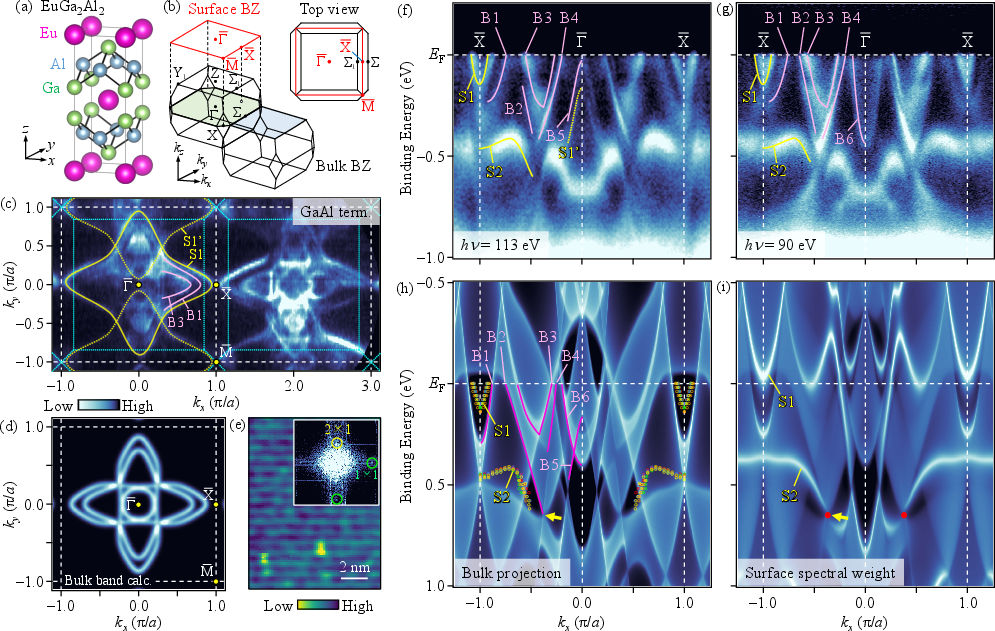
Figure 1: ARPES measurements and DFT comparisons revealing TSSs and reconstructed Fermi surfaces on the GaAl termination of EuGa2Al2.
ARPES band mapping further confirms the persistent, non-dispersive nature of select states (S1, Eu(Ga1−xAlx)40) with respect to Eu(Ga1−xAlx)41, as expected for surface states. Notably, the Eu(Ga1−xAlx)42 state displays a distinct drumhead-like dispersion that connects to the projected bulk DNL, a behavior predicted for topological surface states in nodal-line semimetals. Slab DFT calculations corroborate these ARPES findings.
Berry phase calculations for loops encircling the DNL (DNL1) yield a quantization of Eu(Ga1−xAlx)43, supporting the topological nature of these surface states. Moreover, Zak phase mapping as a function of Eu(Ga1−xAlx)44 demonstrates quantization outside the DNLs with sharp transitions at DNL points, consistent with the presence of topologically protected TSSs (Figure 2).
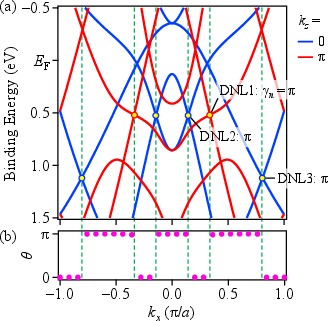
Figure 2: Topological invariants (Berry phase, Zak phase) and DNL locations confirming momentum-space nontriviality.
Surface and Magnetic Robustness of Topological Surface States
The work systematically explores the robustness of TSSs against extrinsic and intrinsic perturbations. Distinct domain imaging and ARPES mapping reveal that TSSs persist with both GaAl and Eu surface terminations, with each hosting different but intrinsically related surface bands (S2 and S3, respectively). The S3 band on the Eu-terminated surface, and its connectivity to bulk features, reaffirm this interpretation (Figure 3).
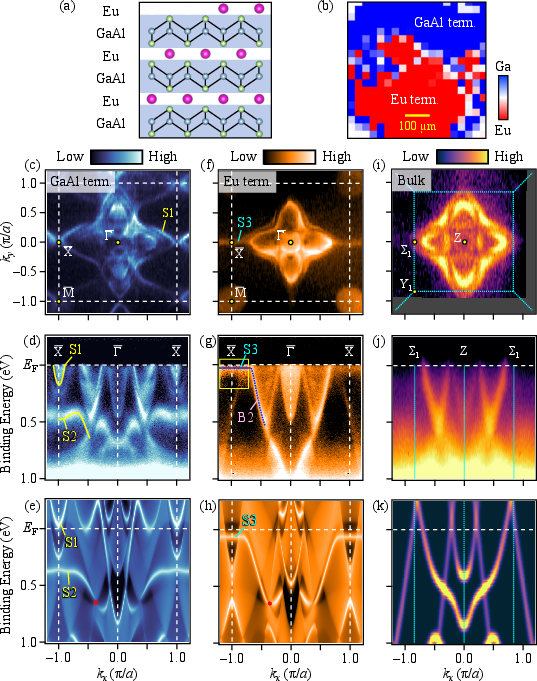
Figure 3: Domain-resolved ARPES demonstrating robust TSSs on both GaAl- and Eu-terminated surfaces.
Bulk-sensitive soft X-ray ARPES data, which suppress surface contributions, confirm the absence of these states in the projected bulk electronic structure, ruling out a trivial origin. Furthermore, the TSSs remain intact even in the presence of pronounced Eu(Ga1−xAlx)45 surface reconstruction and are insensitive to changes in surface chemistry.
Magnetic robustness is established by observing TSSs across the Néel temperature. Below Eu(Ga1−xAlx)46, replica bands emerge through magnetic band folding, directly revealing the coupling of electronic structure to the helical antiferromagnetic order. This coupling is highly surface-sensitive—band folding amplifies on the Eu-terminated surface, indicating that local magnetic moments at the surface interface enhance the effect (Figure 4).
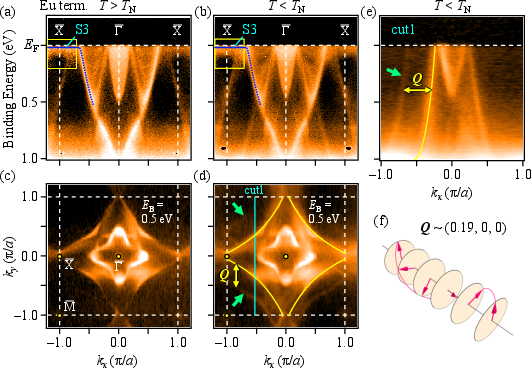
Figure 4: ARPES evidence of persistent TSSs and magnetic band folding across the magnetic phase transition.
Generality Across Eu(Ga1−xAlx)47 Family and Theoretical Implications
ARPES and DFT investigations of the end-member Eu(Ga1−xAlx)48 reaffirm these findings: analogs of S1 and S2 states are observed, exhibiting the same topological connectivity to the underlying DNL and resistance to surface perturbations (Figure 5).
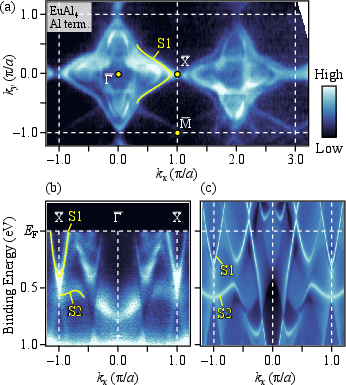
Figure 5: Topological surface states in Eu(Ga1−xAlx)49 confirming the generality of dual topology.
In contrast to other DNL semimetals, including widely studied Eu(Ga,Al)40-type materials and magnetic topological metals such as Eu(Ga,Al)41 and Eu(Ga,Al)42, Eu(Ga,Al)43 uniquely combines bulk skyrmion phases, robust Dirac-derived TSSs, and a natural, tunable coupling between them without resorting to artificial heterostructuring. This intrinsic duality enables direct probing of emergent physical phenomena, including predicted gauge couplings between surface electrons and skyrmions as well as potential for electric-field control of magnetism.
Implications and Future Outlook
The identification of Eu(Ga,Al)44 as a dual-topology platform has substantial implications for both quantum materials science and potential spintronic applications:
- Emergent Couplings: The co-presence of real- and momentum-space topology allows direct realization and study of coupling terms predicted in gauge field theories, e.g., dressing of skyrmions with TSSs.
- Manipulation and Control: The pronounced surface sensitivity and chemical tunability open routes for designer interfaces, facilitating surface engineering of topological coupling strength.
- Robustness for Devices: Unprecedented robustness of TSSs to surface structure and magnetic perturbations boosts prospects for integration into operational devices, especially those relying on dissipationless manipulation.
Future research will likely focus on experimental manipulation of skyrmion-TSS coupling, electric-field control schemes, realization of dissipationless currents, and exploration of related quantum orders accessible through the unique tunability of this material system.
Conclusion
Systematic ARPES, STM, and DFT studies on Eu(Ga,Al)45 establish this material family as a rare case of tunable dual-topology system: both magnetic skyrmions and topologically protected Dirac surface states are robustly present and intrinsically coupled. The persistence of TSSs under surface and magnetic perturbations, the demonstrable topological invariants, and the magnetic band folding effects collectively complete the dual-topology paradigm, providing a new material stage for exploring and exploiting the interplay of real-space and momentum-space topologies in quantum materials.

