- The paper derives closed-form expressions for logarithmic negativity and identifies negativity cores—modewise structures carrying all distillable entanglement between spacelike-separated regions.
- It employs Gaussian state methods and the Kähler structure, analytically characterizing different distance regimes with numerical validations that confirm the theoretical predictions.
- The findings provide a foundation for extending the approach to fermionic fields and higher-dimensional QFT, potentially optimizing strategies for entanglement extraction in quantum information science.
Analytical Characterization of the Negativity Core in 1+1D Massless Scalar QFT
Introduction
This paper provides a rigorous analytical treatment of the mixed-state entanglement between two bounded, spacelike-separated regions in the vacuum of a (1+1)-dimensional free massless real scalar quantum field. Utilizing Gaussian state methods and the Kähler structure of such states, the authors derive closed-form expressions for the logarithmic negativity and identify the precise modewise structure—termed "negativity cores"—responsible for carrying all distillable entanglement between these regions. The results consolidate numerical and replica-method studies of negativity in quantum field theory (QFT), offering an explicit foundation for future theoretical work and practical applications in quantum information science.
Problem Setup and Methodological Framework
The system considered is the vacuum state of a (1+1)-dimensional free massless real scalar field, governed by
H=21∫dx[π(x)2+(∂xϕ(x))2]
with canonical commutation relations [ϕ(x),π(x′)]=iδ(x−x′). The field naturally decomposes into right- and left-moving modes, which are mutually decoupled and contribute equally to the entanglement structure. Observables are restricted to field derivatives to avoid divergences associated with zero modes.
The primary quantity of interest is the logarithmic negativity—a computable upper bound on distillable entanglement in mixed states—between two spatial intervals A=(a1,a2) and B=(b1,b2). The authors employ phase space (Gaussian) techniques, reducing the entanglement calculation to diagonalization of the partially transposed linear complex structure $J^$, closely related to the negativity Hamiltonian.
Main Results
Analytical Derivation of Logarithmic Negativity
The logarithmic negativity is shown to be:
EN=−n∈N∑log2(tanh(πsn))
where each sn is a solution to
P−is−1/2(1−η1+η)=0
with (1+1)0 a conical (Mehler) function and (1+1)1 the cross ratio relating the interval geometry. For equal-length intervals, (1+1)2, with (1+1)3 the separation and (1+1)4 the interval length.
Two asymptotic regimes are analytically characterized:
- Large separation ((1+1)5): Logarithmic negativity decays exponentially, (1+1)6, with (1+1)7 the (1+1)8 zero of (1+1)9.
- Small separation (H=21∫dx[π(x)2+(∂xϕ(x))2]0): Divergence in negativity, H=21∫dx[π(x)2+(∂xϕ(x))2]1, matching universal results from conformal field theory scaling.
Numerical validation confirms the analytical expressions across these regimes.
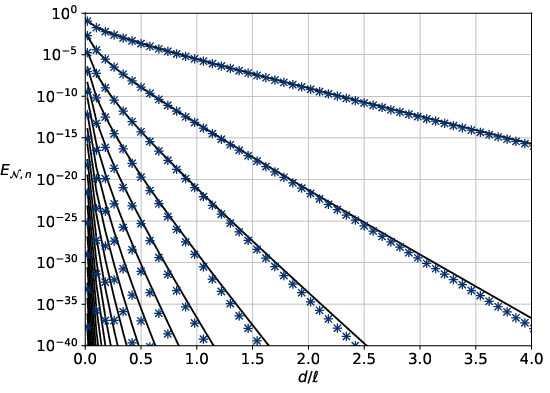
Figure 1: The numerically computed modewise contributions to logarithmic negativity, versus analytical predictions, for varying interval separation.
Modewise Decomposition: The Negativity Cores
The eigenfunctions of H=21∫dx[π(x)2+(∂xϕ(x))2]2 define the optimally entangled pairs—negativity cores—between H=21∫dx[π(x)2+(∂xϕ(x))2]3 and H=21∫dx[π(x)2+(∂xϕ(x))2]4. Each core corresponds to smearing functions H=21∫dx[π(x)2+(∂xϕ(x))2]5 and H=21∫dx[π(x)2+(∂xϕ(x))2]6 given in closed form, parametrized by their respective H=21∫dx[π(x)2+(∂xϕ(x))2]7. The quadratures in each region, constructed from these smearing functions, constitute canonical pairs with maximal negativities.
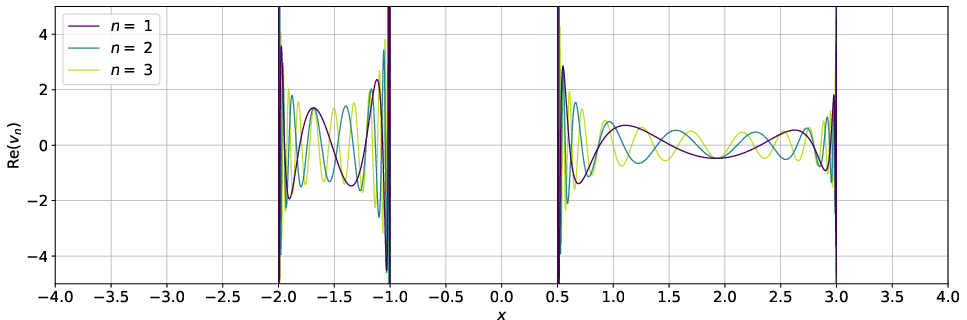
Figure 2: Smearing functions for the negativity cores of the three most entangled modes between H=21∫dx[π(x)2+(∂xϕ(x))2]8 and H=21∫dx[π(x)2+(∂xϕ(x))2]9.
Notably, as the separation increases, [ϕ(x),π(x′)]=iδ(x−x′)0 increases, reducing the negativity but increasing function oscillations. This explicitly demonstrates the UV-IR interplay observed numerically in prior lattice models.
Numerical Validation and Physical Insights
The analytical predictions are corroborated through extensive numerical diagonalization of the discrete Hamiltonian, with careful implementation of field derivatives and removal of zero-mode artifacts. The numerical results showcase the twofold degeneracy and match the analytical values for low [ϕ(x),π(x′)]=iδ(x−x′)1 and modest separations. Deviations at high frequencies—associated with small-mode negativities—are attributed to discretization limitations.
Implications and Extensions
The explicit characterization of negativity cores provides optimal detection/harvesting profiles for entanglement between spacelike-separated regions. The analytical boundary value problem techniques developed here are amenable to extension in several directions:
- Fermionic fields: The Kähler structure framework is available for fermionic QFT and could yield analogous closed-form negativity core decompositions, bridging to recent studies on negativity Hamiltonians.
- Higher dimensions: Boundary value methods for integral kernels are extensible to higher-dimensional settings, offering concrete paths for analyzing mixed-state entanglement in realistic QFT environments.
- Entanglement extraction and operational costs: Having explicit mode profiles allows detailed study of the "halo" correlations, non-normal mode decompositions, and energy expenditure for entanglement harvesting protocols.
The formalism clarifies the maximal form and limitations of spatial entanglement, inviting further analysis of operational resources required for physical extraction or manipulation.
Conclusion
This work rigorously characterizes the mixed-state entanglement structure of the [ϕ(x),π(x′)]=iδ(x−x′)2-dimensional massless scalar field vacuum, deriving closed-form expressions for both total negativity and the underlying negativity core modes. The analytical approach, validated numerically, provides a robust foundation for future investigations into entanglement in QFT, from higher dimensions to fermionic systems and practical entanglement harvesting. The explicit modewise structure enables optimized access to spacelike-separated entanglement, advancing both theoretical understanding and potential quantum information applications.