- The paper introduces a framework where repeated application of M-qudit quantum channels captures information transfer along the causal lightcone.
- It demonstrates that the presence of peripheral eigenvalues is necessary for lossless transmission, even within chaotic and thermalizing dynamics.
- The study shows that dual-unitarity and operator entanglement are key factors in preserving encoded information in both qubit and qutrit systems.
Introduction and Motivation
The propagation and retrieval of locally encoded information in many-body quantum systems constitutes a central challenge in nonequilibrium dynamics, with direct implications for quantum communication and remote sensing. Addressing the issue of faithful information transfer through large quantum chains is notoriously difficult due to exponential Hilbert space growth and rapid complexity of quantum state evolution. This paper provides a rigorous framework for analyzing these phenomena using brickwork quantum circuits, a class of Floquet models amenable to efficient description, even for non-integrable and thermalizing dynamics.
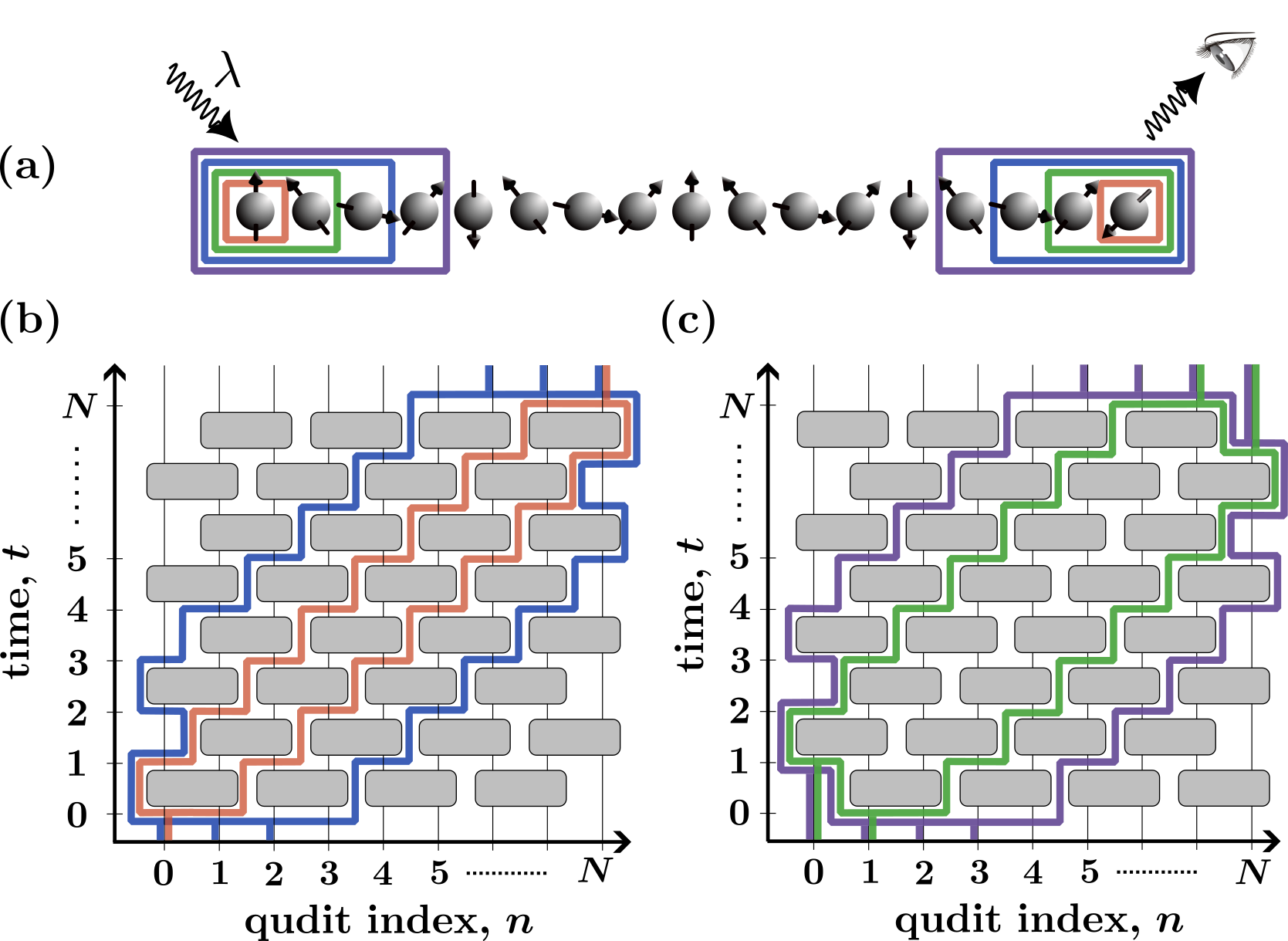
Figure 1: Local information λ is encoded at the chain's edge and measured at the opposite edge after evolution through a brickwork quantum circuit.
Efficient Lightcone Dynamics via Quantum Channels
The paper demonstrates that, for small subsystems (M qudits), reduced dynamics along the chain's lightcone can be captured by repeated application of an M-qudit quantum channel ΦM. This approach circumvents computational intractability by exploiting the causal structure of brickwork circuits: the relevant channel is a d2M×d2M matrix, independent of the global system size N. Analytical tractability is established for M=1, and recursive channel constructions extend this to arbitrary M.
Peripheral eigenvalues of ΦM—those with ∣zμ∣=1—are shown to be necessary and sufficient for lossless information transfer. When all nontrivial eigenvalues decay (M0), information is dissipated, with exponential suppression governed by the principal eigenvalue's modulus.
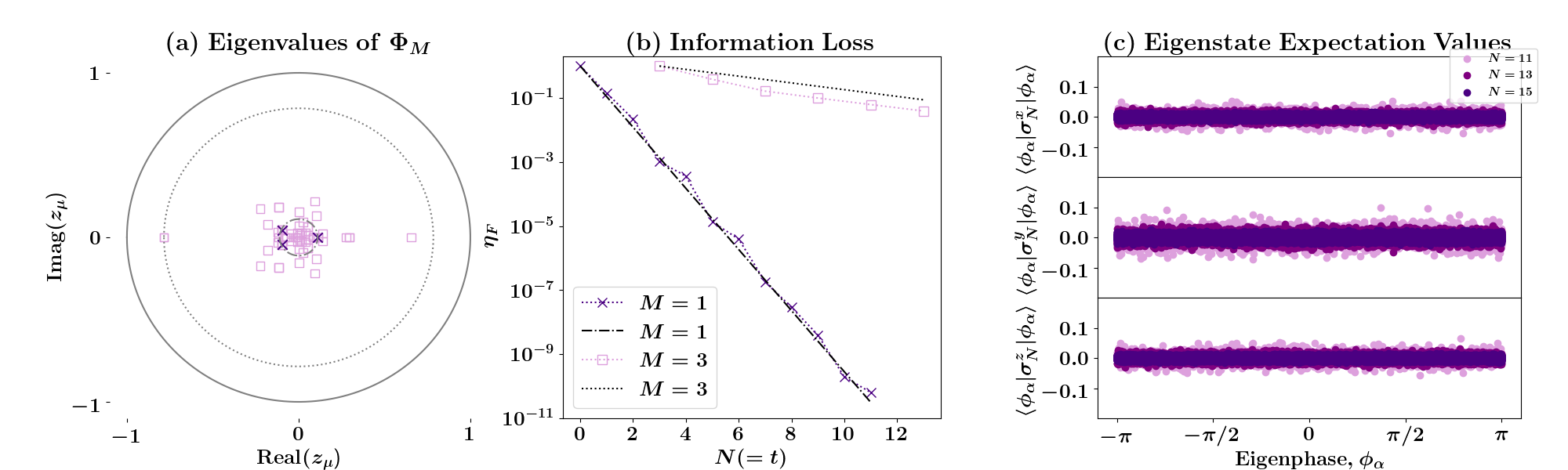
Figure 2: Complex eigenvalue distributions for M1 and M2 reveal the absence of peripheral eigenvalues for typical Haar-random gates.
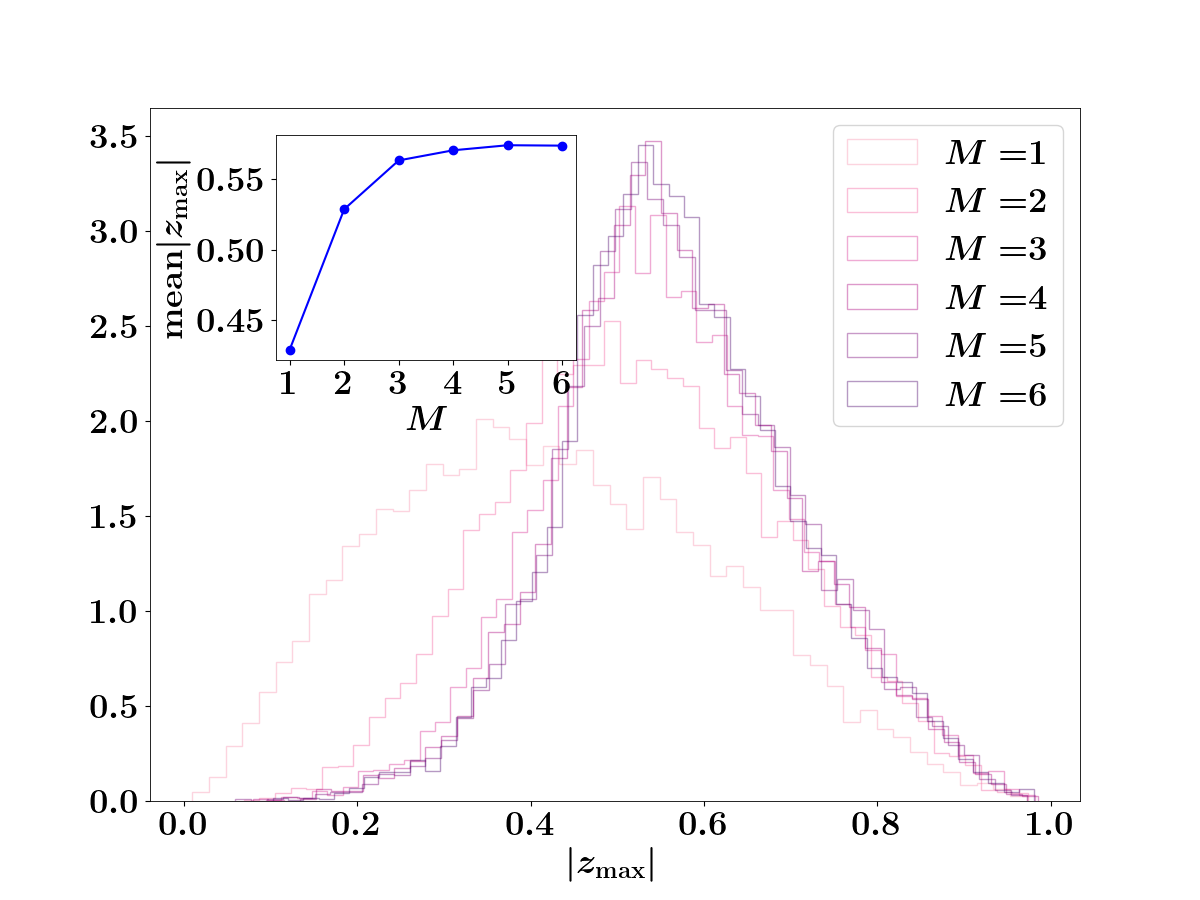
Figure 3: The statistical distribution of M3 for random gates, indicating that peripheral eigenvalues are rare and the mean saturates below unity.
The existence of peripheral eigenvalues in M4 guarantees that certain encoded information survives transmission without loss, manifesting in both the trace distance for discrete encodings and QFI for continuous parameters. Exemplified by the SWAP circuit, which trivially transports information, the framework generalizes to protocols where only peripheral eigenspaces are preserved, and all others fade.
For generic circuits (e.g., Haar-random gates), peripheral eigenvalues are statistically absent; the evolution is quantum chaotic and thermalizing, as confirmed by global level-spacing statistics consistent with CUE predictions.
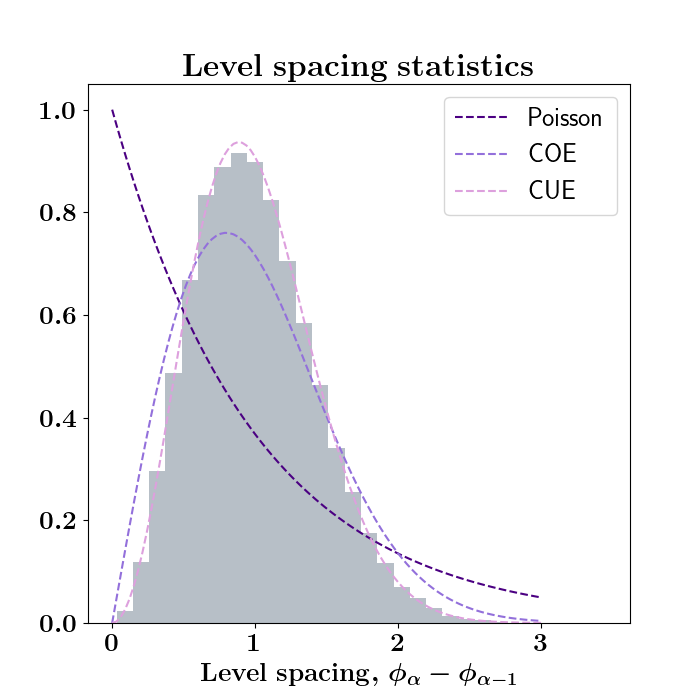
Figure 4: Floquet eigenphase spacing statistics for a brickwork circuit built from random gates, confirming typical quantum chaos.
Necessary and Sufficient Conditions: Dual-Unitarity and Operator Entanglement
For qubits (M5, M6), peripheral eigenvalues of M7 are only found if the two-qubit gate M8 is dual-unitary. Dual-unitarity ensures unitarity in both time and space directions; mathematically, it requires at least two nonlocal parameters in the gate decomposition to attain M9.
For M0 in qubit chains, numerical optimization uncovers non-dual-unitary gates with peripheral eigenvalues in M1, provided at least one parameter takes the critical value. A minimum, but not maximal, operator linear entropy of M2 is observed, establishing a nontrivial entanglement threshold.
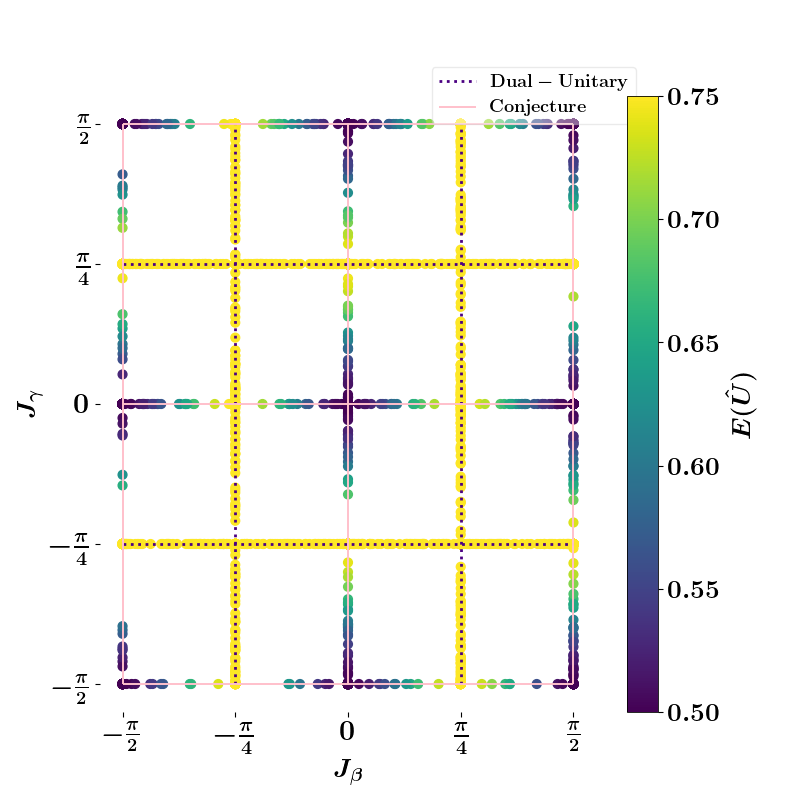
Figure 5: Optimization landscape of peripheral eigenvalues for M3 reveals both dual-unitary and non-dual-unitary solutions, correlated with operator entanglement.
For qutrits (M4, M5), similar numerical evidence supports the appearance of peripheral eigenvalues for non-dual-unitary gates, given sufficient operator entanglement.
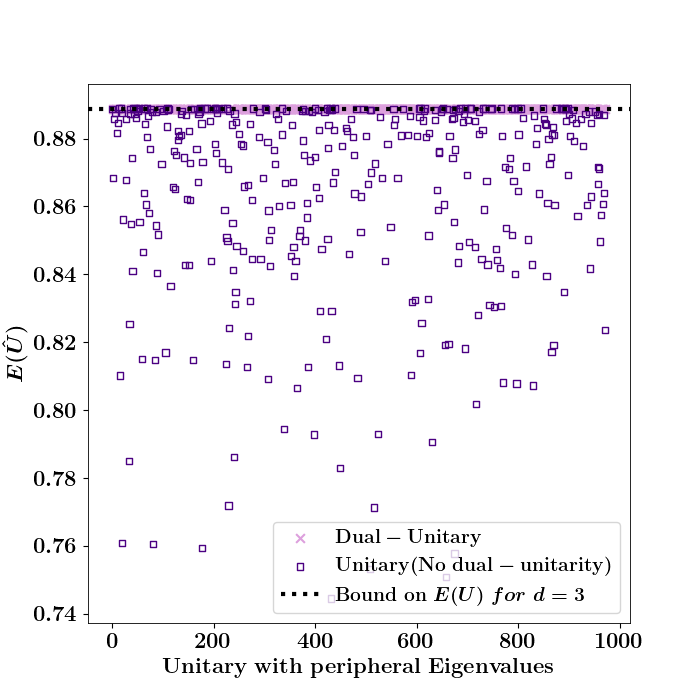
Figure 6: Operator linear entropy for optimized two-qutrit gates—peripheral eigenvalues do not necessarily imply dual-unitarity, but require significant entanglement.
The paper constructs explicit examples where lossless information transfer occurs in circuits that are globally quantum chaotic and local-thermalizing (obeying ETH). Such circuits exhibit a single peripheral eigenvalue in M6, allowing perfect transfer of information encoded in the corresponding mode, despite thermalization at long times.
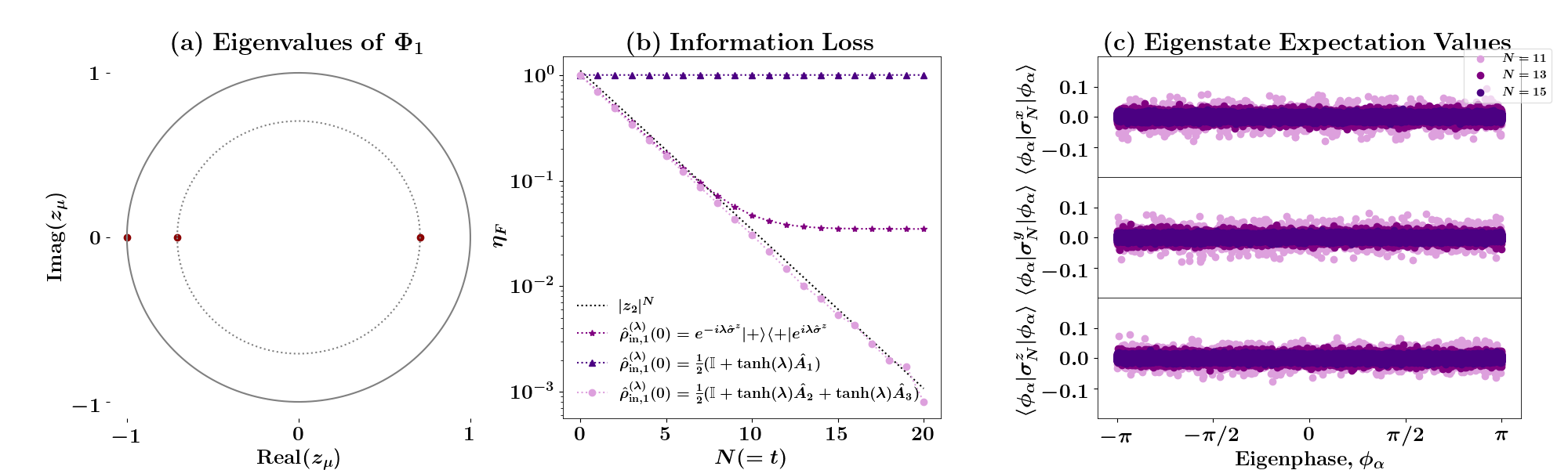
Figure 7: Spectrum of peripheral and nonperipheral eigenvalues for M7 in a dual-unitary circuit, showing the unique peripheral mode.
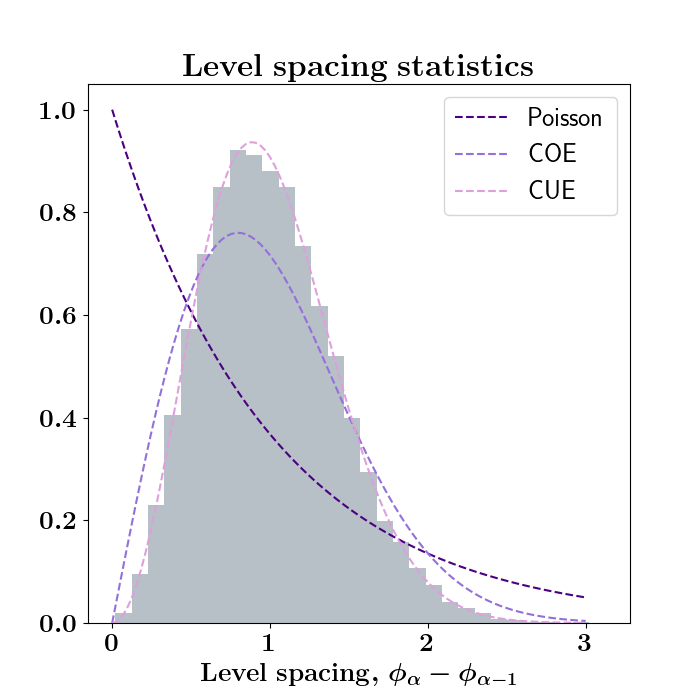
Figure 8: Global level spacing statistics for the same model, confirming quantum chaos.
QFI transfer simulations corroborate these predictions: only information encoded in the peripheral eigenspace is preserved, while other components decay exponentially.
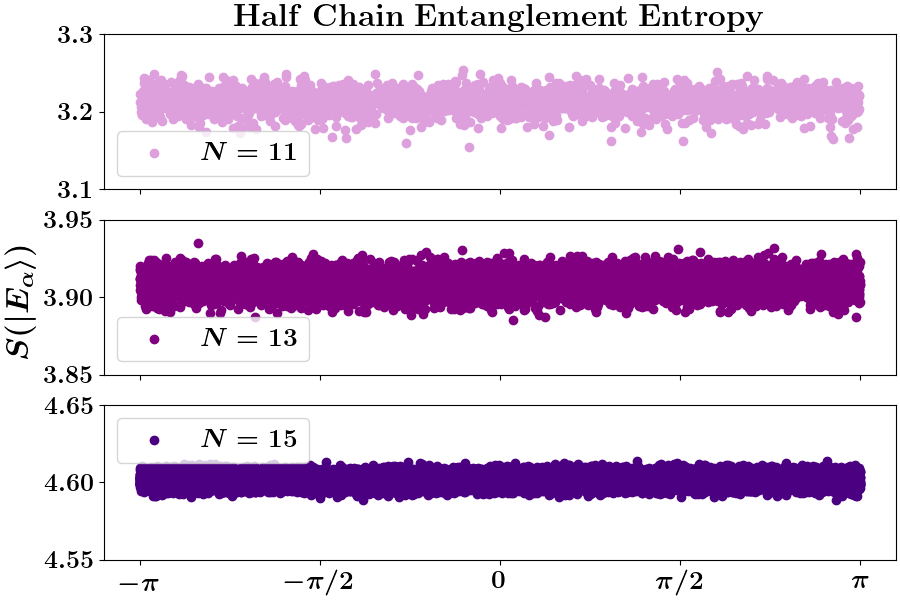
Figure 9: Half-chain entanglement entropy for Floquet eigenstates—no evidence for quantum scarring; all eigenstates appear thermalized.
The crucial insight is that order of limits matters: in the thermodynamic limit, information can propagate along the lightcone before boundary reflections or full thermalization occur, enabling perfect remote sensing at finite times.
Implications and Future Directions
The spectral properties of M8 decisively predict information transfer quality in quantum circuits. The peripheral eigenvalue criterion provides both diagnostic and constructive power for designing quantum communication protocols, state transfer, and remote sensing systems. Notably, dual-unitarity emerges as a sufficient—but not always necessary—condition in certain regimes, and operator entanglement plays a central role in more general scenarios.
From a practical standpoint, these results suggest that brickwork circuits—even those exhibiting quantum chaos and thermalization—can support lossless information transmission. The theory motivates further exploration of robustness to imperfections, noise, and finite-size effects in realistic platforms, and advances the analytical classification of quantum channel spectra for higher M9.
Conclusion
This work establishes a rigorous connection between the spectral features of local quantum channels in brickwork circuits and the global behavior of information transfer. It shows that, although quantum chaos and thermalization generally degrade information, precisely engineered circuits with peripheral channel eigenvalues can circumvent such effects, achieving perfect transfer in select modes. The results inform both theoretical understanding and applied design of quantum information protocols and quantum engineering, offering a pathway to robust state transfer and remote sensing even in strongly interacting, nonintegrable systems.
Cited paper: "Information transfer along the causal lightcone of a brickwork quantum circuit" (2605.23622)