- The paper demonstrates that second-order Carleman linearization recovers steady states of forced nonlinear systems, validated on both the forced logistic equation and Navier–Stokes flows.
- It employs a temporal coarse-graining approach that filters out transient oscillations while achieving relative L2 errors on the order of 10⁻⁴ in steady state recovery.
- The approach provides a potential pathway toward integrating quantum simulation with classical CFD techniques for robust fluid dynamics computations.
Second-Order Carleman Linearization for Steady State Fluid Flow: Analytical and Numerical Evidence
Introduction
The simulation of nonlinear fluid dynamics on quantum computers is fundamentally challenged by the incompatibility between the nonlinear structure of the governing equations and the linearity intrinsic to quantum mechanics. Carleman linearization—specifically its lowest-order truncation (C2)—has emerged as a candidate for bridging this gap, enabling a systematic embedding of nonlinear dynamics into a linear framework amenable to quantum algorithms. This paper rigorously demonstrates that the second-order Carleman linearization not only captures the transient and early-time dynamics but also recovers the correct asymptotic steady state for forced nonlinear systems. The analysis spans both a canonical model (the forced logistic equation) and two-dimensional fluid flows governed by the Navier-Stokes equations at moderate Reynolds numbers.
Analytical Results: Forced Logistic Equation
The initial investigation centers on the forced logistic equation, a prototypical nonlinear dynamical system with external forcing:
x˙=−ax+bx2+f
This equation admits two fixed points—one stable and one unstable—whose analytic expressions are functions of the nonlinearity and forcing. The paper demonstrates that the C2-Carleman system, by embedding the nonlinear equation into an expanded linear system truncated at second order, yields steady-state solutions congruent with the nonlinear attractor up to O(g4) corrections, where g2=bf/a2 parametrizes the effective strength of nonlinear effects.
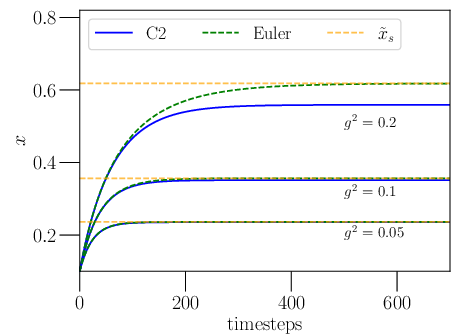
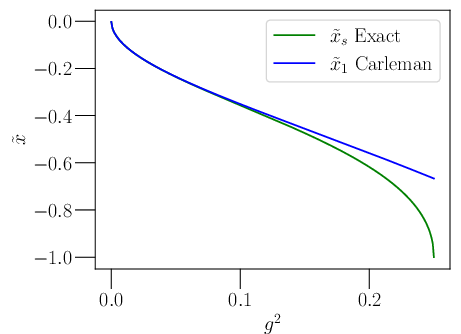
Figure 1: Comparison between the solutions of the forced logistic equation and its C2-Carleman linearization in various dynamical regimes, showing convergence of stationary states with decreasing g2.
These findings substantiate the claim that C2 can reproduce the steady-state solution of sufficiently weakly nonlinear and forced systems, provided the nonlinearity parameter remains below a critical threshold g2<1/4. Importantly, the Carleman variables are shown to perform a temporal coarse-graining, effectively acting as time-filtered averages that suppress short-timescale fluctuations.
Transitioning to physical fluids, the paper adopts the Navier-Stokes-Hamilton-Jacobi (NSHJ) formalism for two-dimensional incompressible flows, which, via the inverse Madelung transformation, facilitates Carleman embedding. The initial field variables—density, scalar potential, and vorticity vector—are lifted to a second-order tensor product structure. The resulting linearized update equations for the Carleman variables retain the original nonlinear physics but within a computationally scalable and linear framework.
This approach targets steady-state solutions for moderate Reynolds numbers, leveraging the C2 truncation to approximate the large-scale dynamics and stationary states of Kolmogorov-type flows subject to periodic forcing.
Numerical Results: Recovery of Stationary States in 2D Fluid Flow
The paper presents extensive simulations encompassing several Reynolds number regimes and initial conditions typical of both laminar and quasi-turbulent flows. For moderate Re, the C2 approximation accurately recovers the stationary velocity field with relative L2 errors O(10−4) compared to full Navier-Stokes integration. The spatial and temporal probes confirm that the C2 scheme acts as a coarse-graining filter, capturing the slow manifold and steady states while suppressing oscillatory dynamics and failing to resolve sharp transients.
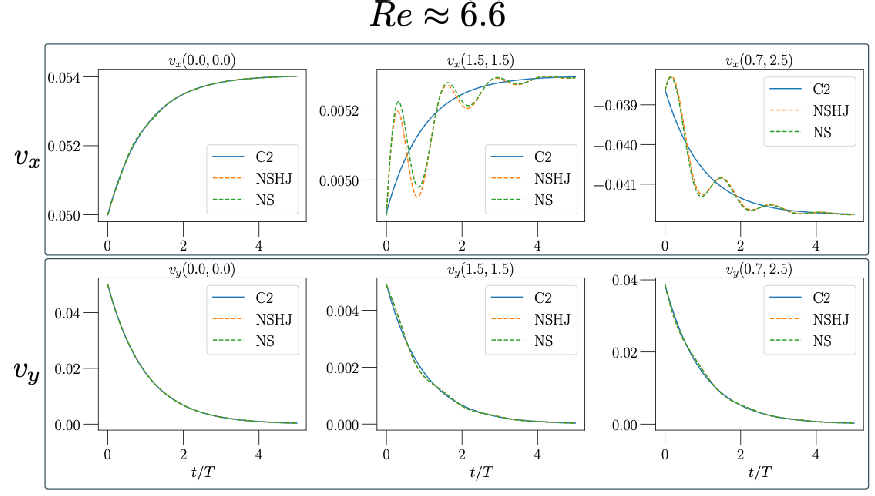
Figure 2: Evolution of the velocity field at three spatial locations for Re≈6.6; C2 tracks stationary values and smooths oscillatory signatures.
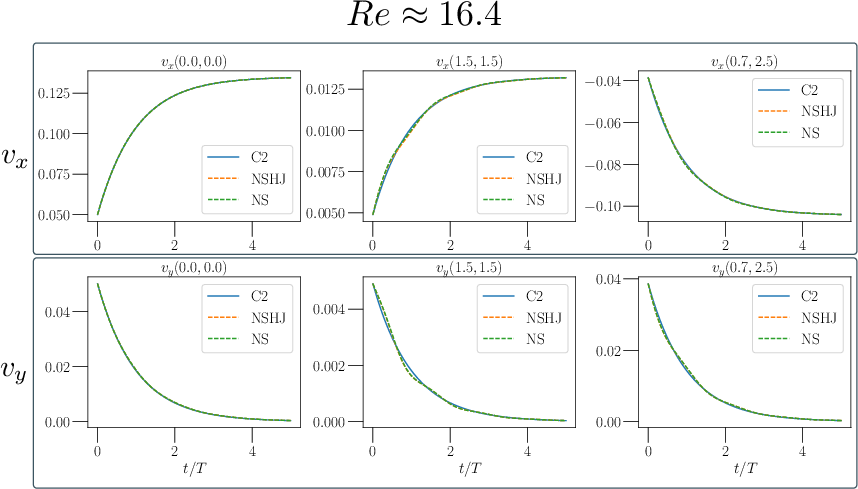
Figure 3: Velocity field evolution at higher Re≈16.4; C2 remains accurate for steady state recovery.
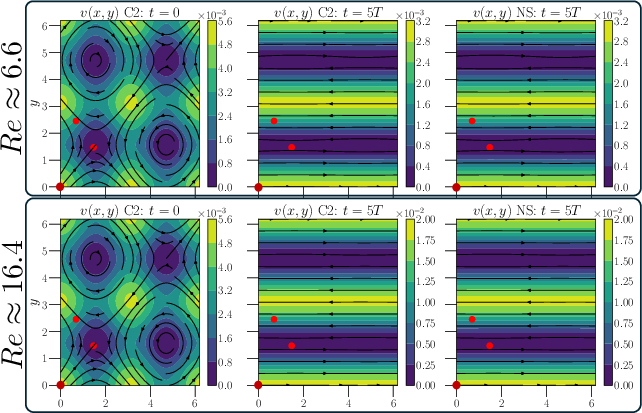
Figure 4: Amplitude and streamlines at O(g4)0 and O(g4)1 for C2 and Navier-Stokes; stationary states are nearly indistinguishable up to maximum errors O(g4)2.
At elevated O(g4)3, including a doubly-mode driven scenario, C2 again converges to the correct forced steady state, but deviations in the transient regime are prominent and sudden features are not captured.
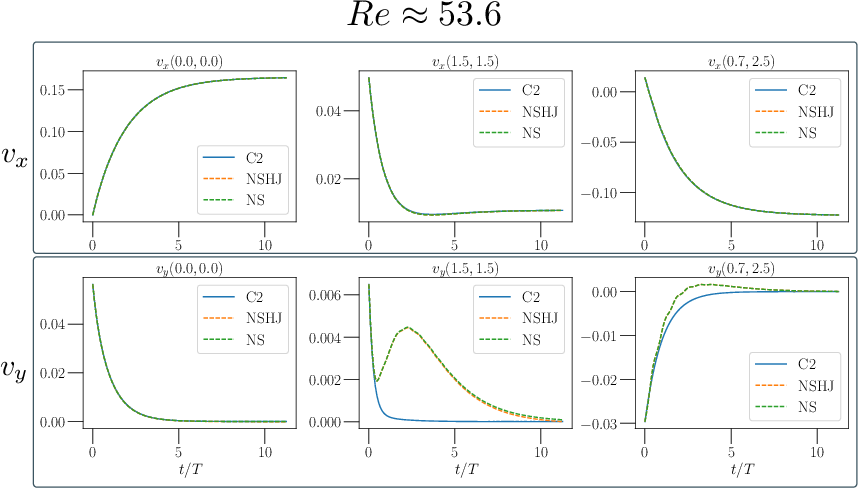
Figure 5: Velocity evolution for a turbulent initial condition, showing C2’s inability to resolve abrupt transients though steady states are correctly recovered.
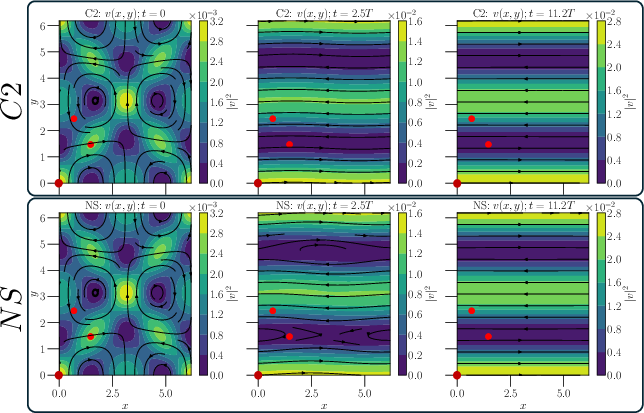
Figure 6: Streamlines and amplitude for turbulent initial conditions during transient and at steady state; C2 matches Navier-Stokes after decay of initial turbulence.
These results collectively affirm that at moderate Reynolds numbers, the second-order Carleman approach delivers robust steady-state accuracy while inherently filtering temporal fluctuations—an effect tied to the mathematical structure of the Carleman embedding as a multiscale expansion.
Implications for Quantum-Centric Simulations and Turbulence Modeling
The demonstrated ability of low-order Carleman linearization to recover steady states in nonlinear fluid dynamics is significant for quantum simulation. The time-filtering property of C2 provides a pathway towards quantum-centric schemes where slow, large-eddy structures are computed quantumly, and unresolved fast dynamics, including turbulence and small-scale dissipation, are handled classically—an architecture reminiscent of Large-Eddy-Simulation (LES) in traditional CFD. However, this approach is speculative and demands rigorous validation at high Reynolds numbers and in fully turbulent regimes.
Theoretically, the results place Carleman linearization as a temporal coarse-graining mechanism, potentially bridging quantum algorithms with practical stationary fluid dynamics computations (e.g., aerodynamic design). The limitations in transient regimes also delimit its applicability, encouraging further research into higher-order expansions or adaptive strategies.
Conclusion
This paper establishes that second-order Carleman linearization reliably recovers stationary states of externally forced nonlinear systems, including Navier-Stokes flows with moderate Reynolds numbers. The inherent temporal coarse-graining enables effective suppression of oscillatory or abrupt transient features, facilitating accurate steady-state computations even as the original nonlinear equations become computationally challenging. These findings suggest practical and theoretical avenues for quantum-enabled computation of fluid dynamics, especially for stationary problems. Further investigations are warranted to systematically quantify coarse-graining effects, extend the framework to higher Reynolds numbers, and explore quantum-classical hybrid architectures for multiscale fluid simulations (2605.23380).

