- The paper proposes pivot-shifted Carleman linearization (PSC) to eliminate strict stability and initial-value conditions for quantum simulation of nonlinear ODEs.
- The methodology employs a pivot shift and a Lyapunov transform to convert non-dissipative systems into forms with negative spectral abscissa, ensuring exponential error decay.
- Key results include rigorous quantum query complexity bounds and successful applications to models like the logistic equation and Lotka-Volterra system.
Quantum Algorithms for Nonlinear Differential Equations via Pivot-Shifted Carleman Linearization
Introduction
This work proposes a new paradigm for quantum simulation of nonlinear ODEs: pivot-shifted Carleman linearization (PSC). Traditional quantum algorithms for nonlinear systems, especially quadratic ODEs, embed the nonlinear dynamics in a truncated, infinite-dimensional linear system using Carleman linearization. However, classical Carleman techniques impose stringent dissipativity and initial-value restrictions, frequently precluding efficient simulation for stable but non-dissipative or unstable dynamics. The central innovation of this work is to shift the dynamical variables by a pivot s prior to Carleman lifting and to apply a carefully chosen Lyapunov transform. This maneuver relaxes stability requirements and, in many relevant cases, eliminates prohibitive restrictions on initial conditions. Extensive complexity analysis and rigorous convergence guarantees substantiate the quantum query efficiency advantages and practical impact of the PSC method.
The classical Carleman embedding transforms a quadratic nonlinear ODE of the form ∂tx=F2x⊗2+F1x+F0 into an infinite linear system (after truncation, of size O(nN) for truncation order N). Classical analyses [liu_efficient_2021, jennings_quantum_2025, kroviImprovedQuantumAlgorithms2023] require the linear part F1 to be dissipative (α(F1)<0) and a Reynolds-type number R<1 (where R∝∥x(0)∥−1), so the method is only efficacious if the initial condition is neither too “small” nor too “large.” This excludes stable nonlinear yet non-dissipative systems and almost all unstable systems, even over short times.
To relax these requirements, the present work considers a shifted variable u=x−s for any pivot s, resulting in new shifted coefficients
∂tx=F2x⊗2+F1x+F00
A subsequent Lyapunov transform (weighted by ∂tx=F2x⊗2+F1x+F01) yields ∂tx=F2x⊗2+F1x+F02, and Carleman linearization is applied to the ∂tx=F2x⊗2+F1x+F03-dynamics. The main result is the identification of regimes (for suitable pivots and Lyapunov functions) where (1) the spectral abscissa of ∂tx=F2x⊗2+F1x+F04 is negative, even if ∂tx=F2x⊗2+F1x+F05, and (2) the nonlinear Reynolds-type bound is independent of ∂tx=F2x⊗2+F1x+F06, dramatically enlarging the class of efficiently simulable nonlinear systems.
Complexity and Convergence Analysis
Rigorous theorems establish quantum query complexity and exponential convergence with truncation order for systems that satisfy the shifted dissipativity and weighted-nonlinearity condition. The truncation order ∂tx=F2x⊗2+F1x+F07 required to reach ∂tx=F2x⊗2+F1x+F08-accuracy after time ∂tx=F2x⊗2+F1x+F09 scales only logarithmically in O(nN)0, i.e., O(nN)1 for O(nN)2. The overall quantum query complexity for preparing the normalized solution state O(nN)3 is
O(nN)4
where O(nN)5 is negative and depends only on the weighted log-norm of O(nN)6 and O(nN)7. Notably, no lower bound on initial norm (i.e., O(nN)8) enters the convergence condition—this is a structural improvement over previous methods [jennings_quantum_2025].
In cases where the system remains unstable after shifting, the PSC formalism still guarantees short-time convergence, with a rigorous bound on the admissible time interval O(nN)9 derived from the shifted coefficients. The critical insight is that by choosing N0, the initial shifted variable vanishes, so Carleman error grows sub-exponentially at first, enabling accurate quantum simulation for short intervals even for (moderately) unstable systems.
Numerical Experiments
Logistic Equation
Numerical integrations of the 1D logistic equation, a prototypical nonlinear system unstable in the sense required by classical Carleman convergence, reveal a dramatic advantage of the PSC method over standard Carleman linearization. For pivots N1 close to the stable equilibrium N2, the PSC error converges exponentially in truncation order, whereas standard Carleman either diverges or stagnates.
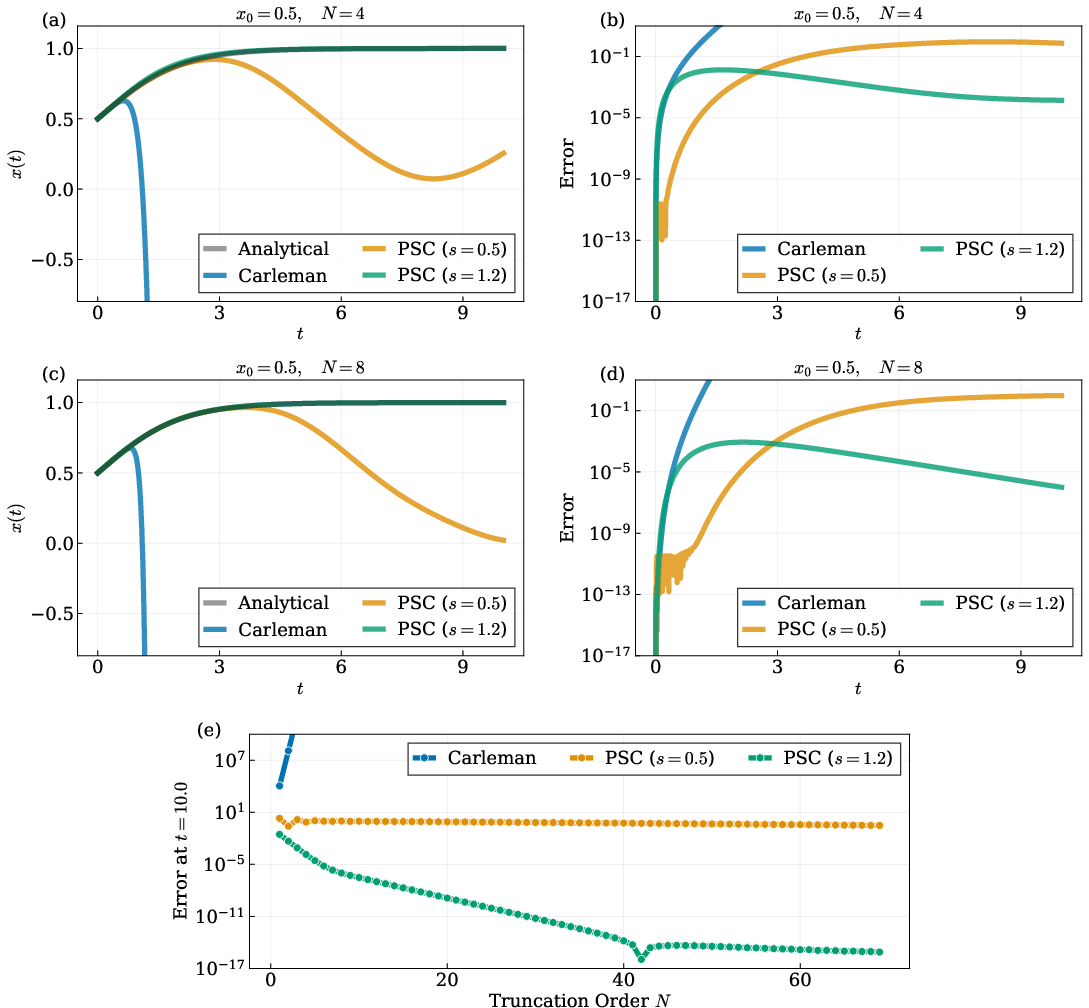
Figure 1: The PSC method with an appropriate pivot exhibits exponential error decay for the logistic equation, while standard Carleman diverges or fails to converge as truncation order increases.
Lotka-Volterra Model
In the 2D Lotka-Volterra population model, classical Carleman once again suffers divergence whenever the original system fails the dissipativity hypothesis. The PSC method, with carefully chosen pivots (either at the stable equilibrium or near initial data), exhibits substantial improvements in both the phase-plane accuracy and N3 error.
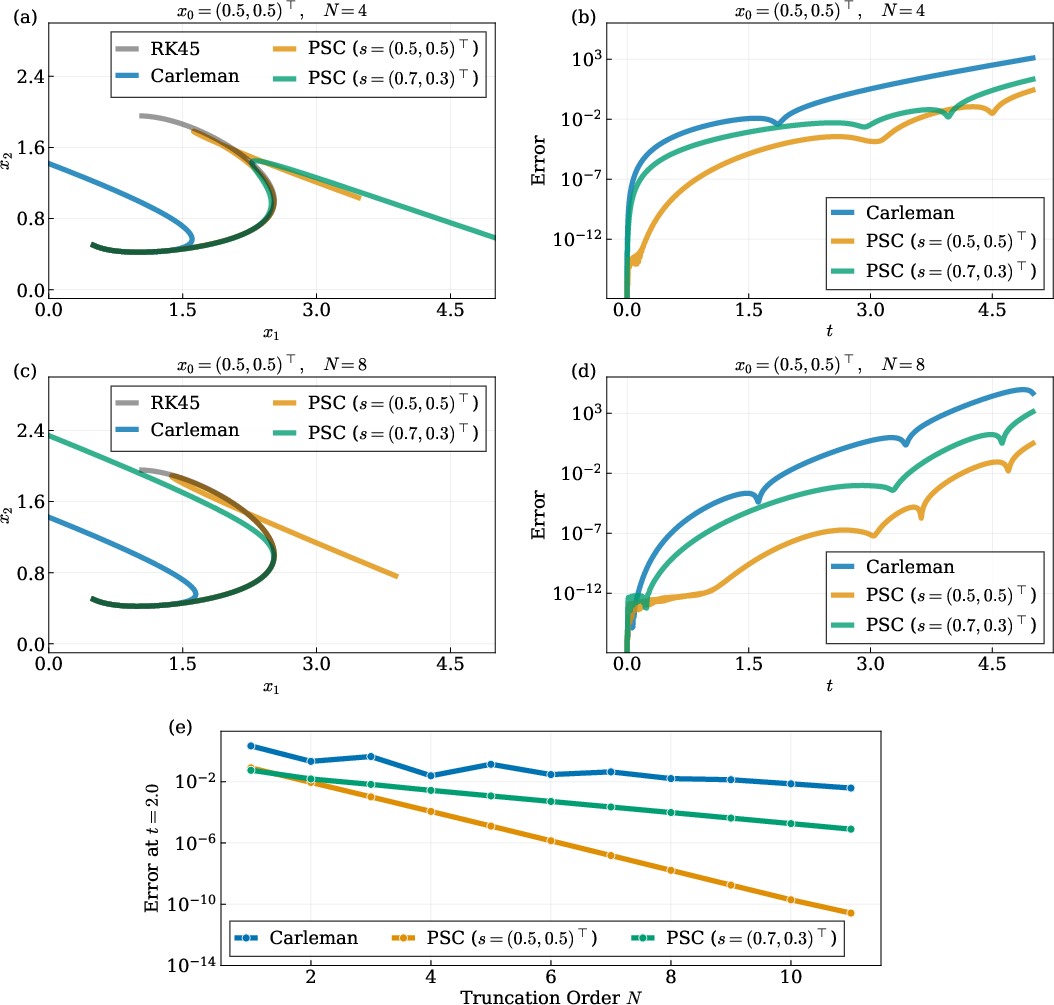
Figure 2: For the Lotka-Volterra system, the PSC method displays stability and rapid error decay with truncation order for suitable pivots, while standard Carleman diverges rapidly.
Analysis and Implications
Theoretical implications are twofold:
- Practical quantum advantage: By eliminating unnecessary initial value constraints, PSC unlocks a much broader class of nonlinear systems—e.g., many from scientific modeling (chemistry, biomedicine, control)—for quantum simulation with provable (sublinear in N4) query complexity. The method is broadly compatible with state-of-the-art quantum linear equation solvers, and block encoding of shifted operators is efficient.
- Generalization of dissipativity: The Lyapunov-weighted stability analysis shifts the focus from global dissipativity (which is physically rare in many-regime nonlinear systems) to local dissipativity in appropriately shifted/weighted coordinates. This mathematical generalization is key for practical quantum ODE integration, especially as experimentally accessible quantum devices continue to scale.
For unstable or even chaotic systems, PSC enables piecewise-in-time global simulation if pivots are switched judiciously, building on single-pivot accuracy over short time windows. However, efficient quantum implementation of dynamic pivot switching remains open.
Relation to Prior Work
Earlier quantum ODE algorithms [liu_efficient_2021, kroviImprovedQuantumAlgorithms2023] are a special case of the PSC with N5, and require stringent dissipativity and initial-norm assumptions. The recent work [jennings_quantum_2025] uses a Lyapunov transform but still enforces constraints involving the initial value in the denominator. PSC absorbs and strictly generalizes these regimes. Other quantum approaches based on Koopman-von Neumann linearization or variational quantum circuits lack rigorous error bounds for general nonlinearities, especially in the regime where global stability fails.
Some numerically-motivated “piecewise Carleman” schemes [novikau2025globalizing, endo2024divergence] perform dynamic pivot switching, but generally incur high block encoding cost due to loss of structure and require repeated state estimation and transformation. By focusing on a single high-quality pivot, PSC maintains block tridiagonality and block-encoding sparsity, essential for quantum tractability.
Future Directions
Key open problems include systematic selection of optimal pivots (possibly using local Lyapunov or spectral information), extension of PSC to higher-degree and mixed polynomial nonlinearities, and development of low-overhead, piecewise-adaptive quantum Carleman schemes for long-time and chaotic systems. Integration of PSC with quantum error correction and variational block encoding architectures is a natural next step for experimental realization.
Conclusion
This work provides a rigorous theoretical, algorithmic, and numerical foundation for pivot-shifted Carleman linearization as a quantum resource for nonlinear ODE integration. The elimination of restrictive dissipativity and initial-norm conditions fundamentally extends the class of nonlinear systems that can be efficiently simulated with quantum algorithms. The results demonstrate that careful pivot selection, combined with Lyapunov weighting, is a principled and practical route for efficient and numerically stable quantum embeddings of nonlinear dynamics (2605.20071).

