- The paper introduces a SAFE pipeline that uses LWPP surrogate pre-training, parameter distillation, and fine-tuning to tackle ma-QAOA’s high-dimensional optimization challenges.
- It demonstrates a 64.3% reduction in active parameter count and a 94.5% decrease in quantum fine-tuning workload while maintaining robust approximation ratios.
- The framework smooths the energy landscape and accelerates convergence through surrogate-assisted initialization and structure-preserving parameter pruning.
Surrogate-Assisted and Fine-Tuning Enhanced Multi-Angle QAOA with Parameter Distillation
Multi-Angle QAOA and Optimization Bottlenecks
The Quantum Approximate Optimization Algorithm (QAOA) is a widely adopted variational approach for solving combinatorial optimization problems on NISQ-class quantum devices. Traditional QAOA employs a shared parameterization at every layer, with a single pair of angles (γℓ,βℓ) controlling the evolution under cost and mixing Hamiltonians per layer. While this shared-angle structure allows for compact circuit representations and some resilience to hardware noise, it constrains ansatz expressivity, often requiring increased circuit depth to solve hard instances.
Multi-angle QAOA (ma-QAOA) relaxes this constraint by assigning independent variational angles to each term in the cost and mixer layers, effectively creating a term-wise parameterization. This increase in expressivity enables improved approximation at low circuit depths—a crucial property for NISQ hardware. However, the dimensionality of the parameter space grows rapidly, particularly for dense combinatorial structures (e.g., SK models), introducing steep optimization bottlenecks related both to the number of trainable parameters and the number of circuit/gradient evaluations during training.
Low-Weight Pauli Propagation (LWPP) as a Surrogate
Pauli propagation constitutes an alternative technique for evaluating expectation values, operating directly in the Heisenberg picture by propagating observable operators backward through the circuit rather than forward-evolving quantum states. For each parameterized Pauli rotation gate, LWPP discards Pauli strings with weight above a threshold wmax. This truncation maintains polynomial scaling in n for fixed wmax, contrasting with exponential scaling for state-vector simulation. LWPP thus enables efficient classical surrogate modeling during the early stages of ma-QAOA optimization.
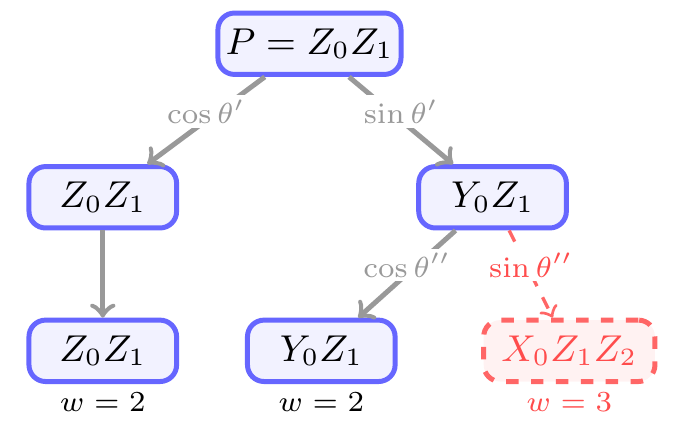
Figure 1: Pauli propagation example for the tracked Pauli word P=Z0Z1 under successive updates, illustrating LWPP’s weight-based truncation.
SAFE Pipeline: Surrogate Pre-Training, Parameter Distillation, and Exact Fine-Tuning
The paper introduces the SAFE framework: a three-stage pipeline leveraging LWPP for surrogate pre-training, parameter distillation to prune the parameter space, and exact fine-tuning using quantum or classical emulators. The LWPP-based surrogate pre-training (500 steps) drives parameters toward promising regimes at reduced computational cost. Distillation then removes angles with magnitudes below a threshold (typically <0.01 or $0.3$), drastically reducing the active parameter count. The final stage executes 100 steps of exact fine-tuning on the reduced parameter set, on classical simulation or quantum hardware.
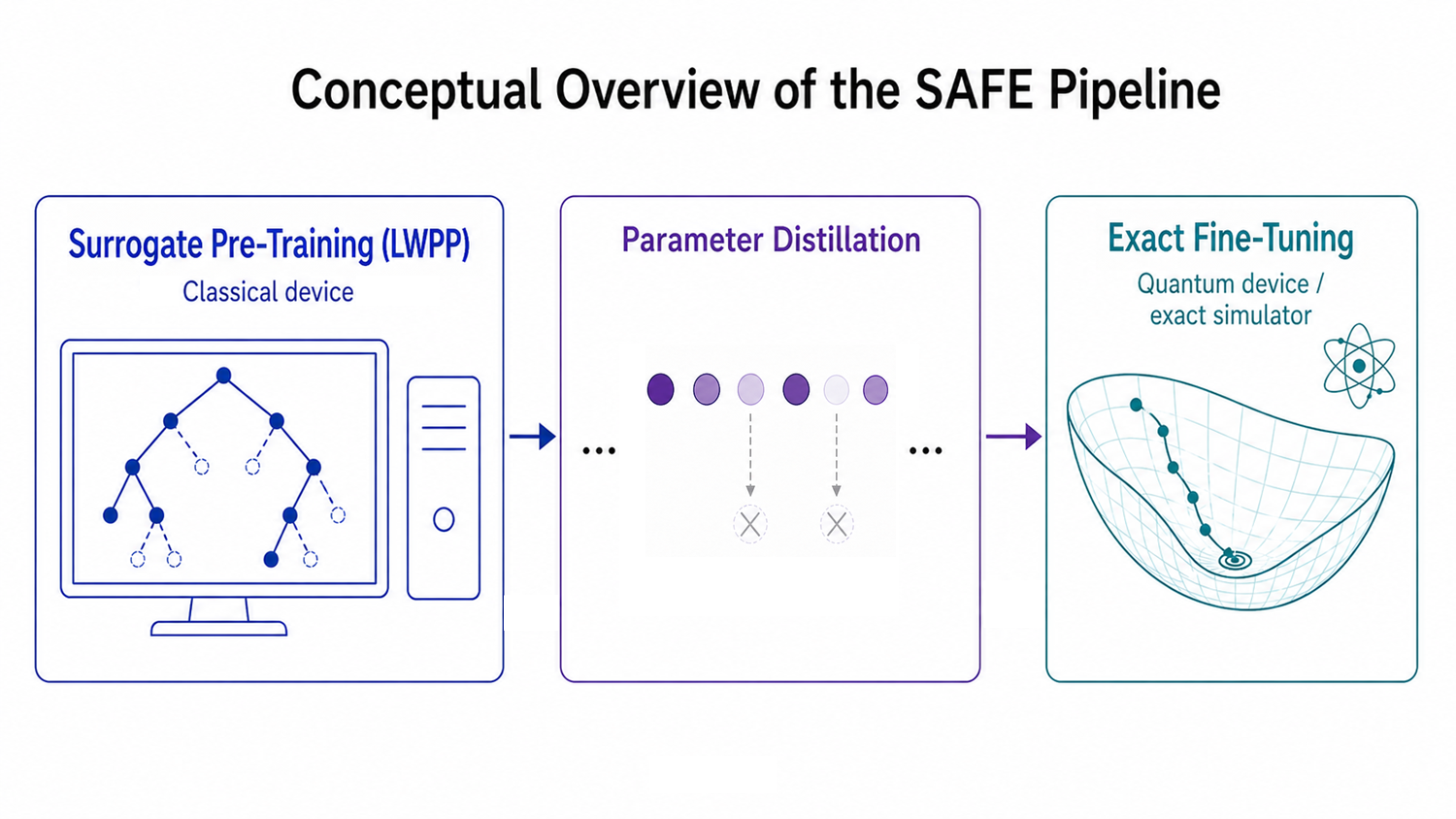
Figure 2: Conceptual overview of the SAFE pipeline, integrating LWPP surrogate pre-training, structure-preserving distillation, and exact hardware fine-tuning.
Empirical Evaluation: Instance Families and Training Protocol
SAFE is evaluated on three classes: fully connected SK spin glass, 2D lattice spin glass, and random Max-Cut instances. Sizes range from 12 to 20 qubits, spanning connectivity and sparsity regimes. Each instance is initialized with eleven strategies: five random seeds, five constant angle magnitudes, and one QAOA Relax (quantum annealing schedule) seed, allowing assessment of robustness to initial conditions.
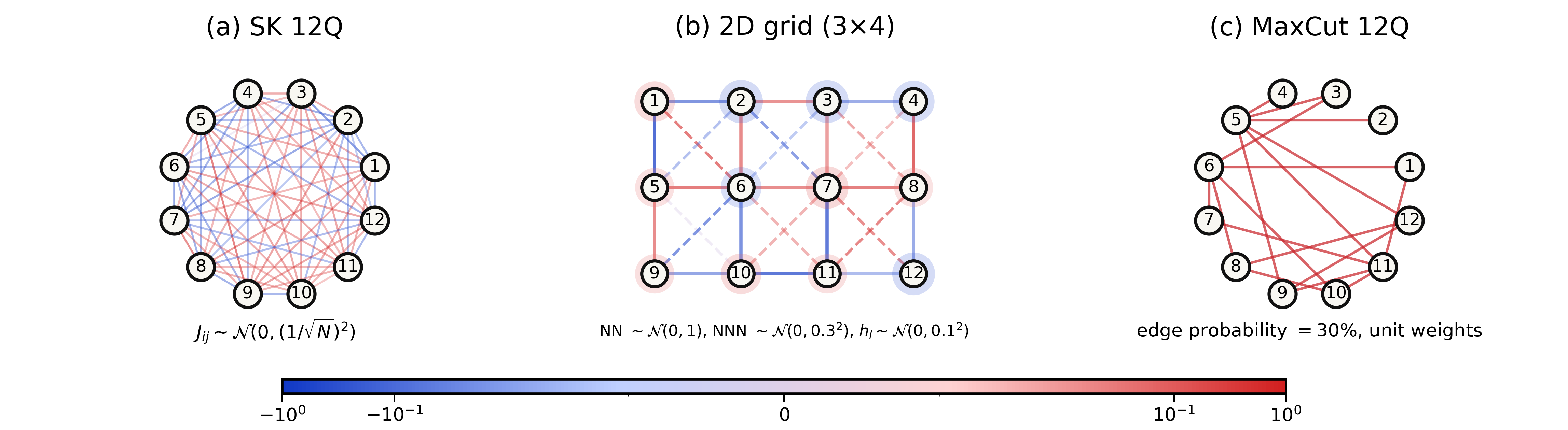
Figure 3: Schematic depiction of SK, 2D lattice, and Max-Cut problem families used in the experiments.
SAFE with parameter distillation yields a 64.3% average reduction in active parameter count and 94.5% reduction in a hardware-oriented fine-tuning workload estimate relative to exact-only ma-QAOA. Crucially, the approximation ratio after exact fine-tuning remains robust to aggressive distillation: even after removing up to 80% of parameters under the $0.3$ threshold, the best-case approximation ratios are comparable to exact-only and SAFE with no distillation (Figure 4).
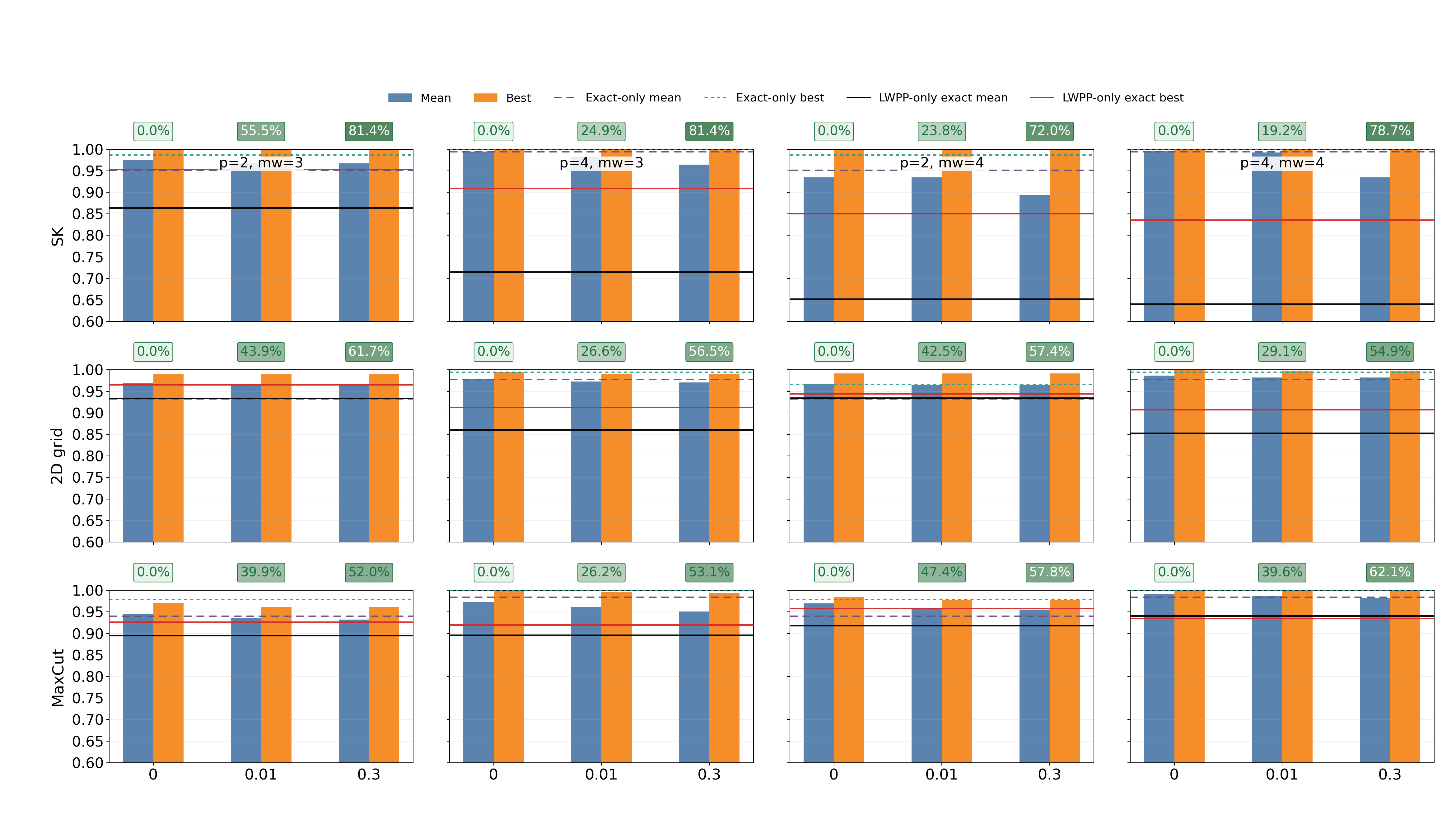
Figure 4: Aggregate final approximation ratio performance versus distillation threshold for SK, 2D grid, and Max-Cut—parameter reduction does not substantially degrade optimality.
Convergence speed is also enhanced: the number of optimizer steps required to achieve near-optimal performance decreases by 44.4% with distillation. Notably, surrogate-initialized fine-tuning trajectories reach low-energy plateaus much faster than exact-only, even when the LWPP surrogate does not attain high absolute solution quality by itself (Figure 5, Figure 6).
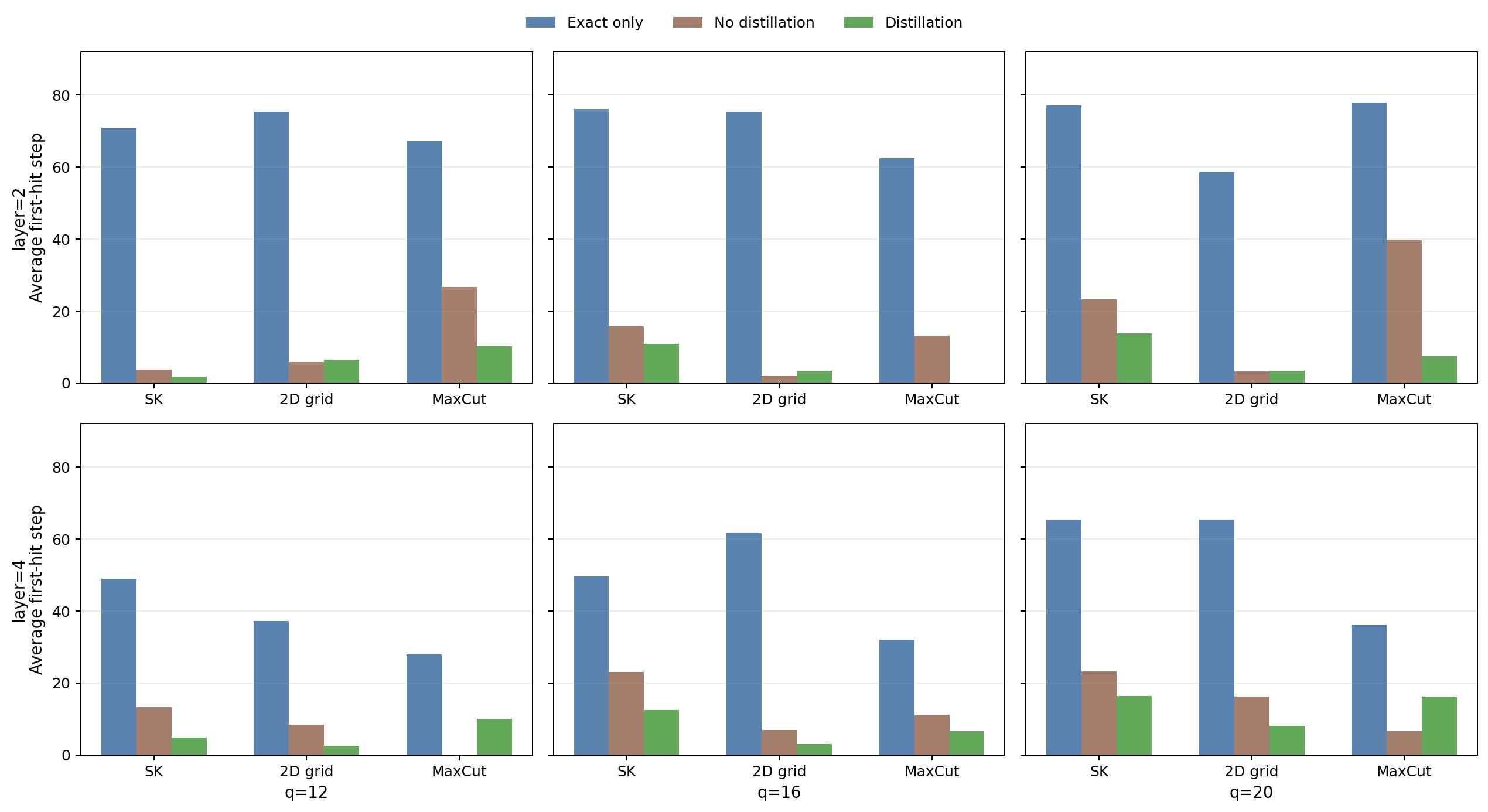
Figure 5: Mean first-hit step required to reach 99% of final normalized approximation ratio during exact fine-tuning; distilled SAFE markedly reduces optimizer steps.
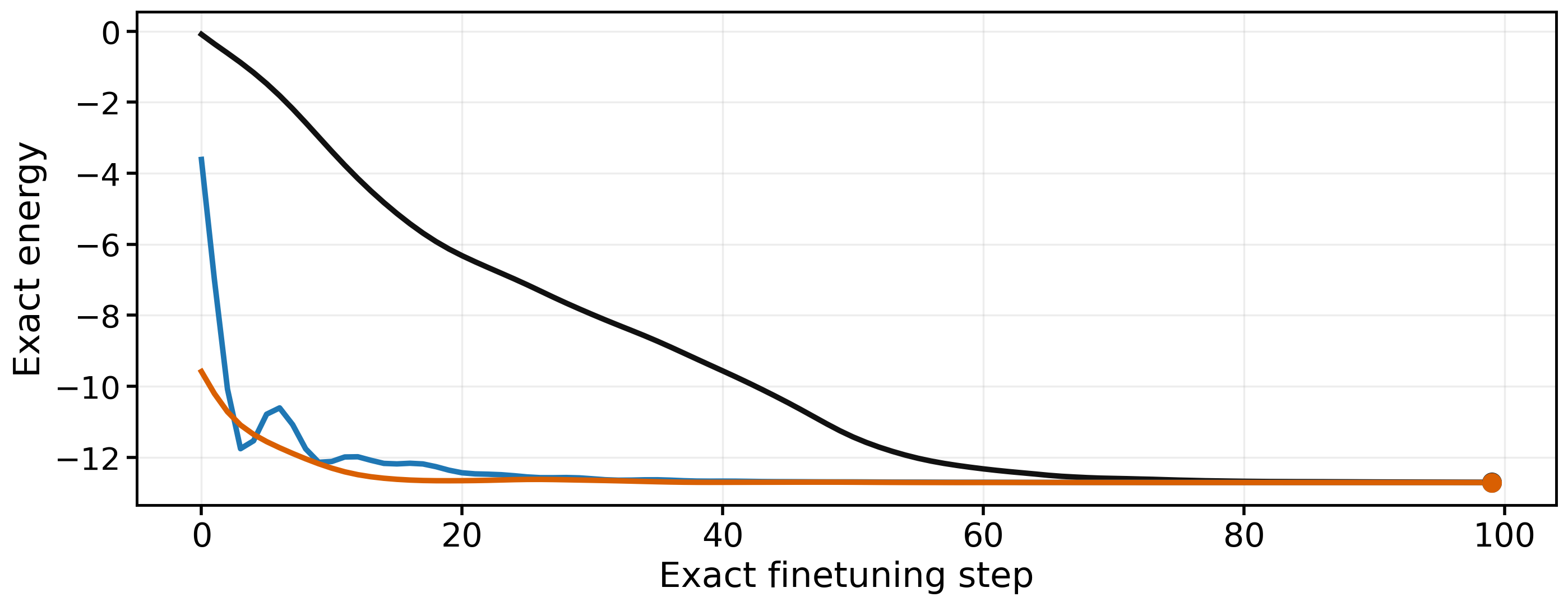
Figure 6: Exact-energy descent trajectories for n=20, p=4—SAFE initialization achieves faster plateau acquisition than exact-only regardless of initial energies.
SAFE’s distilled parameters often begin fine-tuning from higher approximation ratios, which further accelerates convergence. Parameter distillation enhances this by removing weakly active angles and refining the parameter subspace, illustrated through cost-angle structure preservation (Figure 7). The fine-tuning stage refines aligned parameter patterns rather than moving to unrelated configurations.
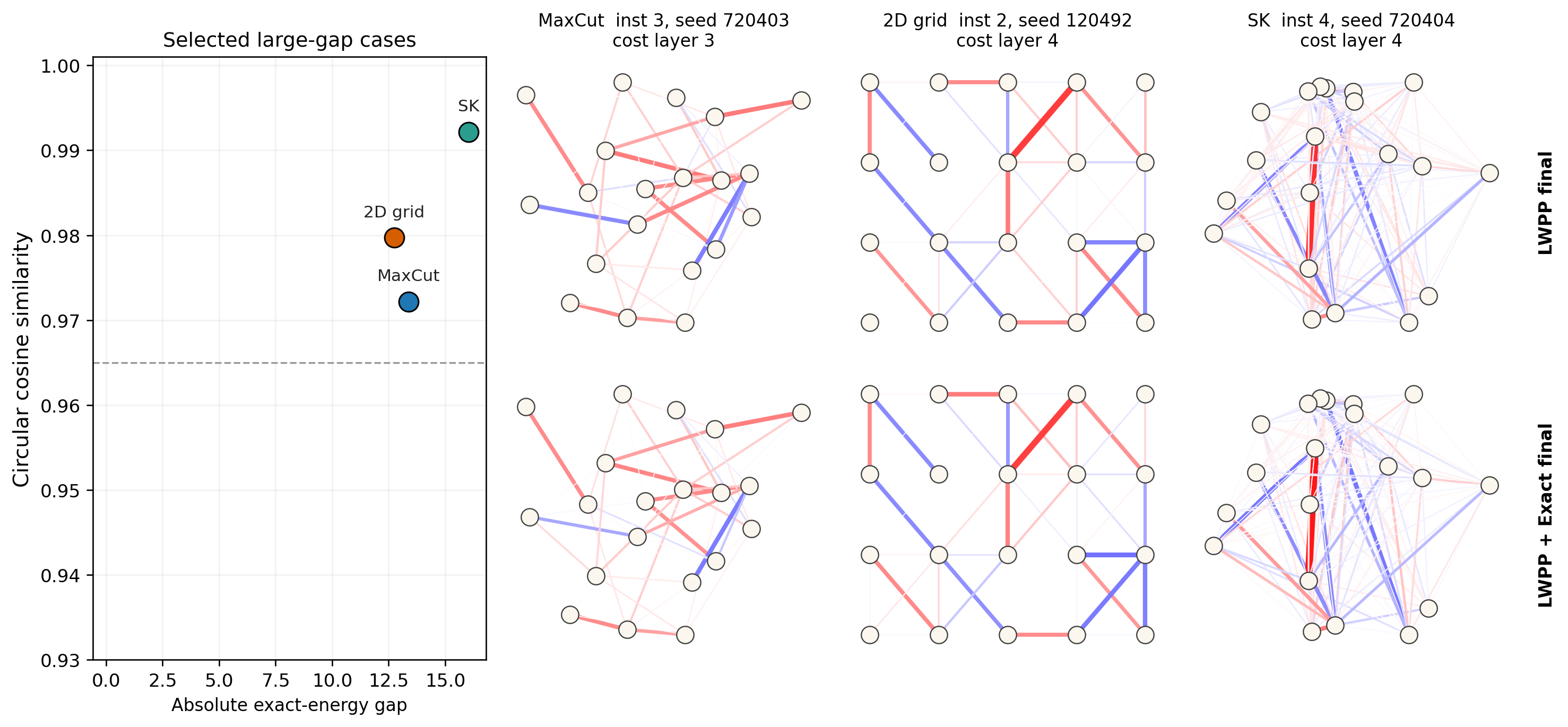
Figure 7: Cost-angle vector structure before and after fine-tuning and gap-vs-cosine similarity analysis—fine-tuning preserves LWPP-trained angle structure.
Mechanistic Interpretation: Landscape Smoothing and Instance Dependence
LWPP acts as a smoothing surrogate for the exact energy landscape (Figure 8), suppressing high-frequency minima arising from multi-qubit interactions. The wmax truncation parameter tunes the surrogate’s fidelity, with denser instances sometimes requiring higher values. This smoothing effect enables LWPP to efficiently guide parameters toward globally relevant basins, where fine-tuning can exploit local exact gradients.
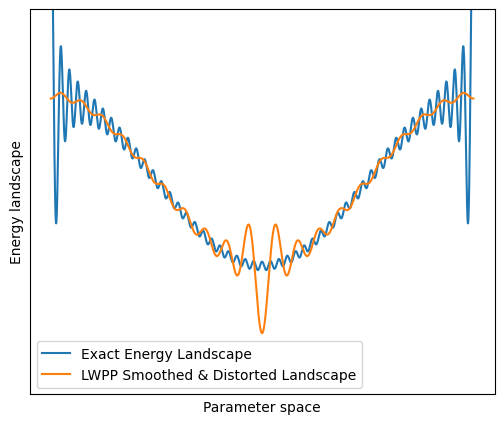
Figure 8: Conceptual illustration of wmax-induced energy landscape smoothing—LWPP surrogate eliminates high-frequency structure yet preserves basin topology.
The effectiveness of distillation depends on the parameter sparsity after LWPP pre-training; empirical results justify selective pruning. The instance- and family-dependence of wmax0 suggests further work on adaptive truncation and robust selection protocols.
Practical and Theoretical Implications
SAFE ma-QAOA provides a resource-efficient protocol for expressive quantum optimization on NISQ hardware, balancing surrogacy and exact evaluation. The framework addresses critical bottlenecks in high-dimensional ma-QAOA optimization by leveraging both classical surrogates and structure-preserving distillation. The significant reduction in quantum resource demands strengthens practical viability for combinatorial optimization at moderate circuit depths and qubit counts. Theoretical implications center on surrogacy as a means of energy landscape smoothing, guided initialization, and parameter pruning, with prospects for extension to other variational quantum algorithms and surrogate-assisted optimization workflows.
Conclusion
SAFE ma-QAOA integrates LWPP surrogate pre-training, parameter distillation, and exact fine-tuning, achieving substantial reductions in trainable parameter count and quantum hardware workload, with minimal performance loss in final approximation ratio. Surrogate initialization enables rapid and structurally aligned convergence, and distillation provides efficient parameter space compression. The observed landscape-smoothing effect and structural preservation in parameter vectors mark promising directions for scalable optimization strategies and resource-aware quantum algorithm design. Future avenues include adaptive tuning of surrogacy and distillation mechanisms, extension to larger qubit counts, and empirical validation on noisy quantum processors.

