- The paper establishes that imposing local equivalence and equivalent-system purification recovers standard finite-dimensional complex quantum theory.
- It leverages symmetric cone structures and Jordan algebra classifications to derive measurement no-restriction, the Born rule, and tensor-product composition.
- The analysis rules out hybrid theories by demonstrating that only the compatibility of these principles yields the full quantum formalism.
Operational Reconstruction: Two Principles Characterize Quantum Theory
Introduction
The paper "Two Operational Principles Single Out Quantum Theory" (2605.23217) addresses a central problem in quantum foundations: discerning which operational requirements uniquely determine the structure of standard finite-dimensional complex quantum theory within the broad landscape of Operational Probabilistic Theories (OPTs). Conventionally, quantum theory is specified simultaneously in terms of complex Hilbert spaces, density matrices, positive-operator-valued measures (POVMs), tensor-product composites, Born rule probabilities, and completely positive trace-preserving (CPTP) maps. This work demonstrates that imposing just two operational principles—local equivalence and equivalent-system purification (ES purification)—suffices to recover the entire formalism of quantum theory, including measurement no-restriction as a derived consequence. The result precludes hybrid or intermediate theories where only some quantum ingredients are adopted, thereby establishing the compatibility of states, measurements, composites, and channels as a consequence of operational constraints, rather than as independent postulates.
Framework and Principles
The analysis is conducted in the context of finite-dimensional causal OPTs, where systems, states, effects, channels, composition rules, and probabilities are specified in generality. The authors isolate two pivotal operational constraints:
Local Equivalence: Channels are fully identified by local input-output statistics. That is, if two channels yield identical probabilities for all possible preparations and measurements, they are operationally indistinguishable and must be regarded as the same.
Equivalent-System Purification (ES Purification): Every state of system A can be prepared as the marginal of a pure state on A⊗A~, with A~ an ancillary system equivalent (reversibly interconvertible) to A. Moreover, any two purifications of the same state are related by a reversible channel on the ancillary system.
Importantly, neither postulate directly presupposes quantum formalism ingredients (e.g., Hilbert space, density matrix, Born rule), but constrains them through operational conditions.
Main Results and Logical Structure
The principal theorem asserts that any finite-dimensional causal OPT satisfying local equivalence and ES purification is necessarily standard complex quantum theory: each system is associated with a complex Hilbert space, states are density matrices, measurements are POVMs, composites are tensor products, and channels are CPTP maps.
Key Aspects:
- The state space for each system is the entire set of density matrices, not a subset.
- Measurement no-restriction (every mathematically consistent probability rule is physically realizable as a measurement) is derived, not assumed.
- The Born rule, tensor-product composition, and CPTP channels also follow, simultaneously fixing measurement, composite, and dynamical structures.
This eliminates any possibility of theories with quantum states but restricted measurements, or with modified composition rules.
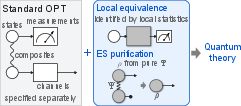
Figure 1: Schematic of the reconstruction: imposing local equivalence and ES purification fixes all ingredients to the standard complex quantum structure, including density matrices, POVMs, Born rule, tensor-product composition, and CPTP maps.
Proof Strategy and Mathematical Implications
The proof proceeds in three stages:
- Symmetric Cone Structure: The state cone of every system is shown to be symmetric (homogeneous and self-dual), leveraging ES purification for geometry and steering arguments, and local equivalence to guarantee channel identities.
- Measurement No-Restriction: The symmetric cone structure enables identification of positive probability assignments with effects. ES purification, via steering, ensures every probability rule summing to one is physically realizable as a measurement; local equivalence, with uniqueness of purification, rules out any locally invisible distinctions.
- Reduction to Complex Quantum Theory: The classification of symmetric cones (Euclidean Jordan algebras) reduces the state space possibilities. Only complex matrix algebras are compatible with tensor-product composition and dimension identities demanded by the operational postulates. Thus, the state space is precisely that of complex quantum theory.
Bold Numerical Result: The proof establishes that the informational dimension (number of perfectly distinguishable states) matches the Hilbert space dimension for every system, nA=dim(HA), and that nAB=nAnB, aligning with quantum compositional counting.
Contradictory/Strong Claims: The result demonstrates, with explicit examples, that neither local equivalence nor ES purification alone imposes quantum structure—classical theory satisfies only local equivalence, and real quantum theory only ES purification. Compatibility and simultaneous imposition are required to fix the full complex structure.
Comparison to Prior Reconstructions
Previous operational reconstructions (e.g., Chiribella–D’Ariano–Perinotti) derived quantum theory from a combination of five operational requirements, including purification and local discriminability, as well as perfect discriminability, ideal compression, and pure conditioning. This paper adopts local equivalence (equivalent to local discriminability), but uses the stricter ES purification. The main advancement is showing that compatibility between local device identifiability and purification by an equivalent ancillary system fixes the entire quantum formalism, simplifying the operational axiomatic landscape.
Practical and Theoretical Implications
The paper establishes a concise operational foundation for quantum theory, with implications for:
- Foundations: Any deviation from one postulate (e.g., restricting measurements or allowing nonstandard composites) breaks compatibility and necessarily departs from quantum theory.
- Generalized Probabilistic Theories: This sets a strong constraint on candidate alternative theories—hybrid theories cannot exist while maintaining both postulates.
- Quantum Information: The operational principles clarify why standard quantum information protocols (e.g., purification, tomography, quantum channels) have their usual structure and operational meaning.
Speculation on Future Developments
With this sharper operational characterization, further work may be directed at:
- Extending the result to infinite-dimensional systems and field-theoretic settings.
- Reconstructing relativistic or topological quantum structures by adapting the operational postulates.
- Analyzing other nonclassical theories (e.g., real quantum theory, Jordan-algebraic frameworks) through the lens of compatibility constraints, potentially identifying minimal operational modifications necessary for deviations.
Conclusion
The paper rigorously demonstrates that the compatibility of local input-output device identifiability with equivalent-system purification determines the entire formalism of finite-dimensional complex quantum theory. Measurement no-restriction, Born rule probabilities, tensor-product structures, and CPTP dynamics arise from these two operational postulates, with no need for additional assumptions. This operational unity is both theoretically clarifying and practically constraining, serving as a foundational result in the mathematical structure of quantum theory.