- The paper introduces a novel protocol that efficiently estimates QFI in many-body quantum states affected by decoherence using explicit wave functions.
- It employs polynomial and Krylov methods to derive lower bounds for QFI, enabling tractable, Monte Carlo-based evaluation even for large systems.
- The study rigorously characterizes the impact of local dephasing, amplitude damping, and global depolarizing noise on the metrological performance of various quantum regimes.
Quantum Fisher Information Estimation for Many-Body Wave Functions under Decoherence
Introduction and Motivation
The paper "Quantum Fisher Information under decoherence with explicit wavefunctions" (2605.22917) develops an efficient computational protocol to estimate the Quantum Fisher Information (QFI) of many-body quantum states subject to decoherence. Direct evaluation of the QFI for mixed states arising from noise is generally intractable due to the requirement for spectral decomposition of the density matrix. The work proposes a systematic method for producing lower bounds to the QFI that are accessible whenever the many-body wave function is analytically known in the occupation-number basis. The approach reduces QFI estimation for noisy states to expectation values computed over a classical probability distribution, enabling efficient Markov-chain Monte Carlo (MCMC) sampling for system sizes far beyond exact diagonalization.
The methodology is applied to Jastrow–Gutzwiller (JG) wave functions, a family of states interpolating from GHZ-type multipartite entanglement to critical Luttinger liquid behavior. The metrological content of these states is characterized by optimizing the QFI over operators and studying the impact of three major noise channels: local dephasing, local amplitude damping, and global depolarizing.
Jastrow–Gutzwiller Wave Functions and Metrological Scalings
JG wave functions are expressed as:
∣Ψα⟩=PN{n}∑ψα({n})∣n1n2…nL⟩
where ψα({n}) encodes particle correlations controlled by α.
- For α≫1: The wave function is GHZ-like, supporting only two configurations corresponding to maximal staggered magnetization (antiferromagnetic order). The QFI achieves the Heisenberg limit, scaling as FQ∼L2.
- For α≪−1: The state becomes a superposition of clustered, Dicke-like blocks, again affording FQ∼L2 under optimal operators.
- For 0<α≤2: The wave function realizes the ground state of critical XXZ chains, characterized by Luttinger liquid physics. The scaling of the QFI follows the power-law decay of correlation functions.
The optimal generator O for maximizing the QFI depends non-trivially on α. In critical regimes, staggered ψα({n})0 or ψα({n})1 magnetization yields variance ψα({n})2, with ψα({n})3 determined by the decay exponent of the relevant correlator. This regime supports metrological advantage above the standard quantum limit (SQL).
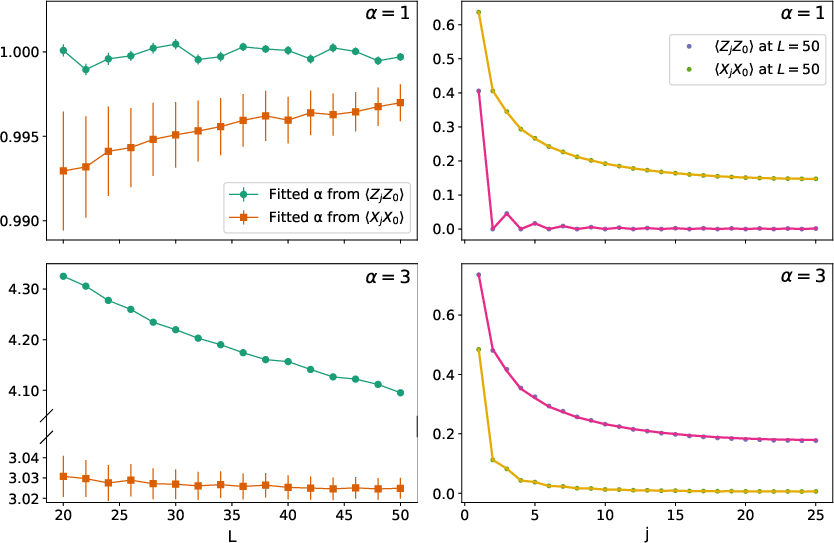
Figure 1: Correlation functions of Z and X for the JG wave functions in the critical regime, fitted with asymptotic forms from Luttinger liquid theory.
QFI Lower Bounds: Polynomial and Krylov Methods
For mixed states, two converging hierarchies of QFI lower bounds are considered:
- Polynomial bounds ψα({n})4: The spectral function is approximated by polynomials, yielding bounds expressible as sums of mixed moments ψα({n})5. Experimental measurement of these moments is possible via randomized protocols.
- Krylov bounds ψα({n})6: Using Krylov subspace techniques, one constructs bounds by repeated application of the superoperator ψα({n})7 to the commutator ψα({n})8. Krylov bounds converge exponentially faster than polynomial bounds for fixed moment budgets and always satisfy ψα({n})9.
Both families are monotonic and tractable for practical experimental and numerical implementation, with convergence controlled by the spectrum of α0 and the operator structure.
Monte Carlo Estimation and Sampling Requirements
All relevant moment traces can be reformulated as expectation values over the classical probability distribution α1. MCMC sampling allows efficient evaluation, with a computational cost scaling as α2 (α3). The sample complexity increases exponentially in system size and depends on α4, but fits are provided for practical guidance.
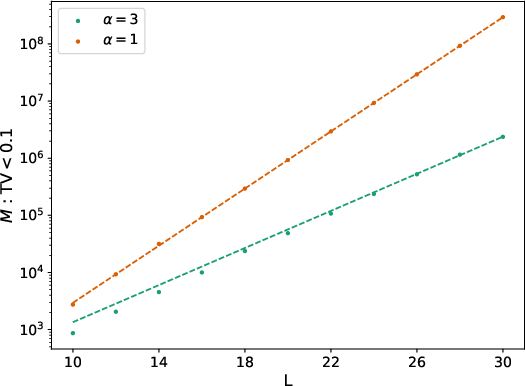
Figure 2: Number of Markov-chain samples required for the JG distribution (for various α5) to achieve total variation distance below 0.1, indicating sampling efficiency.
Decoherence Channels and QFI Behavior
Local Dephasing
The dephasing channel suppresses off-diagonal elements in the density matrix, exponentially diminishing the QFI for GHZ-like states:
α6
For critical JG states, symmetry properties can preserve the scaling of the QFI under dephasing—even when the operator anti-commutes with the noise channel generator—resulting in only a renormalization of the prefactor, not the power-law scaling. In Dicke-like clustered regimes, the QFI saturates to a α7-dependent constant in the thermodynamic limit.
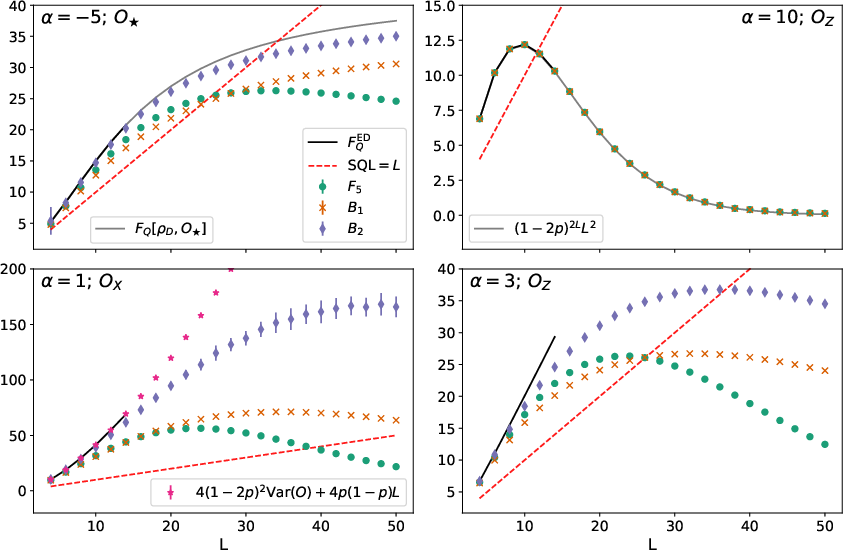
Figure 3: Bound estimates for QFI in dephased JG wave functions as a function of α8 with local dephasing probability α9.
Local Amplitude Damping
Amplitude damping alters both diagonal and off-diagonal components and modifies the particle-number sector. For GHZ-like states, only the coherence between macroscopically distinct configurations survives, yielding:
α≫10
The QFI is exponentially sensitive to α≫11 under damping. Outside GHZ regimes, the bounds indicate persistent metrological advantage over the SQL.
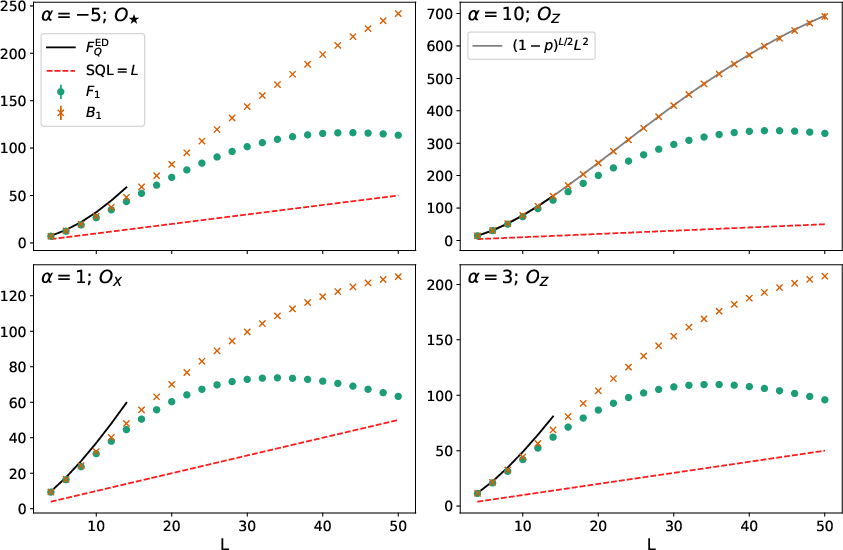
Figure 4: Bound estimates for QFI in the damped JG wave function for various α≫12 and α≫13.
Global Depolarizing
Depolarizing noise uniformly mixes the state with the maximally mixed density matrix, yielding a simple reduction of QFI:
α≫14
Since the spectrum is flat, QFI bounds converge immediately for any initial state or operator.
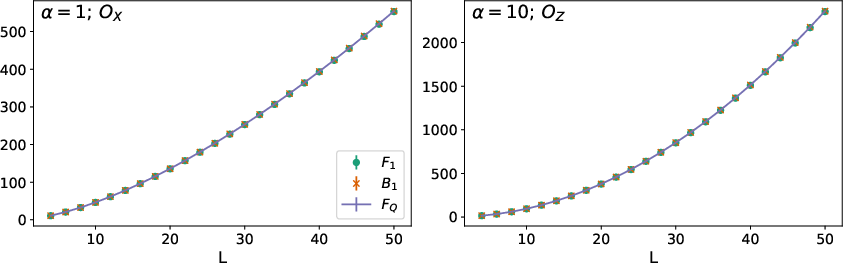
Figure 5: QFI bounds for depolarized JG wave functions for α≫15.
Theoretical and Practical Implications
The protocol established here shows that QFI lower bounds for many-body noisy states can be computed efficiently from explicit wave function amplitudes. For metrological applications, the results quantify precisely how various noise channels degrade the metrological utility of states with diverse entanglement and criticality properties, emphasizing the fragility of GHZ-like and Dicke-like phases to local decoherence and the relative robustness of critical states.
Beyond QFI, the same approach is extensible to information-theoretical observables including purity and correlation functions, and to wave functions from other paradigms such as fractional quantum Hall states. Experimentally, the polynomial and Krylov bounds are compatible with measurement schemes based on shadow tomography and randomized protocols.
Outlook and Future Directions
The framework suggests further directions:
- Extension to other analytically tractable many-body states, including higher dimensions and exotic correlations.
- Application of Krylov bounds in experimental settings using shadow tomography for metrological witnesses.
- Exploration of state preparation protocols for robust metrological phases on quantum hardware, for example via variational algorithms [VitalePRX2024, Xu2025].
- Investigation of optimal observable selection algorithms based on symmetry properties, to maximize practical parameter sensitivity.
Conclusion
This work delivers a comprehensive protocol for scalable, rigorous QFI estimation under decoherence using explicit wave functions and classical sampling. The theoretical analysis, supplemented by analytical and numerical results for JG wave functions, clarifies the interplay between noise, entanglement structure, and metrological performance. The generality and computational efficiency of the method establish it as a powerful tool for future research in many-body quantum sensing and quantum information theory.

